ZEC Leads Uptober Rally

Olivia Capozzalo & Denis Omelchenko
October 02, 2025
gm, Defiers!
Today’s big story:
- Kicking off “Uptober,” the price of Zcash has rocketed over 100% amid renewed calls for privacy in crypto
In other news:
- 1inch integrates with Coinbase app
- Major UAE firms announce L2, AED stablecoin
- XRP rallies as Ripple CTO steps down
- Feature: GENIUS Act targets stablecoin yield, but workarounds remain
- ETHGas building critical infra for Ethereum blockspace [SPONSORED]
Read more below! But first, please give our sponsors some love; they make this newsletter possible.

ETH Needs Its Own MicroStrategy and DeFi Just Built It
Bitcoin has MicroStrategy. Ethereum has no whale — until now. Michael Saylor turned his company into Bitcoin’s giga-whale, stacking billions through corporate debt and creating a new Wall Street narrative. But Ethereum, despite powering DeFi, stablecoins, NFTs, and restaking, has lacked an equivalent story of large-scale accumulation.
Rezerve is fixing that. Its mission: build a 1 million ETH treasury, fully on-chain, transparent, and community-led. Instead of corporate debt, Rezerve issues convertible bonds and staked RZR tokens, creating a collective balance sheet that steadily accumulates ETH. With ~$20M TVL already, Rezerve is proving Ethereum doesn’t need billionaires — it needs conviction.
Learn how Rezerve is turning MicroStrategy into a DeFi protocol.
We’re back! Here’s what you need to know in web3 today
📈 Markets in the Past 24 Hours
| TICKER | VALUE | 24H | |
|---|---|---|---|
 | Bitcoin | $119,957 | 2.10 % |
 | Ethereum | $4,436.73 | 2.48 % |
 | XRP | $2.99 | 1.53 % |
 | BNB | $1,056.12 | 3.55 % |
 | Solana | $226.71 | 2.99 % |
Today’s Big Story
ZEC Leads Uptober Rally as Privacy Takes Center Stage, Again
This Uptober arrived with a twist: privacy coins are stealing the spotlight once again, and Zcash is leading the charge, at least for now.
The price of ZEC has ripped through the charts in the past couple days, surging more than 250% on the month and spiking 67% in just the past 24 hours to hit over $150, a three-year high. Investors and blockchain developers are waking up to a reality that’s been hiding in plain sight — privacy isn’t optional, it’s the next frontier.
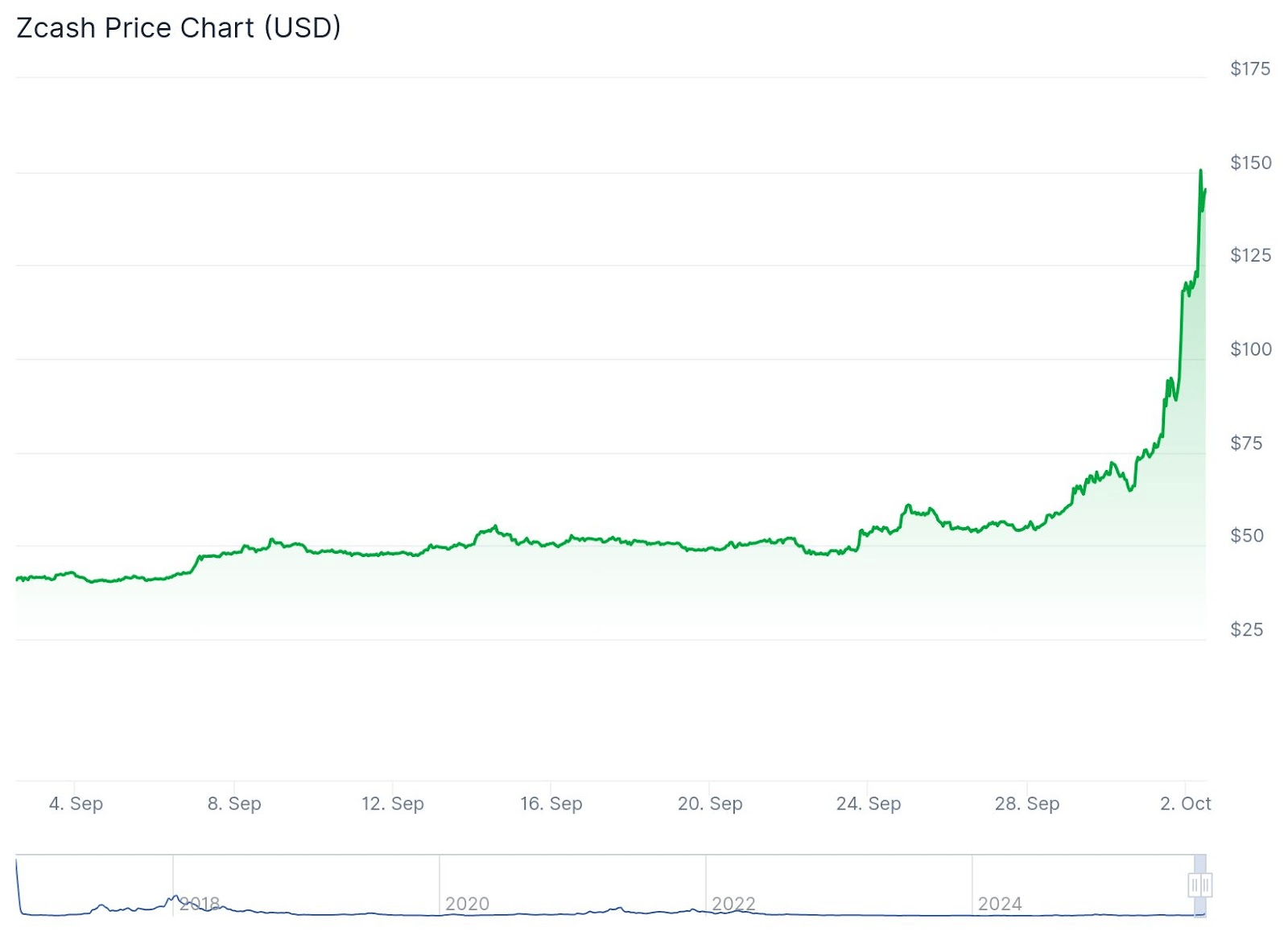
ZEC 1-month price chart. Source: CoinGecko
Mert Mumtaz, Grayscale, Naval Ravikant and many others have weighed in on ZEC’s rally this week, evidently realizing all at once that a Bitcoin-like cryptocurrency with privacy features has been on the table for quite a long time.
No one seems to fully understand what’s driving Zcash’s parabolic rise over the past few days, but part of the story seems to be lying in its design. As Ravikant pointed out in an Oct. 1 post on X, Zcash functions as “insurance against Bitcoin,” implying that it offers a layer of privacy and protection for users who see Bitcoin’s transparency as a vulnerability.
Built on Bitcoin-like architecture, Zcash uses zero-knowledge proofs to hide amounts and addresses when users choose, while still giving auditors or exchanges access through viewing keys. That optional privacy sets it apart from Monero (XMR), which enforces privacy by default, a rigidity that has already pushed some exchanges to delist it over compliance concerns.
Centralized Privacy?
Still, Zcash itself also has some concerns. The network’s mining remains heavily centralized, with a single mining pool, ViaBTC, controlling over 70% of hashrate power. Also, most users still ignore the shielded transactions option, leaving ZEC far from the fully private utopia it promises to be.
But the privacy renaissance isn’t limited to ZEC and XMR. After sanctions on Tornado Cash were lifted, developers rushed to expand privacy tools across other networks too.
Solana, for instance, just this week welcomed Privacy Cash, a payments protocol that lets users deposit SOL into a privacy pool by using ZK proofs. Paxos Labs also announced the launch of USAD, a U.S. dollar-pegged stablecoin built with end-to-end encryption and native privacy features, making it the first stablecoin to debut on the Aleo Layer 1 network with privacy baked in.
Denis, staff reporter at The Defiant
Forwarded this newsletter? Subscribe for daily insights and curated news from The Defiant team, Monday-Saturday. It’s free.
🎬WATCH
StarkWare Bets on Becoming Bitcoin's Execution Layer, Not on Attracting Corporate Chains
On the latest episode of The Defiant Podcast, Cami sat down with Eli Ben-Sasson, co-founder and CEO of StarkWare. Ben-Sasson details StarkWare's latest bet on Bitcoin: Adding BTC staking and lending/borrowing to the Ethereum Layer 2 (coupled with 100M in STRK incentives) in its bid to become Bitcoin's execution layer.
StarkWare is focusing on BTC while much of competitors' attention has gone to lure large fintech and TradFi names on-chain. Ben Sasson says he couldn't care less because "corporate chain and decentralized chain is a contradiction."
Top News in the Past 24 Hours
- 1inch Brings DeFi Swaps to Coinbase App The integration of the major DEX aggregator’s swap API lets Coinbase app users make token swaps directly from their own self-custody wallets. The deal marks 1inch’s largest U.S. client to date. Why it matters: The move is part of a growing trend among CEXs to integrate DeFi with the goal of becoming a “super app” — or as Coinbase execs put it, an “everything exchange.”
- Abu Dhabi Investment Giant IHC Backs L2 Chain for Dirham-Backed Stablecoin IHC, an Abu Dhabi-based investment firm with a market capitalization of $240 billion, is backing a new L2 blockchain as well as a dirham-pegged stablecoin, developed in partnership with the UAE’s largest bank. Why it matters: The UAE has made a strong effort to develop crypto-specific regulations and encourage the local crypto industry in recent years, attracting many global firms in the process.
- XRP Rallies as Key XRPL Architect Schwartz Steps Back from Ripple CTO Role XRP pushed higher yesterday as broader markets rallied, despite the fact that Ripple’s longtime CTO, David Schwartz, said he will step back from his role at the company, but stay on as a board member. Why it matters: Schwartz was CTO at Ripple for over a decade, and was also one of the original creators of XRP Ledger — the native blockchain of XRP.
- FEATURE: GENIUS Act Targets Stablecoin Yield, But Workarounds Could Keep Returns Alive The stablecoin-focused GENIUS Act, passed in mid-July, bans stablecoin issuers in the U.S. from sharing yield with holders; but experts say workarounds could keep returns alive — and are nothing new.
Trending on The Defiant
- 1inch Brings DeFi Swaps to Coinbase App
- GENIUS Act Targets Stablecoin Yield, But Workarounds Could Keep Returns Alive
- Crypto Market Rebounds Despite U.S. Government Shutdown
- XRP Rallies as Key XRPL Architect Schwartz Steps Back from Ripple CTO Role
- Abu Dhabi Investment Giant IHC Backs L2 Chain for Dirham-Backed Stablecoin
- Paxos Labs and Aleo Network Foundation to Launch US Stablecoin
That’s it for today — if you enjoyed this newsletter, tell your friends! https://thedefiant.io/subscribe
Free newsletters
Good reporting. Delivered.
Choose your coverage: crypto and DeFi, the future of finance, or both.
Free. Unsubscribe anytime.