MegaETH Launches Mainnet
Plus, Andre Cronje’s new DeFi project announces public sale

Olivia Capozzalo & Jona Jaupi
February 10, 2026
gm Defiers!
Today’s big story:
- Amid uncertainty around the role of L2s, MegaETH launched its mainnet on Monday, and early on-chain data shows the network didn’t arrive quietly.
In other news:
- Flying Tulip announces public sale
- CME plans to launch ADA, LINK and XLM futures
- Experts weigh in on Bitcoin’s recent crash
Read more below! But first, please give our sponsors some love; they make this newsletter possible.

Stellar: The Proving Ground for Real-World Privacy
The latest Stellar upgrade, X-Ray, delivers zero-knowledge cryptography that lets developers build privacy into their apps—protecting what matters while keeping Stellar radically open, trusted, and ready for real-world finance.
We’re back! Here’s what you need to know in web3 today
📈 Markets in the Past 24 Hours
| TICKER | VALUE | 24H | |
|---|---|---|---|
 | Bitcoin | $69,795 | -0.53 % |
 | Ethereum | $2,037.57 | -4.05 % |
 | XRP | $1.42 | -1.86 % |
 | BNB | $623.81 | -1.95 % |
 | Solana | $84.71 | -2.33 % |
Today’s Big Story
MegaETH’s Mainnet Is Live, and the First Day Was Quietly Busy
MegaETH launched its mainnet on Monday, and even though excitement had cooled heading into the launch, early on-chain data shows the network didn’t arrive quietly.
The Ethereum Layer 2 — which describes itself as a “real-time” blockchain — went live with more than 50 apps already deployed. By the end of its first day, MegaETH had processed nearly 39 million transactions, averaging about 28 to 29 transactions per second (TPS), according to data from its public explorer.
A big part of the blockchain's marketing has been promoting that it uses a specialized architecture designed to handle up to 50,000 transactions per second with block times as low as 10 milliseconds — though, unsurprisingly, real-world usage on day one was below those limits.
By comparison, Solana, which is known as a high-performance network, generally records over 3,000 TPS. Meanwhile, fellow Ethereum L2 Base has seen TPS of about 100-150 recently.
On the DeFi side, MegaETH’s total value locked (TVL) stood at about $41 million, according to DefiLlama. That places it among the top-20 L2s by TVL, which are led by Base with nearly $4 billion. Most of MegaETH’s on-chain value comes from stablecoins, which made up roughly $35.6 million of the total. Bridged TVL was higher, at around $91 million, while trading activity was minimal, with DEX volume at just $40 over 24 hours.
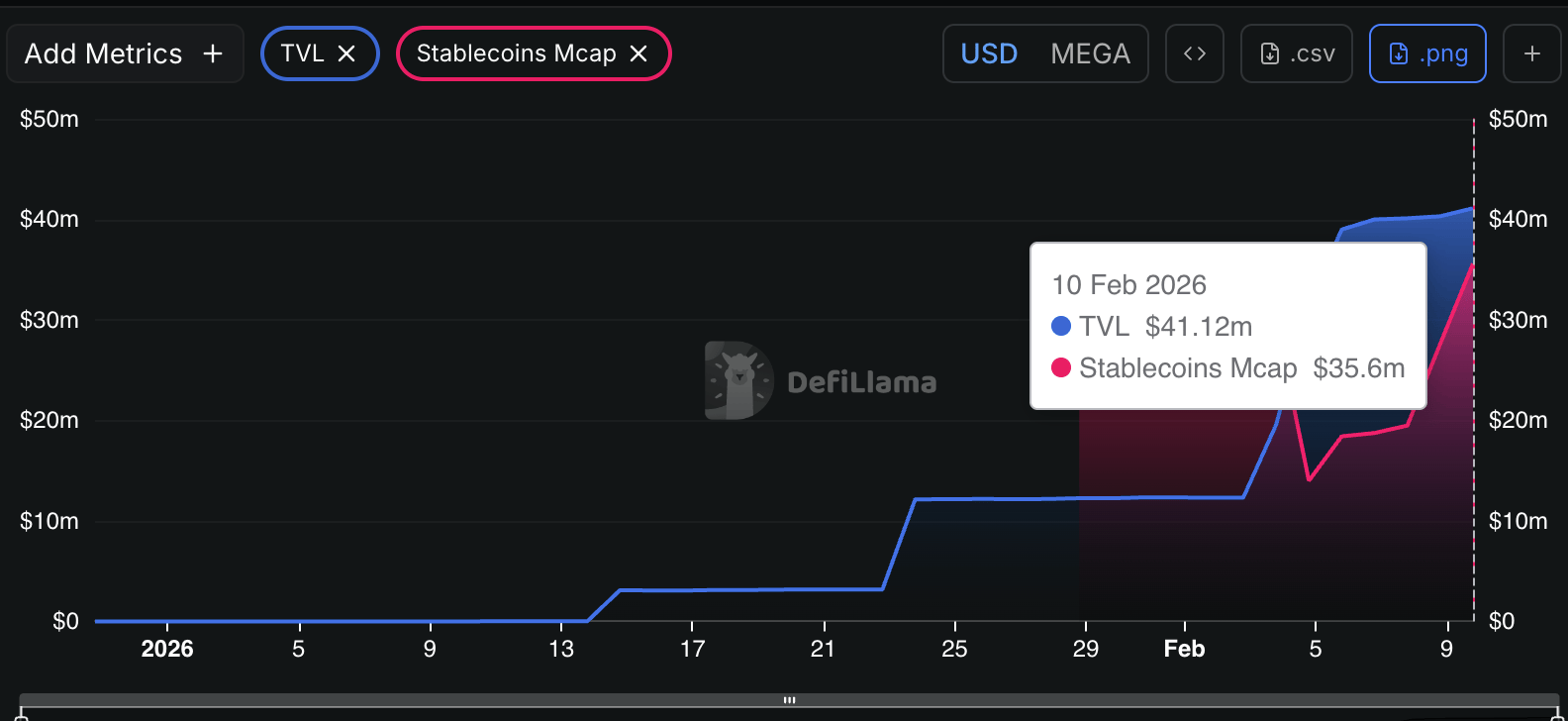
MegaETH TVL and stablecoin market cap. Source: DefiLlama
The launch also came with major protocol support. Aave, the largest DeFi protocol by TVL, went live on MegaETH on day one, using Chainlink’s data and cross-chain infrastructure. As part of the deal, MegaETH committed to a five-year revenue guarantee of at least $10 million for the Aave DAO.
Chainlink was also integrated through its Scale program, giving MegaETH access to price feeds and cross-chain connectivity. That setup allows apps on MegaETH to plug into existing liquidity and assets like Lido’s wstETH and Lombard’s BTC.b, instead of starting from scratch. FYI, MegaETH also announced Lombard as its primary Bitcoin partner in September 2025 — a move that allows users to mint and redeem Bitcoin directly on MegaETH’s network.
Token Expectations
MegaETH’s debut follows months of intense attention (and changing sentiment) around the project. For instance, its public token sale in October 2025 attracted $1.39 billion in commitments for just $50 million worth of tokens, making it one of the most oversubscribed raises of the cycle. Token allocations, however, left some participants feeling slighted.
But heading into mainnet launch, MEGA’s premarket price dropped sharply, with valuations falling from around $4 billion to closer to the $1-$1.5 billion range. Today, MEGA premarket perps on Hyperliquid are within that range, trading around $0.136.
As for the launch of the MEGA token itself, the team said on Friday that it won’t launch until certain performance metrics are met.
Meanwhile, the L2 launched its mainnet less than a week after Vitalik Buterin set off a wave of doubts and takes around the future of Ethereum L2s, writing in an X post that L2s “need a new path,” as the “the original vision of L2s and their role in Ethereum no longer makes sense.”
Against such a backdrop, MegaETH’s first day of mainnet looked less like a hype-driven surge and more like a careful rollout as the network posted steady activity, some early liquidity, and launched with major protocols already live.
Whether MegaETH can find its niche in the new L2 landscape and that early traction turns into long-term usage is the real question.
Xx, Jona, staff reporter at The Defiant
Forwarded this newsletter? Subscribe for daily insights and curated news from The Defiant team, Monday-Saturday. It’s free.
🎬WATCH
Crypto’s Point of No Return: Institutions are Finally Here, with Brett Tejpaul
In this episode of The Defiant Podcast, Cami sits down with Brett Tejpaul, Co-CEO of Coinbase Institutional, to discuss why institutional adoption accelerated last year. From ETFs and stablecoin regulation to banks using public blockchains in production, crypto crossed a line it can’t uncross.
Top News in the Past 24 Hours
Andre Cronje’s Flying Tulip Gears Up for Public Sale
Yearn Finance founder Andre Cronje has announced that the public token sale for his latest DeFi product, Flying Tulip, will launch next week.
Why it matters: The DeFi super app space is facing headwinds following the Infinex token generation event in January, where ICO participants are sitting on 60% losses.
CME Group to Launch Futures for Cardano, Chainlink, and Stellar
CME Group, the world's largest derivatives marketplace, has announced plans to introduce regulated futures contracts for Cardano (ADA), Chainlink (LINK), and Stellar Lumens (XLM), pending regulatory review.
Why it matters: CME was one of the first U.S. TradFi players to launch Bitcoin futures back in late 2017, around the same time BTC reached the peak of its massive rally at the time, near $20,000.
Why Bitcoin Crashed Over 10% in One Week
The crypto market went through another round of wild swings in early February after Bitcoin suddenly plunged to the low-$60,000s in just a few hours on Thursday — some point to Asia-based hedge funds trading options, while others said macro conditions are to blame.
Why it matters: BTC is trading about 30% lower than where it was a year ago.
Trending on The Defiant
- Andre Cronje’s Flying Tulip Gears Up for Public Sale
- CME Group to Launch Futures for Cardano, Chainlink, and Stellar
- Why Bitcoin Crashed Over 10% in One Week
- Bitcoin Recovers $70,000 Levels After Multi-Billion Dollar Crash
- Bitcoin Selloff Sparks Hedge Fund Speculation Around BlackRock ETF
- MegaETH Unveils Token Buyback and TGE Plan
That’s it for today — if you enjoyed this newsletter, tell your friends! https://thedefiant.io/subscribe
Free newsletters
Good reporting. Delivered.
Choose your coverage: crypto and DeFi, the future of finance, or both.
Free. Unsubscribe anytime.