Are Zora's Content Coins Just Highbrow Memecoins?

Olivia Capozzalo & Camila Russo
July 29, 2025
gm, Defiers!
Today’s big story:
- ZORA’s recent rally spurs a debate about the value of so-called “content coins,” a new asset class coined by Base creator Jesse Pollak
In other news:
- Market update: total crypto market cap drops, most large-caps hold steady, ETH ETF momentum slows
- U.S. PayPal merchants can now accept over 100 crypto assets
- Mill City becomes the first SUI treasury with a $450 million deal
- RAKBANK becomes first UAE bank to offer crypto trading to retail customers
- A quiet pivot is underway in Beijing, as blockchain startups pilot yuan-backed stablecoins after the country’s long struggle with a CBDC [FEATURE]
- Getting started with Flare and XRP DeFi SPONSORED]
- Shinkai Protocol empowers users with open source agentic system [SPONSORED]
Read more below! But first, please give our sponsors some love; they make this newsletter possible.

DIA launches $DIA Staking and Oracle Grants with 20 chains, including Arbitrum, BNB Chain, and Avalanche. Power your dApp with trustless oracles, cost-free.

The Road to 5000 TPS: Scaling Stellar in 2025
In 2025, one of the Stellar Development Foundation’s (SDF) primary goals is to increase Stellar Core’s theoretical throughput to 5000 transactions per second (TPS). As adoption of Soroban — the Stellar smart contracts platform — accelerates and new use cases emerge, scalability is essential to ensuring that Stellar remains fast, affordable, and developer-friendly.
This post provides a high-level overview of our comprehensive scalability efforts, categorized into five key themes. Consider this a brief introduction to our major projects; we will delve deeper into each optimization area in upcoming posts.
Read more: The Road to 5000 TPS: Scaling Stellar in 2025

Blockchain Futurist Conference is the next major web3 event in the U.S., happening November 5-6, 2025, in Miami, Florida. Held at the iconic Hard Rock Guitar Hotel and DAER, the event features 350+ speakers, immersive stages, poolside networking, and thousands of attendees from across crypto, blockchain, and AI. Now in its 8th year, it’s built for founders, investors, and developers, with a strong focus on networking and deal flow.
Learn more at www.futuristconference.com.
We’re back! Here’s what you need to know in web3 today
📈 Markets in the last 24 hrs
| TICKER | VALUE | 24H | |
|---|---|---|---|
 | Bitcoin | $117,472 | -0.71 % |
 | Ethereum | $3,736.12 | -2.09 % |
 | XRP | $3.08 | -3.02 % |
 | BNB | $805.52 | -3.81 % |
 | Solana | $179.37 | -4.32 % |
 MessariPortals MessariPortals | MINDSHARE Rank | MINDSHARE % Change (7d) |
|---|---|---|
 | MINDSHARE Rank | MINDSHARE % Change (7d) |
 |  | -11.22% |
 | | -14.88% |
 | | -25.82% |
| Powered by Messari Portals | ||
Today’s Big Story
Are Content Coins Just Brooklyn-Branded Memecoins?
Zora has gone parabolic. The protocol’s $ZORA token is up more than 600% over the past two weeks, pushing the fully-diluted cap near $850 million and on-chain activity looks even wilder with Dune dashboard charts going vertical, even surpassing Pump.fun in terms of tokens minted in the past 24 hours.
Meanwhile Zora’s founders and Base’s Jesse Pollak have flooded X, proclaiming a “new creator-economy paradigm.” Critics dismiss the frenzy as “digital slop” in artisanal packaging.
So which is it, a re-skinned memecoin launchpad or something structurally new?
Before answering, let’s just look at the numbers. Since July 26, more tokens have been minted per day on Base – the Ethereum Layer 2 where Zora is built– than on Solana, the (former?) king of token launchpads.
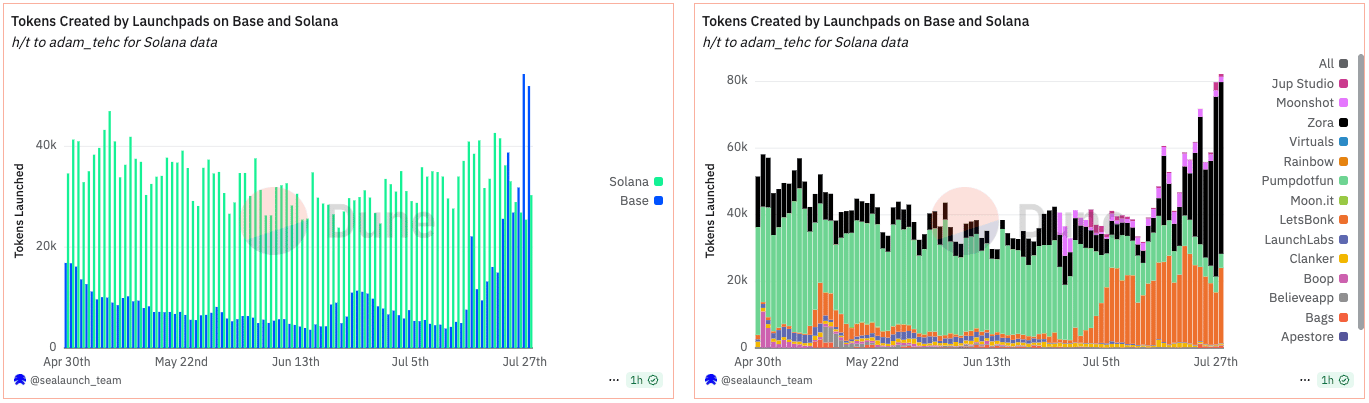
On July 27, a record 54,000 content coins were minted on Base, an 11x jump from June’s 5k-a-day dribble. Unique daily transacting wallets jumped to over 50k from less than 5k just a month ago, while daily volume climbed to a record $41 million, according to Dune Analytics data. Monthly revenue for July jumped to $2M after failing to cross $600,000 for the past two years, according to DeFiLlama.
A Five-Year Overnight Success
While this explosion in activity may seem sudden, Zora is no overnight success story. Founded in 2020 by Jacob Horne, Dee Goens and Tyson Bataller, the project was initially an open-source NFT marketplace. The team has iterated from different types of NFT auctions to launching its own Ethereum Layer 2, to now creator coins on Base.
And after much iteration, the team has seemingly hit the nail on the head, apparently by riding the memecoin launchpad bandwagon, allowing for instant token minting with every post. That’s what makes it easy to lump Zora with memecoin launchpads together.
Looks Like a Doge, Smells Like a Doge?
On the surface, Zora looks a lot like memecoin launchpads. Both let anyone spin up a fungible token in seconds, both encourage hyper-speculation on low-cap tickers, and both are currently overrun by degens chasing a quick 10x.
Those who see Zora as just another memecoin farm are understandably irked when they see Jesse and Jacob talking about a new system to empower creators etc. etc.
And so you have Solana’s Anatoly Yakovenko calling content coins on Zora "digital slop.” Artist Sterling Crispin, who said it’s a “zero sum PvP game of musical chairs.” Jon Charbonneau said, “everything launched so far on zora, pump, bonk, believe, etc is a memecoin.” X user who goes by Mosi said, “it's fine to build memecoins Jesse, just embrace degeneracy.”
Are Content Coins Just Brooklyn-Branded Memecoins?
Zora has gone parabolic. The protocol’s $ZORA token is up more than 600% over the past two weeks, pushing the fully-diluted cap near $850 million and on-chain activity looks even wilder with Dune dashboard charts going vertical, even surpassing Pump.fun in terms of tokens minted in the past 24 hours.
Meanwhile Zora’s founders and Base’s Jesse Pollak have flooded X, proclaiming a “new creator-economy paradigm.” Critics dismiss the frenzy as “digital slop” in artisanal packaging. So which is it, a re-skinned memecoin launchpad or something structurally new?
Before answering, let’s just look at the numbers. Since July 26, more tokens have been minted per day on Base – the Ethereum Layer 2 where Zora is built– than on Solana, the (former?) king of token launchpads.
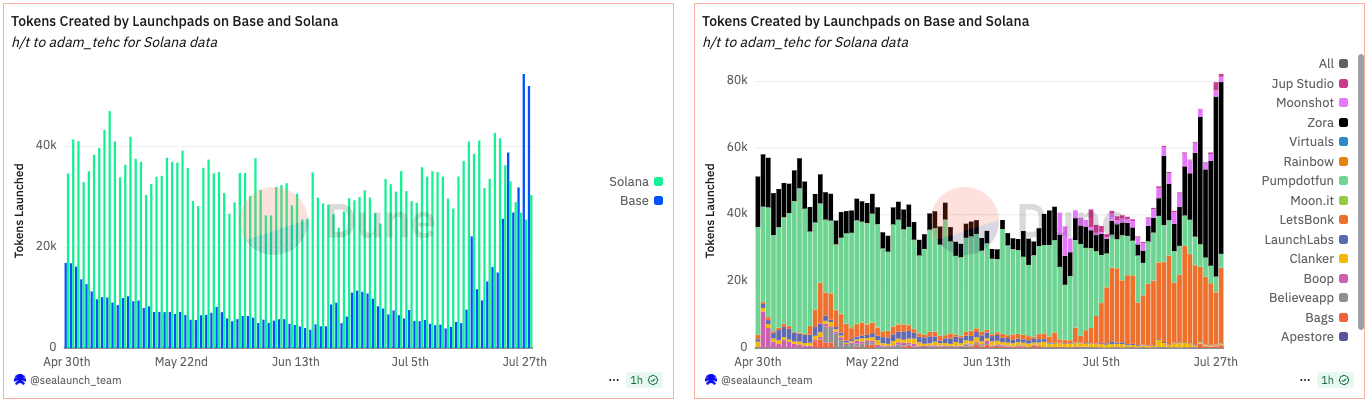
On July 27, a record 54,000 content coins were minted on Base, an 11x jump from June’s 5k-a-day dribble. Unique daily transacting wallets jumped to over 50k from less than 5k just a month ago, while daily volume climbed to a record $41 million, according to Dune Analytics data. Monthly revenue for July jumped to $2M after failing to cross $600,000 for the past two years, according to DeFiLlama.
A Five-Year Overnight Success
While this explosion in activity may seem sudden, Zora is no overnight success story. Founded in 2020 by Jacob Horne, Dee Goens and Tyson Bataller, the project was initially an open-source NFT marketplace. The team has iterated from different types of NFT auctions to launching its own Ethereum Layer 2, to now creator coins on Base.
And after much iteration, the team has seemingly hit the nail on the head, apparently by riding the memecoin launchpad bandwagon, allowing for instant token minting with every post. That’s what makes it easy to lump Zora with memecoin launchpads together.
Looks Like a Doge, Smells Like a Doge?
On the surface, Zora looks a lot like memecoin launchpads. Both let anyone spin up a fungible token in seconds, both encourage hyper-speculation on low-cap tickers, and both are currently overrun by degens chasing a quick 10x.
Those who see Zora as just another memecoin farm are understandably irked when they see Jesse and Jacob talking about a new system to empower creators etc. etc.
And so you have Solana’s Anatoly Yakovenko calling content coins on Zora "digital slop.”
Artist Sterling Crispin, who said it’s a “zero sum PvP game of musical chairs.” Jon Charbonneau said, “everything launched so far on zora, pump, bonk, believe, etc is a memecoin.” X user who goes by Mosi said, “it's fine to build memecoins Jesse, just embrace degeneracy.” VC Richard Chen called content coins an example of an “elitist” type of “Brooklyn crypto.”
But coins on Zora are structurally different from memecoins.
Here’s why
- Tokenomics. Each Zora content coin (one per post) and Creator Coin (one per profile) comes with a fixed 1 billion supply. Content coins hand authors just 1% upfront, but every trade routes a 1% fee back to the creator. Creator coins give influencers immediate access to 50% of the supply, while the other 50% vests linearly over five years, but only unlocks when the coin actually trades. Pump.fun, by contrast, gives 20% of supply to the launcher instantly and locks the remaining 80% in a bonding-curve AMM, with no vesting or trickle of revenue. Also, Zora’s 3 % round-trip fees are 3x Pump.fun’s, which makes Zora a lot less “fun” than Pump.fun for degens who just want to trade.
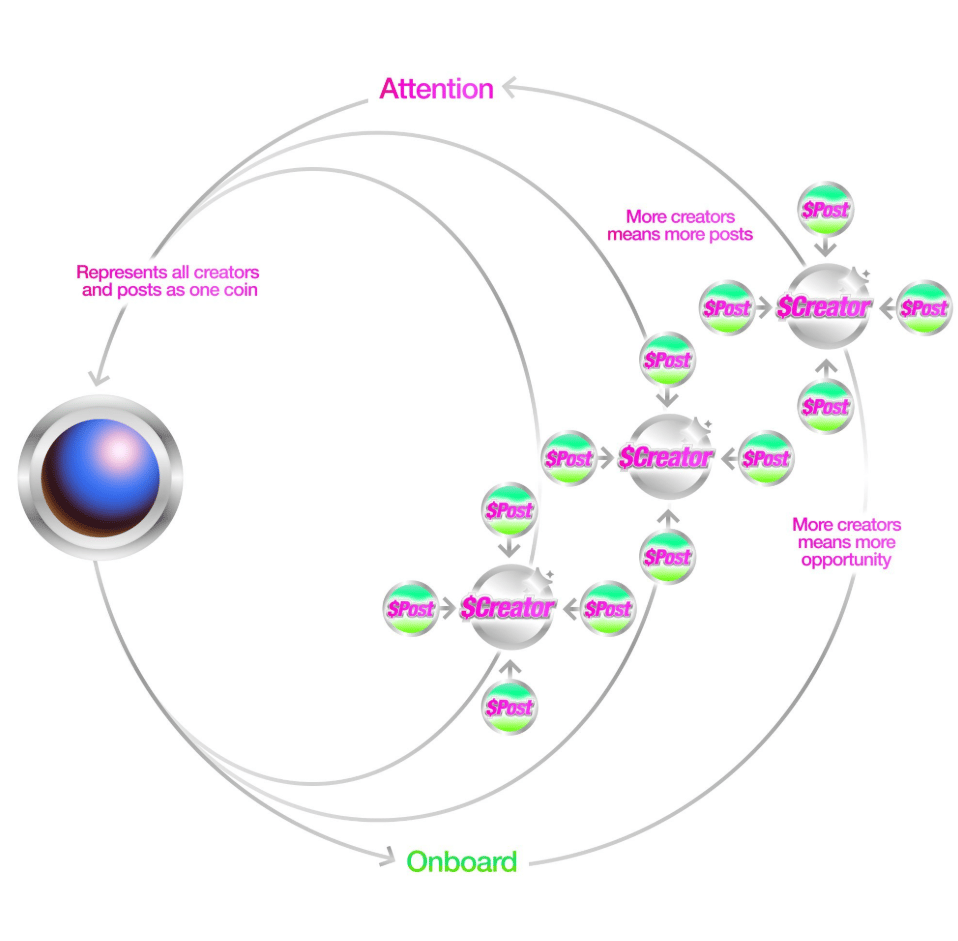
- Reflexive pairing. Zora wires coins together. Every content coin is auto-paired in a Uniswap v4 pool against its author’s creator coin, which in turn trades versus $ZORA. It’s a feedback loop designed to concentrate value in the human at the center of the graph, not the meme of the moment. Launchpad memecoins float in isolation, each ticker lives and dies on its own hype cycle.
- Medium. Zora’s app is an Instagram-style feed where content is the hero. On Pump.fun, the price chart is the content. In McLuhan terms, “the medium the message.” In Zora’s case, the medium places the focus on content and creators, while memecoin launchpads place the focus on the token.
Why this matters—even if 90 % still goes to zero
Critics are not wrong that most tokens launched this summer will go to zero and that most of the content on Zora is actually digital slop. But writing the experiment off as repackaged junk misses the point. Here’s a social network that’s natively piping trading fees back to the people who create the content we all consume. Pollak’s rebuttal to the “slop” accusation is blunt: “Content is valuable. Creators are valuable,” and coins are “the most powerful technology we have for letting that value flow.” I agree and I think it’s worth at least trying to improve economics for content creators.
We’re still early and, yes, this model will have to continue evolving so I wouldn’t get so hung up on the very specific tokenomic details, but rather focus on the bigger picture:turning every like, share and view into a liquid, creator-owned micro-economy. That’s a bet worth tracking, even if you’re not ready to ape into someone’s bathroom selfie or this author’s creator coin.
But coins on Zora are structurally different from memecoins.
Here’s why
- Tokenomics. Each Zora content coin (one per post) and Creator Coin (one per profile) comes with a fixed 1 billion supply. Content coins hand authors just 1% upfront, but every trade routes a 1% fee back to the creator. Creator coins give influencers immediate access to 50% of the supply, while the other 50% vests linearly over five years, but only unlocks when the coin actually trades. Pump.fun, by contrast, gives 20% of supply to the launcher instantly and locks the remaining 80% in a bonding-curve AMM, with no vesting or trickle of revenue. Also, Zora’s 3% round-trip fees are 3x Pump.fun’s, which makes Zora a lot less “fun” than Pump.fun for degens who just want to trade.
- Reflexive pairing. Zora wires coins together. Every content coin is auto-paired in a Uniswap v4 pool against its author’s creator coin, which in turn trades versus $ZORA. It’s a feedback loop designed to concentrate value in the human at the center of the graph, not the meme of the moment. Launchpad memecoins float in isolation, each ticker lives and dies on its own hype cycle.
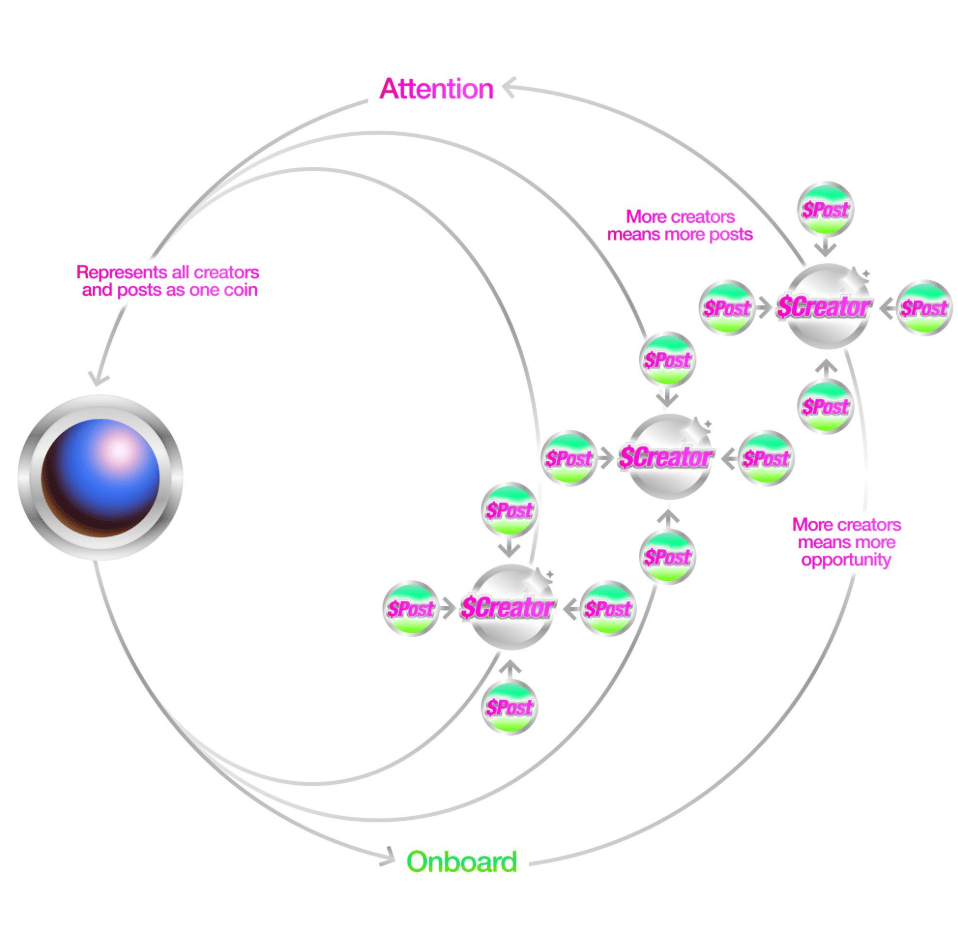
- Medium. Zora’s app is an Instagram-style feed where content is the hero. On Pump.fun, the price chart is the content. In McLuhan terms, “the medium the message.” In Zora’s case, the medium places the focus on content and creators, while memecoin launchpads place the focus on the token.
Why this matters—even if 90% still goes to zero
Critics are not wrong that most tokens launched this summer will go to zero and that most of the content on Zora is actually digital slop. But writing the experiment off as repackaged junk misses the point. Here’s a social network that’s natively piping trading fees back to the people who create the content we all consume. Pollak’s rebuttal to the “slop” accusation is blunt: “Content is valuable. Creators are valuable,” and coins are “the most powerful technology we have for letting that value flow.” I agree and I think it’s worth at least trying to improve economics for content creators.
We’re still early and, yes, this model will have to continue evolving so I wouldn’t get so hung up on the very specific tokenomic details, but rather focus on the bigger picture: turning every like, share and view into a liquid, creator-owned micro-economy. That’s a bet worth tracking, even if you’re not ready to ape into someone’s bathroom selfie or this author’s creator coin.
With love,
Cami, founder of The Defiant
Forwarded this newsletter? Subscribe for insights and curated news from The Defiant team, Monday-Friday. It’s free.
Subscribe to The Defiant Daily
🎬WATCH
Stablecoins Redefined: How the Genius Act Impacts Cryptocurrency Exchanges
In the latest episode of The Defiant Podcast, Vinny sat down with the team at Biconomy, a centralized crypto exchange that serves customers globally, to discuss the implications of the GENIUS Act — the landmark U.S. stablecoin legislation that was signed into law less than two weeks ago. They explore how this new legislation is reshaping the industry in the U.S. and globally, the opportunities it unlocks, and what it means for the future of digital assets.
Top News in the Past 24 Hours
- Crypto Markets Weaken as Ethereum ETF Inflows Slow While crypto markets broadly where down today and ETH ETF inflow momentum slowed, analysts at Glassnode shared insights on ETH derivatives. They noted that the open interest dominance of Ethereum perpetual futures has climbed to nearly 40%, which is the highest level since April 2023, marking a “clear shift in speculative focus, with capital rotating from BTC to ETH at the margin.”
- PayPal Launches Expansive 'Pay with Crypto' for Global Commerce PayPal just launched a new feature for U.S. merchants, letting them accept over 100 cryptocurrencies, including BTC and ETH, alongside USDT, SOL, BNB, and dozens of others, including memecoins. merchants can convert crypto payments to fiat, or to PayPal’s USD stablecoin, PYUSD — and earn 4% on their PYUSD holdings on PayPal.
- Mill City Ventures to Buy $450M of SUI Tokens in Blockchain Pivot Publicly traded U.S.-based specialty finance company Mill City announced on Monday a $450 million private investment deal to accumulate SUI, making it the first public treasury firm for the altcoin. Mill City said it plans to buy SUI on both the open market and through private transactions, including direct purchases from the Sui Foundation. Sui is a Layer 1 blockchain that supports smart contracts written in programming language Move. SUI is currently ranked #15 among cryptocurrencies by market cap.
- UAE’s RAKBANK Partners With Bitpanda to Offer Retail Crypto TradingThe National Bank of Ras Al Khaimah (RAKBANK), a majority government-owned bank in the United Arab Emirates, has partnered with EU-based crypto exchange Bitpanda’s MENA arm to launch a crypto brokerage service. The move makes the bank the first in the country to offer crypto trading services to retail customers.
- FEATURE: China Turns to Yuan-Pegged Stablecoins to Take On Dollar after Long CBDC Struggle For years, the world has been watching China's efforts to establish the digital yuan as a major player on the global stage. However, despite high-profile trials and substantial government support, a Chinese CBDC hasn’t yet caught on internationally as Beijing likely expected.
Trending on The Defiant
- PayPal Launches Expansive 'Pay with Crypto' for Global Commerce
- Binance Launches Yield-Bearing Product Pegged to Users’ Stablecoin Deposits
- Crypto Markets Hold Steady as Bitcoin Recovers from $9B Whale Sale
- Bitfinex-Backed Plasma Ends Public Sale with $300M+ Oversubscription
- Sui DEX Momentum Teases Expansion Plans After Hitting $100 Million in Daily Volume
- China Turns to Yuan-Pegged Stablecoins to Take On Dollar after Long CBDC Struggle
That’s it for today — if you enjoyed this newsletter, tell your friends! https://thedefiant.io/subscribe
Free newsletters
Good reporting. Delivered.
Choose your coverage: crypto and DeFi, the future of finance, or both.
Free. Unsubscribe anytime.