Advertisement

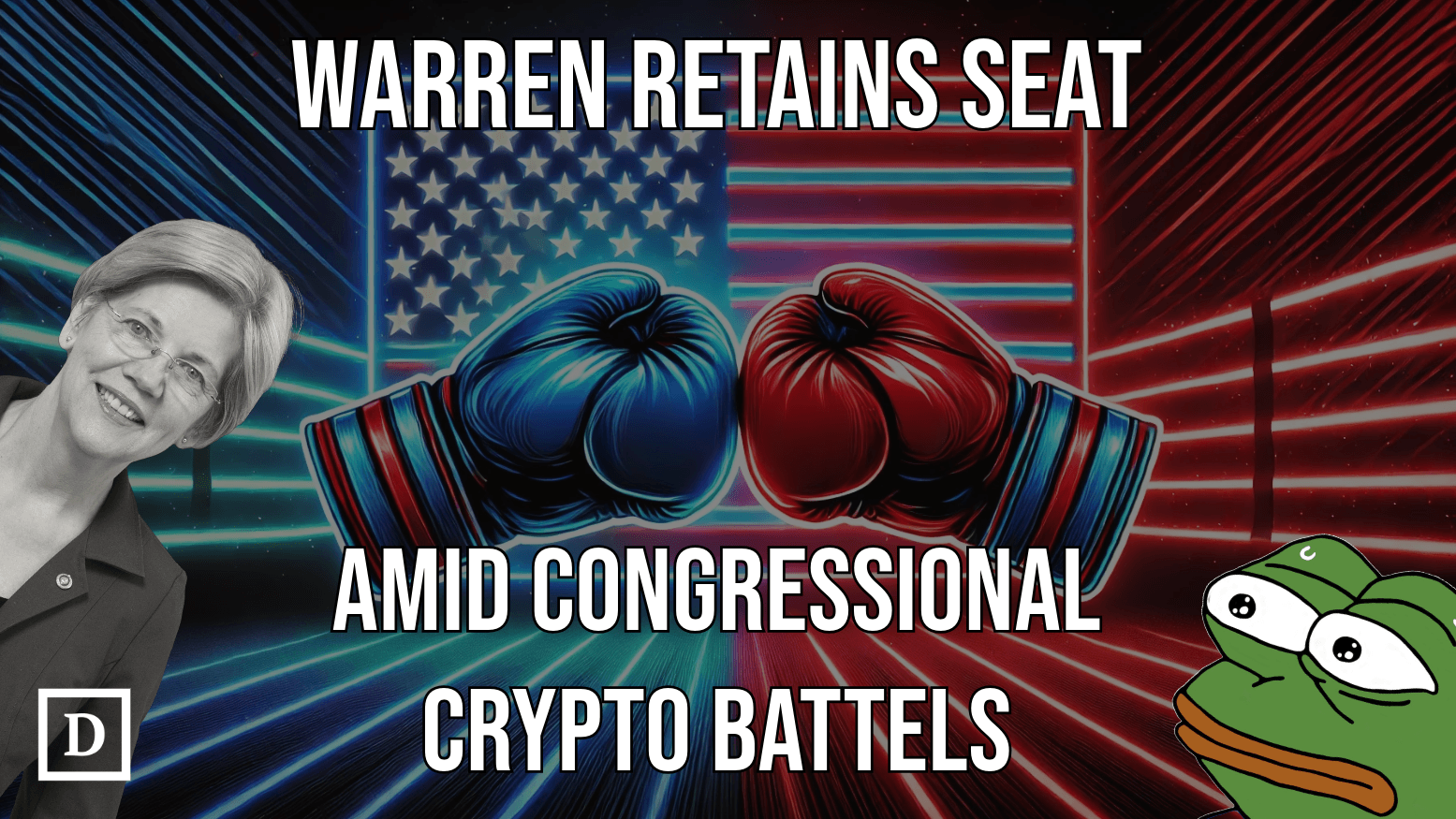
Elizabeth Warren Defeats Pro-Crypto Deaton To Secure Third Senate Term

The 2024 U.S. presidential election featured several tight Senate races involving pro-crypto candidates.
By: Mehab Qureshi
Elizabeth Warren Defeats Pro-Crypto Deaton To Secure Third Senate Term

Efforts from crypto proponents to unseat Democrat Senator Elizabeth Warren have failed.

On Nov. 5, Warren comfortably won re-election to the U.S. Senate in Massachusetts, defeating the Republican crypto advocate John Deaton in a decisive victory.

Warren, among the most prominent crypto skeptics in U.S. politics, captured around 60% of the 173,000 votes counted, leaving Deaton well behind with 40% of votes. The result marks the beginning of Warren’s third term in the Senate.

John Deaton, a lawyer known for representing XRP token holders in the long-running legal battle between Ripple Labs and the U.S. Securities and Exchange Commission, received significant support from the crypto community.

Deaton secured $2.14 million in donations from individuals between Jan. 1to Oct.16. On July 15, Ripple Labs contributed $1 million to the Commonwealth Unity Fund, a super PAC formed by James Murphy, a pro-crypto attorney, with the explicit goal of unseating Warren in support of Deaton.

Deaton’s other backers included Brian Armstrong, the CEO of Coinbase, Tyler and Cameron Winklevoss, the co-founders of the Gemini, Brad Garlinghouse, the CEO of Ripple Labs, Charles Hoskinson, the founder of Cardano founder, Jesse Powell, the co-founder of Kraken, and Anthony Scaramucci, co-founder of Skybridge Capital,

Deaton addressed his supporters in a livestream on X following the result.

“I’m disappointed with the results,” he said on Nov. 5. “I’m a competitive guy. I’m proud of my campaign and how it was run… no lies, no name-calling, just trying to focus on policy.”

Warren’s “Anti-Crypto Army” Stance

OnMarch 9, 2023, Warren’s re-election campaign included a worrying call to build an “anti-crypto army.”

On Dec.14, 2023, Warren introduced the Digital Asset Anti-Money Laundering Act, co-sponsored by Republican Senator Roger Marshall, to mandate strict Know-Your-Customer (KYC) requirements across more crypto services, including miners and wallet providers​. The bill aimed to curb the use of crypto in money laundering, drug trafficking, and sanctions evasion by dramatically expanding regulatory oversight of the industry.

In a series of debates leading up to the election last month, Deaton criticizedWarren’s anti-crypto stance, rather than focusing on other economic issues facing Massachusetts.

Warren said she has no problem with people trading crypto, provided that digital asset service providers follow the same rules as banks and other financial corporations, adhere to consumer protection laws, and abide by stringent KYC, anti-money laundering, and sanctions protections.

However, with the Republican Party appearing poised to win the House, Senate, and Presidency, Warren's ability to pass legislation intended to curtail the crypto may be significantly hindered during her third term.

A High-Stakes Election for Crypto

The battle between Warren and Deaton was not the only seat at stake during the 2024 U.S. election with implications for the web3 sector. Several Senate races feature candidates with strong views on digital asset regulation.

Brown vs. Moreno

In Ohio, pro-crypto Republican Bernie Moreno narrowly defeated the incumbent Democrat Sherrod Brown.

Moreno, a car dealer and a blockchain entrepreneur, campaigned on making Cleveland a tech hub and received roughly $40 million in support from crypto-related PACs,

Brown, known for his strong anti-crypto stance as chair of the Senate Banking Committee, was viewed by the crypto industry as a key barrier to passing legislation favorable to digital assets.

“This is what happens when you mess with the crypto army,” tweeted Cameron Winklevoss of Gemini following Moreno’s win.

Tester vs. Sheehy

Montana’s Senate seat is another significant race for crypto interests, with the incumbent Democrat Jon Tester facing pro-crypto Republican Tim Sheehy.

During a Dec. 11appearance on NBC’s Meet the Press, Tester claimed that digital assets offer no real value and thus shouldn’t be regulated to avoid giving the sector legitimacy.

“It's not been able to pass the smell test for me,” Tester said. “I have not been able to find anybody who's been able to explain to me what's there other than synthetics [...] which means nothing… If we regulated it, it may give it the ability of people to think it's real.”

Sheehy, meanwhile, positioned crypto as “the future of finance” and pledged to oppose the development of a central bank digital currency (CBDC).

The latest polls show Sheehy leading with 52.3% of the vote​.

Casey vs. McCormick

Pennsylvania’s race, viewed as a crucial swing state, also has implications for the crypto sector.

Incumbent Democrat Bob Casey Jr., considered neutral toward crypto, is up against Republican Dave McCormick.

The race between the candidates remains close, with McCormick enjoying a slight lead of 49% over McCormick with 48% of 6.52 million votes counted so far.

Casey Jr. has shown a mixed approach to crypto regulation. He supported the pro-crypto SAB 121 House Joint Resolution, aimed at nullifying the SEC’s despised crypto accounting rule, Staff Accounting Bulletin 121 (SAB 121). However, Casey Jr also voted for Warren's Digital Asset Anti-Money Laundering Act of 2023.

Meanwhile, McCormick is openly pro-crypto.

“Crypto and blockchain have the potential to create incredible jobs for our commonwealth and strengthen our national security,” McCormick wrote on Sept. 28. “We need leaders who will embrace it and ensure America is leading the world in another generation of critical innovation.”

Baldwin vs. Hovde

In Wisconsin, Democratic incumbent Tammy Baldwin faced pro-crypto Republican Eric Hovde in a Senate race. Baldwin held a narrow lead by 2.2% over Hovde as of the latest counts.

“I support decentralized finance, and see Bitcoin as an asset for the future and fully support the community,” Hovde said in a July interview with Politico. “I believe the United States needs to provide a regulatory structure for legitimate actors involved in Bitcoin and Ethereum in this country so that shady people like Sam Bankman-Fried, drug traffickers, and scam artists can’t take advantage of consumers.”

Hovde also spoke critically on the “thousands of different junk coins that have no value being created.”

While Baldwin has not made any public statements on crypto, he voted against the SAB 121 House Joint Resolution.

Advertisement

Get an edge in Crypto with our free daily newsletter

Know what matters in Crypto and Web3 with The Defiant Daily newsletter, Mon to Fri

90k+ Defiers informed every day. Unsubscribe anytime.