Yorke Rhodes Explains How Microsoft Is Leveraging Ethereum
This week on The Defiant Podcast, we speak with Yorke Rhodes, the co-founder of Blockchain at Microsoft.
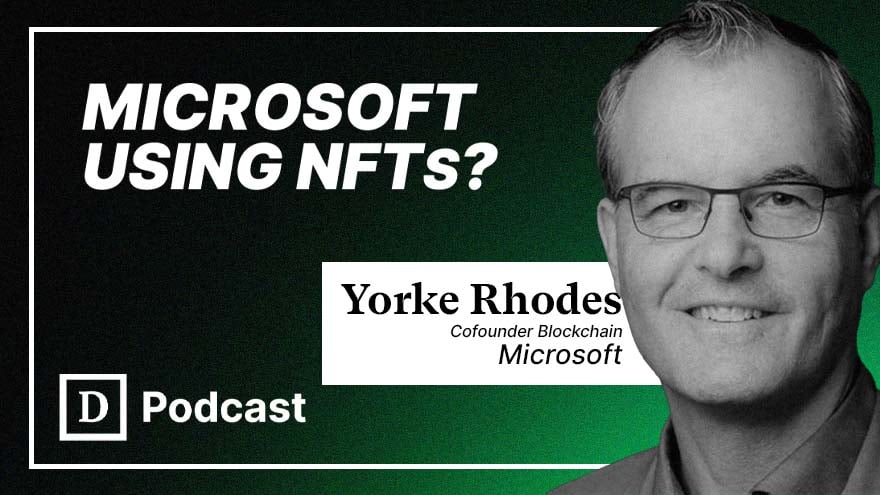
Microsoft is a Web2 giant producing software, consumer electronics, personal computers, and related services.
Yorke shares his experience working at Microsoft in a strategy and transformation role in blockchain and Web3 technology, specifically focusing on the production of a blockchain-based full-stack application within one of the largest supply chains in the world.
We dive into what Microsoft is doing within the blockchain space, how Microsoft is using NFTs internally, and the use-cases of Ethereum and IPFS inside the company.
We also talk about the different CEOs that have led Microsoft over the years and even get into the rumors of Google choosing their slogan “Don’t Be Evil” because of Microsoft.
Listen to the interview in this week’s podcast episode here:

Thanking our podcast sponsors:
- This episode is brought to you by the Glo dollar, a new stablecoin that reduces extreme poverty as its market cap goes up. With Glo, you can lift people out of poverty just by holding a stablecoin. To join the waitlist, visit https://www.glodollar.org/defiant
- Store your tokens safely. Go self-custodial with 1inch Wallet.
Podcast Summary
I am interested in learning more about how Web3 and crypto work together. Web3 aims to keep everything decentralized and open to give power back to users. However, I am curious to know if there are any centralized elements in this and how you approach this concept. Can you provide more information?
- The journey of exploring blockchain and supply chain started in 2018 with a thesis around the intersection of blockchain technology and the developing world in the context of raw materials.
- As the exploration continued, the opportunity for traceability of high-value goods and the transformative potential for the finances of those goods was realized.
- The team also realized that their technical approach solved for a distributed system across multiple parties in a supply chain, which existing ERP systems like SAP and Dynamics are not equipped to handle.
Who would be the clients of such a service?
This is a high-tech industry that focuses on providing enterprise supply chain solutions. The suppliers are all companies that supply components in the high-tech industry, which now includes automotive and other industries as well. Microsoft is a key player in this industry and is investing in it.
Other companies involved include Lenovo, AMD, Intel, Nvidia, ZT systems, Samsung, and many others. These companies supply high-value components that go into every computing platform, including cloud, PCs, laptops, and phones. By working with Microsoft’s Cloud, which is one of the largest supply chains in the world, these companies have the incentive to drive the end product to its final state. It would be difficult to achieve this in any other way.
How did you start in the blockchain space initially? I know it’s been a while. And how are you thinking about that within the context of Microsoft?
I stumbled upon blockchain technology while researching new and innovative technology trends. I wondered why I didn’t discover artificial intelligence technology instead, but eight years ago, it wasn’t as advanced as it is today. I constantly read and follow social media to stay updated on new technology.
In early 2015, I came across blockchain and realized that it solved problems that I had struggled with in my tech career. These included unique identification and transcending the boundaries of an enterprise. This led me to think about humanitarian identity and opportunities. The intersection of blockchain technology and humanitarian opportunities resonated with me, and I dove deeper into this technology for about six months before fully committing to this journey.
Why are you excited about crypto and Web3, and how do you view the space in general?
From 2015 until now, there has been a lot of progress and changes in technology, especially in the Ethereum public network. We’ve seen a big shift in how we view technology and its evolution. One major change is the Merge, which has had a big impact on the carbon footprint of the organization.
This is a significant historical moment and it opens up new opportunities for businesses to think about how they can reduce their carbon footprint when building systems.
As we near 10 years of using public blockchain technology as a computing mechanism, there are many possibilities for continued growth and development in this field. This is a different pattern than we’ve seen in traditional enterprise companies, as systems were previously separated in silos. This is an evolution of open-source and distributed systems.
Microsoft has a lot of moving parts, so between cloud and social and developer resources, and then even gaming, how do Web3 and crypto kind of fit into that?
Microsoft is a large company with many divisions and capabilities, including its browser and Bing search business, LinkedIn, dynamics ERP business, gaming business, Office, and Azure cloud business. To strategize on anything in a company of this size, it is important to be a catalyst and instigator, but ultimately the business must prioritize which capabilities will work best for them.
Product teams have their own cycles, and it is important to educate and understand the capabilities and advantages of an approach. An example of this is the decentralized identity work in Microsoft’s identity engineering organization, which has now been made available to the public as part of the identity suite of products.
The concept of digital certificates, assets, and ownership rewards, whether referred to as blockchain tokens or Web3 tokens, will continue to evolve in the industry and may be used differently across product teams within Microsoft.
How do you handle the challenge of answering questions from different topics in gaming, social, and crypto, and how do you navigate pushing new ideas, such as tokens on a balance sheet, within a company? Any advice for others in a similar situation?
A while back, I started on a journey and had questions about what to do next. I had been teaching entrepreneurship and enterprise in my role as a professor at NYU and had developed some course materials on the subject. However, I decided to apply my startup instincts to my current situation within a large corporation. I realized that the same instincts and qualities needed in a startup are also required in any ecosystem, even within a company.
One important aspect for success on this journey is resilience, as you will often face rejection or negative answers. It’s also important to remain objective and understand the business reasons behind decisions, prioritizing based on what the company needs to achieve.
There is always a need to educate and inform others about new developments and ideas. To do this, I run a weekly crypto briefing series where I invite founders to speak about their work and record it for internal use. This journey is ongoing and requires constant effort to share information and stay informed.
Can you describe the level of difficulty you faced in maintaining excitement within Microsoft, both for yourself and for the company, during the years 2015 and 2016?
Companies, including Microsoft, have default behaviors and these behaviors can diverge from those of innovators. One of the biggest challenges in innovation within a large corporation is that the structure of the company promotes taking the easy path instead of focusing on long-term innovation. This can cause employees to focus more on achieving short-term goals and rewards rather than having a mission for their work. In a startup, the mission is the first priority and this is something that can be lost in a larger enterprise.
New technologies, such as AI and blockchain, can bring excitement but it’s important to recognize that implementing these technologies in a large enterprise takes time and requires resilience.
What is the current attitude within Microsoft towards crypto and blockchain, considering the bear market and the recent events with FTX?
The behavior seen on Twitter as a result of the massive fraud committed by FTX is an unfortunate result of people using the crypto industry for their own personal gain and to the detriment of consumers.
This type of behavior can harm innovation in the industry and lead employees to question why they should continue working in the field.
The lack of oversight and regulations in the crypto industry can change the industry and cause a desire for more regulations, but it is important to remember that instances like FTX are not the norm and are not a part of the design of the industry. Those who believe in the importance of technical innovation will continue to work in the field, understanding that these incidents are aberrations.
Tell us about your involvement in the Ethereum Enterprise Alliance
- In 2016, the Enterprise Ethereum Alliance was founded to create compatible and aligned Ethereum stacks for the enterprise sector, using Quorum as a template for a standardized enterprise-class stack.
- We have continued to guide others towards this standard and have recently welcomed more crypto-native companies to participate in our work.
- Going forward, we anticipate that the need for privacy and privacy enablement will become increasingly important in the enterprise sector, so the Enterprise Ethereum Alliance will focus on this topic and take a point of view on it.
How has the perception of using blockchains in enterprise systems evolved over time, and what was your perspective on the shift from private internal blockchains to tooling solutions, such as Microsoft’s approach?
I think technology can be helpful or harmful. It can be hard to see how a transactional system with sidecar storage works in a distributed system outside of a company. Some may question if it’s necessary to use it in a company when there are better options available. This lack of understanding can lead to issues like censorship and corruption. In the consortium space, there’s also confusion around governance.
People may not understand that blockchain technology is not like a database and this can cause problems with systems integrators. When people are first introduced to blockchain technology through products like Hyperledger Fabric or Corda, they may not fully understand it. Even companies like IBM have expanded to include other products because of this.
I remind my teams about the limitations of transactional blockchain systems and the potential for abuse when giving them options or opportunities.
How did you choose IPFS over something like Arweave, as an example?
- I have been in the space since 2015 and have known about IPFS for a long time, finding it to be a fascinating technology.
- I have continually reevaluated our technical choices and have considered other products like Arweave and Textile, but ultimately found that IPFS is the best fit for our needs and our application stack.
- We are using IPFS in a private context, with the privacy switch turned on, and have implemented controls to ensure resilience and to connect it to our private network using Tessera.
It’s always fascinating to observe how protocols are applied in real-world scenarios, so that’s exciting. Additionally, you briefly mentioned your work with cloud technology. Can you explain your approach toward utilizing the cloud and blockchain technology together?
I described a client application in an enterprise that’s in a cloud organization from a supply chain perspective. We fully embraced the idea of using distributed systems to work with end-tier suppliers. We also have regulations around the country of origin and anti-slave labor. To build this, we need to think beyond just our enterprise and use distributed systems as a valuable tool.
To reconcile cloud with distributed systems, we need to be careful and maintain the capabilities of a system that runs well in cloud while also maintaining the qualities of a truly distributed system. We can facilitate this by having multiple customers run in our cloud, but ideally, we need to provide the utility for those who want to be on-premises or in a different cloud.
- We see a natural symbiotic relationship between decentralized systems and centralized provisioning through cloud.
- We’re interested in participating in programs that drive decentralization of all things in Ethereum, such as multiple clients and multiple infrastructure providers.
There are many companies that provide centralized Remote Procedure Call (RPC) services, and they have played a role in the development of Web3. However, it is important to note that they are not fully Web3 due to their centralized nature. My question is, many people transition from Web2 to Web3, but you have spent nearly a decade working within a Web2 company. What has kept you within this company?
It’s actually eight years and seven months, so not quite a decade. It’s definitely two decades in crypto terms.
I returned to Microsoft in November 2014 and shortly after that, I fell into a rabbit hole. I asked myself, “Now that I’m in this rabbit hole, what do I do? How do I set myself up for success?” The decision to return to Microsoft was a hard one as I had already spent eight years at Microsoft in the nineties when technology and systems were very different. I returned with a clear goal of working in this technical space for at least 10 years.
I put on my startup hat and believed in the humanitarian mission associated with this and decided to go on this journey, not knowing how long it would take. I have had three different roles at Microsoft, each lasting two and a half to three and a half years, which has given me a fresh perspective.
I started in partner development, recruiting startups into the cloud. My second role was in an engineering group, working on developer tooling and providing utility for enterprise customers. My current role is in supply chain and it has kept the journey fresh for me internally. The Web3 space has many interesting and exciting companies and technologies and many of my colleagues have gone to work for them.
On a slightly sensitive topic, I was curious about your thoughts on the rumors that Google created their “Don’t be Evil” branding as a response to Microsoft’s alleged “evil” actions. While it may be a stretch, I know there were accusations of monopoly behavior in the past. What are your thoughts on this topic?
I believe that Google’s statement of “don’t be evil” has come full circle. At one point, it had a right to make that statement, but now it’s different.
In any competitive market, you can find instances of monopoly-like characteristics if you look hard enough.
Microsoft has always been a company that enables other businesses to grow by creating utilitarian products across a wide range. In the past, some competitors who weren’t performing well in the market pointed fingers and complained about certain decisions made by Microsoft during the browser wars. Overall, the market is what it is and this is a normal occurrence.
How important is it to consider incentives when designing systems in the Web3 and crypto space, and why is this important to you? Also, can you discuss your experience in the crypto industry before I ask the next question?
Your idea about incentives is very important for the topic we are discussing. In order to create public goods, we must understand how to maintain them by using different incentives. Without considering how incentives work, we may end up in unexpected situations.
In the early days of Web2, it was difficult to predict the various types of business models that would develop. Now that we have gained more understanding, we can make positive changes. I understand that you entered the crypto field primarily on the Ethereum side. Are you still primarily interested in Ethereum or are there other ecosystems that you are excited about?
I started in 2015 when Ethereum was the only game in town. From a mission perspective, it was an easy place to start because there was no other obvious place to start. Over time, I have realized that tooling becomes really important as things scale. I often have two gut reactions when thinking about other ecosystems. One is wondering about other options because the grass is always greener on the other side. The other gut reaction is the fear of having to recreate all of the work that already exists.
I also think about other programming languages, VMs, and consensus algorithms. The maturity of understanding a particular framework in the market, plus tooling in a mature market, is extremely important. A new application stack and framework with new tooling and vulnerabilities takes you back many years. That’s why I have chosen to work in the largest ecosystem. It’s no longer just Ethereum with EVM compatibility, but tens of systems with EVM compatibility and a diverse community of layer two approaches. This includes privacy technology and scaling technology through zero-knowledge proofs.
This is an amazing landscape to design in, and I can’t see a reason to start fresh in another ecosystem. I think if you’re coming into the market new, you can easily go down another road and live with the choices you make. I also think there’s a much richer landscape today in terms of the concept of multiple blockchain substrates. This implies a multi-chain world and a whole new design space for how to deal with it effectively. This includes Hyperlane, where my son is working, which is focused on starting out thinking multi-chain when designing a solution and leveraging that capability to avoid the challenges of bridges with escrows and lockups.
Red pilling the children, I see.
I introduced my son to programming when he was in high school because he was already a phenomenal programmer and I knew that the smartest people were working in this field. I reached out to my trusted friend and partner Joe Lubin at ConsenSys in Brooklyn and asked if they were offering internships. They were and my son took to it in just weeks. He went on to have internships at ConsenSys, IBM, and Celo. Celo even hired him after his junior summer. He then worked for Tarun Chitra for a short while before moving on to Hyperlane.
How is Microsoft thinking about the use of NFTs in the current market and in the future of multi-chain technology?
I have been running an internal project for over a year now, which is focused on NFTs for good. Through this project, I have gained a deeper understanding of NFTs and their potential uses. I believe that NFTs are often misunderstood, as they are often seen as just visual art pieces. However, NFTs are actually a type of token that can be used in many different ways. I have recently been accepted as a speaker at an NFT conference in New York City and I plan to use this opportunity to share my insights on the design and possibilities of NFTs with others. Additionally, I use NFTs in my supply chain work to uniquely track high-value goods.
Various companies such as Reddit, Instagram, Twitter, Starbucks, and others have been getting involved in NFTs. Do you believe that this trend will continue and would you share your thoughts on it?
I said earlier that not everyone may call them NFTs, but they can be used as something like Starbucks rewards points. I believe there should be a standard object type that is flexible and can show up in different wallets made by different manufacturers as a displayable and transactable object.
Brands like Nike and Starbucks recognize that these are just digital consumer goods and we will see an evolution in different directions using the core ERC721 or other formats that will show up broadly in wallets and marketplaces. But they will be used for all different types of things and in many cases, they will want to be called NFTs.
Absolutely, and then is there a universe where you see Microsoft maybe using tokens, call them whatever you want for subscription models?
I would say that there is a possibility for software and software licenses to be turned into NFTs. A license is an entitlement and can be defined in an NFT, just like a rewards token. The consumer brand industry is interested in these technologies as it’s a better way of doing what has been done in enterprise systems historically.
Microsoft’s leadership has changed quite dramatically, at least it appears from the outside and it also appears that it’s been quite positive. Any comments on what you think leadership is doing well that maybe other leaders can learn from?
I mean, interesting, fun fact. I have worked under all three CEOs of Microsoft, from Bill Gates to Steve Bomber to Satya. I was fortunate not to work under Steve Bomber for long, but I had a lot of exposure to him during my time at the company. I think what’s interesting about Satya’s leadership is his cultural understanding and emphasis on doing the right thing. This extends to areas such as sustainability, climate, and interpersonal relationships. Satya was the right person for the CEO role at that time because he came from the cloud business and fully understood how to pivot the company from software licenses to a cloud services revenue stream.
What are you most excited about in Web3 when it comes to the crypto space?
I believe we have not yet fully utilized the humanitarian opportunities in the industry. I am optimistic about using end-tier traceability and chain of custody to improve the situation.
I have been working with colleagues on issues such as conflict minerals and child labor in the high-tech industry supply chain. We have held workshops with organizations such as Gold Standard and Impact Gold to address these problems. It is now becoming a business imperative and we are on a journey to solve it.
In the Web3 technical space, I am excited about the potential of Zero Knowledge proofs and using AI to enable different types of conversations with Web3 endpoints.
Last question, how are you defiant?
I believe in holding onto my beliefs, regardless of what is happening around me. Without doing this, I don’t think you can achieve anything. I have made decisions in the past where I have either asked for permission or forgiveness after breaking the rules, or I have gone through the proper channels and not achieved anything.
I have embraced the concept of a Growth Mindset, which is about understanding where the boundaries are, but also realizing that achieving what I want is not always going to be easy by following the rules.
I believe in pushing the envelope and making decisions that are unconventional, as I believe this is necessary for moving forward with my mission or vision.
I disagree with the idea that corporate employees should just fit into the mold and only focus on the success of their current role. I believe that in a transformative or innovative role, leaders are not always the ones who have the knowledge and that it’s important to lead from your position, regardless of what your superiors are telling you.
Free newsletters
Good reporting. Delivered.
Choose your coverage: crypto and DeFi, the future of finance, or both.
Free. Unsubscribe anytime.