Solana's Historic Governance Vote — While Robinhood Invades Its Meme Coin Turf
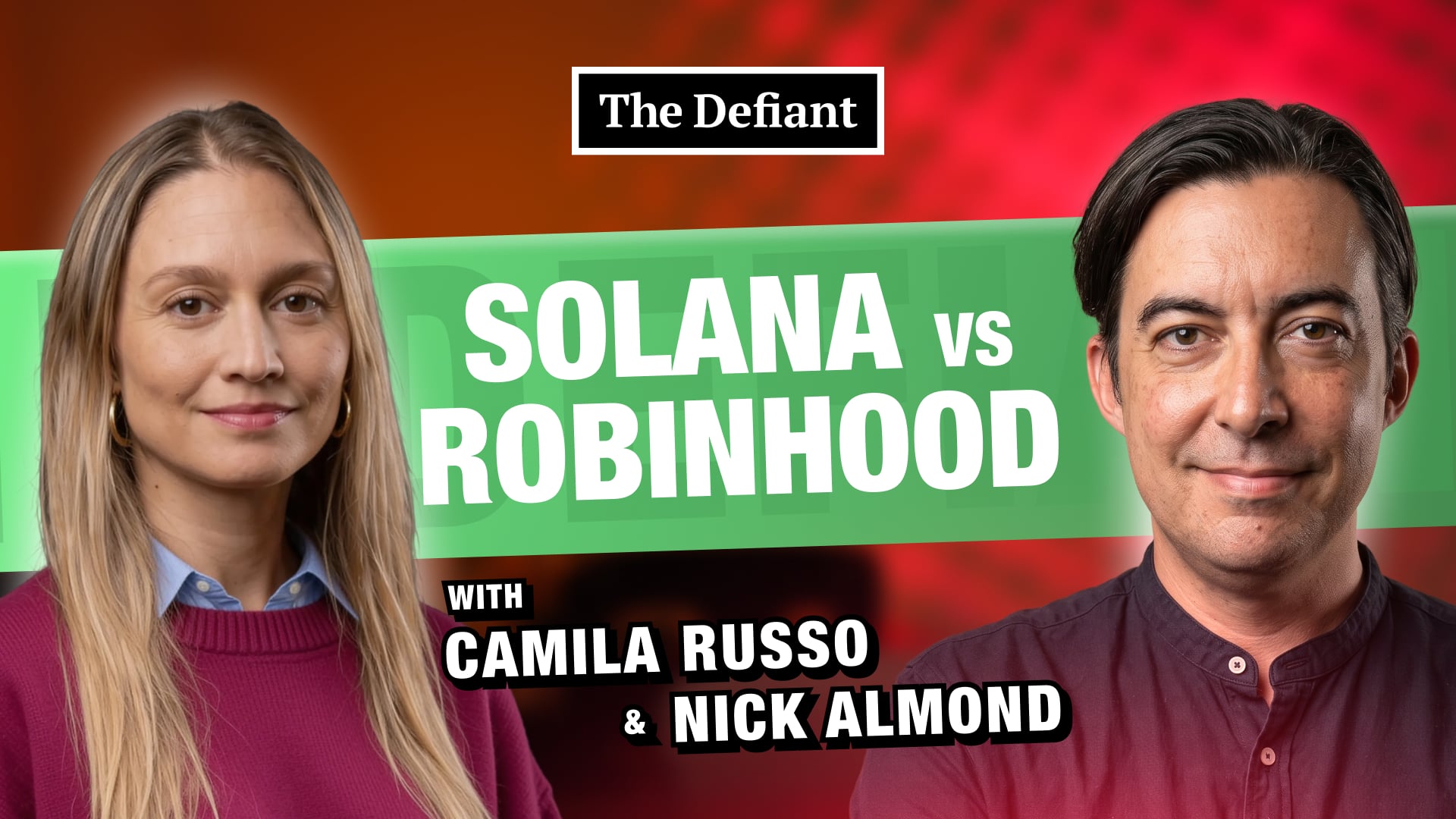
🎧 Listen to Interview
💻 Watch Video
How JitoSOL Swung Solana's Governance Vote
Jito Foundation's head of governance says a liquid-staking override mechanism decided Solana's closest on-chain vote, as validators confront an 87% revenue decline and rising competition from Robinhood Chain.
Solana's proposal to double the network's disinflation rate passed by 0.334 percentage points above the two-thirds threshold it needed, and it would have failed without a mechanism that let holders of Jito's liquid staking token vote independently of the validators holding their stake, according to Nick Almond, head of governance at the Jito Foundation.
"We got 13% of the TVL in the end and the whole JitoSOL stake pool voted during the actual on-chain vote," Almond said in an interview on The Defiant Podcast, describing roughly 10 million SOL, then worth close to $1 billion, that Jito directed toward the proposal known as SGP-0002.
The vote was one of three that closed on August 28, in the first binding governance referendum Solana validators have held since the network's constitution went live earlier that month. Solana Validators Approve Doubling Disinflation in First Governance Vote, With Kraken Reversing Late SGP-0002 doubles the rate at which Solana's annual issuance shrinks, moving the network's terminal inflation rate of 1.5% up by roughly three years, to early 2029. It passed with 67.001% of votes cast in favor, against a required 66.667% supermajority. A separate proposal to split Solana's flat transaction fee into resource and inclusion components failed to clear the same threshold and has gone back to the proposal stage, Almond said.
A mechanism built for liquid staking
Jito built the override under a proposal called JIP-30, ratified last year, which lets holders of JitoSOL, the network's largest liquid staking token, signal a vote preference during a window that opens roughly three epochs before validators cast theirs. If at least 10% of JitoSOL's total value locked participates, the stake pool casts its entire holding as a single bloc, reflecting how those holders voted, rather than leaving the decision to the roughly 350 validators the pool dynamically delegates to.
"What this allows is basically any Sol holder that's staked their Sol can vote individually," Almond said, describing the broader voter-override rule that Solana's new constitution established for all stake accounts, not just JitoSOL. "For me, that really decentralizes the network out to almost the individual level."
Almond recalled the count flipping in the vote's final seconds. On-chain vote tallies show the swing came earlier: with roughly 70 minutes left before the epoch closed, the yes side was still about 58 million SOL short of the threshold, until a reversal by Kraken's validator, which flipped roughly 8.1 million SOL, combined with JitoSOL's bloc vote to push the proposal over the line.
The proposal compresses margins for staking providers, including exchanges such as Kraken, that pass through a share of Solana's inflation rewards to customers. "We're asking them to earn less money by being staking providers," Almond said. "So you can imagine the rational economic actors in the network don't necessarily want that to happen."
Fewer validators, same decentralization argument
Solana's validator count has fallen to around 700 from roughly 1,000, Almond said, a trend he attributed to rising hardware requirements as the network pushes for bigger blocks and shorter block times. He argued that measuring decentralization by validator count alone misses how concentrated stake already is on other networks. "If you actually look at it critically and look where the stake is actually living on both chains, it's almost exactly the same," Almond said of Solana and Ethereum, adding that a comparison he ran recently found the two networks' validator stake similarly distributed across data centers geographically.
The first of the three August proposals, SGP-0001, ratified the Solana Constitution that created the voting framework itself, passing with 85.97% support on 51.96% turnout of eligible stake. Solana Launches Onchain Governance With Stake-Weighted Voting for Validators It replaced an earlier, off-chain process that produced Solana's first major economic vote in 2025, SIMD-228, a proposal to cut inflation that failed after opposition from smaller validators despite backing from large stakeholders including Multicoin Capital. Solana Community Rejects SIMD-228 Proposal to Reduce Token Emissions Almond said that failed vote was one of the reasons he moved to Solana from prior DAO governance work 18 months ago.
Revenue down 87%, and Robinhood Chain closing in
Solana's network revenue fell 87% year-over-year in the first half of 2026, to $141 million from $1.09 billion, as memecoin trading's share of the network's spot volume dropped to 16% from 40% over the same period, according to a report published by 21Shares. Almond attributed part of the decline to a deliberate tradeoff: Solana has roughly tripled block sizes over the past year, he said, which lowers competition for block space and reduces priority fees and Jito's own MEV tips, both major components of network revenue.
"The network intentionally is compressing its own margins," Almond said. "We're trying to build a network that can swallow 10x the demand or 50x the demand."
Solana faces a new competitor for the tokenized-equities trading it has courted: Robinhood Chain, the Arbitrum-based layer 2 that Robinhood Markets launched this year. Robinhood Chain's gas fees rose 82-fold over 11 days in early September, briefly exceeding those of Ethereum, Solana and Tron combined on a single day. Robinhood Chain Gas Fees Jump 82-Fold In 11 Days To Top Every Other Chain Almond said Robinhood built its own chain, rather than deploying on Solana, to capture sequencer revenue directly. "They get to own their rails to a degree where they can capture the rents on the chain as much as possible," he said, noting Robinhood's fees have run higher than Ethereum mainnet's despite it operating as a layer 2.
Almond said Solana's SGP-0003 fee proposal, which failed in August after developers of applications including the perpetuals exchange Phoenix warned it could raise their operating costs, is likely to return in smaller pieces. He also pointed to buyback-and-burn programs, including one Jito plans to route its own revenue lines through next year, as the more active lever protocols are using to tie token value to network activity while the fee debate continues.
SOL traded at $99.48 on Thursday, up 2.4% over 24 hours and down 1.7% over the past week, according to CoinGecko. Jito's JTO token traded at $0.4254, up 3.4% over 24 hours. Jito's total value locked stood at just over $1 billion, according to DefiLlama.
Advertisement
Get an edge in Crypto with our free daily newsletter
Know what matters in Crypto and Web3 with The Defiant Daily newsletter, Mon to Fri
90k+ Defiers informed every day. Unsubscribe anytime.