What's Behind the Weekend Rally?

Olivia Capozzalo & Denis Omelchenko
October 27, 2025
Happy Monday, Defiers!
Today’s big story:
- This weekend, markets caught some relief on the macro front, pushing BTC to near $116K by this morning — we took a look at what’s driving the uptick.
In other news:
- Stable pre-filled its vault before public deposits
- Pumpfun acquired trading terminal Padre
- XRP surged on close of Hidden Road deal
- Let’s build open highways, not railroads [SPONSORED]
Read more below! But first, please give our sponsors some love; they make this newsletter possible.

Blockchain's future is still ours to shape. Let's make sure it stays open, accessible, and built for everyone. Denelle Dixon, CEO of the Stellar Development Foundation wrote about why that choice still matters.
We’re back! Here’s what you need to know in web3 today
📈 Markets in the Past 24 Hours
| TICKER | VALUE | 24H | |
|---|---|---|---|
 | Bitcoin | $114,719 | 0.80 % |
 | Ethereum | $4,144.03 | 1.38 % |
 | BNB | $1,144.27 | 0.77 % |
 | XRP | $2.61 | -1.18 % |
 | Solana | $199.02 | -0.13 % |
What You Missed Over the Weekend
This weekend, crypto markets ticked upward, amid rising confidence in rate cuts, pro-crypto regulatory moves, and news of a potential trade agreement between the U.S. and China.
In U.S. regulatory developments, on Saturday news broke that President Trump had nominated Michael Selig to chair the U.S. Commodity Futures Trading Commission.
His nomination is quite interesting given that it follows a messy episode with Trump’s first pick, Brian Quintenz, the former CFTC commissioner. In early September, Quintenz revealed in an X thread that Gemini founders Tyler and Cameron Winklevoss, who have donated millions of dollars worth of BTC to President Trump's campaign, had contacted him about a legal dispute over how the CFTC handled a 2022 case against Gemini.
According to Quintenz, the Winklevoss twins then lobbied the White House to delay his confirmation, effectively clearing the path for Selig. All eyes are now on Selig, who is widely considered pro-crypto and currently serves as chief counsel for the SEC’s Crypto Task Force, led by Commissioner Hester Peirce.
Kyrgyzstan’s Crypto Moves
Meanwhile, Kyrgyzstan announced the launch of a national stablecoin, pegged 1:1 to the som, as well as the imminent rollout of a central bank digital currency (CBDC), to be used for government payments. The move is part of a larger partnership with Binance and the som-pegged stablecoin is built on BNB Chain. At the same time, the government is setting up a national cryptocurrency reserve that will include BNB and other cryptocurrencies.
While the move is positioned as part of a broader strategy to modernize the country's financial infrastructure, it drew criticism from some in crypto circles.
Binance founder Changpeng “CZ” Zhao — who has been the official crypto adviser to Kyrgyzstan’s president since May — was called out for promoting the milestone, given the inherently centralized nature of CBDCs.
Mert Mumtaz, CEO of Solana-focused infrastructure platform Helius, replied to CZ in an X post saying that the crypto industry “should not be helping nations develop CBDCs, it is incredible to brag about this,” and adding that CBDCs are “entirely antithetical to what crypto is” — echoing sentiment that is widespread in the space.
BNB, meanwhile, is holding out above $1,100, up about 1% over the past 24 hours.
Markets See Relief
Markets reflected cautious optimism following news headlines over the weekend, including strengthening expectations of another 25 bps rate cut at the FOMC meeting this week, as well as news of a potential trade deal with China.
Buoyed by the economic and geopolitical news, Bitcoin climbed to nearly $116,000 by this morning, up 2.6% from Friday’s close, while Ethereum rose 4.5% to around $4,169.
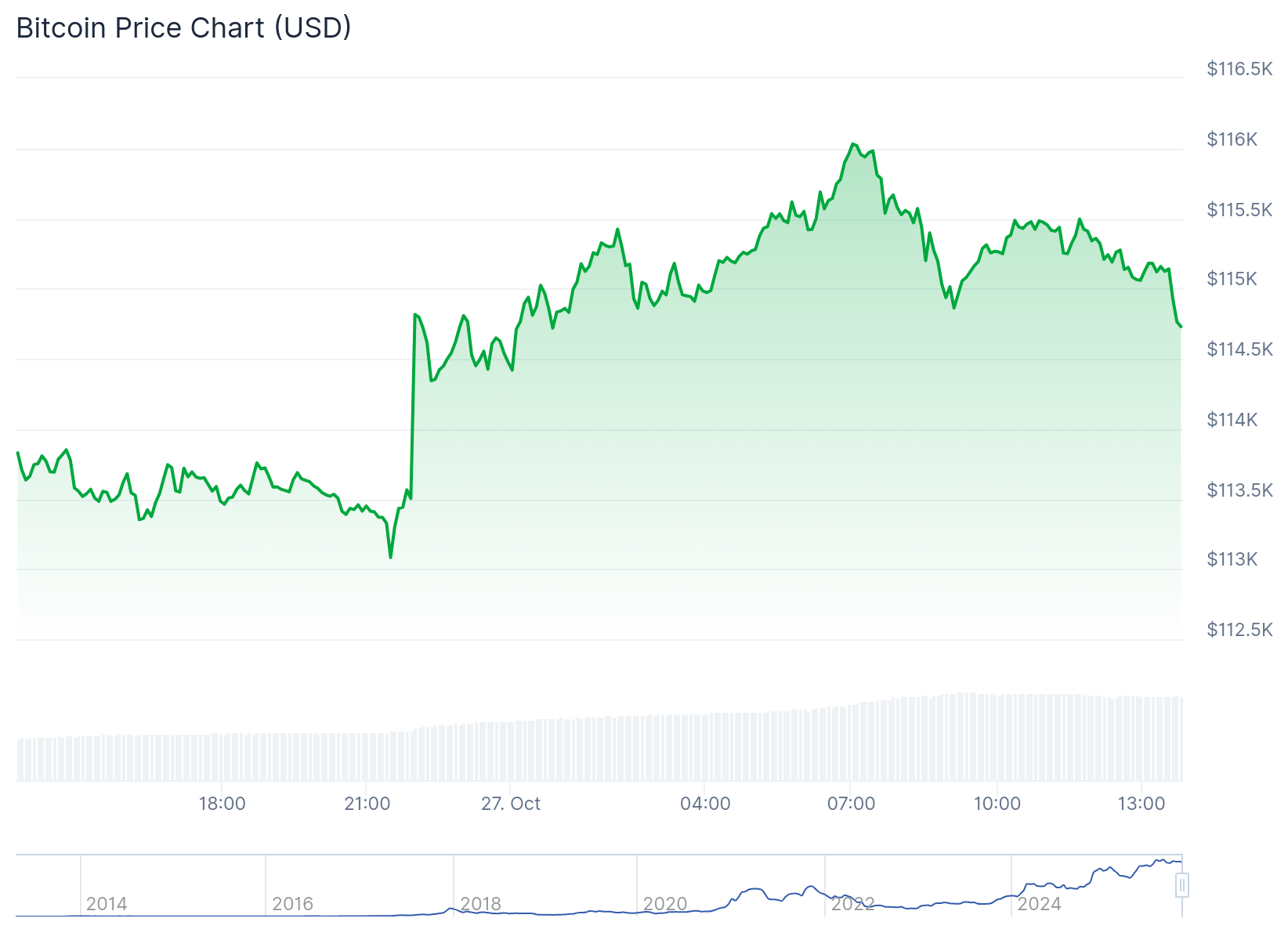
BTC 24-hour price chart. Source: CoinGecko
On the geopolitical front, Treasury Secretary Scott Bessent said in a Sunday interview with NBC that the U.S. and China have agreed to a "framework" for a trade deal, avoiding Trump’s threatened 100% tariff hike — news of which saw nearly $20 billion liquidated across crypto markets on Friday, Oct. 10.
Markets are reacting favorably to the news, evidently interpreting the framework as at least close to a done deal, and a good sign of a possible end to an escalating trade war.
Denis, staff reporter at The Defiant
Forwarded this newsletter? Subscribe for daily insights and curated news from The Defiant team, Monday-Saturday. It’s free.
🎬WATCH
Why Yat Siu Believes Altcoins Will Surpass Bitcoin
In the latest episode of The Defiant Podcast, Cami sat down with Animoca Brands co-founder Yat Siu. He reveals his vision for a trust layer built on zero-knowledge proofs, as well as plans for a Hong Kong dollar stablecoin, plus unpacks the Mocaverse ecosystem where staking power and airdrops build a verifiable, cross-chain identity.
Their conversation also explores the future of web3 gaming, the coming meta shift from GTA 6, and a bold thesis: why the entire altcoin market may one day eclipse Bitcoin.
Top News Since Friday
- Stable Controversially Pre-Fills $825 Million Vault $500 million of the total $825 million cap for Stable’s pre-deposit vault was pre-filled by a cluster of ten wallets directly linked to the Stable Vault owner, implying that the team took 60% of the initial allocation. Why it matters: The campaign followed the initial success of Plasma, another stabelcoin-focused blockchain also backed by Bitfinex.
- Pumpfun Acquires Memecoin Trading Terminal Padre Memecoin launchpad pumpfun announced its newest acquisition, closing a deal to add Padre, a multichain trading terminal, to its ecosystem. Why it matters: The acquisition marks pumpfun’s latest move towards controlling the entire memecoin trading stack.
- XRP Surges as Ripple Completes Hidden Road Acquisition XRP, the native token of Ripple’s payment network, jumped on Friday after Ripple said it had completed its acquisition of global prime broker Hidden Road, now rebranded as Ripple Prime. Why it matters: The move underscores Ripple’s efforts to expand beyond payments and into broader institutional finance.
- FEATURE: Can Decentralized Networks Make the Internet More Resilient? After the recent major AWS outage, experts weigh the risks of centralized clouds and the role of decentralized alternatives. Why it matters: Experts say the outage highlights the fragility of today’s internet, where a few centralized cloud providers dominate.
Trending on The Defiant
- 2025 is the Year ‘Crypto Went Mainstream’: a16z
- Pumpfun Acquires Memecoin Trading Terminal Padre
- Stable Controversially Pre-Fills $825 Million Vault
- XRP Surges as Ripple Completes Hidden Road Acquisition
- Crypto Markets See Moderate Gains as US Inflation Hits 3%
- Bitcoin Critic Peter Schiff Reveals Plans for Tokenized Gold App, Debit Card
That’s it for today — if you enjoyed this newsletter, tell your friends! https://thedefiant.io/subscribe
Free newsletters
Good reporting. Delivered.
Choose your coverage: crypto and DeFi, the future of finance, or both.
Free. Unsubscribe anytime.