The End of the Rollup-Centric Era
Plus, Polymarket and Circle announce integration
Olivia Capozzalo & Camila Russo
February 05, 2026
gm Defiers!
Today’s big story:
- Vitalik says L2s that want to remain under the Ethereum umbrella must decentralize. But if Ethereum actually wants that outcome, it needs to make decentralization the economically dominant path.
In other news:
- Polymarket partners with Circle
- Cap airdrops stablecoins
- DAT losses deepen
- How Ethereum gas and blockspace could become commodities [SPONSORED]
- ZetaChain 2.0 brings private memory and AI interoperability to creators [SPONSORED]
Read more below! But first, please give our sponsors some love; they make this newsletter possible.

Stellar: The Proving Ground for Real-World Privacy
The latest Stellar upgrade, X-Ray, delivers zero-knowledge cryptography that lets developers build privacy into their apps—protecting what matters while keeping Stellar radically open, trusted, and ready for real-world finance.
We’re back! Here’s what you need to know in web3 today
📈 Markets in the Past 24 Hours
| TICKER | VALUE | 24H | |
|---|---|---|---|
 | Bitcoin | $66,050 | -9.97 % |
 | Ethereum | $1,939.18 | -9.66 % |
 | BNB | $650.18 | -8.46 % |
 | XRP | $1.25 | -18.41 % |
 | Solana | $82.28 | -10.85 % |
Today’s Big Story
Decentralization Comes at a Cost
Ethereum creator Vitalik Buterin says L2s that want to remain under the Ethereum umbrella must decentralize. But if Ethereum actually wants that outcome, it needs to make decentralization the economically dominant path. Right now, it’s just the socially preferred one.
Vitalik’s blog posts have a way of starting entire cycles and product categories, and this week he did it again. An important Vitalik-driven cycle was the “rollup-centric Ethereum roadmap” announced in a 2020 blog post. That vision gave way to a proliferation of Ethereum L2s and important technical innovation that allowed Ethereum – if you view Ethereum + L2s as a single ecosystem – to scale.
That era, as originally envisioned, ended this week.
Vitalik said, Ethereum no longer needs to pretend every L2 is “scaling Ethereum,” and that projects should stop borrowing the Ethereum brand if their guarantees do not match Ethereum’s. You can sense Vitalik’s exasperation underneath the polite framing that it’s a fine business decision to be centralized, just don’t call yourself Ethereum-aligned if you are. Specifically, he’s calling out L2s for stalling in the Stage 1 phase (as defined by L2Beat) and failing to decentralize their sequencers and progress to Stage 2.
Vitalik’s post focused on the ideological side (decentralized vs. centralized), but there’s a very real economic side to why many ETH holders have too been exasperated by this deal: Ethereum has subsidized L2s security, while Ethereum L1 revenue dropped and L2s (at least the top ones) profited.
Take Base: they’ve made $19M in revenue mostly from sequencer fees in Q4 2025, while paying $363k in L1 expenses, according to Token Terminal data. Meanwhile, Ethereum revenue has collapsed: from a peak of $3.8B in Q4 2021 to just $28.4M in Q4 2025, according to Token Terminal.
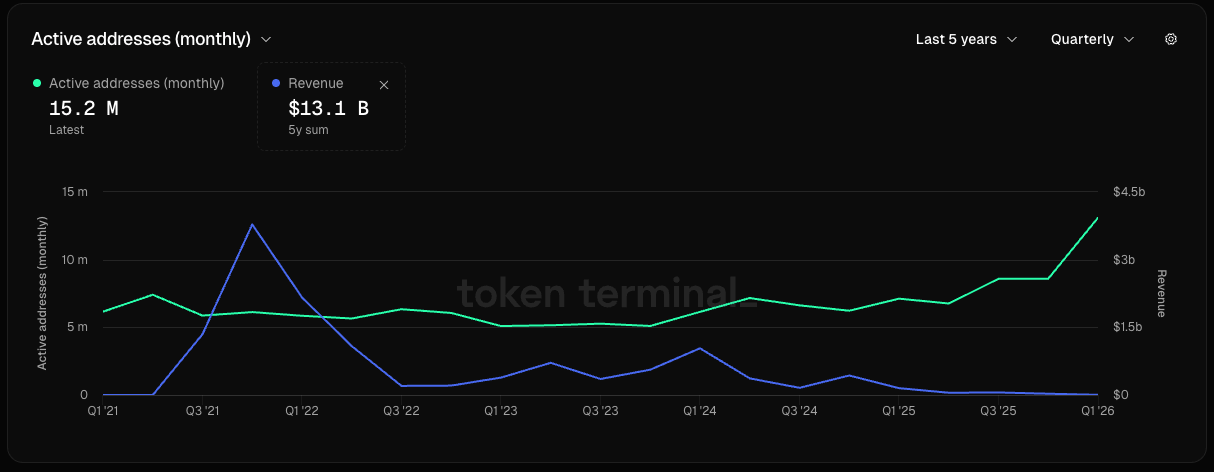
Ethereum Active Addresses and Revenue
It’s great that Vitalik is pushing for more decentralized L2s. But drawing a conceptual line between what’s “Ethereum-aligned” and what’s not, and letting the market sort it out, is messy and inefficient.
If Ethereum actually wants a particular outcome, namely, deeply decentralized execution environments that preserve Ethereum’s role as the world’s neutral financial settlement layer, then norms alone are not enough. Incentives matter – we’re in crypto, this should be front and center.
Vitalik’s solution is mostly social. Stop blessing everything as Ethereum. Let L2s exist along a spectrum. Make “vibes match substance.”
This leaves open a question: What actually pushes teams to decentralize, beyond reputational pressure?
Right now, the economic incentives often point the other way.
Incentives, Incentives, Incentives
Centralized sequencers are lucrative. They capture user fees and MEV, offer product control, and allow fast upgrades. As outlined above, Base is the canonical example. By running a centralized sequencer, Coinbase captures tens of millions of dollars a month in gross fees while paying Ethereum a relatively small amount for data availability and settlement. Giving that up is a revenue decision, as much as the Coinbase team may be philosophically aligned with Vitalik.
At the same time, the costs of remaining centralized are mostly deferred. Sure, non-Ethereum L2s will have less composability in the long-term. Maybe greater regulatory and operational risk. But right now, there’s no great interoperability win anyway, and regulation is still in flux. And while those points matter to finance, they’re not that relevant to consumer apps.
So without stronger incentives, many L2s will rationally stay where they are.
Make being Ethereum-aligned great again
If Vitalik/Ethereum wants more native rollups and deeper decentralization, it should make that path economically dominant.
One lever is cost. Ethereum could raise the relative cost of posting data or settling for systems that do not meet stronger decentralization standards, while subsidizing or structurally favoring native rollups and fully Ethereum-secured designs.
Another lever is interoperability. If Ethereum-native rollups get privileged access to trustless, synchronous composability, shared liquidity, or protocol-level interoperability, that becomes a powerful lock-in. Liquidity follows safety and convenience. Users do not want to bridge constantly or reason about trust assumptions chain by chain. If Ethereum-aligned L2s are simply better places to deploy serious capital, that’s a strong reason to be Ethereum-aligned.
Where is the user?!
Also, the most important piece of all is missing from the current debate: Why does this degree of decentralization matter at all? In all this talk about what’s sufficiently decentralized, and the wonders of zk — it seems like the actual use cases Ethereum is optimizing for is an afterthought.
I’ve been beating this drum for a while, but I’ll say it again: The answer is finance.
DeFi only works if users can credibly believe that execution will not be censored, reversed, or selectively reordered. Institutions will only use blockchains if settlement risk is minimized and rules are not subject to operator discretion. That’s where Ethereum can compete with other chains: credible neutrality.
That suggests a clearer strategic stance. Ethereum should explicitly optimize for high-stakes finance as the anchor use case. The place where trillions can settle without asking permission.
Viewed through that lens, the trade-offs for L2s become clearer. By decentralizing or becoming native rollups, L2s give up sequencer rents, upgrade speed, and regulatory flexibility. But in exchange, they gain deep liquidity, trustless composability, institutional adoption, and long-term relevance as financial infrastructure.
Vitalik is right that not every L2 needs to choose that path. But if Ethereum wants to remain the settlement layer for global finance, it should do more than signal who is part of the club. It should align incentives so that the highest-decentralization path is also the most economically rational one.
Incentives determine outcomes.
With love,
Cami, founder of The Defiant
Forwarded this newsletter? Subscribe for daily insights and curated news from The Defiant team, Monday-Saturday. It’s free.
🎬WATCH
Why OG DeFi Failed | Kain Warwick, Founder of Synthetix
In this episode of The Defiant Podcast, Camila Russo sits down with Kain Warwick, DeFi OG and founder of Synthetix and Infinex, for a no-BS conversation at a pivotal moment: Infinex just ran its INX token sale and completed its TGE.
We get into:
- Why Kain believes DeFi’s biggest bottleneck isn’t “more decentralization,” but UX + distribution
- The hard lesson OG DeFi learned: users won’t “learn to love complexity” — the product has to be holistically better
and more! Watch the full interview:
Top News in the Past 24 Hours
Polymarket Partners with Circle to Integrate Native USDC
Circle announced today that it has partnered with Polymarket, the largest on-chain prediction market by trading volume, to provide its U.S. dollar stablecoin settlement infrastructure.
Why it matters: Polymarket will shift from using Polygon Bridged USDC to native USDC as collateral on its platform, expanding usage of the second largest stablecoin.
Cap Airdrops $12 Million in Stablecoins to Early Users
Cap Protocol ended its “Frontier” rewards phase on Wednesday by distributing 12 million cUSD, its dollar-pegged stablecoin, to early users. The project is calling the initiative crypto’s “first-ever stablecoin airdrop.”
Why it matters: Stablecoin airdrops are uncommon in crypto, as projects typically distribute their native governance or utility tokens.
Losses Top $17 Billion at Crypto Treasury Companies
Just one month into 2026, the DAT sector, which exploded into a trend in 2025, are almost $20 billion in the hole.
Why it matters: Industry experts have repeatedly warned that the DAT structure could pose significant risks to crypto markets.
Trending on The Defiant
- Cap Airdrops $12 Million in Stablecoins to Early Users
- Limitless Token Rallies as Monthly Volume Tops $200 Million
- Vitalik Says Ethereum’s Layer 2 Vision ‘No Longer Makes Sense’
- Crypto Markets Slide as Government Shutdown Delays Jobs Report
- Trading Bot Bankr Expands to Solana with Token Launches on Raydium
- Spanish Red Cross Taps Ethereum to Protect Privacy of Aid Recipients
That’s it for today — if you enjoyed this newsletter, tell your friends! https://thedefiant.io/subscribe
Free newsletters
Good reporting. Delivered.
Choose your coverage: crypto and DeFi, the future of finance, or both.
Free. Unsubscribe anytime.