Starknet Puts Its Ethereum Exit to a Vote
Plus: Tether paid Bo Hines's firm during the GENIUS Act push, Ledger blames an organized group, and U.S. producer prices rise 6.3%.
gm, Defiers!
These are the biggest stories in DeFi and crypto:
- Tether paid Bo Hines's firm, WSJ reports
- Ledger blamed an organized group for implants
- Bitcoin slips as U .S. producer prices rose
- Starknet opened a vote on L1 research
- Russia barred withdrawals to self-custody
Starknet is a Layer 2 network on Ethereum. It runs its own transactions and posts proofs and data to Ethereum, so in principle its users get Ethereum's security. On Oct. 8, StarkWare said it is weighing a move to become an independent Layer 1 that resists quantum computers, with 2027 as the target. On Oct. 10, it called that shift its "clearest path forward." Today Starknet opened a poll on whether to research that move. StarkWare CEO Eli Ben-Sasson explained his reasons on our livestream. His case rests on one idea: an L2 is only as safe as the chain under it. How much security do Ethereum's L2s take from Ethereum today?
Ben-Sasson's argument starts with quantum risk. A large quantum computer could break the signatures and data commitments that Ethereum uses. "If Ethereum as a layer one is not post-quantum secure, then there's no L2 on Ethereum that is quantum secure," he said. Starknet's own proofs are hash-based, which he says already resists quantum attacks. He doubts Ethereum will upgrade in time, and he said no blockchain is fully post-quantum secure today.
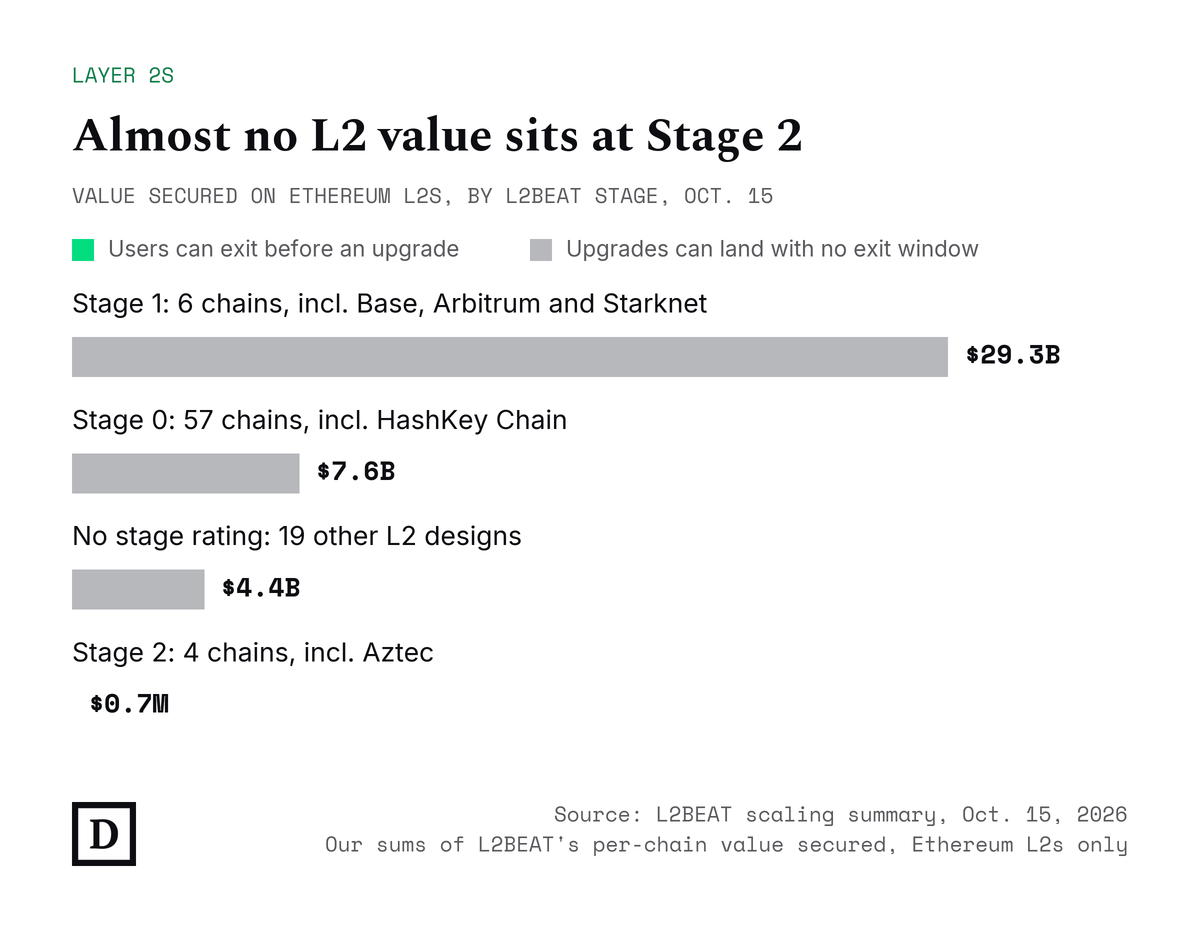
L2BEAT data shows a second dependency. L2BEAT rates rollups in stages, and only at Stage 2 do proofs govern the chain and users get time to exit before an upgrade. Of $41.3 billion on Ethereum L2s today, Stage 2 chains, including Aztec since June, hold about $700,000, by our count. The rest sits on chains where, per L2BEAT, an upgrade can take effect with no window for users to exit first. Starknet itself is Stage 1, with $657 million, and its contracts are instantly upgradable. This week, HashKey Chain's administrator swapped a contract for six minutes and moved a user's 142,818 USDT without a signature.
A move to Layer 1 would replace Ethereum's validators with a consensus system of Starknet's own. Ben-Sasson said the research has to settle whether it uses proof of work or proof of stake. It also has to settle whether the chain is programmable or a minimal store of value with L2s on top. Ben-Sasson added that some bridges might have to close if a quantum computer arrives.
By Thursday afternoon, 422 wallets with 272 million STRK had voted, and 99.9% backed research. By our arithmetic, that is 3.7% of circulating STRK, and the poll has no quorum. The vote closes Oct. 22. Ben-Sasson expects a report two to three weeks later, with design options to vote on in about a month. Those options will show whether an independent Starknet keeps an upgrade council like the one L2BEAT flags today, or gives users an exit window.
Read more below!
As of 20:22 UTC, Oct. 15. Data: CoinGecko, Aave, Hyperliquid. Full list
STRK's L1 Bet: Eli Ben-Sasson on Starknet's Exit Plan
Camila Russo talked with StarkWare co-founder and CEO Eli Ben-Sasson about Starknet's plan to leave Ethereum and become a post-quantum Layer 1. They covered what replaces Ethereum's settlement guarantees, who approves the move and when a proposal reaches governance. Watch the full conversation.
Tether Routed Payments to Hines's Firm During White House Tenure, WSJ Reports
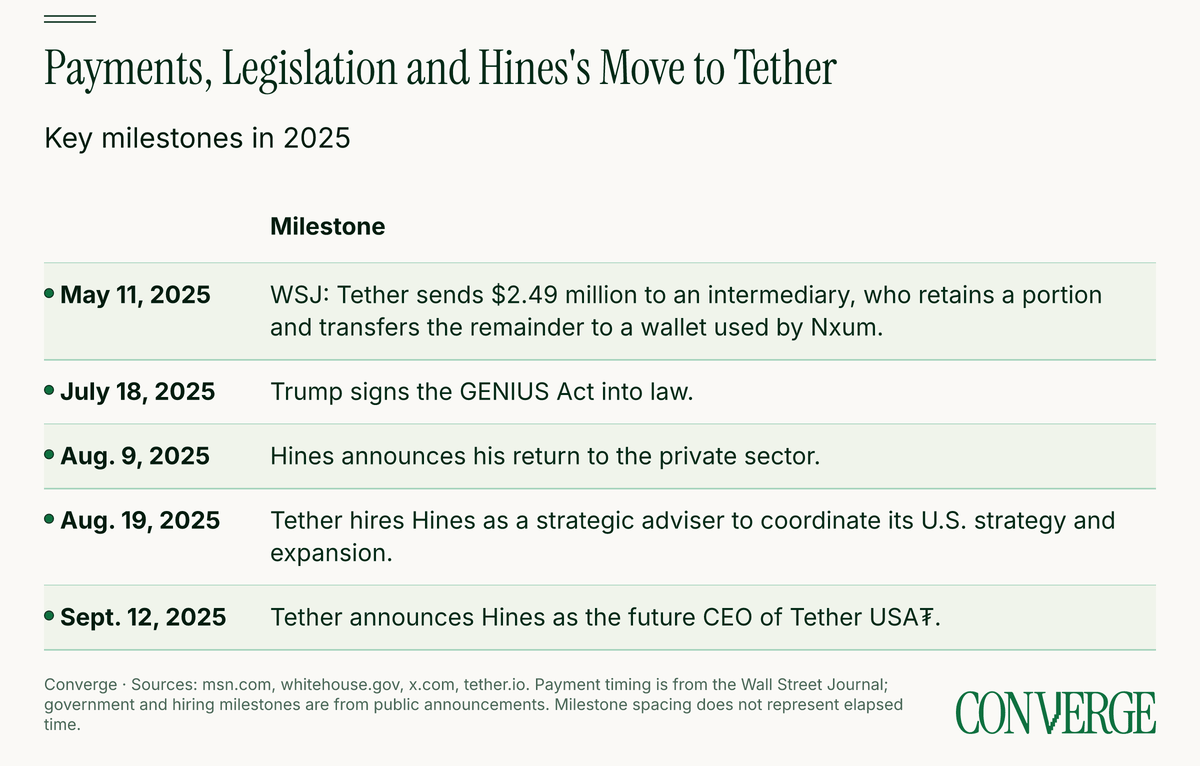
Tether paid a consulting firm co-owned by Bo Hines while he led the White House push for the GENIUS Act, The Wall Street Journal reported. The firm, Nxum, has earned $6.3 million under a $415,000-a-month arrangement that began in May 2025, two months before the law was signed. The Journal says Hines pushed to extend the deadline for exchanges to drop noncompliant stablecoins from 18 months to three years, a change that helped Tether. Nxum says Hines was recused and received no Tether-derived funds. Tether later hired Hines to run its U.S. stablecoin business.

Ledger Blames Organized Group for Months-Long Wallet Tampering Campaign
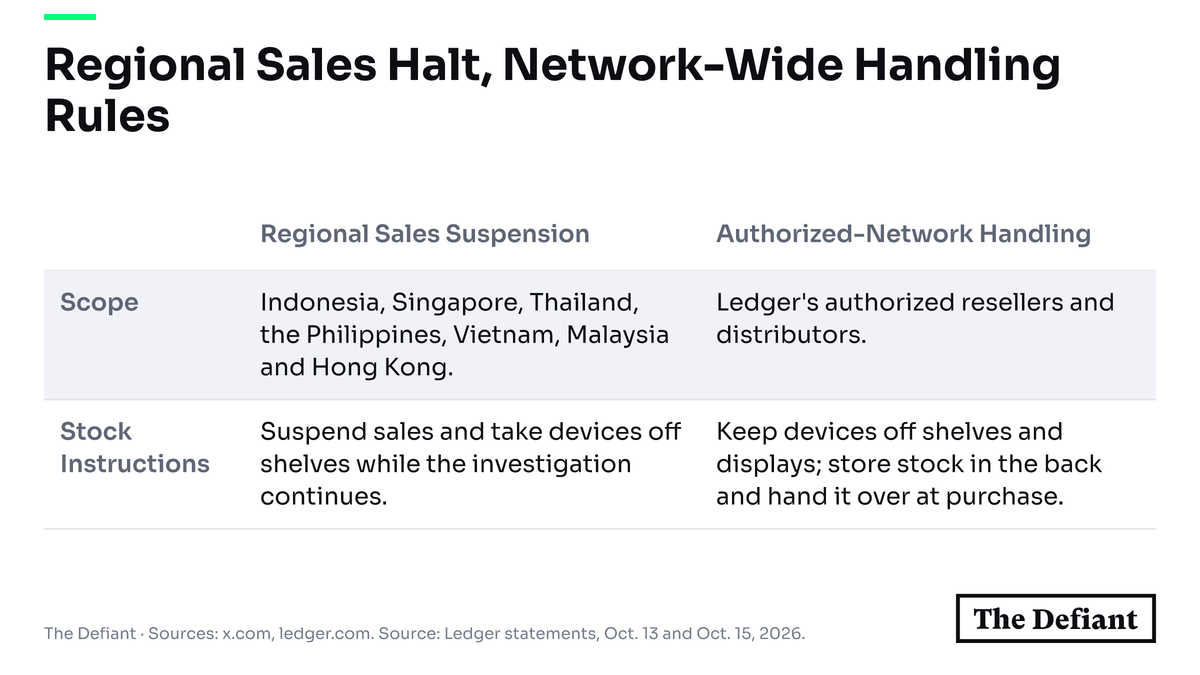
Ledger said an organized criminal group spent months buying genuine wallets, fitting implants that steal recovery phrases and returning them to Southeast Asian resale channels. Ledger says the group spent millions and drained wallets in one coordinated operation. Authorized sellers must now keep devices off shelves and report unusual products. Spot checks in German stores and Ledger's own stock found no compromised units. Ledger still gives no count of victims or losses. Our guide sets out what is confirmed, and our livestream with Opsek's Pablo Sabbatella covers who buyers can trust.
US Wholesale Inflation Accelerates to 6.3% as Bitcoin Slips
U.S. producer prices rose 6.3% in the year to September, up from 5.6%, after a 1.3% monthly jump, the largest since March 2022. Energy caused more than 80% of the rise in goods prices, and gasoline rose 20.3%. Core producer prices still rose 5% over the year. Bitcoin held above $81,000 after the release, a smaller move than after Wednesday's consumer price report. Polymarket traders raised the odds of a Fed rate increase at the Oct. 27-28 meeting to about 27%, from 21% a day earlier.
Starknet Puts Independent L1 Research to a Community Vote
Starknet opened a non-binding poll on whether to research becoming an independent, post-quantum Layer 1. STRK stakers and delegators can vote until Oct. 22, and a yes vote approves only research into the move. The poll has no quorum. STRK traded near 8.7 cents, up about 13% in 24 hours, per CoinGecko. STRK would stay the token, and bridges from Ethereum would stay open. Also on Thursday, Aztec set the end of 2030 for its full post-quantum migration, which also depends on Ethereum's own upgrades.
Russia Bars Self-Custody Withdrawals From Regulated Crypto Accounts
Russia's central bank said individuals cannot withdraw crypto from regulated accounts to self-custody wallets. The ban comes from Article 31 of the new crypto-market law, in force since Sept. 1. An individual who passes a test can still move assets to an authorized foreign custodian. Direct trades between individuals stay legal only until July 1, 2027. After that date, residents must trade through brokers or exchanges in the central bank's register. The rules keep Russian retail holdings inside supervised custody, with no route to a personal wallet.
Other Stories Worth Your Time
Visa Direct Moves USDC Prefunding Into Production With Inyo Global — also live or planned: BVNK on Mastercard rails, Stripe and Plasma cards and Tempo's Zones with Deel.
Schwab Completes Retail Bitcoin and Ether Rollout, Begins Crypto Transfers — three more tokens are planned by the end of 2026.
Ripple Prime Rolls Out Traditional-Asset Perps Linked to Trade.xyz, Bloomberg Reports — and OKX opened an onchain spot and perps beta with simulated TradFi markets.
Crypto.com Launches Predict Pro With Order Books and Sports Combos — our guide to U.S. event-contract rules explains what the CFTC has changed.
VanEck Seeks to Withdraw Lido Staked Ethereum ETF Filing — separately, Lido added ETH staking from four Layer 2s.
Ethereum HEX Sinks 31% After Reports of Richard Heart's Detention — thin pool liquidity makes large sales costly.
Jupiter Launches Unaudited YOLO Beta With Up to 1,000x Leverage — profits can queue if house funds run low.
Firelight Adds $30.5 Million of Cover to Kraken USDC Vault — onchain records show the cover; Sentora handles conditional payouts.
Safe Launches Safenet Aegis Security Network on Three Chains — checks cost 0.40 USDC per transaction, with optional Guard enforcement.
Algorand Marketing Chief Resigns After CEO and CTO Departures — Marc Vanlerberghe follows Staci Warden and Bruno Martins out.
Tokenization Is About Much More Than Bringing Assets Onchain — Cap's Benjamin Sarquis Peillard on settlement, coupons and collateral.
Trending on The Defiant
Free newsletters
Good reporting. Delivered.
Choose your coverage: crypto and DeFi, the future of finance, or both.
Free. Unsubscribe anytime.