Sports Take Over Prediction Markets

Olivia Capozzalo & Squiffs _
October 31, 2025
Happy Halloween, Defiers!
Today’s big story:
- Sports betting is leading prediction market activity in the U.S. — and a new tax rule could be part of the reason.
In other news:
- FourMeme flips pumpfun in revenue
- NFTs crater as OpenSea farming campaign disappoints
- NEAR halves its inflation rate
- Let’s build open highways, not railroads [SPONSORED]
Read more below! But first, please give our sponsors some love; they make this newsletter possible.

High Gain is a professionally managed vault that's designed to bring you up to 20% rewards on ETH, delivering blue-chip strategies through a one-click deposit.

Blockchain's future is still ours to shape. Let's make sure it stays open, accessible, and built for everyone. Denelle Dixon, CEO of the Stellar Development Foundation wrote about why that choice still matters.
We’re back! Here’s what you need to know in web3 today
📈 Markets in the Past 24 Hours
| TICKER | VALUE | 24H | |
|---|---|---|---|
 | Bitcoin | $109,143 | 2.01 % |
 | Ethereum | $3,838.19 | 2.84 % |
 | XRP | $2.51 | 3.63 % |
 | BNB | $1,080.45 | 1.52 % |
 | Solana | $185.35 | 2.28 % |
Today’s Big Story
Sports Bettors Embrace Prediction Markets
The prediction market frenzy is exploding into year-end, with the most popular form of gambling in the U.S. — sports betting — commanding huge volumes on Kalshi and Polymarket.
Kalshi’s volumes are also surging over the weekend when more sports games are being played.
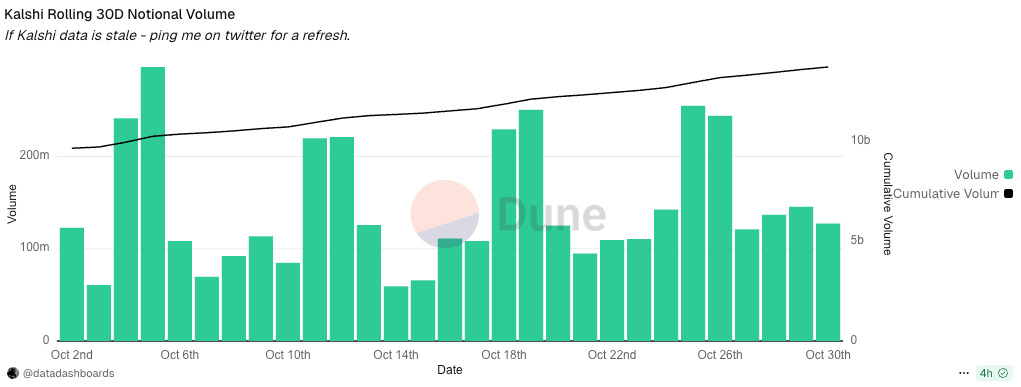
Saturday+Sunday Volume Surges - Kalshi
While onlookers may assume this is mostly crypto degenerates looking to get active on prediction markets in hopes of an airdrop, a new U.S. tax law written into the Trump administration's One Big Beautiful Bill (OBBB) is pushing real, established sports betting operations on-chain.
U.S. taxpayers are currently allowed to deduct 100% of their gambling losses from their winnings. Per the OBBB, however — which was signed into law this summer and will go into effect next year — the IRS will only allow up to 90% of gambling losses to be deducted against winnings, meaning high-volume gamblers are subject to owing a significantly higher tax bill than before if they continue to operate on standard sportsbooks.
However, per multiple reports, prediction markets apparently aren't subject to the same rules — at least if they’re regulated by the CFTC and offer bets as commodity futures contracts.
At least on Kalshi, which received CFTC approval back in 2020, it appears that bettors will still be able to deduct 100% of their losses against their winnings. As for Polymarket, after acquiring a CFTC-registered exchange and clearinghouse this summer, the platform appears to have also recognized the shift.
According to a report from Bloomberg this week, Polymarket is prioritizing the release of its sports markets to U.S.-based users in the coming weeks, with the platform’s full U.S. launch to follow at a later date.
Meanwhile, Donald Trump Jr. has become an adviser to both Kalshi and Polymarket this year, while Trump Media-owned Truth Social announced its own prediction market platform this week. The Trump family connection has only further fueled speculation that the tax rule in the OBBB could have been intended to further fuel the growth of the prediction market sector.
So, while increased volume on prediction markets is partially due to speculation, it is safe to assume that more multimillion-dollar sportsbooks are entering the arena in what could be a watershed moment for prediction markets and sports betting.
The shift also explains why DraftKings — one of the top sports gambling platforms in the U.S. — has gone out of its way to acquire its own prediction market.
While offboarding users from existing infrastructure to a new on-chain, crypto-backed marketplace like Polymarket is a tall order, one surefire way to do it is by allowing gamblers to maintain an extra 10% cushion.
And while the crossover is in its early days, as established prediction market brands, Polymarket and Kalshi have a real edge over traditional sportsbooks like DraftKings heading into 2026, and the $100 billion sports gambling market is ripe for the taking.
Squiffs, resident degen at The Defiant
Forwarded this newsletter? Subscribe for daily insights and curated news from The Defiant team, Monday-Saturday. It’s free.
🎬WATCH
Why Yat Siu Believes Altcoins Will Surpass Bitcoin
In the latest episode of The Defiant Podcast, Cami sat down with Animoca Brands co-founder Yat Siu. He reveals his vision for a trust layer built on zero-knowledge proofs, as well as plans for a Hong Kong dollar stablecoin, plus unpacks the Mocaverse ecosystem where staking power and airdrops build a verifiable, cross-chain identity.
Their conversation also explores the future of web3 gaming, the coming meta shift from GTA 6, and a bold thesis: why the entire altcoin market may one day eclipse Bitcoin.
Top News in the Past 24 Hours
- FourMeme Surpasses Pumpfun With $43 Million in Monthly Revenue Over the last 30 days, BNB Smart Chain memecoin launchpad FourMeme outpaced pumpfun in revenue by 13%, making it the fourth-largest revenue generator in DeFi, trailing only Hyperliquid, Circle, and Tether. Why it matters: The rotation to BNB Chain memecoin trading was potentially catalyzed by two BSC-based token launches, ASTER and STBL.
- NFTs Crater as Farmers Abandon OpenSea Legacy NFT collections such as Bored Ape Yacht Club and Pudgy Penguins are down more than 50% since the summer, when the market rallied following the start of OpenSea’s chest farming system. However, following the first chest distribution, volumes on OpenSea and other platforms dropped sharply, and prices followed.
- Why it matters: OpenSea users were farming XP in order to earn chests, which were thought to contain valuable NFTs and points for future OpenSea token allocation. However, the chest distribution left most farmers disappointed.
- NEAR Cuts Inflation Rate by Half Despite Failed Community Vote NEAR Protocol has upgraded its network with a new update that reduces its annual token inflation rate from 5% to roughly 2.5%, even though the initial community vote on the change failed to reach the required threshold. Why it matters: The upgrade still needs a supermajority of validators to adopt it in order to be implemented, but the core team’s disregard for the governance vote triggered public criticism, with one NEAR validator saying it set a “dangerous precedent.”
- FEATURE: GENIUS Has Yet to Take Effect, Despite Some Firms Claiming to Be ‘Regulated’ and ‘Compliant’ Just over three months since it was signed into law, GENIUS has yet to go into effect, even as established and new players position themselves to comply with the upcoming rules. Why it matters: Some stablecoin companies are already claiming to be regulated under and compliant with GENIUS — statements experts say risk misleading investors.
Trending on The Defiant
- Bitcoin Slips Under $107,000 After Powell Casts Doubt on Further Rate Cuts
- MegaETH ICO Crosses $1 Billion in Commitments
- Hedera Rallies on Canary Capital ETF Launch
- Bittensor Rallies Ahead of First TAO Halving
- Bitcoin Dips Under $110,000 After Fed Cuts Rates
- Morpho Gets $775 Million of Pre-Deposits from Stable, Adds Support for Optimism
That’s it for today — if you enjoyed this newsletter, tell your friends! https://thedefiant.io/subscribe
Free newsletters
Good reporting. Delivered.
Choose your coverage: crypto and DeFi, the future of finance, or both.
Free. Unsubscribe anytime.