RALPH Plummets 90% After Dev 'Derisks'
Plus, Seeker's SKR surges 300%
Olivia Capozzalo & Jona Jaupi
January 22, 2026
gm Defiers!
Today’s big story:
- RALPH just became the latest memecoin to implode in public after its Bags fee earner sold $300K worth of tokens
In other news:
- Pendle sparks debate
- Solana Seeker token rallies 300%
- Base DEX volumes overtake Ethereum, BSC
- FEATURE: Crypto VCs debate the future of DePIN
- EXCLUSIVE INTERVIEW: Inside Stripe’s crypto strategy with Privy CEO
The Defiant’s 2025 in review:
- How Digital Asset Treasuries Went Mainstream in 2025
- RWAs Became Wall Street’s Gateway to Crypto in 2025
- Prediction Markets Expand from DeFi Niche to Global News Sources
- Stablecoins Became Crypto’s First Mainstream Use Case in 2025
- Looking Ahead: The Biggest Names in Crypto Predict New Bitcoin Highs and a Tokenization Boom in 2026
Read more below! But first, please give our sponsors some love; they make this newsletter possible.

Stellar: The Proving Ground for Real-World Privacy
The latest Stellar upgrade, X-Ray, delivers zero-knowledge cryptography that lets developers build privacy into their apps—protecting what matters while keeping Stellar radically open, trusted, and ready for real-world finance.
We’re back! Here’s what you need to know in web3 today
📈 Markets in the Past 24 Hours
| TICKER | VALUE | 24H | |
|---|---|---|---|
 | Bitcoin | $89,618 | 1.92 % |
 | Ethereum | $2,962.18 | 1.96 % |
 | BNB | $887.35 | 2.08 % |
 | XRP | $1.93 | 1.91 % |
 | Solana | $128.43 | 1.17 % |
Today’s Big Story
RALPH Crashes After Geoffrey Huntley’s $300K Sale
RALPH just became the latest memecoin to implode in public. The Solana-based token plummeted Thursday after Australian developer Geoffrey Huntley sold roughly $300,000 worth of tokens. The move sparked both an immediate sell-off and messy backlash online.
Within hours, RALPH — launched earlier this month and named after the “Ralph Wiggum Technique” for AI coding, a viral prompt loop created by Huntley — fell from around $0.05 to below $0.01, wiping out most of its value. At the time of publishing, the token is down more than 90% over the past 24 hours, trading at $0.0026. Liquidity is hovering near $145,000, with a market cap and fully diluted valuation (FDV) both at around $2.5 million.
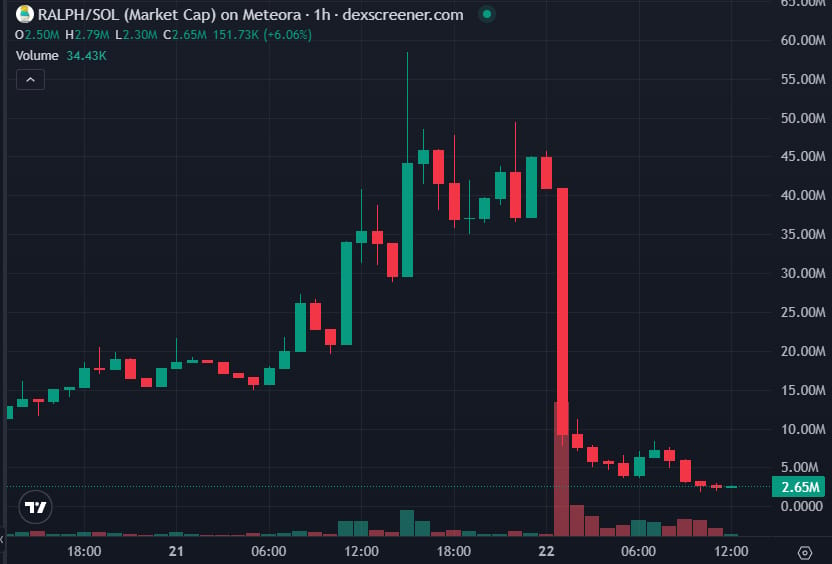
RALPH/SOL market cap. Source: DEXScreener
The bigger issue, however, appears to be around trust — mainly how much control Huntley had over the situation. RALPH trades on Bags, a recently hyped Solana memecoin launchpad that routes fees to designated “fee earners,” and the project’s listing shows that 99% of those royalties go to Huntley, who's collected over $266,000 in fees so far.
It’s important to note that Huntley was designated as the token’s fee earner by its creator(s), and he also appears to have received a portion of the token supply, meaning his position was an allocation rather than a purchase.
But when Huntley later sold roughly $300,000 worth of RALPH in three transactions today, on-chain data shared by Bubblemaps showed the sale triggered an 80% red candle. Bubblemaps added that wallets linked to Huntley still hold around 3% of the token supply.

RALPH holders map. Source: BubbleMaps
Huntley confirmed the sale on X early Thursday, describing it as a “de-risking” move and saying he still holds the token. “Moments like this will test the paperhands from the diamondhands,” Huntley wrote. He added that he could have waited 12 hours for the next vesting unlock but didn’t, and shared a Streamflow vesting link as proof of his remaining allocation.
“Fees have been lovely but i too also needed to derisk my investments,” he said, adding: “the hat stays on.”
That response did little to calm critics. AshRobin, the founder of Kanto Labs, criticized Huntley for framing the sale as “de-risking,” writing that he “claimed 1000+ SOL in fees and still felt the need to ‘derisk his position’ which he was given for free.”
‘Crypto Hater’
Some traders also pointed to Huntley’s past views on crypto. In a 2022 interview with The Sydney Morning Herald, he described crypto as an industry that had “searched for a use case” and found that the one it’s landed on is “extortion.” He also argued that many projects promote grand narratives simply “so they can exit and get liquidity.”
“Okay this whole thing was an elaborate troll,” said a popular crypto commentator by the name of PK on X today. “This guy is just a crypto hater from 2021/22 who found a fun grift to extract money from people he hates lol.”
Memecoin Struggles
The episode echoes other recent memecoin blowups. Last week, the Gas Town (GAS) token, which also trades on Bags, fell more than 90% after its designated fee earner distanced himself from the token.
And then earlier this month, the Eric Adams-backed NYC token plummeted after a wallet linked to its deployer pulled roughly $2.5 million in USDC liquidity near the top, triggering rug-pull allegations.
While the NYC token team said the move was a “liquidity rebalance,” on-chain analysts and traders said the damage was already done, underscoring how quickly prices can unravel when a small number of wallets hold the keys.
All of these situations highlight one thing: the chart can recover, but trust usually doesn’t.
Xx, Jona, staff reporter at The Defiant
Forwarded this newsletter? Subscribe for daily insights and curated news from The Defiant team, Monday-Saturday. It’s free.
🎬WATCH
Liquid Staking Explained: From ETH to XRP with Firelight | Crypto 101 [SPONSORED]
In this episode, we explore liquid staking, how it works, why it was created, and how it’s expanding beyond traditional proof-of-stake blockchains. We start with staking fundamentals, explain why locked capital became a problem, and show how liquid staking tokens (LSTs) unlock new utility across DeFi.
How Stablecoins Are Rewiring Global Payments | Borderless CPO Alex Garn
In this episode of The Defiant Podcast, Chris Storaker sits down with Alex Garn, chief product officer at Borderless, to unpack how stablecoins are quietly transforming cross-border payments — and what it actually takes to move money at scale across jurisdictions.
We explore why stablecoins are moving beyond trading and DeFi collateral into real-world enterprise payments, where they already outperform legacy rails on settlement speed, transparency, and custody — especially across emerging market corridors like Latin America and Southeast Asia.
Top News in the Past 24 Hours
- Pendle Sparks Debate With veTokenomics Phase-Out Plan Pendle’s plan to move away from vote-escrow (ve) tokenomics is sparking debate within the DeFi community, with some builders calling it a needed upgrade and others warning it could hurt long-term alignment. Why it matters: Vote-escrow models, pioneered by Curve, are widely used across DeFi protocols to manage governance and incentives.
- Solana Seeker Token SKR Jumps 300% on First Day of Trading The native token of Solana Mobile’s crypto smartphone, Seeker, has seen hyperbolic growth since it launched just 24 hours ago. Why it matters: Many crypto phone models, including Seeker’s predecessor Saga, have struggled to transform short-term token interest into sustained usage.
- Base Overtakes Ethereum, BNB Chain in DEX Volumes for the First Time Base’s decentralized exchange activity surged over the past week, pushing the chain past Ethereum and BNB Smart Chain (BSC) in weekly DEX volume for the first time. Why it matters: Activity could in part be driven by interest in what’s become the largest Base gaming protocol — backed by Coinbase and promoted on official channels — the native token of which launched last week.
Trending on The Defiant
- Bitcoin Reclaims $90,000 After Trump Cancels Europe Tariffs
- Vitalik Backs Decentralized Social Media as Mask Network Takes Over Lens
- Bermuda Taps Circle, Coinbase to Build ‘Fully Onchain’ Economy
- Crypto Markets Slide as BTC Falls Below $90K, ETH Drops 7%
- Pumpfun Unveils Investment Arm and $3 Million Hackathon
- ME Token Slumps After Magic Eden Announces Buybacks, Staking Rewards
That’s it for today — if you enjoyed this newsletter, tell your friends! https://thedefiant.io/subscribe
Free newsletters
Good reporting. Delivered.
Choose your coverage: crypto and DeFi, the future of finance, or both.
Free. Unsubscribe anytime.