Is Binance to Blame?

Olivia Capozzalo & Denis Omelchenko
October 13, 2025
gm, Defiers
Today’s big story:
- In the aftermath of Friday’s brutal selloff and record liquidations, crypto is reflecting — and asking questions
In other news:
- Tether co-founder’s USST briefly depegs after launch
- Privacy tokens rally on the EF’s Kohaku toolkit
- Larva Labs’ NFT sale on Art Blocks closes at 7.5 ETH
- Who really controls your blockchain? [SPONSORED]
📈 Markets in the Past 24 Hours
| TICKER | VALUE | 24H | |
|---|---|---|---|
 | Bitcoin | $115,202 | 3.17 % |
 | Ethereum | $4,155.15 | 9.20 % |
 | BNB | $1,297.84 | 5.94 % |
 | XRP | $2.59 | 8.40 % |
 | Solana | $194.66 | 8.58 % |
Today’s Big Story
Friday’s Crash Sparks Questions and Concerns — Mostly for Binance
This weekend was wild, as Oct. 10 once again reminded everyone just how fragile the crypto market can be, with tens of billions of dollars liquidated and Bitcoin briefly falling below $103,000, sparking questions about what happened, and who was really to blame.
While most top DeFi protocols fared well in the mayhem, experiencing zero downtime and operating as intended, much of the drama concentrated around Binance and USDe, Ethena’s dollar-tied token. USDe briefly crashed to $0.65 on Binance alone, although its price on other platforms, like Curve Finance, barely moved — raising questions and concerns that it was Binance’s system that was behind the whole incident.
The problem in part seems to come down to how Binance values collateral using its own spot prices, instead of referencing the asset’s price on external trading venues with deeper liquidity. When USDe, wBETH, or BNSOL suddenly dropped on the exchange, it wiped out margin for anyone using those assets there, triggering forced liquidations.
Dragonfly managing partner Haseeb Qureshi wrote in an X post on Saturday that the USDe depeg was indeed Binance’s fault, explaining: “Binance had their oracle poorly implemented and started liquidating positions they shouldn’t have—good liquidation mechanisms don’t trigger on flash crashes.”
He also noted: “Binance was extremely unstable during this period, causing MMs to be unable to shift inventory because APIs were failing and withdrawals and deposits were bricked.”
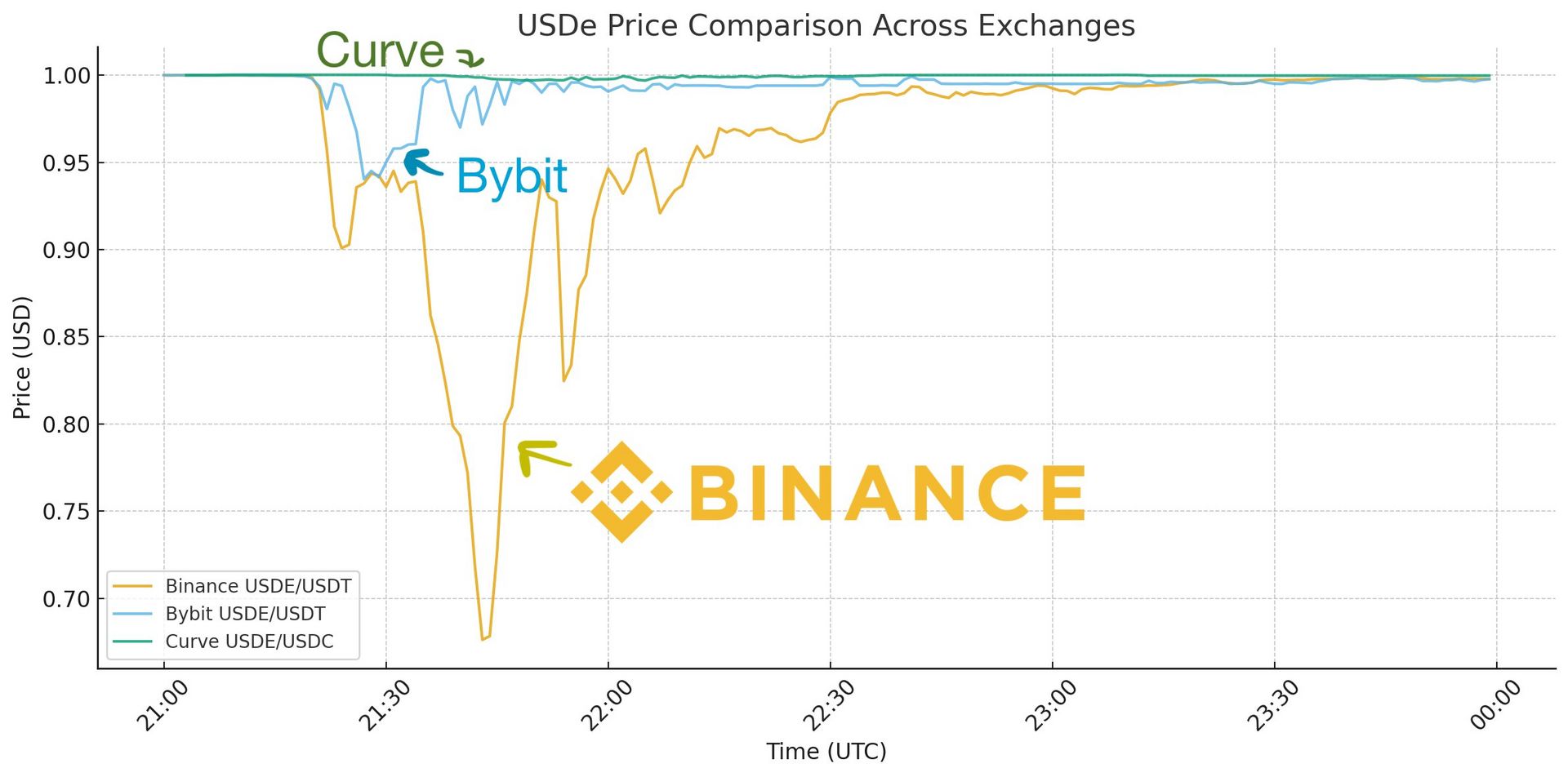
USDe on Curve vs Binance vs Bybit on Oct. 10. Source: Haseeb Qureshi on X
Ethena’s founder, Guy Young, also wrote in an X post Saturday “No one would have been liquidated on any money market with oracles referencing the deepest pools of liquidity for USDe globally.”
Rough estimates put about $60 to $90 million of USDe dumped on Binance, causing $500 million to $1 billion in forced liquidations locally, which commentators say could have triggered further panic, and eventually spread to cause the at least $19 billion in total cascading liquidations that occurred across many exchanges and protocols.
Liquidations May Be Bigger Than We Think
Some, like Hyperliquid founder Jeff Yan, whose platform came through the chaos mostly unscathed, took a jab at Binance for underreporting liquidations, posting that “even if there are thousands of liquidation orders in the same second, only one is reported,” and making it clear that centralized exchanges are way more opaque compared to on-chain systems, like Hyperliquid’s.
According to Binance’s own documentation, for each trading symbol “only the latest one liquidation order within 1000ms will be pushed as the snapshot,” so if hundreds or thousands happen at the same time, most of them aren’t shown.
But as blockchain analytics platform Coinglass noted in an X post today, Binance isn’t the only centralized platform downsizing the scale of liquidations, as other major players like OKX have also limited their liquidation order updates over the past few years.
Shawn Young, Chief Analyst at MEXC Research, noted in commentary to The Defiant that the $20 billion leverage wipeout was a “wake-up call for traders and market participants, revealing how fragile risk sentiment can become, especially when excessive leveraging collides with macro and geopolitical uncertainty.”
Stay safe out there,
Denis, staff reporter at The Defiant
Forwarded this newsletter? Subscribe for daily insights and curated news from The Defiant team, Monday-Saturday. It’s free.
🎬WATCH
What Crypto VCs Want Now | Aryan Sheikhalian
In this episode of The Defiant Podcast, we sit down with Aryan Sheikhalian, Research Lead at CMT Digital, to unpack the shift from “crypto as an asset” to crypto as infrastructure: 24/7 markets, instant clearing and settlement, and new structured products that couldn’t exist before.
We talk about tokenized equities, how identity layers and ZK proofs unlock mainstream distribution through banks and fintechs, and where regulation is pushing builders toward partnerships and licensed rails.
Top News in the Past 24 Hours
- Tether Co-Founder’s Stablecoin USST Depegs Hours After Launch USST, a new stablecoin launched on Friday by stablecoin platform STBL, slipped below its $1 peg to as low as $0.96 within hours of debuting on Curve, sparking concerns over confidence in the project. Why it matters: The project is co-founded by Reeve Collins, one of the co-founders of Tether, the issuer of the largest stablecoin, USDT.
- Railgun Token Soars as Vitalik Calls Privacy a ‘First-Class Priority’ for Ethereum Ethereum’s new privacy initiative, Kohaku, boosted Railgun’s RAIL token to an all-time high, following comments from Vitalik Buterin emphasizing privacy as a core focus. Why it matters: RAIL’s surge followed a broader rally among privacy coins in recent weeks, led by ZEC.
- Larva Labs Art Blocks Auction Surpasses $30,000 Generative art NFT platform Art Blocks launched its final sale in its Curated series with an auction for a new collection, Quine, by Larva Labs, the creators of CryptoPunks, Autoglyphs, and Meebits. The sale closed at 7.56 ETH, or $31,000 per Quine NFT.Why it matters: The closing price shows that interest in NFTs is still alive and well. Also, Quine marks Larva Labs’ first 1/1/X release since Meebits, and its first non-avatar, unique generative art collection since Autoglyphs.
Trending on The Defiant
- Crypto Markets Plummet as BTC Briefly Drops Below $106K
- Tether Co-Founder’s Stablecoin USST Depegs Hours After Launch
- Railgun Token Soars as Vitalik Calls Privacy a ‘First-Class Priority’ for Ethereum
- Sorare Migrates to Solana, Abandoning Ethereum L2 StarkEx
- Larva Labs Art Blocks Auction Surpasses $30,000
- Crypto Markets Stall as Traders Bet Government Shutdown Will Extend into November
That’s it for today — if you enjoyed this newsletter, tell your friends! https://thedefiant.io/subscribe
Free newsletters
Good reporting. Delivered.
Choose your coverage: crypto and DeFi, the future of finance, or both.
Free. Unsubscribe anytime.