CFTC Zeros In on Prediction Markets
Plus, Across might unwind its DAO
Olivia Capozzalo & Camila Russo
March 12, 2026
gm, Defiers!
Today’s big story:
- Prediction markets have spent years operating in regulatory limbo in the United States. Now the country’s top derivatives regulator wants to change that.
In other news:
- Across proposes dissolving its DAO
- AI agent unveils skill for secure MetaMask access
- Ethena’s deployed capital slumps
- Sahara AI’s Vision for the Agentic Era [SPONSORED]
- 7 Altcoins That Outgrew Bitcoin in 2025 — And What They Have in Common [MEDIA PARTNER]
Read more below! But first, please give our sponsors some love; they make this newsletter possible.

Ethereum's decentralised staking protocol just got a big upgrade! Saturn One brings 4 ETH validators, an RPL fee switch, and more. Stake your ETH with Rocket Pool today.
Aligned: The Infrastructure Making Ethereum Inevitable
Less than 1% of the world’s assets are onchain.
The gap is immense, but it is accelerating and it is surmountable. To be equipped for the remaining 99% of global assets, Ethereum must prepare for the next phase of capital migration: business.
But today, building an onchain business means compiling a patchwork of solutions from a variety of vendors.
Aligned is the Ethereum migration stack helping businesses run real financial products onchain, without stitching together disparate vendors. It bundles the core infrastructure businesses need to launch, operate, and scale on Ethereum: wallets, rollups, interoperability, liquidity, and ZK.
Businesses want to run on Ethereum. Aligned makes it inevitable.
We’re back! Here’s what you need to know in web3 today
📈 Markets in the Past 24 Hours
| TICKER | VALUE | 24H | |
|---|---|---|---|
 | Bitcoin | $70,061 | -0.63 % |
 | Ethereum | $2,055.04 | -0.86 % |
 | BNB | $649.73 | -0.29 % |
 | XRP | $1.37 | -1.52 % |
 | Solana | $86 | -1.50 % |
Today’s Big Story
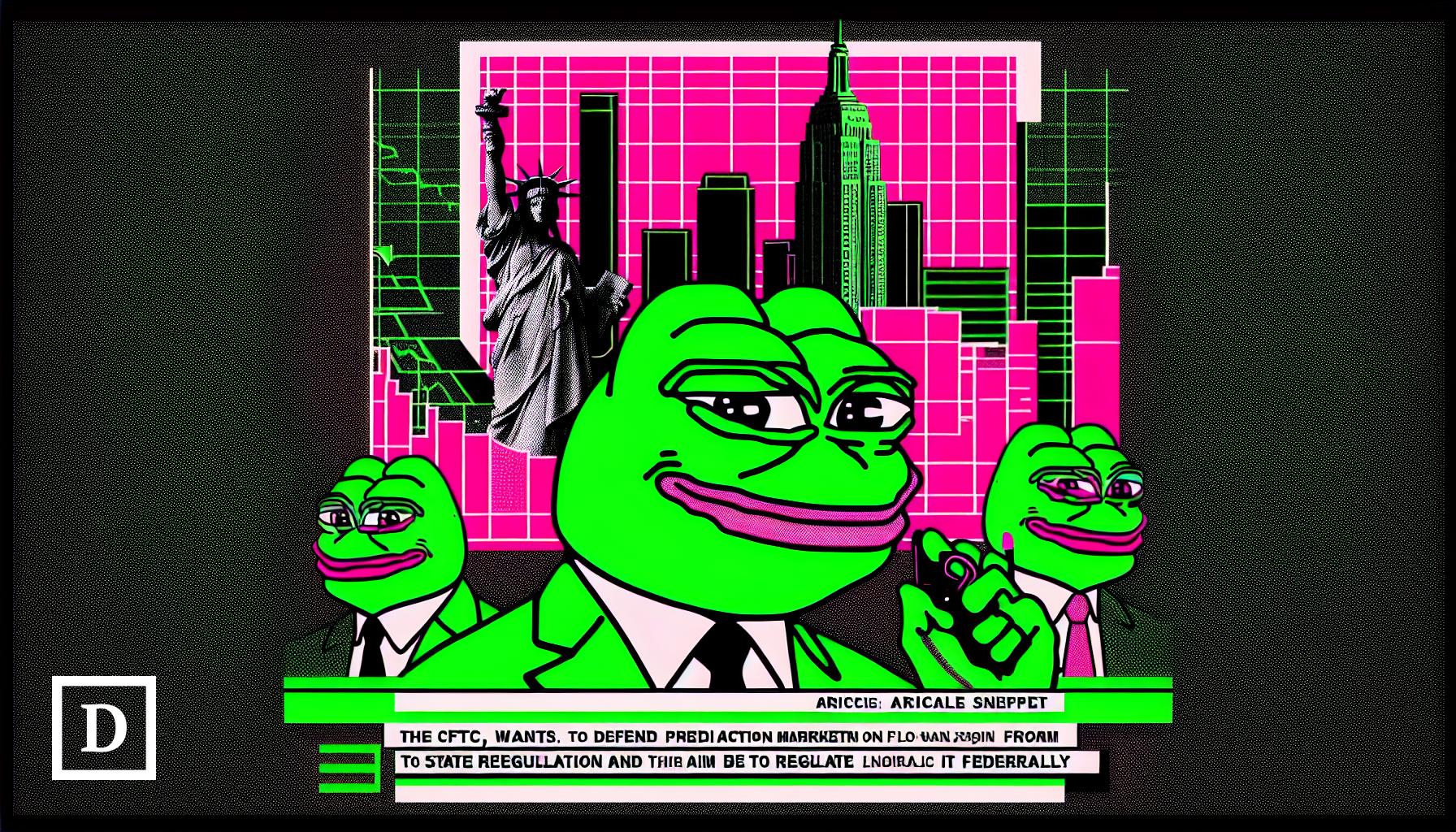
The CFTC Wants to Make Prediction Markets Mainstream Finance
Prediction markets have spent years operating in regulatory limbo in the United States. Now the country’s top derivatives regulator wants to change that.
The Commodity Futures Trading Commission (CFTC) threw its weight behind federal oversight of prediction markets today, launching a sweeping review of how these markets should be regulated and issuing guidance for exchanges listing event-based contracts.
That is good news for both the industry and its users. But the rules are not finished yet, and the legal fight over who regulates these markets is far from settled.
Why the CFTC’s Move Is Positive
For prediction market platforms, the CFTC’s intervention offers something the industry has long wanted: a legitimate path to operate in the U.S.
Companies like Kalshi and Polymarket have spent years fighting regulators and state gaming authorities over whether their contracts are financial derivatives or simply unlicensed gambling. By asserting federal jurisdiction and opening the door to clearer rules, the CFTC is effectively saying prediction markets belong inside the regulated derivatives ecosystem.
That matters because it provides regulatory certainty. Exchanges can structure contracts to comply with federal market rules instead of navigating a patchwork of state gambling laws.
For users, federal oversight also brings safeguards that many crypto-native prediction markets have historically lacked.
The CFTC’s framework emphasizes market surveillance, anti-manipulation controls, and enforcement against insider trading. Exchanges listing event contracts would need systems to detect unusual trading activity and mechanisms to investigate potential misconduct. They would also have to rely on reliable settlement data and transparent methodologies for determining outcomes.
In other words, prediction markets would start to resemble traditional financial exchanges more than online betting platforms.
That could reduce risks like insider trading, manipulation of event outcomes, or opaque settlement procedures.
What the CFTC Actually Announced
The CFTC made two moves simultaneously.
First, its Division of Market Oversight issued an advisory explaining how regulated exchanges should list and oversee “event contracts,” derivatives tied to real-world outcomes like elections, economic indicators, or sports results.
Second, the Commission opened a formal public consultation on whether new rules are needed to govern these markets.
The advisory lays out the regulator’s expectations: Exchanges must show that contracts are not easily manipulated, implement real-time market surveillance, and ensure settlement data comes from reliable sources.
Contracts tied to large aggregate outcomes, like election results or season-long sports performance, are generally seen as less susceptible to manipulation than contracts tied to narrow events like a single player injury.
The guidance also encourages exchanges to work with sports leagues and governing bodies to maintain integrity and investigate suspicious activity.
At the same time, the CFTC made clear it retains authority to halt trading in contracts that violate the law or threaten market integrity.
What Needs to Happen Next
Despite the announcement, prediction market regulation is not finalized. The current document is only staff guidance. It does not create binding rules.
To become formal regulation, the CFTC would need to complete the standard rulemaking process. The agency has started with an advance notice asking the public for feedback on how prediction markets should be governed.
The next step would likely be a proposed rule, followed by another comment period, and eventually a final rule voted on by the Commission.
This process could take months or longer.
In parallel, courts are still deciding who has authority over these markets.
Several U.S. states argue that sports and other event contracts offered by prediction platforms are simply gambling products that require state gaming licenses. Platforms like Kalshi counter that the contracts are financial derivatives governed by federal commodities law.
Those legal battles are ongoing across multiple states.
Are Prediction Markets Really Derivatives?
At the heart of the debate is a basic question: should prediction markets be treated as financial derivatives at all?
The argument hinges on how the Commodity Exchange Act defines derivatives.
Under the law, derivatives include swaps or futures whose value depends on a future event or measurable outcome. Many prediction market contracts fit that description. They typically have binary payoffs, for example, paying $1 if an event occurs and $0 if it does not. Because the payout depends on the occurrence of a future event, regulators argue that the contracts function like financial derivatives rather than traditional wagers.
Supporters of this view say prediction markets provide valuable information aggregation and price discovery. Critics argue that many contracts, especially those tied to sports or political outcomes, look indistinguishable from betting.
That distinction will likely remain contested.
What Comes Next
Prediction markets are entering a pivotal phase.
Federal regulators are signaling that these markets belong inside the financial regulatory perimeter, not outside it. That is a major step toward legitimacy for an industry that has often operated in gray areas.
But the path forward is still uncertain. For now, probably the best way to tell whether CFTC will get its way, is on Kalshi and Polymarket themselves.
With love,
Cami, founder of The Defiant
Forwarded this newsletter? Subscribe for daily insights and curated news from The Defiant team, Monday-Saturday. It’s free.
🎬WATCH
Optimism Is Done with ‘Ethereum Alignment’ — Users Come First
In this episode of The Defiant Podcast, Cami sits down with Jing Wang to discuss how Optimism is evolving and why the debate over what counts as a “real” Ethereum L2 might be missing the point.
Watch the full interview:
Top News in the Past 24 Hours
Across Protocol Proposes Shift From DAO to Private Company
Risk Labs, the team behind cross-chain bridging protocol Across, is proposing to dissolve the project's token-based DAO structure and transition its operations to a newly formed U.S. C-corporation.
Why it matters: Across’s ACX token is down 97% from its ATH; The project raised $41 million last year from prominent VCs.
AI Agents Can Now Transact Via MetaMask Without Accessing Private Keys, Says CoinFello
The team behind AI agent CoinFello has released an open-source, OpenClaw skill that lets AI agents securely connect to MetaMask and execute on-chain transactions, without ever handling a user's private keys.
Why it matters: The skill addresses a core vulnerability in how most AI agent crypto wallets currently operate, usually getting access to private keys or API credentials.
Ethena's Deployed Capital Slumps as Demand for Leverage Dries Up
According to an analysis, Ethena's transparency dashboard reveals that deployed capital, a proxy for excess long demand in futures markets, has fallen to just $791 million, down more than 85% from its all-time high.
Why it matters: Ethena’s shrinking book, therefore, implies that directional shorts and hedgers are increasingly filling the role that basis traders once dominated.
Trending on The Defiant
- Bitcoin Holds Above $70,000 as U.S. Inflation Remains Subdued
- Ethena's Deployed Capital Slumps as Demand for Leverage Dries Up
- Foundry to Launch Institutional Zcash Mining Pool
- AI Agents Can Now Transact Via MetaMask Without Accessing Private Keys, Says CoinFello
- Across Protocol Proposes Shift From DAO to Private Company
- Binance Sues WSJ for Defamation as DOJ Opens Iran Sanctions Probe
That’s it for today — if you enjoyed this newsletter, tell your friends! https://thedefiant.io/subscribe
Free newsletters
Good reporting. Delivered.
Choose your coverage: crypto and DeFi, the future of finance, or both.
Free. Unsubscribe anytime.