Aave Drama Shows DAO + Labs Model is Cracking
Olivia Capozzalo & Camila Russo
December 16, 2025
gm, Defiers!
Today’s big story:
- The debate around Aave ownership continues with governance proposals and $10M AAVE purchases
In other news:
- Visa launches USDC settlement
- JPMorgan unveils MONY
- Prediction markets grow 130x since 2024
- HumaTek is rebuilding trust in humanitarian aid with blockchain [SPONSORED]
Read more below! But first, please give our sponsors some love; they make this newsletter possible.

Stellar: The Proving Ground for Real-World Privacy The latest Stellar upgrade, X-Ray, delivers zero-knowledge cryptography that lets developers build privacy into their apps—protecting what matters while keeping Stellar radically open, trusted, and ready for real-world finance.
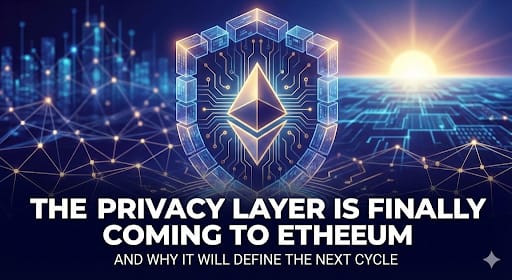
Ethereum has solved scale. It unlocked programmability.
Now it’s approaching the challenge that will define the next crypto cycle: privacy.
As institutions and everyday users move onchain, radical transparency is no longer enough. Payroll, treasury flows, vendor relationships, and financial strategies can’t live forever in public. Adoption has arrived, but retention depends on confidentiality that works in the real world.
A new privacy layer is forming across Ethereum, focused on selective disclosure, regulatory alignment, and practical use at scale. This isn’t about hiding activity, it’s about restoring balance between transparency and discretion.
In our latest article, we explore why privacy is becoming crypto’s next foundational layer, and how it will shape the cycle ahead.
We’re back! Here’s what you need to know in web3 today
📈 Markets in the Past 24 Hours
| TICKER | VALUE | 24H | |
|---|---|---|---|
 | Bitcoin | $87,443 | 2.02 % |
 | Ethereum | $2,931.35 | 0.03 % |
 | BNB | $868.74 | 2.78 % |
 | XRP | $1.92 | 1.47 % |
 | Solana | $127.38 | 2.36 % |
Today’s Big Story
Aave Drama Shows DAO vs. Labs Tension is Unsustainable
What began as a dispute over fees at Aave has turned into something much larger: a public reckoning with the structural compromises crypto protocols made to survive an era of regulatory ambiguity.
The immediate trigger seemed almost mundane. After Aave’s CoWSwap integration went live, delegates noticed that certain fees were not flowing to the DAO treasury, but instead to a separate Gnosis Safe. From there, the argument escalated quickly.
Delegates questioned whether Aave Labs was entitled to those fees. Labs countered that the revenues sat “entirely outside the protocol the DAO stewards.” Accusations of misalignment followed, spilling from governance forums onto X.
An Uneasy Coexistence
But the heat of the argument obscures the deeper issue. Aave is grappling with the same structural fault line that runs through most of DeFi’s blue chips: the uneasy coexistence of tokenholders and corporate entities that control critical assets.
As DeFi’s largest protocol, with $300B+ in TVL, what Aave does next to resolve this issue can serve a signal and blueprint for the entire sector.
Crypto didn’t arrive at this structure by accident. For most of the last decade, projects were forced into convoluted setups involving foundations, “Labs” companies, DAOs, service agreements, SAFE + Token Warrant deals.
Tokens have been carefully stripped of economic rights because attaching ownership or revenue claims to tokens risked regulatory consequences. Tokens could govern, but not own. So we got utility tokens and governance tokens, which ultimately looked a lot like memecoins, even though holders often viewed them as akin to equity.
Aave’s current controversy is essentially the boiling over of a long-simmering tension.
Ernesto Boado’s “Token Alignment Phase 1 – Ownership” proposal crystallizes that tension. The ARFC argues that if the DAO is meant to be the neutral steward of Aave, then core “soft assets” — the brand, domains, front-end gateways, and attribution — must be placed under a DAO-controlled vehicle with strong anti-capture protections.
Otherwise, contributors who control those assets hold structural leverage over every other participant, regardless of token ownership.
Delegates have largely rallied behind this framing. The reaction reflects a broader frustration that DAOs are often expected to bear responsibility without corresponding authority or rights.
Morpho and Uniswap Models
Contrast this with Morpho, a lending protocol built on Aave. Morpho’s governance model is explicitly token-centric. The MORPHO token governs protocol parameters, upgrades, and treasury decisions, with no parallel corporate entity exerting informal control over branding or front ends. The model sacrifices some flexibility but it reduces ambiguity. There is no confusion about where authority lives, because there is only one locus of governance.
Uniswap, meanwhile, is attempting something more nuanced. Its unification proposal seeks to reconcile the historical split between the Uniswap Labs company, which develops the Uniswap frontend, and the Uniswap Foundation, which develops the protocol. The goal is not to eliminate organizational structures, but to realign them under a clearer mandate where both frontent and protocol development fall under Labs responsibility. At the same time, the Uniswap token will directly benefit from protocol fees.
Implicit in the proposal is an admission that the old separation, once a regulatory shield, now creates friction and misaligned incentives.
These three approaches outline crypto’s fork in the road.
A New Phase
The industry is emerging from a phase where legal uncertainty forced protocols to design around regulators rather than users or contributors. In that environment, tokenholders were often asked to supply capital, legitimacy, and governance labor without formal claims on ownership or value capture. That tradeoff was tolerated when survival was the priority.
It is harder to justify now.
There is room for both equity and tokens in crypto’s future. Companies can build, hire, and execute. DAOs can coordinate capital and govern shared infrastructure. But the boundary between the two can no longer be left vague, enforced by social consensus or symbolic gestures (like open-market token buys).
The Aave debate feels messy because it is. But it may also be necessary. As regulatory clarity slowly improves, crypto is being forced to confront its original sin: building trillion-dollar, decentralized and DAO-led networks, while the token holders of those networks stand in limbo.
With love,
Cami, founder of The Defiant
Forwarded this newsletter? Subscribe for daily insights and curated news from The Defiant team, Monday-Saturday. It’s free.
🎬WATCH
Becoming the "Institutions Chain" with Avalanche’s Morgan Krupetsky
In this episode of The Defiant podcast, we speak with Morgan Krupetsky, VP of OnChain Finance at Ava Labs, to break down one of the most significant shifts happening in crypto today: the rapid institutionalization of blockchain and Avalanche’s strategy to lead it.
Morgan walks us through Avalanche’s “real-world adoption first” ethos, explaining how its unique architecture enables enterprises, fintechs, banks, governments, and consumer apps to build purpose-designed blockchains while tapping into a shared liquidity hub.
Top News in the Past 24 Hours
- Visa Unveils Stablecoin Settlement in the United States Payments giant Visa Inc. launched USDC settlement today in the United States, allowing U.S. issuer and acquirer partners to settle transactions via Circle’s stablecoin on Solana, using Visa’s payments rails. Why it matters: With settlement in USDC, banks and fintechs can be expected to offer settlement seven days a week.
- JPMorgan Launches Tokenized Money Market Fund on Ethereum J.P. Morgan Asset Management launched its first tokenized money market fund (MMF) on Ethereum, marking another step by a major bank to move traditional financial products onto public blockchains. Why it matters: The move highlights how large financial institutions are increasingly using public blockchain infrastructure to deliver traditional products.
- Prediction Market Monthly Volumes Grew 130x Since 2024: Keyrock, Dune On-chain prediction markets have grown quickly over the past two years, with total monthly volume jumping from under $100 million in early 2024 to more than $13 billion today, per a new report. Why it matters: The rise of prediction markets underscores how they are becoming a leading tool for real-time insights.
Trending on The Defiant
- JPMorgan Launches Tokenized Money Market Fund on Ethereum
- Bitcoin Dips Below $87,000 as Analysts Debate Bear Market
- SushiSwap Approves SUSHI Emissions Boost in Vote Controlled by Single Wallet
- Interactive Brokers Enables Stablecoin Deposits
- Crypto Markets Post Minor Losses Amid Tech Sell-Off
- DTCC Gets SEC Clearance to Pilot Tokenized U.S. Securities
That’s it for today — if you enjoyed this newsletter, tell your friends! https://thedefiant.io/subscribe
Free newsletters
Good reporting. Delivered.
Choose your coverage: crypto and DeFi, the future of finance, or both.
Free. Unsubscribe anytime.