An Inside look Into Solana After FTX's Collapse
This week on The Defiant Podcast, we speak with Tal Tchwella, Product Manager of Products Engineering at Solana Labs.
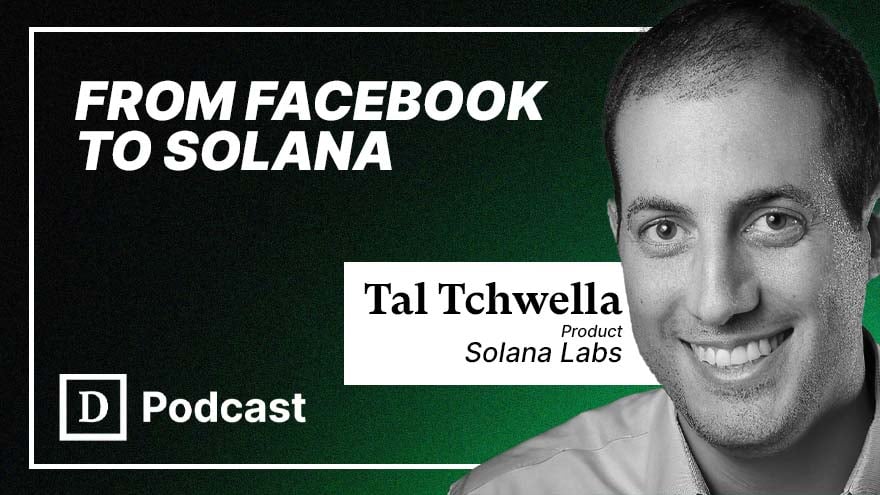
In our conversation, we dive deep into Tal’s work on crypto inside Facebook (Meta), his transition to Solana, the resurgence of NFTs on the network, and all the hype with the $BONK meme coin.
We also discuss what it’s like working full-time in Web3, the Solana Phone, as well as the future of Solana after the collapse of FTX.
Listen to the interview in this week’s podcast episode here:

Thanking our podcast sponsors:
- This episode is brought to you by the Glo dollar, a new stablecoin that reduces extreme poverty as its market cap goes up. With Glo, you can lift people out of poverty just by holding a stablecoin. To join the waitlist, visit https://www.glodollar.org/defiant
- Store your tokens safely. Go self-custodial with 1inch Wallet.
Tal’s Crypto Journey
In 2013, while taking a class on distributed systems at MIT, I first learned about the Bitcoin paper. At the time, I didn’t invest in it, but later in 2016-2017, a friend introduced me to other decentralized protocols, and I became interested in the potential new economies they could create.
In 2021, I joined the Diem group to work on the Libra blockchain and later led the product team for the crypto platform that built infrastructure for Instagram and Facebook, which is now being used for NFTs.
What led you to decide to leave Facebook and join web3 more natively?
Web3 and the pace of innovation in this space have been incredibly fast. Every day, the world changes and there have been both positive and negative outcomes.
As an entrepreneur, I find this exciting. There are many opportunities for innovation and growth in this field, and that is what drives me and my creativity. Web2 companies, on the other hand, may be limited by their current use cases and customer base.
Role at Meta
- We have been focusing on understanding how to come together and become chain agnostic in this multi-chain world.
- Our goal is to understand what part Meta is playing in this space and how we can become chain agnostic.
- We have been spending a lot of time trying to figure out which networks we should be working with, where the majority of use cases are, and which chains exhibit the most activity.
- We are looking at overlaps with existing audiences and the type of things that we have on the platform, as well as the creators and users that we already have on the platform.
At the end of the day, the world we live in now and the world we probably will live in the future is a multi-chain world. There’s not gonna be one chain to dominate everything.
I know that Microsoft uses IPFS internally because it has a private feature. I am interested in understanding the reasoning behind Meta’s decision to use Arweave instead of a similar technology like IPFS.
IPFS, while decentralized, still requires users to run a node. The team at Meta was concerned about what would happen if they decided to end the NFT project and run it on IPFS.
This would require users to run their own nodes and download their own media, which is not something the average Meta user would be comfortable with. The team’s goal was to make it as easy as possible for users to retain ownership of their NFTs.
It was a challenging task for a web 2.0 company to trust in decentralization and give up control over their media. However, Meta’s high standards for media content made this decision worth it to ensure users had true ownership over their assets.
How Crypto and web3 is thought about internally inside of Facebook or Meta?
There are mixed opinions among web2 companies about the potential impact of decentralization and blockchain technology, also known as web3. Some believe in the potential of these technologies, while others are skeptical.
In my opinion, it’s important for these companies to start exploring how they can integrate blockchain and web3 into their core business, as it will become increasingly important in the coming years.
At Meta, we have already started building products for the web3 space, but there is still a lot of skepticism, especially regarding the use of NFTs and concerns about their environmental impact.
It can be challenging for companies to explain the value proposition of these technologies and how they can benefit creators by monetizing their work and building a following.
Blockchain Technology at Meta
When I joined the company, leadership already had buy-in for blockchain technology. I didn’t have to convince them to start using it. This made it easier for us to move forward with implementing it. David Marcus, Stephane, and Adam Mosseri have done a great job in pushing the use of blockchain technology forward. Adam Mosseri’s TED talk discussed the potential uses of blockchain technology.
Having leaders who are invested in the concept of blockchain and its potential uses made it easier for us to move forward with our projects. Without their support, it would have been difficult to get funding and bring our projects to fruition.
I believe that Facebook’s Meta will not fully become a part of web3 or the Metaverse because the incentives for it to do so are not present. I define web3 as a platform for decentralized applications to exist. It seems that control is desired, but that may be my perception. What are your opinions on this and what role do you think cryptocurrencies play within the Metaverse?
So I think you said the metaverse. I don’t know if there’s gonna be a singular metaverse. I think there are gonna be a bunch of metaverses, and I think maybe we should start changing the conversation from Metaverse to Metaverses and how those come together.
Web3 technology has the potential to serve as a connection between different metaverses. It’s important to note that web3 and metaverses are not the same thing. Many games in the past have had their own metaverses, but now web3 technology can enable connections between them.
It’s still uncertain if this is a viable use case that consumers and companies will want to invest in. Web3 is one way to give users true ownership and control over assets within these metaverses.
Why Solana
Solana is the cheapest, fastest, most reliable, most decentralized, and greenest blockchain out there.
I met the Solana community at the Breakpoint event in Lisbon in November and it was really something spectacular to see the community come together. It’s been eye-opening to see how approachable and accessible the Solana community is, and they are a force to be reckoned with. I don’t see this type of community in a lot of other chains, but ETH does and I think a lot of other chains that are EVM based have a similar community.
Solana has been able to build this community from scratch, which is truly amazing. The type of use cases and value proposition that Solana provides for businesses is really interesting, and I believe the future is bright for Solana in terms of what it can do for users and businesses that want to interact with the blockchain.
So I am very bullish about Solana’s potential; otherwise, I wouldn’t be here.
I find it interesting that you say Solana is one of the more decentralized platforms, given that some people define decentralization as the ability to secure the network oneself at a very low cost, and I know that the cost of securing the Solana network is quite high. In my opinion, Bitcoin is probably the gold standard when it comes to decentralization. I’m curious to know how Solana is thinking about reducing costs for users to be able to secure the network.
I believe it all depends on the definition. Some people use the Nakamoto coefficient to measure the security of a network. This measure takes into account the number of validators that need to collude to bring the network down. I believe the number of validators required for this is over 30, which is the highest among all proof-of-stake networks.
Personally, I find it interesting to also consider the censorship resistance of a network. Is it more important to have a secure network or a censorship-resistant one? Ultimately, I believe that censorship resistance is more critical than anything else.
Solana v/s Solana Killers
Being elevated to a point where people want to kill you probably means a lot.
I believe that Solana is a major player in the blockchain space and its success helps to put the company on the map. There are other companies in the space that are facing challenges in building a strong community and developing content.
These companies, who were once part of a group I was involved in, are now trying to replicate Solana’s strategies such as creating hacker houses. While I wish them well, I believe that Solana has established a strong presence and will continue to be a force in the multi-chain world.
Some of these other companies have even dubbed themselves as “Solana killers”, but we will have to wait and see if they can truly compete with Solana’s established position in the industry.
Any regrets about your decision to join Solana just in light of the FTX blowup?
No, not at all. I think it happened in my first or second week when I was here. I don’t know a lot of the details, but based on what I’m hearing and seeing already, FTX was not a core part of Solana.
The fact that they’ve invested in rival blockchains that have dubbed themselves as Solana killers just mean that it wasn’t what people think that it was.
Blockchains hit highs and lows every day, moving at the speed of light. Zero regrets, super excited about the opportunity and building something awesome.
Solana Ecosystem
It’s about building.
We have been keeping our heads down and focusing on building. This has not changed and is still the main focus of our community. This mindset began at the end of Breakpoint and has continued to drive us forward. There are new and exciting projects that have recently been developed, but the overall theme is still centered around building and growth.
It does seem as though, a lot of the activity within the Solana ecosystem seems to have been because of SBF. How much of it would you say has been, was organic versus because of SBF?
I have no idea. I cannot comment on that at all. All I can say is some of the things that were sponsored by FTX, like Serum, have already been forked into, for example, Openbook. The community could coordinate on its own and push things in the direction of openness and transparency and more open source.
Solana Developer Community
The community is pretty strong. It’s ever-growing. At the end of the day when you talk to people and talk about their requirements, that’s one of the big things. And I think that’s what’s exciting about this place and why people are choosing Solana time and time again.
Can you give us an idea of the size of the developer ecosystem and the number of projects building?
I would have to refer you to the report that I think just came out like a few weeks ago that it’s on Twitter.
Some interesting statistics or KPIs are the number of developers it’s somewhat hard to quantify. But looking at the number of reusable programs that live on-chain Solana is all about reusability.
I think it’s the number of people using SDKs that you can see from downloads of forks on GitHub. At the end of the day, the on-chain activity. It’s the number of users and it’s the number of wallets, and it’s the number of transactions that really happen on-chain.
That’s how you know that we’re active. We can have many different developers, but no on-chain activity. I think at the end of the day, it’s about the utilization of block space. That’s what blockchains are.
NFTs on Solana
Solana has a unique feature where both digital collectibles and digital art exist on the blockchain. This is different from many other blockchain platforms, and both types of assets are growing in popularity.
The high trading volume for both digital art and collectibles on Solana, and the fact that it is second only to Ethereum in terms of volume, shows the potential for success on Solana and why more and more projects are being built on it.
The Trilemma
When it comes to blockchain technology, there’s something called the trilemma and its decentralization, security, and scalability. Usually, you can’t have all three. There are definitely trade-offs and I would love to kinda understand what those trade-offs are for Solana and how developers should think about those trade-offs when choosing to build in the space.
So to me, even though it’s a trilemma, we’re potentially stretching the bounds. More than any other blockchain.
Solana has made different architectural decisions than other blockchains and therefore has better scalability and security. Solana is able to process more transactions per second and has a higher level of decentralization than other networks.
It is also less susceptible to censorship and has a higher “Nakamoto coefficient,” which is a measure of decentralization. This makes Solana one of the most secure and decentralized blockchains currently available.
Ethereum has a scaling problem, but some of the Layer Twos have helped to solve this issue by providing security from the main chain while also allowing for increased scalability. What are your thoughts on this within the Ethereum ecosystem?
Scalability is an important factor to consider when evaluating a blockchain’s performance. One measure of scalability is the number of transactions per second (TPS) that a blockchain can handle. It’s also important to consider how quickly transactions are finalized on the blockchain. For example, a blockchain may be able to process a large number of transactions, but if it takes a long time for those transactions to be finalized, it may not be considered highly scalable.
Solana has a high TPS and a fast finality time. Each block on Solana is generated every 400 milliseconds, which means that transactions are finalized quickly. This is a key factor in the scalability of Solana and sets it apart from other blockchain networks. When evaluating the scalability of a blockchain, it’s important to look at both TPS and finality time.
Bonk
I believe the term “culture coin” is used to describe a certain type of cryptocurrency. Some people may also refer to it as a “meme coin.” I am not certain if “culture coin” is an official term or not, it could be called a “culture token.” In different communities, it is referred to as a “meme coin.”
One of the unique aspects of this coin is that it has been quickly adopted as a payment option, which has contributed to its popularity. This integration into various platforms is one of the interesting features of this coin.
Insights from the Ground
One of the interesting changes for someone moving from web2 to L1, L2, is the shift from using internal engineering resources to building on a sense of community and collaboration.
We act as a technology provider and encourage others to build on top of our platform. This creates a culture of innovation and creativity as we work together to advance the community. An example of this is the Saga phone, which was the first web3 mobile device, and how it helped the Solana ecosystem move forward.
Understanding where to operate and how to support the community is key in driving innovation and progress.
Solana’s Phone – Saga
I did not participate in the beginning stages of this project. However, since I joined, I have seen progress being made. In December, we shipped the first developer kits, which generated excitement among users. This new technology allows for new types of experiences, particularly in the mobile world, through centralized management of keys and the ability to interact with various types of wallets.
It functions like an app store, providing a centralized location for decentralized apps and addressing issues with distribution in the DAP (decentralized application) world. We anticipate seeing many exciting developments in this area and it also enables Solana to move into the Solana Mobile Stack (SMS) and create a software layer that facilitates interaction between web3 and mobile devices.
Do you believe that the app store will eventually move towards decentralization by implementing a moderation protocol, allowing any decentralized application (DAP) to be submitted and moderated by a decentralized moderation protocol, giving users the option to choose different levels of moderation?
I do not know. I’m not involved in that part of the Solana Mobile and the Dap store. So I cannot speak to their vision, but I think it’s a very interesting idea.
What’s Next
Tell us a little bit about the roadmap for Solana. What’s coming up in 2023. And what are you excited about?
- We are currently in the midst of planning for 2023 and are excited about the potential developments in the DeFi and gaming spaces.
- We are specifically looking forward to the integration of Solana’s compression technology in Q1, as it will enable new experiences for various applications and use cases.
- We are also interested in the potential for Solana Pay to create new types of transactions, such as consented airdrops, that are unique to the Solana ecosystem.
- Overall, we are eagerly anticipating the advancements in the ecosystem and will share more information as our plans progress.
What are you excited about in crypto in 2023?
- I believe that 2021 was the year of NFTs and now the era of games is upon us.
- I see games starting to bridge from web2 games to web2.5 games and hopefully, soon, full web3 games.
- I think identity is a topic that is currently being tackled by different teams and I am excited about the potential of ZKs and the types of experiences they can provide.
- I am keeping my eye on these developments and excited to share more about other things we are thinking about in the future.
What advice would you give to someone who is interested in following a similar journey as yours?
First of all, free to reach out. Always happy to chat with folks. But I think at the end of the day, it’s about finding a place where you’re excited about the people as I have been about Solana. You are excited about the tech and the opportunities that it provides and just find something you are really gonna enjoy. And so to me, those are the recipes for success.
How are you defiant as an entrepreneur?
As an entrepreneur, you constantly strive to push boundaries and create new and exciting ideas. This is what innovation is all about – challenging the current norm and finding ways to improve. As an entrepreneur or innovator, you should always be looking for ways to defy the status quo and build a brighter future.
Free newsletters
Good reporting. Delivered.
Choose your coverage: crypto and DeFi, the future of finance, or both.
Free. Unsubscribe anytime.