Snowden Calls Solana Centralized and Gets Challenged to Debate

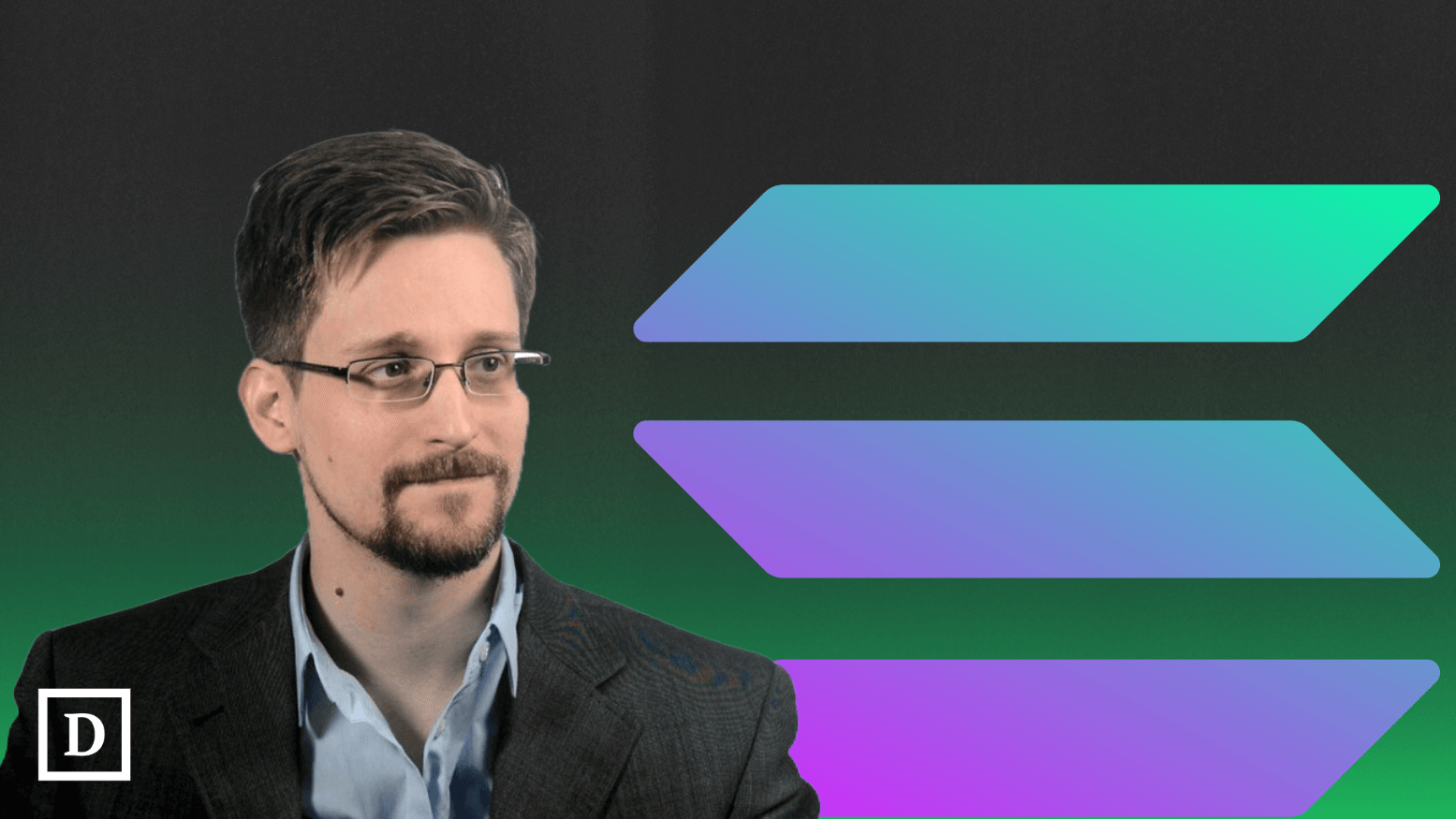
A top Solana developer has challenged Edward Snowden to a debate about centralization after the whistleblower made some scathing comments about the network.
“Let's debate live Snowden — you pick the time, place, and even moderator,” wrote Mert Mumtaz, CEO of developer platform Helius Labs, on Oct. 2 on X.
Snowden caught the wrath of Mumtaz when he said, “I don’t want to name names but Solana is taking good ideas and they’re just going, ‘well what if it’ just centralizes everything?”
He hasn’t replied to Mumtaz’s challenge.
The CIA whistleblower, who revealed in 2013 how the U.S. government was spying on its citizens, didn’t hold back with what he thought about the fifth-largest network in the industry.
Just for Memecoins
“It'll be faster, it'll be more efficient, it'll be cheaper, and yeah sure it is, you're right, but nobody's using it but for meme coins and scams,” he said. “Because if anybody puts anything significant on it and then all the states begin moving towards it, it's going to be a system that has levers that people can simply just take from you."
The one-directional debate brings back to the forefront an ongoing discussion about how decentralized Solana, one of the industry’s top blockchains, actually is. In the past, the network suffered a plethora of outages, raising concerns over centralization.
According to Mumtaz, there are thousands of full nodes, geographically distributed over hundreds of data centers, jurisdictions, governments, and locations.
"No Idea"
“I think he fundamentally has no idea what he's talking about in the context of Solana,” Mumtaz told The Defiant. “I've done the work to look at the numbers (and do so everyday for my job), and I can prove he's wrong.”
Mumtaz said Solana’s stake is distributed such that even the largest validator only has 3% delegated, which compares with Coinbase's 11% on Ethereum, he added.
But according to Solana Beach, there are currently 1,389 validators, 19 of which belong to super minorities. This number represents the smallest number of validators that together control more than 33% of the total stake. These entities could theoretically censor/halt the network if they colluded.
That number can be contested by Rated Network, which shows 2,328 validators.
Mumtaz explained that the Solana Beach figure refers to consensus nodes, whereas full nodes which he said “verify state” reaches a higher number. The number for full nodes was extremely hard to find, and according to Solana Compass, the entire number of nodes reaches 4,449 across 42 countries and 477 data centers.
For comparison, Ethereum has 5,843 nodes, and Bitcoin has 19,179 nodes.
Another interesting statistic from Rated Network is Solana’s Gini coefficient. This metric refers to the amount of inequality in a system, and while 1.00 means perfect inequality and 0.00 is perfect equality, Solana reaches 0.89.
Stake Concentration
Solana’s centralization also came under fire from others within the cryptocurrency community. Pseudonymous crypto investor Evan signaled that Solana suffers from stake concentration. “While these could be rotated to another geography with just a key, that doesn’t change the ultimate underlying concentrated ownership of founders/SF/early VCs,” he wrote.
That said, the staking footprint of each large validator such as Galaxy, Mumtaz’s Helius, Coinbase, and Figment barely exceeds 3.27% individually (some are as low as 2.55%).

In 2022, Snowden revealed he was one of six core contributors that gave birth to the privacy-protecting cryptocurrency, Zcash. He operated under the pseudonym John Dobbertin. After his involvement in Zcash, Snowden remained active, and has become a staple in many Bitcoin conferences, despite calling out the network’s inherent flaws with privacy.
Advertisement
Get an edge in Crypto with our free daily newsletter
Know what matters in Crypto and Web3 with The Defiant Daily newsletter, Mon to Fri
90k+ Defiers informed every day. Unsubscribe anytime.