Your Crypto Swap Was Flagged for AML Review: Who Holds Your Funds, How Long It Takes, What to Do
You send crypto to an exchange service and wait for the swap to finish. Instead, the status changes to a review, and the coins you expected don't arrive on schedule.
The change raises three questions at once: where the funds are now, who decides what happens next, and how long the wait will last.
Reviews like this are uncommon. “Based on SwapSpace's experience, no more than 0.05% of swaps are typically escalated to an AML review at most non-custodial exchange providers,” the SwapSpace team says.
In short, the service that received the deposit holds the funds and sets the timeline, and the first move is to contact support with your order ID.
SwapSpace, a non-custodial cryptocurrency exchange aggregator, compares offers from many exchange providers and sees how reviews play out across them.
This guide draws on that experience to explain how AML reviews work across the industry and what you can do while one is open.
AML reviews and why exchanges use them
AML reviews are compliance checks on individual transactions. Exchange services conduct them to meet anti-money laundering (AML) rules, which require them to spot and look into activity that could link to crime or sanctions.
Those rules largely trace back to the Financial Action Task Force (FATF). FATF standards treat crypto exchange businesses as virtual asset service providers, and countries build their own AML laws on that framework.
FATF also asks these businesses to take a risk-based approach. In practice, a provider screens incoming transactions with automated tools and passes the ones that score as higher risk to a compliance team for a closer look.
Signals that can raise a flag include links to addresses tied to sanctions or illicit activity and unusual transaction patterns.
Reviews don't mean anyone suspects you of wrongdoing. They mean the provider wants more context before it completes the transaction.
Who holds your funds during an AML review?
The service that received your deposit holds the funds during a review. Who that is depends on how the platform works.
Who holds the funds, and who decides, by service model:
- Centralized exchange: the exchange holds the funds in your account, and the exchange's compliance team decides on the review.
- Instant exchange (swap service): the provider that received the deposit holds the funds and decides on the review.
- Non-custodial aggregator: the provider you chose holds the funds, since the deposit goes straight to its address, and that provider decides on the review.
- Decentralized exchange (DEX): there is no central party holding the funds for the on-chain swap itself, and no central reviewer for it.
Source: FATF guidance and published provider AML/KYC policies. Last verified: November 25, 2026.
Non-custodial aggregators don’t touch the deposit. “SwapSpace is a non-custodial aggregator and does not receive or hold users' funds,” the SwapSpace team explains, so the chosen provider's procedures and terms decide what happens next.
Decisions and outcomes during a review
Exchange providers can hold or freeze a swap while they review it, and the service that holds the funds makes the call. Compliance staff there check the flagged transaction under the provider's own policy and local law.
Published policies across the industry describe a similar process. At ChangeNOW, for example, automated tools flag unusual patterns, and its team then reviews each case individually.
Provider policies point to a few broad outcomes. The provider can clear the swap and complete it, or it can ask for clarification or verification first and continue once it has what it needs, as StealthEX's policy describes.
In other cases, the provider applies its own terms to decide what happens to the funds, as Exolix's policy sets out.
Aggregators don't make these calls, but they stay involved. At SwapSpace, support can locate a swap under review by its exchange ID, contact the provider about its status, and pass the provider's requests and updates back to the user.
Users can also follow the order status at any time, reach support 24/7, and work with a dedicated manager on large transactions.
How long an AML review takes
AML reviews have no standard duration. The provider that holds the funds determines the conditions and the timeline, and the length depends on the case.
Short checks can close quickly, while cases that need more information stay open until the provider receives it and finishes its review.
Users still control part of that timeline. Prompt replies help, and so does a complete answer that covers everything a request asks for in one message.
Keep the conversation inside the official support route, and hold off on new deposits, since a second transfer only adds another transaction for the provider to trace.
What to do if your swap gets flagged
Flagged swaps call for calm, organized steps. These five cover the essentials:
- Leave the deposit as it is and don't send the coins again.
- Note the exchange or order ID and the deposit transaction hash.
- Contact support on the platform where you created the order and share both. Reach the provider directly only through the route that support gives you.
- Prepare clear answers about the transaction, such as its purpose and where the funds came from, in case the provider asks.
- Reply only through official channels, and confirm that any message about the swap comes from the platform or the provider.
What to expect at each stage
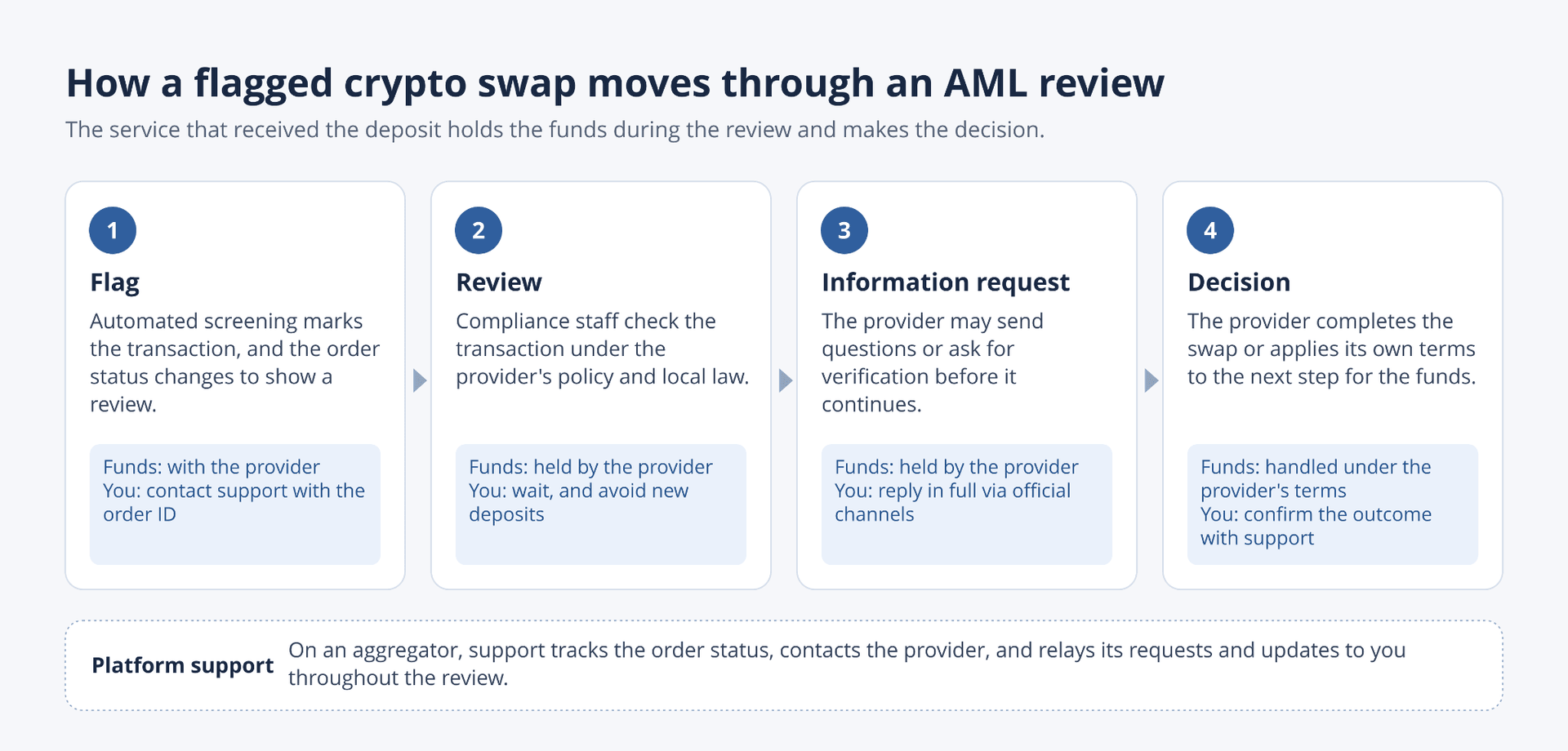
Reviews tend to move through four stages. First, the provider's screening flags the transaction and the order status changes to show a review, which is the point to reach out, as step 3 explains.
During the review, compliance staff look at the transaction under the provider's policy, and support can confirm the case is open.
The provider may then send questions or ask for verification, so reply in full through the route support gives you.
Finally, the provider completes the swap or applies its terms to the next step for the funds, and support passes on the decision and what follows.
The four stages of a typical AML review, from flag to decision. Illustration based on FATF guidance and published provider AML/KYC policies.
Scammers target people with a stalled transaction. Fake “fund recovery” or “unlock” services promise to release coins for a fee, but legitimate providers don't route review fees through outside services.
Steps to swap 10 BTC safely
For a 10 BTC swap, safety starts before the deposit. Compare several offers for the full amount, and confirm the provider accepts 10 BTC in one order, since exchange amount limits differ from one provider to the next.
Read the provider's verification and refund terms before you send, and add a refund address so any returned funds have a clear destination.
Before a large order, the SwapSpace team recommends contacting a VIP manager in advance. SwapSpace never holds the funds on a large order, and the manager can review the available options and coordinate the exchange from start to finish.
Key takeaways
AML reviews follow the same broad logic across the industry, and they remain uncommon.
The service that received the deposit holds the funds and handles the review, while an aggregator such as SwapSpace tracks the status, relays updates through 24/7 support, and offers a manager on large orders.
Timelines depend on the provider, and quick, complete replies through official channels help most. Before a large swap, compare providers, check limits, and read the policies, so any later question has a ready answer.
FAQ
Does an AML review mean I did something wrong?
Usually not. Providers check the history of the coins and addresses in a swap, and that history can reach back several transfers before the funds came to you. Coins that once passed through a flagged address can prompt a review even when your own activity looks ordinary, and clear answers help the provider close that question.
Is an AML review the same as a KYC check?
They're related checks with different jobs. KYC (know your customer) checks confirm who you are, often when you open an account or raise a limit, while an AML review looks at a specific transaction and where its funds came from. Providers can combine the two and ask for identity details during a transaction review.
Can I cancel a swap that's under review?
Only the provider can make that call once your deposit arrives, but you can still ask. Send the request to support on the platform where you placed the order. SwapSpace support, for example, raises it with the provider and passes back the answer, and the provider then decides under its own terms whether to complete the swap or take another step.
Can a review happen on a decentralized exchange?
Not for the on-chain swap itself, since DEX trades settle through smart contracts with no central party in the middle to hold the funds or review them. Some DEX websites do screen wallet addresses before a trade and block those linked to sanctions. Rules for these front ends vary by operator and country, so check the terms of the interface you use.
How does SwapSpace handle large swaps?
SwapSpace never holds the funds. The deposit goes straight to the provider the user picks, and that provider handles any compliance review. Before a large order, a VIP manager can review the options and coordinate the exchange, and 24/7 support follows the case with the provider if a question comes up.
Last verified: November 25, 2026.
Disclaimer: This article is for educational purposes only and isn't legal or financial advice. Compliance rules, provider policies, and availability differ by provider and jurisdiction, so check the current terms before any transaction.
 sources
Advertisement
Free newsletters
Good reporting. Delivered.
Choose the newsletters you want in your inbox.
Free. Unsubscribe anytime.


