Every Stablecoin Card, Settled in RLUSD on the XRP Ledger
Ripple built the institutional stack. The next chapter happens on the ledger.
Ripple has done something very few companies in digital assets have managed. It built an institutional business that works at bank scale. Ripple Prime clears around $3 trillion a year for more than 300 institutions. GTreasury customers ran about $13 trillion of treasury payments in 2025. Ripple Payments has processed more than $100 billion across fiat, RLUSD and XRP. RLUSD passed $2.5 billion in circulation in September, with approval from Japan's FSA and a MiCA licence in Luxembourg. The OCC has approved Ripple National Trust Bank, a federally chartered bank that will hold the RLUSD reserves and custody digital assets for institutions.
The pace has picked up this month. In October alone, Ripple Prime became prime broker to Brevan Howard, a $35 billion investment group. Standard Chartered launched custody for RLUSD on the XRP Ledger. DriveWealth chose RLUSD on the XRP Ledger to settle stock trades in Europe. Ripple Prime opened perpetual swaps across more than 100 markets to institutions, with Virtu among the first clients. Ripple joined the central banks of Singapore, Malaysia and Thailand in a cross-border stablecoin programme covering 111 million people, and it sits in the DTCC tokenization working group beside BlackRock and JPMorgan.
That is a serious business, and it deserves the credit it gets. It is also, for the most part, a business that still runs beside the XRP Ledger rather than on it. Standard Chartered's custody and DriveWealth's settlement are the first institutional flows to land on the ledger itself, and they are the exception so far. A prime brokerage trade or a corporate treasury payment adds no transaction to the ledger, burns no XRP, and puts no RLUSD in the hands of someone who will spend it tomorrow.
At XRP Seoul on 3 October, Ripple President Monica Long said the next stage is to move that customer volume onto the XRP Ledger in 2027, to connect it to lending on the ledger, and to make RLUSD the dollar the network runs on. I agree with the direction. I also think most of the on-chain activity will come from a place the institutional business cannot reach on its own: regular people and the companies that serve them.
Here is the claim I want to make. Stablecoin-powered Visa cards are already a $1.2 billion a month business, and RLUSD should be the dollar behind them. By the end of 2027, Tria and every neobank built on its stack will settle in RLUSD on the XRP Ledger. XRP holders in Japan and Korea will borrow against their XRP and spend it instead of selling it. And BestPath, the routing layer under Tria, will pull assets from every other chain onto the XRP Ledger as XRP or RLUSD in 8 seconds. That is how the on-chain activity, the lending and the RLUSD growth Monica Long asked for in 2027 actually show up.
What Monica Long said Ripple wants in 2027
Monica Long set out three priorities for 2027 in her XRP Seoul keynote.
- Payments settled on the XRP Ledger. Ripple is running a pilot that routes customer payments through the ledger's native exchange, and Monica Long said the plan is to move customer transaction volume onto the ledger in 2027.
- Lending and credit on the ledger. The native Lending Protocol (XLS-66) lets pools of XRP fund short-term credit for payment companies. Monica Long said the credit service is in testing now and is meant to launch commercially in 2027.
- RLUSD as the unit people hold and transact in, with tokenized assets on the ledger growing from about $6 billion to $30 billion.
In each case success is measured on the ledger itself, in transactions, value moved and capital locked. The XRP community has thought this way for years. It cares more about on-chain data than exchange volume, and it is right to.
All three priorities share the same missing piece. Payments need people paying, lending needs borrowers with collateral, and RLUSD needs people who spend it. Each one depends on a front end that ordinary XRP holders and ordinary businesses use every day, and that front end now exists.
Expanding XRP's utility starts with the XRP sitting idle on exchanges
Japan and Korea hold more retail XRP than anywhere else, and most of it is doing nothing. It sits in an exchange account, earns nothing, touches the ledger only when it is withdrawn, and the only way to use it is to sell it.
I have spent the past two months with XRP holders in Seoul, Tokyo, Kuala Lumpur and Jakarta, and the same question comes up in every room: I do not want to sell my XRP, can I borrow against it and use it every day? Nobody had built that for RLUSD. It needs a lending product, deep liquidity and everyday places to spend, all at once, and until now no one had put the three together.
The size of the gap shows up in the card data. Stablecoin spending on digital asset cards went from $4.2 million a month in November 2023 to $1.2 billion a month in September 2026, across 27 card programmes tracked by Paymentscan. None of that $1.2 billion is RLUSD. The spending habit already exists and is waiting for Ripple's dollar.
The XRP neobank: borrow, earn and spend without selling your XRP
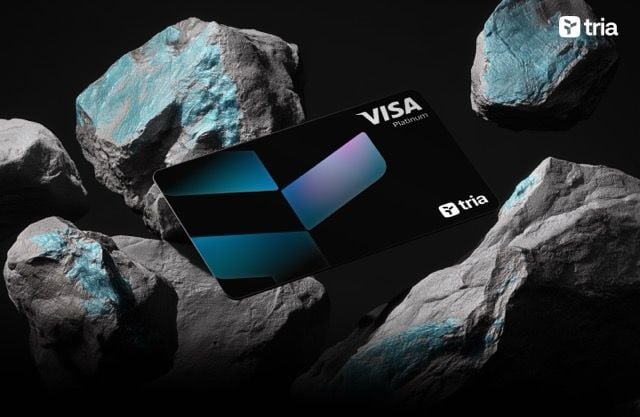
Tria is a self-custodial money app. One wallet, one Visa card accepted in more than 150 countries, swaps, futures, and earn, with the user holding the keys the whole time. The XRP Ledger went live in Tria on 30 September 2026. You can deposit XRP from any wallet or exchange, top up the card with XRP in one tap, fund a futures account with it, and swap into XRP or RLUSD with no Tria fee on the conversion.
The product is still in private beta, and the numbers already show the demand. Users have paid more than $170 million to merchants on the card in 12 months, traded more than $2 billion of futures in 5 months, and more than 50,000 of them have passed KYC. Japan is 47 percent of revenue and Korea is 13 percent, which is exactly where the idle XRP sits.
Here is the flow we are building toward, and it answers the question from every XRP meetup:
- Deposit XRP from any wallet or exchange.
- Put it in a vault as collateral. It stays in a wallet you control.
- Borrow RLUSD against it. Your XRP is never sold.
- Top up the Tria Visa card with RLUSD.
- Tap to pay, with cashback of up to 6 percent.
Earn works the same way. Deposit XRP or RLUSD into a vault, built with Veda, and the yield streams to the card so the vault pays for your spending. Borrowing RLUSD against XRP goes live in the first quarter of 2027. Every step of that loop is a transaction on the XRP Ledger, and every swipe keeps RLUSD in circulation.
BestPath: the infrastructure that moves any asset onto the XRP Ledger in 8 seconds
A money app is only as good as the plumbing under it, and when we launched XRP support we found the plumbing was the problem. The cross-chain routes available to us relied on a single liquidity source per route. In testing and on launch day, swaps into XRP and RLUSD capped out at around $50,000, failed outright at peak, showed up to $4,000 of slippage on a $10,000 swap, and left refunds stuck for up to a day. Quotes were not backed by real inventory. You cannot run a neobank on that, and nobody can run the XRP Ledger's retail economy on it either.
So we built our own. BestPath is Tria's routing and settlement layer. Any asset on any chain goes in, XRP or RLUSD on the XRP Ledger comes out, with one signature from the user. Our own solvers fill the order, the source asset is held in escrow until delivery on the ledger is proven, and the user never has to know which chains the trade crossed. More than $350 million has already moved through BestPath inside Tria.
We chose the hardest possible test to prove it on mainnet: a meme coin. On 24 October, 364,275 BONK on Solana became RLUSD on the XRP Ledger in 8 seconds, from the Tria web app, with one signature. Every step is public on chain. The first run on 15 October took about 18 seconds, the next day it took 11.8 seconds, and nine days later it took 8.
The first run, about 18 seconds:
The 11.8-second run, the day after the first:
On-chain proof for the first run: Solana escrow and RLUSD settlement on the XRP Ledger. For the 8-second run: Solana and XRP Ledger.
That progression is the point I most want readers to take away. Tria is, at its core, a technology company that builds multi-chain infrastructure. More than 70 engineers, most of them from ConsenSys, Polygon, OpenSea, Nethermind and Morpho, built BestPath's XRP Ledger route in a matter of days and then cut its time by more than half in under two weeks, on mainnet, with real money. Ripple's 2027 goals need a partner that can ship and iterate at that pace, and the XRP Ledger has not had one on the retail side. The neobank is the first product on that infrastructure. The infrastructure is the larger business.
If a meme coin can make the trip, any asset can. Over the coming weeks every asset on Solana will be able to move to the XRP Ledger as XRP or RLUSD, and other chains follow. The feature I am most excited about is one button: hold ETH or SOL, press once, and about 8 seconds later it is XRP on the XRP Ledger sitting in an earn vault, with no exchange in the middle. BestPath is designed to be one large intake for the ledger, pulling assets in from every other chain and settling them as XRP or RLUSD.
That is why Tria is both the XRP neobank and an infrastructure layer for the XRP Ledger. The app is the first customer of BestPath, and any wallet, bank or application on the ledger can plug into the same API.
Bringing the entire neobank ecosystem onto RLUSD, settled on the XRP Ledger
The bigger number is not Tria's own users. It is the institutions that are now building their own self-custodial money apps and want the stack rather than the eighteen months it takes to build one. Tria white-labels the whole thing: wallet, card, swaps, earn, futures and BestPath, under the partner's brand.
The first partners are signed, in music, entertainment and banking, and their names will follow as each one launches. A music platform is integrating Tria so that every artist on it gets a wallet and a card. An entertainment group is building a creator finance product on the stack. Several banks want BestPath to bring liquidity from every chain into wallets of their own.
Here is the part that matters for the XRP Ledger. From the first quarter of 2027, card settlement in Tria moves to RLUSD. From the second quarter, partner payouts move from USDC and USDT to RLUSD. Every card issued on the Tria stack, under any brand, then settles in RLUSD on the XRP Ledger, and every payout to an artist, a creator or a bank customer lands as RLUSD on the ledger.
This is the framework, and it is bigger than Tria. BestPath moves any asset onto the XRP Ledger and settles it in RLUSD. The Tria stack turns that settlement into a wallet, a card, earn, borrowing and payouts. That same stack is extensible to any neobank or money app, direct to retail or as a B2B platform, and card spending through that category has grown from $4.2 million a month to $1.2 billion a month in under three years. Every dollar that moves through it has to be minted and held as RLUSD first. Run that framework across the neobank ecosystem rather than through one app, and it generates many billions of RLUSD, with RLUSD as the default settlement instrument for stablecoin cards everywhere.
What it adds up to for XRP, RLUSD and the ledger
Put the pieces together and each of the 2027 priorities Monica Long named gets a retail and B2B engine behind it.
- Payments on the ledger. Every card top-up, every swap through BestPath, every partner payout is a transaction on the XRP Ledger.
- Lending on the ledger. XRP holders who were going to leave their coins on an exchange instead post them as collateral and borrow RLUSD, which is exactly the collateral the Lending Protocol is designed to put to work.
- RLUSD in circulation. Our target is $1 billion of RLUSD in circulation by the end of 2027 across Tria, the partners on the stack and the applications settling through BestPath. At today's Treasury rates that is roughly $40 million a year of reserve income for the issuer.
And there is a fourth effect the community cares about most. Every transaction on the XRP Ledger destroys a small amount of XRP as its fee, so tens of millions of top-ups, swaps, loan draws and repayments burn XRP permanently in a way that off-ledger institutional trades never will. The activity that scales fastest is the kind people do every day with their own money.
Keep your XRP. Use it.
I spent ten years building on Ethereum, at ConsenSys from 2015 and then at Polygon. I moved my work to the XRP Ledger because the demand is already there, the ledger is ready for it, and nobody had built the money app that joins the two.
To XRP holders in Japan, Korea and everywhere else: you can keep your XRP in a wallet you control, borrow RLUSD against it, earn on it and spend it on a card, and every one of those actions runs on the XRP Ledger.
To the banks, platforms and payment companies watching Ripple's institutional business and wondering how to reach its users: the stack exists, it is live, and it settles in RLUSD on the XRP Ledger by default.
Ripple built the rails, and Monica Long has said the volume moves onto the ledger in 2027. Tria is the money app that brings it, BestPath is the infrastructure that settles it, and both are built by a team that can ship at the pace 2027 demands.
John Lilic is Co-founder and Chief Strategy Officer of Tria, a self-custodial money app live in more than 150 countries. He was an early employee of ConsenSys and later worked at Polygon.
Sources and notes
- Monica Long at XRP Seoul, 3 October 2026: AMBCrypto via KuCoin, Bitget News, Coinpedia
- XLS-66 Lending Protocol: XRP Ledger Standards
- Ripple institutional figures (Ripple Prime, GTreasury, Ripple Payments, RLUSD circulation and licences) as presented in Tria's XRP Seoul keynote, 3 October 2026
- Tria traction figures: company data, private beta, as of October 2026
- Stablecoin card spend: Paymentscan, 27 card programmes, November 2023 to September 2026
- BestPath demos and transactions: Tria, 15, 16 and 24 October 2026, links in the text
- Tria XRP Ledger launch: Chainwire, 30 September 2026
- Ripple National Trust Bank: OCC conditional approval, 12 December 2025, Ripple press release
- October 2026 institutional announcements (Brevan Howard, Standard Chartered, DriveWealth, Ripple Prime perps, Asian central banks, DTCC): 24/7 Wall St, 23 Oct, 24/7 Wall St on the central bank programme
Advertisement
Free newsletters
Good reporting. Delivered.
Choose your coverage: crypto and DeFi, the future of finance, or both.
Free. Unsubscribe anytime.