AFX Launches Sovereign L1 for Onchain Perpetuals
Sponsored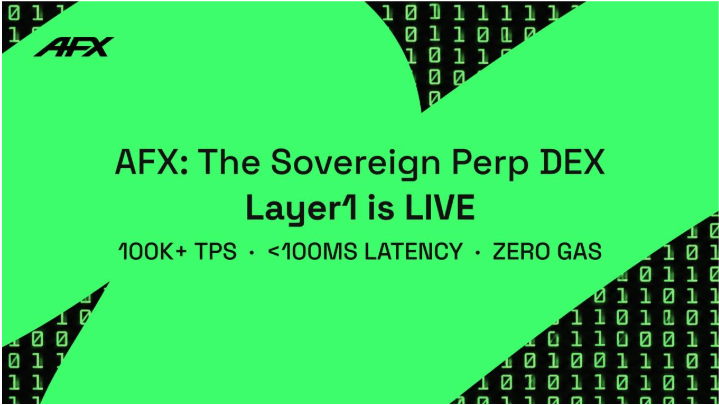
AFXhas launched its mainnet, bringing a purpose-built Layer 1 to the onchain derivatives market.
The project is entering a part of DeFi where the infrastructure debate is becoming more specific. Perp DEXes have already proven there is demand for self-custodied derivatives trading. The harder question is whether general-purpose chains are the right home for orderbook-based perps. Traders running these books expect tight order placement and cancel latency, and they expect liquidation behavior they can model in advance.
AFX’s answer is to move the trading stack onto its own chain, rather than rent block space from a network optimized for something else.
A Chain Built Around Order Flow
AFX describes itself as a Sovereign Trading Layer, rather than a DEX front end deployed on shared blockspace. Its architecture uses a custom execution layer, Mysticeti-based DAG BFT consensus and an ABCI/Cosmos SDK modular structure. The design separates execution from consensus, giving order flow a dedicated path instead of forcing trading activity to compete with unrelated network demand.
The current performance figures cited by AFX are roughly 100ms P50 order latency and more than 100,000 TPS.
The broader point is not only throughput. For orderbook perps, consistency is often more important than peak capacity. Market makers need to know that order placement, modification and cancellation will behave predictably under load.
Onchain Orderbook, Margin and RiskAFX is built around a fully onchain orderbook and margin engine. It supports market and limit orders, stop orders, reduce-only orders, PostOnly, GTC and other order controls. The matching engine follows price-time priority and is paired with onchain liquidation, ADL logic and real-time risk checks.
That puts AFX closer to the infrastructure side of the perp DEX category than the retail UI side. AMMs helped DeFi bootstrap trading, but active derivatives markets usually need tighter control over execution, collateral and liquidation paths. AFX is trying to build that directly into the chain.
The margin system also reflects that focus. AFX supports cross positions, reuse of unrealized PnL and real-time risk monitoring. It cites a 1.25% maintenance margin, which positions the system around capital efficiency for active traders rather than simple isolated-position trading.
Risk design is a major part of the product. The protocol uses a mark price system with multiple index sources, liquidation logic and ADL ranking. In onchain perps, these are not backend details. Oracle construction, mark price behavior and liquidation sequencing can become market structure risks during volatile periods.
Zero Gas Execution and MEV Resistance
AFX has also introduced zero gas execution. For high-frequency order flow, gas is not only a cost issue. It changes behavior. Traders may avoid placing or cancelling orders if every action carries network-fee friction. Removing gas from the trading path makes execution decisions more dependent on price, liquidity and risk rather than fee mechanics.
The protocol also points to MEV resistance through a dedicated mempool and execution architecture. That will be important to watch in practice. For perp DEXs, execution quality is not just speed. It is also whether order priority and transaction ordering create avoidable disadvantages for users and market makers.
Launch Markets
At launch, AFX supports USDC-margined linear futures on BTC, ETH, XAU (Gold) and CL (Crude Oil), with up to 40x leverage on BTC pairs.
The asset mix is notable because perp venues are increasingly moving beyond crypto-native pairs. Traders are looking for broader macro exposure from the same collateral base, especially when gold, oil and crypto narratives are trading together around liquidity, rates and geopolitical risk.
Incentives and Distribution
AFX is also launching with trader incentive programs.
Its VIP structure lowers maker and taker fees based on 30-day trading volume across a master account and sub-accounts. Base fees are 0.01% maker and 0.06% taker, with lower rates at higher VIP tiers. VIP users also participate in a platform fee reward pool.
The referral program is built around wallet-linked invite flows. A user becomes bound to a referrer after connecting through a unique link, and referrers earn commissions from direct invitee trading fees. The program also includes sub-agent economics for broader downline networks, with commission rates adjusted daily based on cumulative network volume.
These programs are not unusual by themselves. Every derivatives venue needs to solve distribution, liquidity and retention. What AFX is trying to emphasize is the surrounding economic structure: no VC round, no private allocation and no scheduled unlock pressure. The project is framing its launch around active traders, liquidity contributors and community distribution rather than venture-led supply overhang.
The Bigger Infrastructure Question
The test now is whether architecture can translate into durable market quality.
Perp DEX users are no longer only asking whether a venue is onchain. They are asking whether execution is fast enough, whether the orderbook is usable, whether liquidations behave cleanly, whether professional liquidity can connect, and whether the market structure holds up during stress.
AFX is one of the more direct attempts to answer those questions at the chain level. Its launch adds to a broader shift in onchain derivatives: the category is moving away from generic DeFi deployment and toward specialized execution environments built specifically for trading.
Trade: http://app.afx.xyz/trade
Advertisement
Free newsletters
Good reporting. Delivered.
Choose your coverage: crypto and DeFi, the future of finance, or both.
Free. Unsubscribe anytime.