Zelenskyy's Fashion Tests Polymarket
Camila Russo & Olivia Capozzalo
July 09, 2025
gm, Defiers!
Today’s big story:
- Ukraine President Volodymyr Zelenskyy’s fashion choices provide a stress test for Polymarket
Plus:
- Pumpfun finally confirmed its PUMP ICO, plus tokenomics
- Trump’s Truth Social filed for a “blue chip” crypto ETF
- DeFi protocol Peapods Finance was reportedly exploited for $200K
- Robinhood's tokenized stocks aren’t stocks [Issue #3 of Real World — our new weekly newsletter on stablecoins and tokenization]
- Investment policy statements: Ending misalignment and empowering long-term vision in decentralized organizations [SPONSORED]
- The Stellar development roadmap paves way for expansion and network scalability [SPONSORED]
Read more below! But first, please give our sponsors some love; they make this newsletter possible.

DIA launches $DIA Staking and Oracle Grants with 20 chains, including Arbitrum, BNB Chain, and Avalanche. Power your dApp with trustless oracles, cost-free.

DeFi is evolving rapidly and maturing, entering a new phase of adoption and growth. With both established protocols like Aave and new entrants driving innovation in capital efficiency and market design. However, liquidity fragmentation across chains and protocols remains a core limitation, particularly in the lending sector. Soul’s new DeFi primitive addresses this by enabling cross-chain lending coordination, using LayerZero’s messaging infrastructure to allow users to borrow across chains and protocols while keeping collateral in one place. Built by the team behind Hatom, a 2 years old secure and mature lending protocol, Soul aims to become a foundational layer in a new phase of interoperable and composable DeFi.
READ MORE: Solving major DeFi problems: Soul new primitive to finally solve liquidity fragmentation
We’re back! Here’s what you need to know in web3 today
Why Is Everyone Mad about the Zelenskyy Suit Polymarket Bet?
The Zelenskyy‐suit market on Polymarket isn’t just a controversial $242 million bet on presidential fashion. It’s also a glaring stress test for a prediction market sector valued in the tens of billions.
The broader predictive analytics market will top $22.22 billion in 2025, according to Demand Sage. Polymarket and Kalshi already command multibillion-dollar valuations of their own. If a single question about Zelenskyy’s wardrobe can spark this much turmoil, what does it say about the integrity of prediction markets more broadly?
After Ukrainian President Volodymyr Zelenskyy appeared at the June 24 opening of the 2025 NATO summit in what many outlets — including the NY Post, the BBC, Reuters and The New York Times – described as a suit or “suit-style” outfit, users expected Polymarket’s “Yes” tokens to settle at $1.00. Instead, UMA’s Optimistic Oracle — the primary resolution system for Polymarket disputes — went from an initial “Yes” verdict to a final “No,” after the outcome was disputed twice.
Traders in the over $240 million market watched in disbelief as “Yes” collapsed from $0.19 (19% implied probability) to a meager $0.04 once UMA’s Data Verification Mechanism (DVM) vote closed.
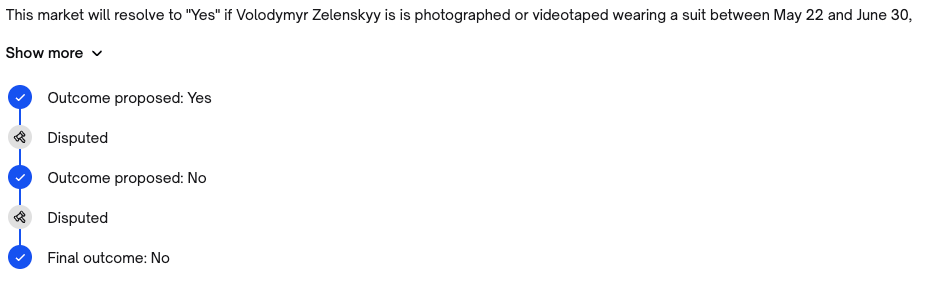
Polymarket outcome for “Will Zelenskyy wear a suit before July?” market
A Handful of Whales Calling the Shots
According to the prediction market’s rules, “the resolution source will be a consensus of credible reporting.” After a dozen news outlets reported that Zelenskyy was wearing a suit that day — and when what appears to be the comms agency of the garment’s designer said the look, though not a traditional suit, “can indeed be referred to as a suit” — speculation that the market was rigged increased.
Some data points suggest that the market may have been manipulated. Fewer than ten UMA holders supplied nearly all of the ~18 million UMA staked in the dispute, with three addresses alone contributing over 70% of that total vote weight (stakes can be verified via the UMA DVM contract’s Etherscan logs). More broadly, 95% of all UMA tokens sit in whale wallets, according to data platform Sentora, meaning an elite can in theory skew subjective outcomes at will.
Add to this the fact that there is no good way to prove that UMA voters aren’t also betting in Polymarket markets aligned with their votes, and the system seems ripe for manipulation.
When Incentives Trump Facts
Beyond (unverified) speculation that there was foul play, it was also rational for UMA stakers to vote “No.”
UMA’s oracle is “optimistic” by design: anyone can propose an answer and, barring a challenge, it’s immediately final. But during the liveness window, token-holders stake UMA to dispute outcomes or defend the proposal. If you end up on the losing side, your stake is slashed and redistributed to winners.
Once “No” looked like the winning horse, rational actors flocked to back it, not necessarily because they believed Zelenskyy never donned a suit, but because of course they’d rather earn tokens than lose them. UMA lays out the full mechanics in its Optimistic Oracle documentation, but the key takeaway is that economic incentives favor consensus over objective truth.
Not the First Time
This isn’t the first UMA controversy. Last March, a Polymarket dispute over a mineral-agreement bet saw a single whale marshal ~5 million UMA to force a “Yes” resolution on a pact that never existed. And during the 2024 Venezuelan election market, UMA-governance tussles led Polymarket to override its own rules.
Since its 2020 launch, Polymarket has exploded, hitting a $2.5 billion trading peak in November 2024. It’s raised over $70 million from big names like Vitalik Buterin and Founders Fund and now peers at a $1 billion valuation. For most straightforward markets (elections, weather, sports) Polymarket delivers razor-sharp forecasts, often outpacing polls and pundits. But when questions hinge on interpretation, the cracks show.
A Path Forward
This isn’t a death knell for prediction markets, it’s a call to refine them. Polymarket could adopt stricter question templates (e.g., defining “suit” by lapel type or button count) or an external court for borderline cases. UMA might introduce quadratic bonding curves to disincentivize whale dominance.
For markets craving pure objectivity, protocols like Chainlink and Pyth offer data‐feed oracles anchored to real-time price aggregators, though they lack UMA’s native dispute mechanism. Hybrid models, combining optimistic proposals with off-chain juries (like Kleros), could blend speed with impartiality. Others are calling for AI to help call the shots.
Polymarket and UMA’s systems work beautifully for clear-cut questions, and prediction markets remain one of the most potent tools for real-world forecasting. But as we edge into more nuanced territory, these platforms must evolve. Otherwise, every edge-case controversy risks further eroding trust in the system — and when dealing with a platform that aims to clarify what’s true, trust is everything.
With love,
Cami, founder of The Defiant
📈 Markets in the last 24 hrs:
| TICKER | VALUE | 24H | |
|---|---|---|---|
 | Bitcoin | $109,285 | 0.48 % |
 | Ethereum | $2,664.72 | 2.05 % |
 | XRP | $2.38 | 3.33 % |
 | BNB | $662.68 | 0.36 % |
 | Solana | $154.5 | 2.01 % |
 MessariPortals MessariPortals | MINDSHARE Rank | MINDSHARE % Change (7d) |
|---|---|---|
 | MINDSHARE Rank | MINDSHARE % Change (7d) |
 |  | 10.26% |
 | | 16.36% |
 |  | -61.26% |
| Powered by Messari Portals | ||
This is the news that mattered in the past 24 hrs
- The second-largest Solana memecoin launchpad pumpfun has officially announced its native token, PUMP, as well as details of the token’s ICO, distribution, and plans for the platform. Reports of the token, valued at $4 billion, first came out last month, but the team had yet to confirm the news.
- President Trump’s Truth Social platform has filed for a multi-crypto spot ETF in the U.S. called the “Truth Social Crypto Blue Chip ETF”; the fund will “primarily” hold large-cap cryptos, as well as CRO.
- 2023-era DeFi protocol Peapods Finance suffered an unauthorized withdrawal of over $200,000 yesterday, causing its token PEAS to drop sharply 5%; the team says it is investigating with auditors and thinks the issue may be “an underlying bad oracle.”
- In the latest issue of Real World, we dive into why Robinhood’s flashy stock tokens are more like the CFDs of old, dressed in ERC‑20 hoodies; plus the latest in the crypto bank charter race.Sign up here to get Real World in your inbox every week.
🎬WATCH
On the latest episode of The Defiant Podcast, Cami sat down with Vlad Tenev, co-founder and CEO of Robinhood, in Cannes to explore the firm’s recently announced major crypto moves, including bringing tokenized U.S. stocks to the EU and launching its own Ethereum L2 with Arbitrum tech.
From tokenized private shares to the long-term vision of blockchain adoption, Vlad shares insights on regulation, innovation, and the battle between Robinhood and Coinbase.
That’s it for today — if you enjoyed this newsletter, tell your friends! https://thedefiant.io/subscribe
Free newsletters
Good reporting. Delivered.
Choose your coverage: crypto and DeFi, the future of finance, or both.
Free. Unsubscribe anytime.