Why Is Goldman Afraid of Public Chains?

Olivia Capozzalo & Camila Russo
July 23, 2025
gm, Defiers!
Today’s big story:
- As Wall Street embraces public chains, Goldman is using a private one. Why?
In other news:
- PNC Bank and Coinbase announced a partnership
- Large stablecoin inflows can cause “quantitative easing” of long-term T-bill yields: Messari report
- Telegram-integrated self-custodial TON Wallet has launched to U.S. users
- Crypto ventures now make up a key part of the Trump family fortune
- Investment policy statements: Ending misalignment and empowering long-term vision in decentralized organizations [SPONSORED]
- DIA's Infra Gardens Event Recap: Building the Future of Crypto & DeFi [MEDIA PARTNERSHIP]
Read more below! But first, please give our sponsors some love; they make this newsletter possible.

DIA launches $DIA Staking and Oracle Grants with 20 chains, including Arbitrum, BNB Chain, and Avalanche. Power your dApp with trustless oracles, cost-free.
Alephium’s Danube Upgrade Is Live — The Web3 We Were Promised, on Proof-of-Work
Alephium, the only scalable Layer 1 powered by Proof-of-Work and native sharding, has launched its landmark Danube upgrade. Danube delivers the performance and simplicity users expect with 8-second block times, seedless onboarding, invisible sharding, and a smoother smart contract experience. It’s Web2-grade UX, running on a decentralized, energy-efficient PoW chain.
Danube marks Alephium’s biggest step toward the Web3 we were promised — scalable, secure, and actually usable.
Arbitrum x Robinhood 🚀🌍
@ajwarner90 reveals their game-changing partnership with @RobinhoodApp, bringing tokenized stock trading to Europe and redefining scalability. From decentralized innovation to blockchain’s next wave—@arbitrum leads the charge.
Are you ready for
— The Defiant (@DefiantNews)
9:39 AM • Jul 22, 2025
A.J. Warner, Chief Strategy Officer at Arbitrum developer Offchain Labs, unveils a revolutionary vision for blockchain scalability through their collaboration with Robinhood. Explore how Arbitrum’s Ethereum Layer 2 chain is enabling tokenized stock trading across Europe while showcasing unmatched flexibility.
Warner sheds light on the pathways emerging from Ethereum’s evolving roadmap and the boundless potential of decentralized innovation. Arbitrum stands as a beacon in harmonizing speed, scalability, and creativity, charting a new course for blockchain's future.
Watch the full interview, shot at the beautiful DIA Infra Gardens event at EthCC Cannes
We’re back! Here’s what you need to know in web3 today
📈 Markets in the last 24 hrs:
| TICKER | VALUE | 24H | |
|---|---|---|---|
 | Bitcoin | $117,592 | -0.42 % |
 | Ethereum | $3,604.33 | -1.25 % |
 | XRP | $3.27 | -5.24 % |
 | BNB | $783.21 | 2.67 % |
 | Solana | $190.56 | -4.49 % |
 MessariPortals MessariPortals | MINDSHARE Rank | MINDSHARE % Change (7d) |
|---|---|---|
 | MINDSHARE Rank | MINDSHARE % Change (7d) |
 |  | -32.97% |
 |  | 254.82% |
 | | -74.73% |
| Powered by Messari Portals | ||
Today’s Big Story
Goldman Sachs Is Tokenizing Funds Like It’s 2018
It’s 2025. BlackRock and Franklin Templeton have tokenized funds live on public chains like Ethereum, Stellar, and Solana. It just became legal for Bank of America and Walmart to issue their own stablecoins. The SEC dropped its lawsuits against Coinbase, Uniswap, and Consensys. Robinhood is launching its own Ethereum Layer 2.
And Goldman Sachs?
In the middle of a Cambrian explosion of real-world assets going on-chain the real way (open, interoperable, composable), Goldman, in partnership with BNY Mellon, is rolling out a closed-door fund on its permissioned GS DAP network.
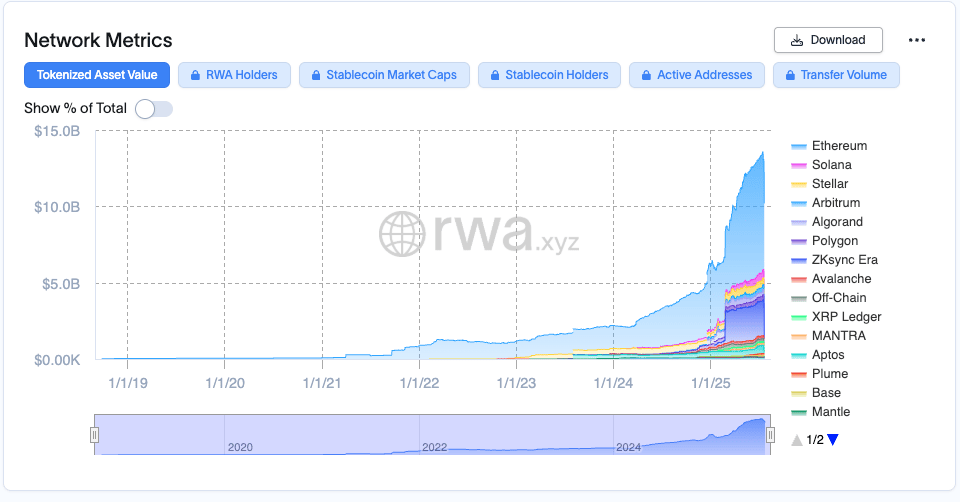
There is $12B worth of RWAs tokenized on public blockchains. Source: RWAxyz
Here’s what they announced:
Goldman Sachs and BNY Mellon will offer tokenized shares of multiple traditional money market funds, including offerings from Fidelity, Federated Hermes, BlackRock and others. These fund shares will settle on Goldman’s private blockchain (GS DAP), while BNY’s LiquidityDirect platform will handle custody and record keeping. The goal is faster settlement, 24/7 access, and using tokenized MMF shares as collateral.
This would have been huge in 2018.
Back then, any Wall Street experiment involving tokens was headline-worthy. The idea of putting real assets on-chain was novel. Infrastructure was immature. Regulation was unclear. Ethereum was still trying to scale. Institutional grade custody was lacking. So the logic was: let’s play it safe, build in a sandbox and keep it private.
But we’re way past those days.
Compare Goldman’s fund to BlackRock’s BUIDL: a tokenized U.S. Treasury fund mostly running on Ethereum, where investors can earn yield directly on-chain and integrate with the wider DeFi ecosystem. Since launching in early 2024, BUIDL has attracted over $2.4 billion, working with platforms like Securitize and Coinbase for seamless access.
Or Franklin Templeton’s money market fund BENJI, live since 2021, initially on Stellar and Polygon, and now also on Arbitrum, Base, Ethereum, Avalanche, Aptos, and Solana.
Apollo Global, one of the largest private equity managers in the world, launched a tokenized yield fund via Securitize that’s also available on public chains like Ethereum, Solana, Avalanche and Aptos.
These aren’t experiments anymore. They’re functioning products that live in the open and benefit from it.
What Goldman’s Private Chain Leaves on the Table
By choosing a private chain in 2025, Goldman Sachs forgoes the very advantages that have made public blockchains like Ethereum the default infrastructure for tokenized finance.
- Composability: BlackRock’s BUIDL fund, tokenized via Securitize, is already being used as collateral on crypto exchanges Crypto[.]com and Deribit. The next step will be for these tokens to be used in DeFi. These integrations allow investors to automatically earn yield, post collateral, or participate in structured products via smart contracts, no custodian needed.
- Interoperability: Public blockchains are where users, assets, and capital already live. RWAs on public blockchains can move across dozens of ecosystems, giving access to different sets of users and liquidity.
- Global access & 24/7 settlement: Public chains don’t close at 4 p.m. Eastern or on bank holidays. GS DAP might be fast for Goldman’s clients. But it’s not global, not interoperable, and not composable. It’s fast only within the walls that Goldman built.
- Developer ecosystem: There are thousands of devs building new financial apps, risk engines, credit layers, and marketplaces on public blockchains. Tokens in closed gardens miss out on that innovation.
Goldman’s decision to tokenize on a private chain is like building a high-speed train that only runs between two buildings on Wall Street. Meanwhile, the rest of the industry is building subways, highways, and airports on open rails, where assets, protocols, and users can freely move and interconnect.
The one real success story in permissioned-chain land is JPMorgan’s Onyx, which processes billions in daily settlement volume through JPM Coin. But even Onyx, which has rebranded to Kinexys, opened up to FX and tokenized asset settlement, and is now connecting to Ondo’s public testnet.
Most other private efforts, like Wells Fargo’s DLT Settlement Network or interbank blockchains from 2018-2019, have been quietly shelved or absorbed into legacy workflows. That’s because the reason to use private chains didn’t scale, since they couldn’t attract open developer ecosystems or liquidity.
The reason to use blockchain technology is for the benefits listed above, which you can only get on public chains. Otherwise, it’s better to use a centralized ledger.
TL;DR: This is lame.
We’re past the “let’s test ‘The Blockchain’ in our own little walled garden” era.
Goldman Sachs is late to the party. Not only that, but it’s dancing with a handful of friends to an iTunes playlist in the coat room. They should just step on the actual dance floor.
With love,
Cami, founder of The Defiant
Forwarded this newsletter? Subscribe for insights and curated news from The Defiant team, Monday-Friday. It’s free.
Subscribe to The Defiant Daily
🎬WATCH
How Lido is Redefining Ethereum Staking: Dual Governance, Liquid Staking, and the V3 Upgrade
On the latest episode of The Defiant Podcast, The Defiant founder Cami Russo sat down with Hasu, strategic advisor to Lido. Their conversation dives into the evolving role of Ethereum in DeFi, the future of staking for institutions, and the broader implications of programmable money.
Top News in the Past 24 Hours
- PNC Bank Announces Strategic Partnership with Coinbase U.S. banking giant PNC has partnered with Coinbase, the top U.S. centralized exchange by daily volumes. The partnership goes both ways — PNC will offer clients access to crypto via the CEX, and Coinbase will use some of PNC’s banking services.
- Stablecoin Flows are Directly Impacting Treasury Yields: Messari A new report on stablecoins from crypto analytics firm Messari states that large inflows of stablecoins are linked to a drop in Treasury bill yields, “comparable to that of small-scale quantitative easing on long-term yields.”
- Telegram-Integrated TON Wallet Launches in the US TON Wallet, which is natively integrated into popular messenger Telegram in many countries, is now available in the United States, where over 87 million Telegram users can now send, receive, and store crypto directly within the messaging app.
- FEATURE: Trump’s Crypto Assets Now Comprise a Key Part of Family Fortune Worth Billions Since launching his re-election campaign in 2024, one that heavily focused on the adoption of cryptocurrency, President Donald Trump and his family have aggressively entered the crypto space with a series of ventures, from memecoins to crypto ETFs. Reports place the total sum of Trump’s net worth derived from crypto ventures in the eight- to nine-figure range.
Trending on The Defiant
- PNC Bank Announces Strategic Partnership with Coinbase
- Crypto Markets Wobble as Fed Chair Powell Faces Pressure
- SOL Flips BNB on Back of Multi-Million Dollar Treasury Bet and DeFi Surge
- TON Wallet Launches in US, Bringing Telegram-Integrated Crypto to Millions of Users
- Stablecoin Usage Soars in Emerging Markets: Messari
- North Korean Hackers Have Laundered Over $1 Billion Stolen From Bybit in Under Six Months
That’s it for today — if you enjoyed this newsletter, tell your friends! https://thedefiant.io/subscribe
Free newsletters
Good reporting. Delivered.
Choose your coverage: crypto and DeFi, the future of finance, or both.
Free. Unsubscribe anytime.