TradeXYZ Whale Highlights Weekend Fragility
Olivia Capozzalo & Denis Omelchenko
December 15, 2025
Happy Monday, Defiers!
Today’s big story:
- Sunday’s chaos on TradeXYZ shows how trading TradFi products on DeFi infra can make the market feel fragile
In other news:
- Interactive Brokers adds stablecoin deposits
- SUSHI holders vote to increase emissions
Read more below! But first, please give our sponsors some love; they make this newsletter possible.

Stellar: The Proving Ground for Real-World Privacy The latest Stellar upgrade, X-Ray, delivers zero-knowledge cryptography that lets developers build privacy into their apps—protecting what matters while keeping Stellar radically open, trusted, and ready for real-world finance.
We’re back! Here’s what you need to know in web3 today
📈 Markets in the Past 24 Hours
| TICKER | VALUE | 24H | |
|---|---|---|---|
 | Bitcoin | $87,090 | -2.12 % |
 | Ethereum | $3,016.58 | -2.20 % |
 | BNB | $859.38 | -3.07 % |
 | XRP | $1.93 | -3.30 % |
 | Solana | $127.8 | -2.24 % |
Today’s Big Story
Trading Against Each Other
TradeXYZ markets itself as a decentralized platform with “No off-hours, no holidays, just deep liquidity 24/7, 365.” It offers on-chain perpetuals like XYZ100, which tracks a Nasdaq‑100-style equity index, and runs on Hyperliquid, letting users trade directly on its blockchain order book without relying on traditional intermediaries.
But Sunday’s chaos on XYZ100 showed that trading traditional equities 24/7 can lead to thin order books and make the market feel fragile. For a few hours, traders weren’t really trading the Nasdaq‑100 — they were trading against each other.
Some brief context: XYZ100’s reference price is tied to Nasdaq futures when those markets are open. During active external trading sessions — when markets like CME Nasdaq futures are live — the protocol’s oracle gets those externally derived prices and converts them into a spot price.
But, as we well know, equity markets don’t trade 24/7. And when external pricing data stops, TradeXYZ switches to an internal pricing mechanism, according to the project’s documentation. Starting from the last available external price, the oracle continues to track on-chain orderbook.
On Sunday, Dec. 14, with the Nasdaq closed, a whale opened a large short order on XYZ100, worth around $10 million. Within about an hour, XYZ100/USDC fell roughly 4%, from $25,178 to $24,214.
Mlm Onchain, a Telegram channel tracking Hyperliquid-related activities, noted that the trade triggered liquidations, as one trader lost $7.4 million and another $2.7 million. In total around $13 million in longs were wiped out. Later, buyers stepped in and the price recovered to $25,276, but the episode highlighted how weekend trading on-chain can swing sharply on its own.
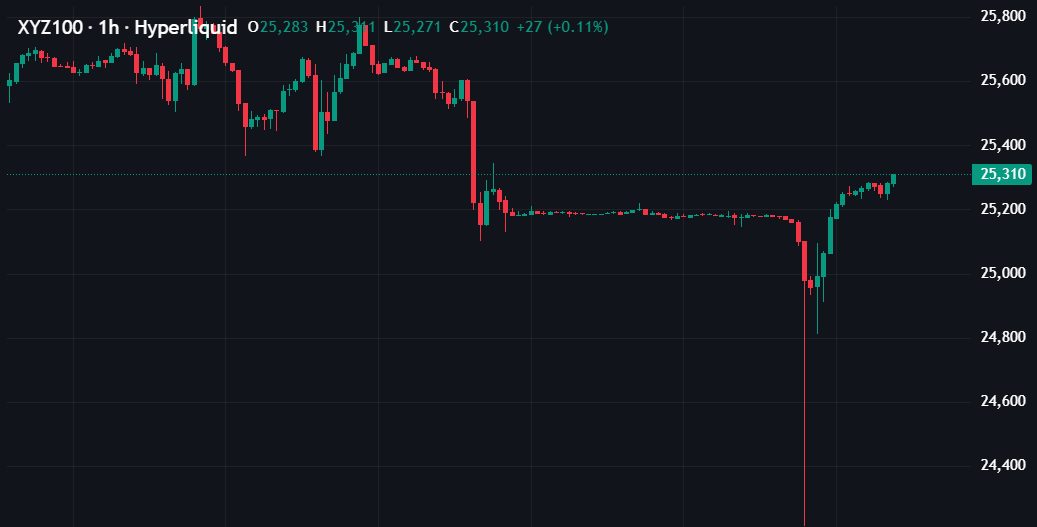
XYZ100/USDC. Source: TradeXYZ
Kaledora Fontana Kiernan-Linn, the co-founder and CEO of Ostium, a self-custodial leveraged trading platform, suggested in an X post yesterday that a solution here could be to reference the “underlying spot market's hours directly,” by creating a “programmatic break in trading.”
Jinsol Bok, research lead at crypto firm Four Pillars, suggested in another X post that perp-based tokenized equities “won’t move to the next stage unless they solve both 1. the oracle problem, and 2. the liquidity problem.”
Until then, weekends are once again a reminder that when the anchor is gone, the market belongs to whoever has the deepest pockets and the thinnest book to push against.
Denis, staff reporter at The Defiant
Forwarded this newsletter? Subscribe for daily insights and curated news from The Defiant team, Monday-Saturday. It’s free.
🎬WATCH
More Than Wrappers | RWAs on Avalanche | Ecosystems, Ep. 3
In our third episode of the Avalanche Ecosystems mini-series, we dive into one of the most important trends in crypto: tokenization of real-world assets (RWAs). From land records to treasuries, private credit, and publicly traded equities, Avalanche is enabling institutions to not just issue onchain wrappers, but to create the real thing. It's tokenization the right way.
With interviews from Luigi D’Onorio DeMeo and Morgan Krupetsky (Ava Labs), Dan Silverman (Balcony), Kevin Chan (Grove) and Gabriel Otte (Dinari), we explore how Avalanche’s architecture is powering a new wave of RWAs across finance, government infrastructure, and consumer applications.
Watch the mini doc here:
This content is part of a media partnership between The Defiant and Ava Labs
Top News Since Friday
- Interactive Brokers Enables Stablecoin Deposits Interactive Brokers (IBKR), one of the world’s largest brokerage services, now allows users to deposit stablecoins in their brokerage accounts. Why it matters: The move presents a much-needed alternative for those with savings in crypto, removing the need to off-ramp into fiat and pay extra fees along the way.
- SushiSwap Approves SUSHI Emissions Boost in Vote Controlled by One Address A SushiSwap governance proposal to sharply increase the SUSHI token annual emission rate passed on Sunday, with most of the voting power concentrated in one wallet. Why it matters: SushiSwap’s TVL is down over 98% since its 2021 high, and the DEX’s longtime “head chef” stepped down earlier this month.
Trending on The Defiant
- Interactive Brokers Enables Stablecoin Deposits
- Crypto Markets Post Minor Losses Amid Tech Sell-Off
- DTCC Gets SEC Clearance to Pilot Tokenized U.S. Securities
- Terra Founder Do Kwon Sentenced to 15 Years in Prison
- Solana Lending Markets Surge as Network Positions for Trillion-Dollar DeFi Future: Redstone
- HyENA Volume Crosses $50 Million in First 48 Hours
That’s it for today — if you enjoyed this newsletter, tell your friends! https://thedefiant.io/subscribe
Free newsletters
Good reporting. Delivered.
Choose your coverage: crypto and DeFi, the future of finance, or both.
Free. Unsubscribe anytime.