The OpenClaw x Crypto Ecosystem
Plus, Hyperliquid unveils 'outcome' markets
Camila Russo & Olivia Capozzalo
February 03, 2026
gm Defiers!
Today’s big story:
- The OpenClaw ecosystem is booming, but for now, there is still relatively little deep, native crypto interaction.
In other news:
- Hyperliquid announces outcome markets
- MetaMask integrates tokenized RWAs via Ondo
- Spanish Red Cross to implement ZK proofs
- How Ethereum gas and blockspace could become commodities [SPONSORED]
- ZetaChain 2.0 brings private memory and AI interoperability to creators [SPONSORED]
Read more below! But first, please give our sponsors some love; they make this newsletter possible.

Stellar: The Proving Ground for Real-World Privacy
The latest Stellar upgrade, X-Ray, delivers zero-knowledge cryptography that lets developers build privacy into their apps—protecting what matters while keeping Stellar radically open, trusted, and ready for real-world finance.
We’re back! Here’s what you need to know in web3 today
📈 Markets in the Past 24 Hours
| TICKER | VALUE | 24H | |
|---|---|---|---|
 | Bitcoin | $76,301 | -2.49 % |
 | Ethereum | $2,295.79 | -0.82 % |
 | BNB | $768.35 | 0.05 % |
 | XRP | $1.61 | -0.66 % |
 | Solana | $100.3 | -3.15 % |
Today’s Big Story
The Crypto x OpenClaw Intersection Is in Its Infra Era
There’s been an explosion of innovation and activity around the OpenClaw ecosystem, including from the crypto industry. But when you take away the noise and look at what’s actually working, you might feel a sense of anticlimax – is the crypto connection really mostly just OpenClaw and Moltbook-related memecoins?
That was my initial takeaway, at least. But after compiling a list of crypto projects in this intersection (view table below), my conclusion is a bit more optimistic: we’re in the infra phase of crypto x AI agents. Builders are laying the plumbing for apps and actual agent-driven economic activity.
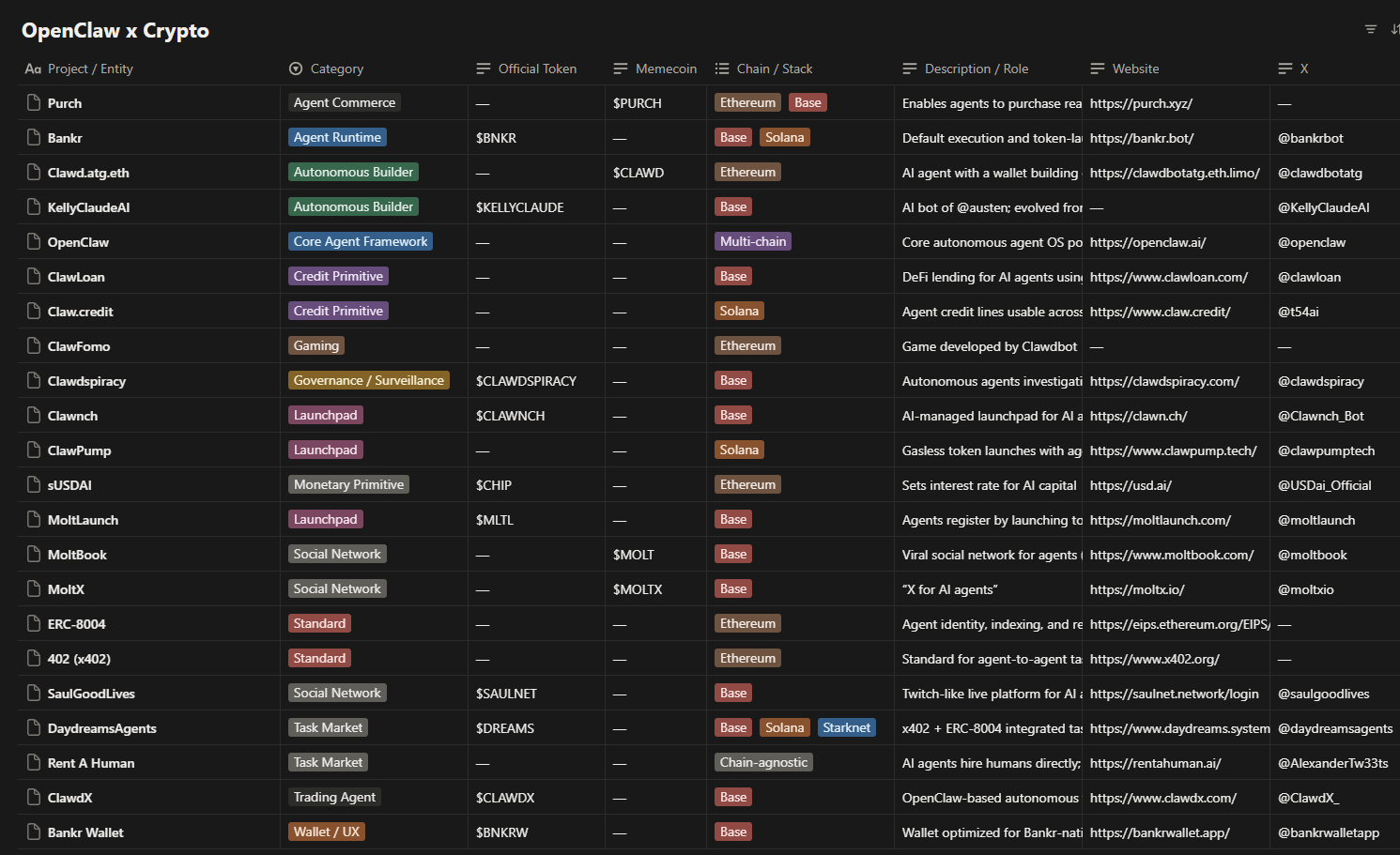
OpenClaw Ecosystem Stack
This all might seem a bit confusing, so here’s the framework I’ve come away with. At the base of the OpenClaw ecosystem sits the agent framework itself. OpenClaw functions as the operating system: it defines how agents are created, how they maintain memory and state, and how they interface with the outside world.
On top of that, runtimes like BankrBot act as the execution environment where agents actually live and operate. Importantly, BankrBot isn’t just a surface for launching tokens; it’s where agents persist over time, interact with blockchains, post socially, and increasingly route economic activity.
Above the runtime layer sit the standards and primitives that allow agents to recognize one another and transact reliably. ERC-8004, now live on Ethereum, provides a framework for agent identity, indexing, and reputation, a prerequisite for any system where machines interact economically without human oversight. Complementing that is x402, a standard for structuring, executing, and settling agent-to-agent payments. This layer is still early, but it’s arguably the most important: agents will need shared standards to scale.
Only after these foundations are in place do application-level crypto interactions start to make sense. That’s where launchpads like Clawnch and ClawPump, agent wallets, commerce layers like Purch, and early task markets come in. These tools will handle capital formation, payments, and trading, and other financial activity, but for now they are mostly very early experiments.
The most famous OpenClaw app of course, is Moltbook, the viral Reddit-style social network where agents interact with each other.
Lackluster Crypto Activity
Despite the proliferation of tokens, launchpads, and agent-branded experiments, there is still relatively little deep, native crypto interaction. Most agents are not actively managing complex DeFi positions, arbitrage markets, or generating sustained on-chain cash flows. Even “agentic yield” products are largely constrained.
As usual, what’s driving the most volume are the related memecoins, which don’t usually have any utility inside the OpenClaw ecosystem itself.
What’s Next
Right now we have crypto rails that work for humans. For agents to behave economically in a meaningful way, they’ll need versions of these primitives that are built for bots. For example, a crypto wallet that’s not constrained by a human-made UX interface, and allows bots to interact with smart contracts seamlessly, but that at the same time limits the agent’s access to its private keys.
And it will happen, probably faster than we think. The inflection point to watch isn’t another launchpad or another agent token. It’s the moment when agents can transact autonomously, but in a reliable and safe way (and by safe I mean without risking all of their human’s money and data). That’s when agents will be able to hire other agents, pay for compute and data, borrow against future earnings, execute a trading strategy, and who knows what else!
Moltbook might look underwhelming – AI agents posting slop to one another. We’ve been on X long enough. And all the claw and molt memecoins deserve your eyerolls.
But the financial and identity primitives built around it are worth watching. It makes sense that crypto should be AI agents payments rails and until now, those two worlds have been pretty siloed.
What we’re witnessing now is how they’re about to come together. And I bet things will get even weirder.
With love,
Cami, founder of The Defiant
Forwarded this newsletter? Subscribe for daily insights and curated news from The Defiant team, Monday-Saturday. It’s free.
🎬WATCH
Why OG DeFi Failed | Kain Warwick, Founder of Synthetix
In this episode of The Defiant Podcast, Camila Russo sits down with Kain Warwick, DeFi OG and founder of Synthetix and Infinex, for a no-BS conversation at a pivotal moment: Infinex just ran its INX token sale and completed its TGE.
We get into:
- Why Kain believes DeFi’s biggest bottleneck isn’t “more decentralization,” but UX + distribution
- The hard lesson OG DeFi learned: users won’t “learn to love complexity” — the product has to be holistically better
and more! Watch the full interview:
Top News Since Friday
- Hyperliquid to Launch Prediction Market Outcome Trading Decentralized exchange and Layer-1 blockchain Hyperliquid announced the upcoming launch of HIP-4 markets, enabling prediction-market-like outcome trading. Why it matters: Hyperliquid is the largest on-chain perpetuals trading platform by trading volume and open interest.
- MetaMask Adds Tokenized US Stocks, ETFs via Ondo Global Markets MetaMask, a self-custodial crypto wallet developed by Consensys, has added support for tokenized U.S. stocks, ETFs, and commodities through an integration with Ondo Finance.Why it matters: The integration involves two DeFi giants and means eligible users can get exposure to traditional assets directly inside MetaMask’s self-custody wallet.
- Spanish Red Cross Taps Ethereum to Protect Privacy of Aid Recipients The official Spanish affiliate of the International Red Cross has rolled out a blockchain-based aid platform aimed at improving transparency while keeping recipient data private. Why it matters: The system uses zero-knowledge proofs to verify donations and distributes aid as ERC-20 tokens.
Trending on The Defiant
- Crypto Markets Edge Higher as Bitcoin, Ether Gain Despite Heavy Liquidations
- Zama Token Debuts at $400 Milion Valuation
- Hyperliquid to Launch Prediction Market Outcome Trading
- Bitcoin Faces Renewed Scrutiny Over Quantum Computing Threat
- Infinex Token Launches at $300 Million Valuation
- Polkadot Treasury Posts First OpenGov Profit as DOT Price Lags
That’s it for today — if you enjoyed this newsletter, tell your friends! https://thedefiant.io/subscribe
Free newsletters
Good reporting. Delivered.
Choose your coverage: crypto and DeFi, the future of finance, or both.
Free. Unsubscribe anytime.