Polymarket Traders Vote on Jesus' Return
Plus, Base drops OP Stack

Olivia Capozzalo & Squiffs _
February 19, 2026
gm, Defiers!
Today’s big story:
- After Polymarket debuted sponsored rewards, a user accidentally contributed $70K to incentivize the “Will Jesus Christ Return before 2027” market — and volumes are surging.
In other news
- Base leaves Optimism
- CME announces 24/7 crypto futures
- Canary Capital launches first staked SUI ETF
- Rocket Pool’s Saturn One Upgrade [SPONSORED]
Read more below! But first, please give our sponsors some love; they make this newsletter possible.

Stellar: The Proving Ground for Real-World Privacy
The latest Stellar upgrade, X-Ray, delivers zero-knowledge cryptography that lets developers build privacy into their apps — protecting what matters while keeping Stellar radically open, trusted, and ready for real-world finance.
We’re back! Here’s what you need to know in web3 today
📈 Markets in the Past 24 Hours
| TICKER | VALUE | 24H | |
|---|---|---|---|
 | Bitcoin | $66,259 | -1.20 % |
 | Ethereum | $1,921.87 | -2.40 % |
 | XRP | $1.39 | -4.68 % |
 | BNB | $599.13 | -2.77 % |
 | Solana | $80.51 | -2.05 % |
Today’s Big Story
Polymarket’s New Incentives Feature Fuels Volume Surge on ‘Will Jesus Christ Return’ Market
As the prediction market wars wage on, Polymarket’s newest feature — sponsored rewards — is off to a hot start after one user accidentally contributed $70,000 of their own money to incentivize the “Will Jesus Christ Return before 2027” market.
User SixCart contributed the sum over a 2 day period, meaning that liquidity providers to the market were set to earn a share of $35,634 over a 24-hour period, for two days straight.
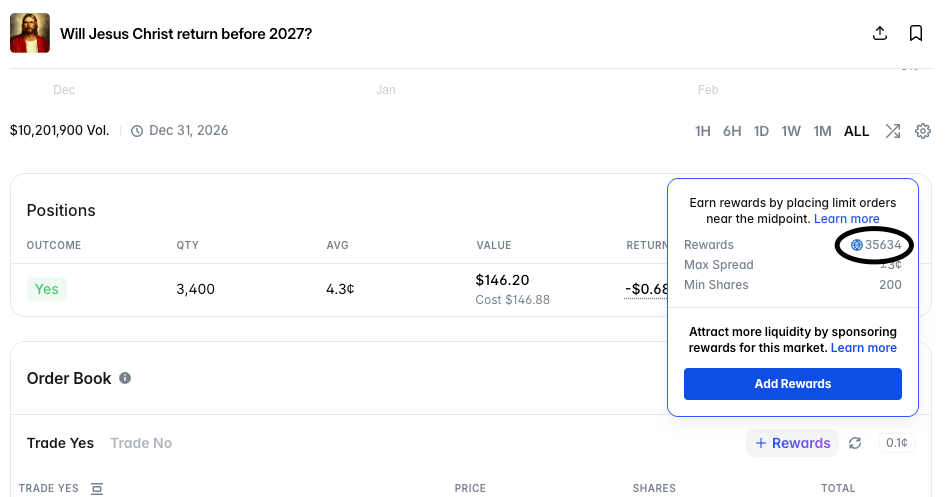
Traders and farmers flooded the order book, resulting in more than $29 million in volume traded on the market over the last 24 hours. However users have reported that they are not receiving LP rewards in line with the massive rewards pool, indicating that the Polymarket team may have disabled the outlandish incentives, though this has not been confirmed or denied by the company.
A Polymarket developer did post on X last night that the team has successfully added the option to cancel sponsorships as well, following the events.
The incident serves as a humorous way to kick off the sponsored rewards feature and the huge surge in volume proves as a proof of concept for the presumed end goal of user incentivized liquidity rewards.
While the prediction market’s 2025 was mostly defined by investment rounds, mainstream partnerships, and its ongoing rivalry with its main regulated U.S. competitor, Kalshi, Polymarket seems to be doing everything it can to boost liquidity on the platform this year.
Earlier this month, it was announced that Jump Trading invested in Polymarket in exchange for market making services on the platform. Sports markets on Polymarket are now very clearly automated by sophisticated operators as opposed to degens with homemade AMM bots, and LP incentive pools are now much larger than they were in 2025.
More Efficient Markets
At one point $200 was the max incentive Polymarket would give out for LPs. Now, the prediction market offers $500 per day to provide liquidity to an array of stock “up or down” markets. While this initial setup boosts liquidity on set markets, user sponsorships take liquidity boosting to a new level.
The feature doesn’t just benefit Polymarket either. Once market depth advances and users can incentivize more niche markets, anyone who has favorably filled an illiquid market can then incentivize said market’s spread and influence farmers to step in and make the market, thus making it more efficient.
Those providing the incentives can basically use the sponsorship markets to create their own exit liquidity at the cost of their sponsorship.
Here’s what that could look like:
Plenty of Polymarket’s markets lack liquidity, making it easy for users to get favorable fill prices when counterparties don’t understand, or misinterpret slippage. So say you, as a trader, assign a market’s true odds are somewhere around 75%, but thanks to the market’s lack of liquidity you have a low bid at 50% that gets filled.
Filling your bid at the desired level is the first step, but you still need to be able to exit that position, and if a market has little to no attention, your previous option was to simply wait for other people to notice the market and sell into the new volume.
Now you can incentivize the market with your own money — aka sponsored rewards — to potentially attract more liquidity that would, in theory, eventually bid the market to its “fair price” of 75%. That would create enough liquidity for you to trade out of the position and realize a 50% gain on the initial capital, minus the cost of your incentives.
While this mechanism is not guaranteed by any means, the new feature should allow for this kind of market efficiency, incentivized by traders themselves, instead of Polymarket needing to hand pick mispriced or popular markets to incentivize.
The increased focus on market depth comes with Polymarket token rumors hitting a fever pitch, as members of the team continue to interact with users on X as if a token is guaranteed.
However, investors have reported that their contributions to Polymarket included terms for both equity and a token, so it is unclear exactly who earns what, and exactly how much value a $POLY token would have, especially if a Polymarket IPO is inevitable.
Squiffs, resident degen at The Defiant
Forwarded this newsletter? Subscribe for daily insights and curated news from The Defiant team, Monday-Saturday. It’s free.
🎬WATCH
Robinhood’s Crypto Head Johann Kerbrat on Why Public Blockchains Will Win
In this episode of The Defiant Podcast, Cami sits down with Robinhood’s head of crypto, Johann Kerbrat, to discuss the strategic move to build on Ethereum. He believes institutions can get the privacy and compliance guarantees they need on public chains like Ethereum, so building on private chains doesn’t make sense as they are just a “fancy database.”
Watch the full interview:
Top News in the Past 24 Hours
Base Parts Ways With Optimism's OP Stack
Initially built on Optimism's OP Stack, Ethereum Layer 2 Base has decided to transition to its own codebase to gain greater control over its infrastructure and streamline upgrades. This move is expected to double the pace of its major upgrades to approximately six per year.
Why it matters: Base is by far the largest revenue driver among networks in Optimism’s Superchain ecosystem.
CME Group to Launch 24/7 Crypto Futures Trading
CME Group, the world's largest financial derivatives exchange, is set to launch 24/7 crypto futures trading on its CME Globex platform beginning on May 29, pending regulatory approval.
Why it matters: CME’s crypto futures and options volumes surged to a record high of $3 trillion in notional volume last year.
Canary Capital Launches First-Ever Staked SUI ETF
Canary Capital’s Staked SUI ETF seeks to track the spot price of SUI while participating in the Sui Network's proof-of-stake protocol, with net in-kind staking rewards reflected in the fund’s NAV. Also on Wednesday, Grayscale converted its SUI Trust product into a staked spot ETF, offering a competing product for U.S. investors.
Why it matters: SUI is currently the 31st-largest crypto asset by market cap, at $3.5 billion.
Trending on The Defiant
- Crypto Markets Fall as Bitcoin Drops 2.5% and Liquidations Near $200 Million
- David Bailey’s Nakamoto Buys His Own Bitcoin Empire at a Discounted Public Price
- OpenAI Unveils AI Benchmark Tool to Enhance Blockchain Security
- Canary Capital Launches First-Ever Staked SUI ETF
- Hyper Foundation Backs New DC Lobby with 1M HYPE for Clearer DeFi Rules
- Nexus to Launch Revenue-Sharing USDX Stablecoin
That’s it for today — if you enjoyed this newsletter, tell your friends! https://thedefiant.io/subscribe
Free newsletters
Good reporting. Delivered.
Choose your coverage: crypto and DeFi, the future of finance, or both.
Free. Unsubscribe anytime.