Jupiter Cuts Token Emissions to Zero
Plus, dust attacks on Ethereum surge post-Fusaka

Olivia Capozzalo & Denis Omelchenko
February 23, 2026
Happy Monday, Defiers!
Today’s big story:
- A governance vote at Jupiter DAO just saw token holders approve a plan to pause new JUP emissions and future airdrops.
In other news
- Fusaka fuels increased address poisoning: research
- 85% of new tokens in 2025 finished the year in the red
- Lightning Network startup partners with Cross River Bank
- Coinspect Releases Wallet Security Ranking Update [SPONSORED]
Read more below! But first, please give our sponsors some love; they make this newsletter possible.

Great crypto products don’t build payment infrastructure from scratch, they partner with Mercuryo. As the backbone behind leading Web3 brands, Mercuryo delivers global on/off-ramp rails with regulatory burden removed.
We’re back! Here’s what you need to know in web3 today
📈 Markets in the Past 24 Hours
| TICKER | VALUE | 24H | |
|---|---|---|---|
 | Bitcoin | $66,197 | -2.07 % |
 | Ethereum | $1,922.44 | -1.56 % |
 | XRP | $1.41 | 0.11 % |
 | BNB | $609.11 | -1.76 % |
 | Solana | $80.68 | -3.89 % |
Today’s Big Story
Jupiter DAO Cuts Token Emissions to Zero, Freezes Airdrops
A governance vote at Jupiter DAO saw token holders approve a plan to pause new JUP emissions and future airdrops. The DAO oversees development of Jupiter, the largest protocol on Solana by total value locked.
The vote ended yesterday, Feb. 22, and drew more than 480 million votes. About 75% supported a package that delays Jupuary — Jupiter’s annual governance airdrop — and pauses new token emissions. It also limits selling from early investors tied to Mercurial, the project Jupiter was originally built from.
An alternative option to move ahead with Jupuary as planned drew only about 25% of the vote and didn’t pass.
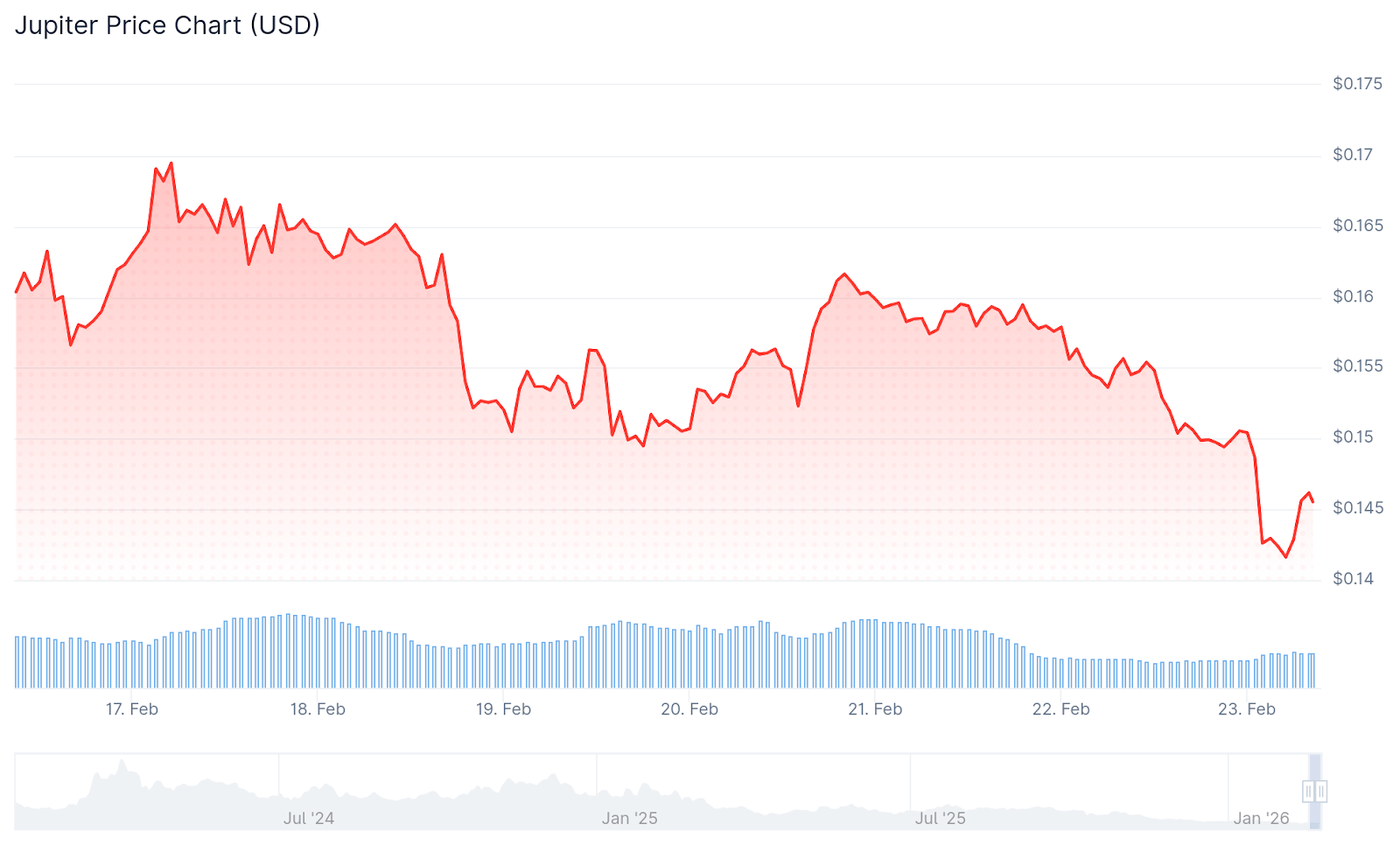
JUP 7-day price chart. Source: CoinGecko
Amid the vote, which kicked off on Jan. 17, JUP’s price dropped about 8% to $0.15 while the broader market also slipped, per data from CoinGecko.
As part of the decision, around 700 million JUP tokens — worth around $105 million — that had been set aside for Jupuary will be moved into the community cold multisig wallet. Those tokens can’t be used unless the DAO approves a new vote later on.
The plan also changes how the team is paid in tokens. Team members will no longer receive JUP directly. Instead, they will receive an internal credit, and Jupiter will buy the tokens itself if any of those allocations are sold, keeping them off the open market.
A similar approach applies to Mercurial stakeholders, who hold about 5% of the total JUP supply. Their tokens will keep vesting, but if they sell JUP to exchanges, Jupiter says it will “offset any sell pressure by purchasing an equivalent amount of JUP.”
Together, these steps are expected to cut projected new emissions from about 1.2 billion JUP to near zero, while separate buybacks, funded by half of Jupiter’s on-chain revenue, will continue as before.
Jupiter’s TVL is currently just over $2 billion and the platform combines on-chain lending, swaps and perpetual futures trading on Solana. After launching in beta just this summer, Jupiter Lend saw its TVL quickly surge above $500 million. It’s currently sitting above $1 billion, only trailing Kamino Lend with $1.7 billion.
Denis, staff reporter at The Defiant
Forwarded this newsletter? Subscribe for daily insights and curated news from The Defiant team, Monday-Saturday. It’s free.
🎬WATCH
Why DAO Governance Always Turns Political
In this episode of The Defiant Podcast, Cami sits down with Rune Christensen to discuss why DAO governance becomes a struggle for resources, how the "iron law of bureaucracy" emerges, and why Sky redesigned its architecture to survive it.
Watch the full interview:
Top News Since Friday
Fusaka Upgrade Fuels Record Address Poisoning on Ethereum
Lower gas costs have turned Ethereum into a playground for mass address poisoning, with scammers hitting thousands of wallets daily, new research shows
Why it matters: Ethereum has spent years trying to fix high network fees — but in doing so, devs may have opened the door to another problem.
Only 1 in 10 Weak Token Launches Recovered in 2025: Arrakis
An 80-page analysis by Arrakis Finance found that about 85% of tokens launched last year finished the year below their initial price.
Why it matters: Arrakis concludes that token outcomes in 2025 were largely decided by launch mechanics rather than market cycles.
Lightspark Teams Up with Cross River Bank for Fiat Payments via Bitcoin
Lightspark, a Bitcoin Lightning Network startup founded by former Meta executive David Marcus, who oversaw the development of Meta’s now-defunct crypto experiment, is pushing the idea of using BTC for everyday payments rather than long-term holding. Its latest move is a partnership with crypto-friendly U.S. bank Cross River.
Why it matters: The Bitcoin Lightning Network has had a strong but uneven run so far, and is still mostly used to move funds on and off crypto exchanges.
Trending on The Defiant
- Why DAO Governance Always Turns Political
- Base AI Tokens Outperform Altcoin Market
- Crypto Markets Tick Up Following Supreme Court Tariff Ruling
- Fusaka Upgrade Fuels Record Address Poisoning on Ethereum
- Only 1 in 10 Weak Token Launches Recovered in 2025: Arrakis
- Lightspark Teams Up with Cross River Bank for Fiat Payments via Bitcoin
That’s it for today — if you enjoyed this newsletter, tell your friends! https://thedefiant.io/subscribe
Free newsletters
Good reporting. Delivered.
Choose your coverage: crypto and DeFi, the future of finance, or both.
Free. Unsubscribe anytime.