DeFi Lending Is Different Now

Olivia Capozzalo & Camila Russo
July 01, 2025
Happy July, Defiers!
Today’s big story:
- Lenders in DeFi are back looking for safe yield, but borrowers are still tentative after the 2022 collapse
Plus:
- USDC-issuer Circle is applying to create a national bank trust in the U.S.
- First U.S. Solana staking ETF is set to launch tomorrow
- Centrifuge and S&P Dow Jones Indices launch tokenized S&P 500 index
- Can PayPal’s PYUSD grow into a true payments powerhouse? [Issue #2 of Real World — our new weekly newsletter on stablecoins and tokenizattion]
- SSV 2.0 and based applications: Decentralized infrastructure for secure, scalable Ethereum staking [SPONSORED]
- The Stellar development roadmap paves way for expansion and network scalability [SPONSORED]
Read more below! But first, please give our sponsors some love; they make this newsletter possible.

DIA launches $DIA Staking and Oracle Grants with 20 chains, including Arbitrum, BNB Chain, and Avalanche. Power your dApp with trustless oracles, cost-free.

Money is broken. Finance today is trapped in analog while the world runs on code. M0 rewires finance at its core. This is financial infrastructure for builders who create, not extract.

Flare brings XRP to DeFi — trade, lend, and stake it for yield opportunities, within a rapidly growing DeFi hub that has seen 200% growth, powered by its enshrined data protocols.
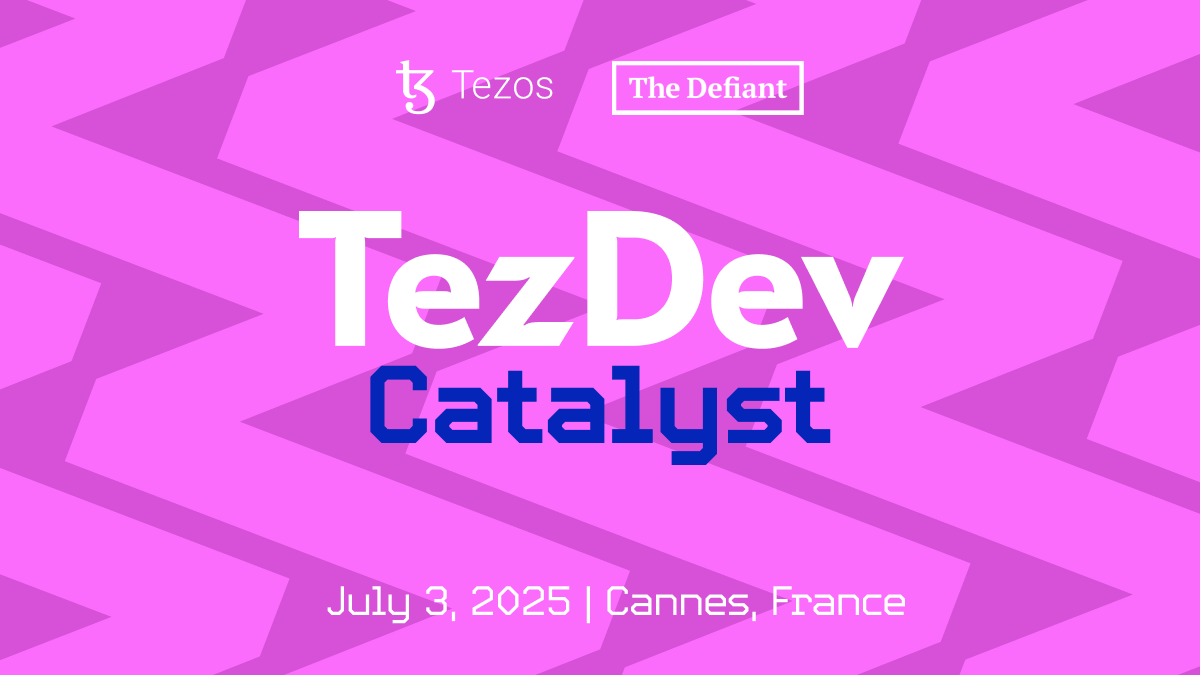
Final Agenda Drop: Arthur Breitman in Conversation with Camila Russo + Surprise Game Reveal
TezDev 2025 is nearly here! Don’t miss Arthur Breitman live fireside chat with The Defiant’s Camila Russo, an exclusive game reveal on Etherlink, and deep dives into DeFi, RWA, and digital art. Full agenda now live — join us July 3 in Cannes!

DIA Infra Gardens V7 During EthCC | July 2 | Cannes
Infra Gardens returns for its 7th edition — this time in Cannes during EthCC 2025. Join top infra builders from Arbitrum, DIA, Conduit, Goldsky, Dune, Symbiotic, and more for panels, workshops, and poolside conversations in a tropical villa setting.
→ RSVP now: lu.ma/InfraGardens-Cannes
We’re back! Here’s what you need to know in web3 today
DeFi Lenders Are Back, But Borrowers Are Still on the Sidelines
DeFi lending is booming again — sort of.
Lending deposits in decentralized finance are climbing back to their 2021 all-time highs, nearing $69 billion. But take a closer look, and the story gets more nuanced: outstanding loans are still stuck around $28 billion, well below the almost $33 billion peak of the last bull cycle, according to Artemis data.
In plain terms: DeFi is flush with lenders, but light on takers.
This divergence tells us a lot about where the crypto market’s mindset is right now.
Lenders Are Ready — Borrowers, Not So Much
The deposit side tells us that there’s growing confidence in DeFi rails. Investors are actively hunting for yield again, parking their assets in lending protocols as they wait for the next big opportunity. But the borrowing side? It’s still cautious. This isn’t 2021. Traders aren’t maxing out leverage to ape into every new memecoin or NFT pump. At least not via DeFi lenders.
Lending deposits all-time chart. Source: Artemis
The subdued borrowing means rates are still relatively soft, especially compared to double-digit yields of the DeFi summer frenzy. It’s a sign that despite all the capital flooding back into protocols, the engines of leverage haven’t kicked into high gear yet.
Lending outstanding loans all-time chart. Source: Artemis
Lagging outstanding loans versus deposits is also a sign that DeFi traders have found faster, more direct ways to take on leverage. In the last cycle, Aave or Compound were pretty much the only place in DeFi to lever up. Now, traders can skip the borrowing step entirely with on-chain perpetuals platforms like Hyperliquid, which let traders go long or short with built-in leverage of up to 50x without having to touch lending protocols. The leverage is baked into the product, not sourced from a separate lending pool. The result? Leverage has gone elsewhere.
Aave Rules, but Competition Is Creeping In
When you zoom into who’s actually powering this lending resurgence, it’s clear Aave is the undisputed heavyweight, at about 40% dominance. Its share of the market is even larger now than during the last cycle, commanding the biggest slice of active loans by far.
Among other lending protocols, Maker is holding steady, still spinning out DAI as a major source of decentralized liquidity.
Compound, though, is a fading star. Once neck-and-neck with Aave, it has steadily ceded ground and now plays a much smaller role in the market.
What’s different this time is the rise of new players.
Protocols like Spark (built by the MakerDAO ecosystem), Morpho, Venus, Sonne Finance, Maple and Seamless are starting to carve out market share. Venus is gaining serious traction on BNB Chain, and Spark is making a quiet but firm push tied to Maker’s growth strategy. The lending landscape is getting more fragmented, more competitive, and more multi-chain.
The Missing Liquidity from CeFi
Here’s what’s striking: all this lending activity is happening without the return of a huge chunk of liquidity that vanished when CeFi lenders imploded.
At their peak, Celsius, BlockFi, and Voyager controlled nearly $46 billion in customer assets. Celsius alone managed more than $25 billion in 2021. After these centralized lenders collapsed in 2022, you’d expect that money to come flooding into DeFi, but it hasn’t — at least not in full.
Maybe some of that capital went into the on-chain perps that we mentioned before, or maybe they moved to more compliance-focused CeFi platforms like Coinbase. And some may just be sitting on the sidelines, waiting for clearer regulatory paths or better yields.
That missing liquidity is a reminder: we’re not yet at peak euphoria. There’s still dry powder that hasn’t fully returned since the major centralized collapses of 2022.
Here’s the TL;DR:
- Lenders are back. They trust DeFi’s infrastructure, they’re looking for safe yield, and they see on-chain protocols as more resilient post-CeFi collapse.
- Borrowers are still tentative. Leverage isn’t back in full on DeFi lenders, risk appetite is subdued, and the market is behaving more conservatively.
- The power map is shifting. Aave is king, but new challengers like Spark, Morpho, and Venus are making moves. The DeFi lending stack is getting more competitive and more distributed.
- CeFi’s collapse left a hole. All of that liquidity hasn’t found a new home yet. And until it does, DeFi’s lending growth will likely stay methodical, not manic.
DeFi is alive, growing, and maturing. But it’s still waiting for its next big risk-on moment to bring back the full energy of the last cycle.
With love,
Cami, founder of The Defiant
📈 Markets in the last 24 hrs:
| TICKER | VALUE | 24H | |
|---|---|---|---|
 | Bitcoin | $106,642 | -0.62 % |
 | Ethereum | $2,429.17 | -1.26 % |
 | XRP | $2.2 | 0.57 % |
 | BNB | $650.22 | -0.46 % |
 | Solana | $147.96 | -2.46 % |
 MessariPortals MessariPortals | MINDSHARE Rank | MINDSHARE % Change (7d) |
|---|---|---|
 | MINDSHARE Rank | MINDSHARE % Change (7d) |
 |  | 74.01% |
 | | 11.95% |
 | | 115.25% |
| Powered by Messari Portals | ||
This is the news that mattered in the past 24 hrs
- Circle — the company behind the second-largest stablecoin by market cap, USDC — is applying for a national bank trust license in the U.S., CEO Jeremy Allaire told Reuters; if approved, Circle would be able to custody its own reserves.
- The first ETF tracking the spot price of SOL — as well as the first staking ETF — in the U.S. is set to launch tomorrow, July 2; news of the REX-Osprey™ SOL + Staking ETF’s launch date sent the price of SOL up by nearly 4.5%, before retracing over the past 24 hours.
- Top-10 RWA platform Centrifuge and S&P Dow Jones Indices announced the launch of a tokenized S&P 500 Index fund in Cannes yesterday; the partnership marks one of the first times the S&P DJI has allowed its index data to be used on-chain.
- In the latest issue of Real World, we take a deep dive into PayPal’s PYUSD, looking into the ecosystem, what it’s used for, and whether there’s any real traction; plus we give you the most important stories in stablecoins and tokenization from the past week. → Sign up here to get Real World in your inbox every week.
🎬WATCH
On the latest episode of The Defiant Podcast, Vinny spoke with Vikram Arun, CEO of Superform, about the evolution of stablecoins as a financial tool, why automation is critical for DeFi growth, and whether 20% on-chain yields are truly sustainable in today’s crypto economy.
That’s it for today — if you enjoyed this newsletter, tell your friends! https://thedefiant.io/subscribe
Free newsletters
Good reporting. Delivered.
Choose your coverage: crypto and DeFi, the future of finance, or both.
Free. Unsubscribe anytime.