Balancer and Stream Shake Confidence in DeFi

Camila Russo & Olivia Capozzalo
November 04, 2025
gm, Defiers
Today’s big story:
- The past two days have seen the hack of an established DeFi protocol, and the collapse of a newer platform, deeply shaking confidence in the sector — while the full fallout remains to be seen.
In other news:
- Aave DAO approves annual buybacks
- USDE market cap drops 40% since 10/10
- Prediction markets break new ATHs
- Fawzi Hamze X Interview [SPONSORED]
Read more below! But first, please give our sponsors some love; they make this newsletter possible.

High Gain is a professionally managed vault that's designed to bring you up to 20% rewards on ETH, delivering blue-chip strategies through a one-click deposit.
We’re back! Here’s what you need to know in web3 today
📈 Markets in the Past 24 Hours
| TICKER | VALUE | 24H | |
|---|---|---|---|
 | Bitcoin | $100,147 | -6.70 % |
 | Ethereum | $3,267.01 | -10.56 % |
 | XRP | $2.18 | -7.70 % |
 | BNB | $910.29 | -8.91 % |
 | Solana | $153.42 | -9.21 % |
Today’s Big Story
Balancer and Stream Shake DeFi to Its Core
DeFi is having its toughest week this cycle. Within days, two massive crises hit the ecosystem.
First came the Balancer v2 exploit, a blow to one of Ethereum’s most battle-tested protocols. Then came Stream Finance’s $93 million loss and the ensuing xUSD yield token collapse. Together, they’ve shaken confidence in decentralized finance at a time when optimism was peaking — just as institutions have been eyeing DeFi rails through stablecoins and tokenized assets.
The Balancer v2 Hack
Balancer opened the week on a grim note. The protocol, one of DeFi’s oldest and most respected automated market makers, saw its v2 vaults exploited for roughly $115–$128 million according to PeckShield.
Audited by Trail of Bits, OpenZeppelin, ABDK and Certora, Balancer had long been considered a model of robust engineering. Its vault contracts have safely held hundreds of millions in total value locked for years. Yet it still fell victim to a sophisticated attack that exploited a logic flaw in the v2 vault layer, letting the attacker drain liquidity across multiple chains and Balancer forks.
The feeling that it can happen to anyone quickly dawned on DeFi traders, along with the question of who’s next. Even battle-tested, repeatedly audited code isn’t bulletproof. Every new DeFi primitive inherits layers of complexity, and multiplies the attack surface.
And most protocols still lack meaningful user protection. On-chain insurance has never truly taken off. Now, once again, thousands of users are left wondering whether they’ll be made whole.
This moment should serve as a wake-up call: insurance must be built in. Every DeFi protocol should maintain a reserve fund dedicated to compensating users in case of catastrophic failures. Maybe there are smarter ways to do this, but a safety net / rainy day fund sounds like a good first step.
The Stream Finance Fallout
Just as the Balancer shock was settling, Stream Finance announced a $93 million loss in its yield funds, and its flagship yield token xUSD promptly cratered from above $1.20 to as low as $0.30.
While not a hack, Stream’s collapse is raising red flags about two of the most popular trends in DeFi this cycle: looping strategies and curated lending markets.
Looping strategies involve borrowing and re-depositing the same collateral repeatedly to amplify yield. It’s a recursive feedback loop: Deposit, borrow, redeposit, borrow again. That can create 10x leverage on the same base capital.
When markets are calm, it magnifies returns. But all it takes is for collateral to wobble or an oracle to lag, and the entire system can unwind.
Stream took the looping strategy even further, recursively minting xUSD to boost leverage to obscene levels. The event shows how composability cuts both ways: when one leg of a strategy — a vault, pool, or oracle — fails, every dependent position collapses simultaneously. Going forward, protocols may need to impose looping caps or dynamic collateral limits to contain systemic risk.
Curators Under Fire
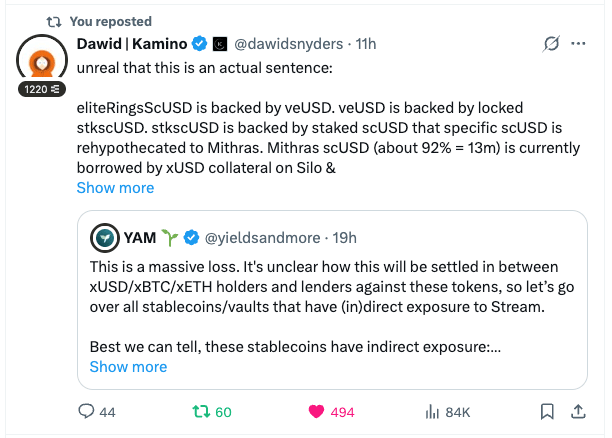
Then there’s the issue of curators – third parties empowered to design and list markets in permissionless lending systems like Morpho Blue or Euler. Curators set parameters, choose oracles, and approve assets, often earning a cut of the interest but without bearing full downside risk and without always disclosing their strategies.
That setup is powerful for scaling DeFi, but it also blurs accountability. Some curators have listed exotic or opaque assets without proper disclosure, and users often have no idea how their funds are being rehypothecated.
In Stream’s case, some funds reportedly took leveraged positions that depositors didn’t fully understand, an echo of Celsius, the centralized lender that imploded in 2022.
If DeFi is to mean anything, it must be open and transparent by design. Every user should be able to see on-chain how their capital is being used and what risks they’re taking. Otherwise, we’re just rebuilding the same opaque systems DeFi was meant to replace.
The Broader Picture
All this is happening less than a month after the 10/10 liquidation wave, which many now suspect took out funds and overleveraged players. That crash, followed by this week’s exploits, suggests deeper structural fragility beneath the surface.
And it comes right as sentiment was turning bullish: stablecoins are going mainstream, tokenization is entering traditional finance, and institutions from PayPal to Western Union are experimenting with blockchain rails.
For a moment, it looked like DeFi was ready for its mainstream moment. Now, the industry must reckon with the fact that transparency and risk management haven’t kept pace with innovation – again.
DeFi doesn’t need to be risk-free. But it does need to be honest.
With love,
Cami, founder of The Defiant
Forwarded this newsletter? Subscribe for daily insights and curated news from The Defiant team, Monday-Saturday. It’s free.
🎬WATCH
Institutions Want Bitcoin Yield — Threshold Is Building the Bridge [SPONSORED]
Institutional Bitcoin treasuries are coming but they won’t touch DeFi unless the liquidity, custody, and risk models meet their standards.
Threshold (TBTC) is building that bridge. In this interview, we break down how TBTC is competing with WBTC, why full decentralization alone isn’t enough, and why Threshold is now designing hybrid custody solutions to connect DeFi with the emerging wave of Bitcoin treasury companies (DATs). We also discuss adoption signals on Aave, real BTC collateral usage, governance structure, and the roadmap toward sustainably scaling Bitcoin finance beyond token incentives.
Top News in the Past 24 Hours
- Aave DAO Makes $50 Million Annual Token Buybacks Permanent The Aave DAO has approved a proposal to make its AAVE buyback program permanent, allocating $50 million per year from protocol revenue to repurchase tokens. Why it matters: While token buybacks are generally considered bullish for price, $50 million represents a relatively small share of AAVE’s $2.8 billion market cap.
- Ethena USDe Market Cap Drops 40% After ‘Black Friday’ October 10 Crash Ethena Labs’ synthetic dollar-pegged token Ethena USDe (USDE) has lost over $5 billion of its market capitalization since the Oct. 10 market crash, after the asset experienced a major stress test. Why it matters: Ethena processed almost $2B in USDE redemptions on Oct. 10-11 alone; when traders redeem USDE, the tokens are burned, removing them from total supply.
- Sports Betting Pushes Kalshi and Polymarket Volumes to All-Time HighsIn October, Kalshi processed $4.4 billion, and Polymarket recorded $3 billion in volume, new all-time highs for both venues.Why it matters: While election markets are still generating hundreds of millions in volume, other niches, namely sports betting, are boosting volume metrics further.
Trending on The Defiant
- Crypto Community Divided on DeFi Trust Implications After $128M Balancer Exploit
- Ethena USDe Market Cap Drops 40% After ‘Black Friday’ October 10 Crash
- Crypto Markets Start November in the Red as Bitcoin Dips Below $108,000
- T3 FCU Has Frozen Over $300 Million in Illicit Funds
- Maple’s SYRUP Stakers Vote to End Staking Rewards, Launch DAO Treasury
- Bitcoin Scrambles to Close October in Green as 2018 Sell-Off Shadows Loom
That’s it for today — if you enjoyed this newsletter, tell your friends! https://thedefiant.io/subscribe
Free newsletters
Good reporting. Delivered.
Choose your coverage: crypto and DeFi, the future of finance, or both.
Free. Unsubscribe anytime.