Unstoppable Domains' Matthew Gould Unpacks Digital Identity in Web3
This week on The Defiant Podcast, Camila Russo chats with Matthew Gould, the founder and CEO of Unstoppable Domains.
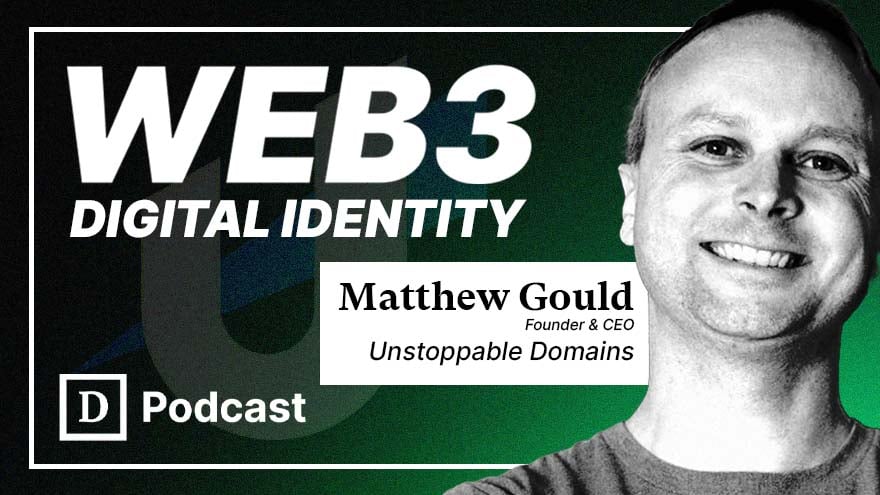
Unstoppable Domains is a service that facilitates the creation of blockchain-based domains that users own to build and verify their digital identity and login into applications, games, metaverses, and much more.
In our conversation, we unpack the concept of digital identity in Web3 and discuss where the market is headed.
But first, Matthew explains the importance of having a blockchain-based domain name service.
Listen to the interview in this week’s podcast episode here:

Thanking our podcast sponsors:
- MetaMask Learn is an educational and entertaining platform designed to immerse you in the world of web3: what it is, why it matters, and how to get started. You will learn core concepts in visually engaging lessons from the world’s leading self-custodial wallet.
Background
Matthew Gould moved to San Francisco to work at a startup focused on ad tech, where he analyzed data to encourage more product purchases. In his free time, he explored the world of cryptocurrency by attending Bitcoin meetups and participating in hackathons with friends.
He eventually landed on NFT domains as a way to create a portable reputation online, which he believed had great potential for making it easier for people to use crypto.
Matthew and his friends were one of the first teams to put a blockchain-based domain name into an ERC-721 format. Since then, millions of people have used domain names instead of regular addresses to send and receive crypto.
The Basics
What Unstoppable Domains is, and why we need a decentralized blockchain-based domain service.
Unstoppable Domains is a service that creates web3 domains or NFT domains, which are unique domain names that can be used to send and receive cryptocurrency instead of using long, complex hex addresses.
These domain names include extensions like dot eth, dot nft, and dot crypto. Unstoppable Domains has been working on this for five years and is one of the larger services in this space.
In addition to simplifying crypto payments, Unstoppable Domains allows users to add information about themselves to their NFT domains, which can function as their identities in the crypto world. This information is visible through reverse resolution, meaning that when someone looks up a cryptocurrency address on a blockchain explorer like Etherscan, they can see the associated NFT domain name.
This concept of owning one’s reputation and data on the internet is a key feature of web3, and Unstoppable Domains is a leader in this space by providing blockchain-based domain names that give users more control over their online identities.
I think the concept of using human-readable names instead of long addresses to send and receive information or crypto is a bit confusing for someone new to this use case, especially since it is different from actual website domains.
However, it started as a way to make sending and receiving information or crypto easier, similar to email. Although it initially did not have the same use case as website domains, it has evolved to be able to serve as one. I am not entirely sure how this use case differs from traditional web2.
In web2, the DNS system only allowed for an easy way to look up IP addresses for websites through .com and other domains, but it did not generalize the process to include other computing resources with domain names.
Web3 domains, such as NFT domains, take the next step by allowing for any kind of lookup to be associated with a name that can be owned with a personal wallet, allowing individuals to update their addresses themselves instead of relying on a developer.
Web3 is more consumer-oriented and extensible, allowing for a digital presence to be created and customized with different types of information, such as social profiles and Bitcoin or Ethereum addresses.
I believe that eventually, web2 protocols will migrate onto the web3 infrastructure, or the web3 infrastructure will become backward compatible with web2.
This is a technology upgrade for naming services in general. I think it’s actually pretty revolutionary mostly because it puts the power back in the hands of the individuals for all the information.
Benefits of Decentralized Identity
- Log in to different web3 apps and bring your contacts and data with you, creating a more customized and efficient experience.
- Users can add more information to their ID, such as NFT collections or social profiles, and verify their identities on different platforms. This can help prevent application lock-in, where users are limited to using certain apps due to network effects.
Potential Risks
- People losing their keys.
- Difficulty in managing keys, backups, and recovery.
- Slow adoption of new standards.
- Lack of education among consumers and developers.
- A change in user behavior is required to incorporate identity information into apps.
- Difficulty in saving user information for future use.
- Difficulty in building consensus and implementing changes across multiple naming services.
Recently, we introduced the Web3 Domain Alliance, which aims to establish standards for lookup procedures and collaborative work with various naming systems. Our objective is to consolidate all these aspects so that several naming services can be resolved with the same fundamental code, which we believe will be extremely beneficial.
What’s the difference, for example, between ENS and Unstoppable Domains?
Each naming service differs in terms of how they function. Some have renewal fees, while others, like Unstoppable Domains, do not. Some are closely associated with specific blockchains, like ENS with Ethereum, Sol with Solana, and Tez with Tezos. Some naming services are even funded by the blockchains they are associated with and are targeted toward their respective communities.
The extensions for each naming service are also different and can be blockchain-specific, generalized for the crypto industry, or related to specific themes like artists and creators. These naming services also differ in brand, target audience, and partnerships.
ENS was the first team to create the first blockchain domain in NFT form, and Unstoppable Domains was the first to allow logging in with a domain name. Signing with Ethereum is also growing, and there are hundreds of applications integrated with different naming systems.
3.2 Million Domains
The company has recently achieved significant growth in two areas: domain registrations and live integrations. They now have over 3.2 million domain registrations and 744 live integrations, which is a substantial increase from their previous numbers in 2020, when they had less than a million domains and fewer than 100 integrations.
Unstoppable Domains has experienced 10x growth during this cycle, although the market has slowed down due to the current “crypto winter”. They are currently focusing on improving its products and user experience, with the goal of attracting more people to the crypto and NFT markets over the next couple of years.
When you talk about integrations, what’s an example?
Digital identity can be used in many different places, such as sending cryptocurrency where people need to look up your address. This includes all wallets, and if your wallet is not integrated yet, please contact us to do so.
Integrations allow people to look up the recipient’s name instead of copying and pasting multiple addresses. Browsers like Brave and Opera are also examples of platforms we integrate with, as people often look for website information. Decentralized applications, like those used for minting NFTs, can also benefit from digital identity verification.
By connecting your domain through Unstoppable, you can improve the user experience by providing more information about yourself. Our goal is for this to become the standard for how people interact in crypto.
In the future, you should see ways to connect your domain or send crypto to a domain everywhere you currently see an address or connect wallet button.
Metamask Integration
Metamask is a type of wallet, and an Unstoppable Domain is the name assigned to the wallet. We don’t do any DeFi transactions and don’t sell cryptocurrency or anything like that.
By setting up a name within the Metamask wallet, such as “cami.nft” it becomes easier for others to send money to that wallet. This could generate more revenue for both the naming service and the wallet through trading, buying NFTs, and making money on swaps.
Additionally, the wallet itself could profit from this collaboration. The overall goal is to bring more information to the wallet app and make it easier for users to manage their finances.
But could you still log in to a web3 app using just your domain and no wallet?
We recently used Wallet Connect. When using Wallet Connect, you log in with your domain name instead of having to search for wallet information. Once you type in your domain name and hit enter, the signature is sent directly to your default wallet. You still need a wallet, but Unstoppable Domains makes it easier by allowing you to use your domain name to connect to apps without having to scan for Wallet Connect every time.
The wallet connection protocol pushes notifications to your mobile wallet. The aim is to make using your wallet easier and more convenient, enabling you to deposit money and connect to apps effortlessly.
Wallets also have the opportunity to upsell other products and services to users as they add more information to their domain names, such as sign messages to prove identity or buy certain products and services. Many wallets already resell DeFi products.
From 0 to 3M
We utilized marketing partnerships to great effect by leveraging our partners’ existing relationships with their customers. For example, when we launched with blockchain.com, they introduced the new dot blockchain domain extension to their customers and explained how it could benefit them. This was very helpful as it allowed us to tap into an established customer base.
Social media was also a key factor in our success. Dot ETH was particularly successful on Twitter in 2021 and 2022, generating excitement about using ETH as an identity and encouraging people to register their dot ETH names to show off their digital ID on Twitter. This success spilled over to dot NFT and dot crypto, with social media being a key channel for us.
- Our success in the web3 market in 2021 and 2022 can be attributed to partnerships and social media.
- The recent wave of people entering crypto has benefited the company tremendously.
- The product makes sense to people because they understand what a domain is and can easily comprehend what an NFT domain is.
What’s Next
- We believe that the best way to reach consumers is by being where they are, which means every app or wallet they connect to should have a way for them to get a domain as simply as possible.
- We want to become a standard part of the web3 experience, just like downloading Metamask is typically the first step for users when they start using crypto.
- The company wants to pair wallet onboarding with getting a domain so that users have a name to start with, which can potentially make it easier for them to use web3.
What TLD (top-level domain) is the most popular?
In my opinion, dot crypto is the most popular domain overall because it has been around the longest. However, on a monthly basis, the top three domains are dot NFT, dot X, and dot wallet. Dot X is popular due to its short length, while dot NFT has seen a surge in popularity due to the NFT boom last year. Dot wallet is also popular because it is associated with people’s wallets and was launched with 20+ wallet partners. Other domains, such as dot DAO, dot bitcoin, and dot blockchain have also been performing well.
Domain Squatting
I think protecting brand names is a huge problem, but my company has done a good job with our brand protection program. We tried to participate in the web2 process for getting brand and trademark owners their domain names, but we were not allowed to because blockchain domains were not allowed to participate.
We built our own process and curated a list of several hundred thousand protected domains and notable people to prevent squatting. Although there have been some bad actors, the majority of people who register these domains want to get them to the right owner. We have put processes in place to protect names, and if a name is already given to a brand, it will show up as protected or taken on our website to prevent squatting and extortion.
Has there been a lot of buying and selling of Unstoppable Domains, and have there been any high-profile sales?
- Generic terms have sold for 80-90 ETH and have seen a lot of success.
- ENS has had a lot of success with numbered domains (e.g. 123.eth).
- This happened with .com domains in 1999 before they crashed.
- The company emphasizes usage over speculative secondary sales, wanting users to buy their names and use them to connect with their applications.
- Domains have an underlying use case for making life easier in web3, which will build a sustainable business over the next few years.
Unstoppable Domains Business Model
Unstoppable Domains has a business model based on selling identity services on top of domain names. They do not charge an annual renewal fee for domain names; instead, they want to sell additional services to domain name owners, such as backup and recovery services for domain names, verification services, and storage services for data associated with the domain name.
Unstoppable Domains believes that in the future, domain names will become a person’s identity on the internet, and they will be able to offer a range of services based around recovering domain names, the data associated with them, and verifying digital identities.
By not charging renewal fees, they hope to get domain names into as many people’s hands as possible and then sell additional services to these users.
- Unstoppable Domains sells unique blockchain-based domain names that cannot be censored or taken down by any centralized authority.
- The company offers a wide range of domain names with prices ranging from a few dollars to hundreds of thousands of dollars for premium domains.
- The median price for a domain name on the platform is $20.
- Unstoppable Domains provides guides and tutorials on how to set up and use the domain names, including how to connect them to web3 assets like NFTs and sign transactions.
- The platform’s business model is based on selling domain names and providing value-added services to help customers use and maximize the benefits of their domain names.
- The company’s target market includes individuals, businesses, and developers who want to build decentralized applications or websites on blockchain technology.
Do you receive fees/royalties from secondary trading?
We do not have that built into the model. Although it has been technically explored, it is not a priority at the moment, but may be considered in the future.
Can you say how much revenue has been generated far from selling domains?
I’d have to check. I know we’ve done over $80M in the past several years, selling domain names. I just don’t know what our most recent up-to-date number is. What is significant? There’s a pretty big market here. I think that the market ultimately is going to be much larger than that.
Reputation Based Lending
How close are we to being able to use a web3 identity to take out a loan, for example?
Issuing a credit line on the blockchain is possible if the right lender is found and an identity verification process is agreed upon. It would not require a credit card but would need a credit score tied to a person’s identity. The challenge is finding a market need for this type of credit without collateral.
I believe that people prefer collateral when borrowing to buy cryptocurrency because it provides a sense of security. While traditional lenders already offer options like home equity lines, I haven’t seen a strong use case for non-collateralized lending within the crypto ecosystem.
However, I think that reputation will play a significant role in enabling trust relationships and non-collateralized lending in the future. By building up a reputation over time, individuals can establish trust and access credit based on their past performance. Web3 use cases can compile various data points about individuals to create profiles people can trust, but this will take time to develop.
This concept of building a profile around your interactions in web3 will build up reputation, which then will allow you to do more trusted things like loan money to each other or give people opportunities based on what you know about that person.
What we’re trying to do with Unstoppable Domains is to make it easier for you to gather all your information from different places and put it into your profile. We have profiles for domain names, like sandy.nft, where you can see your information and all the apps you’ve used, and even earn badges for them.
We’re also exploring the idea of displaying your DAO voting record. Building a profile of your Web3 interactions will enhance your reputation and allow for more trustworthy transactions like loaning money or giving opportunities to others.
Web3 Credit Score
I remember the Degen score. People don’t realize this, but you actually have a couple of hundred credit scores right now. In the future, people may have dozens or even thousands of credit scores in web3. I believe there needs to be a standard for credit scores, but it’s also okay for people to create their own scores and make them public. NFT Domains could be a good fit for this. The goal is to make it easier for people to verify information about themselves and have a single identity for reputation on the internet.
What about how easy it is for anons to start over and get a new address if they did something bad or didn’t pay back their loans? You don’t have the history, but you also don’t have the bad defaults or bad stuff.
If I do a good job building out my online profile, it will become more expensive for me to build a new one in the future. This is because I would need to invest years into building up my reputation again before I can take advantage of other people.
There are tools being developed that will tie negative information back to me more easily. For example, if I do something negative under another address and someone is able to verify that it was me, it will show up on my reputation. In the future, my reputation may follow me even if I try to get around it.
There will always be hackers who can get around these types of things, so it’s about raising the cost of doing the wrong thing to make it less common. Reputation networks can help do this, and if platforms like Twitter had stronger reputation systems, bots would be more expensive.
We may never get rid of the wrongdoers entirely, but we can make it more expensive for them to do the wrong thing and hopefully make the internet a better place for everyone.
Privacy
Having all your information in a public address sounds like a problem. How do you think that can be solved?
I believe privacy is crucial, and that’s why we allow users to modify the privacy settings of the data they share on their profiles. It’s important to have both on-chain and off-chain data, but if you want to keep on-chain data private, you can encrypt it or publish a hash or proof of it. However, it’s better to store the raw data off-chain to avoid compromising your privacy.
For example, when logging in to an app, the app can request access to your off-chain data, and you can grant or deny access. This way, your data remains private, and it doesn’t show up on-chain.
In the future, I think advanced cryptography can enable us to share data without compromising our privacy. This is where technologies like zk-rollups and zk-proofs come in, and I believe this will make web3 much more privacy-oriented than web2.
We’re waiting for these technologies to mature, and we plan to integrate them into NFT domains. This will allow users to toggle on and off different privacy features with their domain names. We’ll continue to improve these features over time, and I believe it’s already better than what web2 offers in terms of privacy.
$65M Funding Round
What’s the big milestone that you’re trying to achieve with this amount of money?
- Our primary focus is on utility, and I want to see an increase in the number of people who actively use web3 technology in their daily lives.
- Currently, there are only a few thousand daily active users for web3, which is low due to the bear market. We are trying to increase the number of monthly active users to the right, which is a key product progress indicator in the web3 space.
- I want to see the number of monthly active users engaging with the apps grow 10x year over year in the next three years.
- The metrics we are tracking for Unstoppable Domains are integrations and the number of monthly active users engaged with the technology.
The people right now using their web3 domain as an identity online it’s in the low thousands. We would like to see that number, I guess in three years, be in the low millions.
Free newsletters
Good reporting. Delivered.
Choose your coverage: crypto and DeFi, the future of finance, or both.
Free. Unsubscribe anytime.