Synthetix, DeFi Summer 2, FTX, 3AC and Crystal Meth with Crypto OG Kain Warwick
This week on The Defiant Podcast, Tegan Kline chats with Kain Warwick, crypto OG and founder of Synthetix.
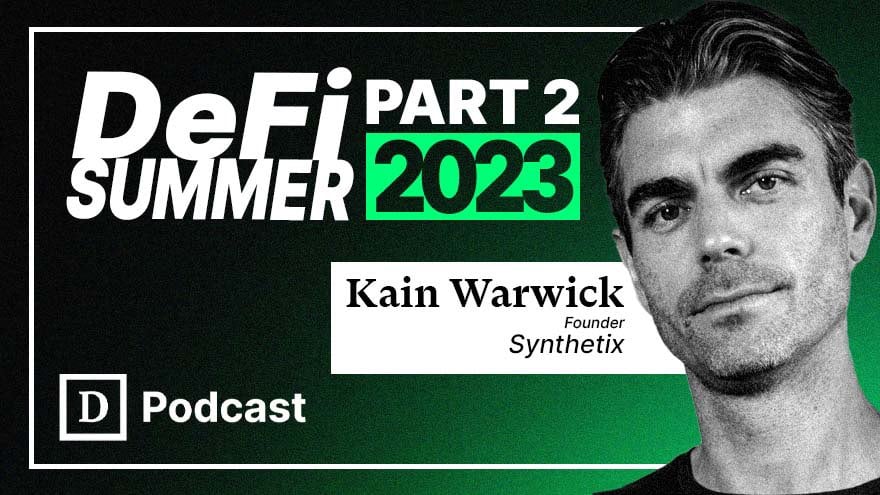
Synthetix is a new financial primitive enabling the creation of synthetic assets, offering unique derivatives and exposure to real-world assets on the blockchain.
Today, we dive into what’s next for Synthetix with the latest V3 launch, and what will cause the next big leg up in DeFi – what we’re calling DeFi Summer 2.
We go on to discuss the differentiation between different perpetual products that exist in crypto, and how Synthetix made the decision to launch on a Layer 2 so quickly and burn all bridges behind them. And it gets pretty spicy with some tea on FTX and 3AC.
Before we dive into it, Kain tells us what he’s been up to since we last spoke to him about what it takes to scale Ethereum.
Listen to the interview in this week’s podcast episode here:

Thanking our podcast sponsors:
- MetaMask Learn is an educational and entertaining platform designed to immerse you in the world of web3: what it is, why it matters, and how to get started. You will learn core concepts in visually engaging lessons from the world’s leading self-custodial wallet.
- Store your tokens safely. Go self-custodial with 1inch Wallet.
Backstory
In 2014, I ran a payment gateway called Blue Shift in Australia. The goal was to allow people to convert fiat currency into digital currency, although we weren’t specifically targeting crypto at the time. The fiat-to-crypto use case became very popular, and Blue Shift now has over 2,000 locations in Australia where people can make these conversions, among other things.
I got interested in the payment space through my work in online retail. Bitcoin intrigued me because it presented an opportunity to solve online payment issues. Despite various narratives that have emerged in the Bitcoin space, my entry point was through the genuine, unsolved problems in online commerce, which even established payment companies like Stripe and PayPal were not addressing. For me, crypto was the solution.
DeFi Summer and Adoption
It’s important to note that it wasn’t as big as people make it out to be. There were only about 50 people involved, communicating through Telegram groups and discovering new yield farms. The same group of people was involved in building these yield farms and participating in the DeFi summer events. This initial activity, though insular, laid the foundation for the DeFi movement that we see today. It proved that smart contracts could work, money could be made and lost, and it was a functional entity.
During the DeFi Summer, transaction costs became very high, which caused concern for many people in the space. Synthetix contracts were complex, and deploying smart contracts on Ethereum was different back then, resulting in high transaction costs of $3 versus a dollar. This was meaningful money for many people, causing complaints about paying $8 to claim things.
When DeFi Summer kicked off and the March 2020 crash occurred, it became clear that the network couldn’t handle the amount of activity on it. With too many interconnected systems and arbitrage transactions, it became impossible for Ethereum to handle the kind of networking required between them, resulting in transaction costs blowing up to $300-$400 just to get a transaction on-chain. It was impossible to support a million users on Ethereum because it was too expensive.
Migrating to Layer 2
We would often handwave the complexity of the high cost of using Synthetix and assume that someone else would solve the scaling issue. I personally listened to Vitalik promise us in 2017 and 2018 that scaling was coming with ETH 2.0, so we didn’t worry about it too much.
However, as the adoption of DeFi grew, the high cost of using Synthetix started to impact us. It became a problem for our adoption within the DeFi community, as people would write off Synthetix because of the high costs. We knew we couldn’t handwave the issue anymore, and we needed a solution. When solutions like Optimism and the Unipig demo appeared, Synthetix was quick to jump on it.
We knew it was important to have a seat at the table in shaping the network’s future, and we were optimistic about the value we could add. We understood that going all in was not the right choice for everyone, but we believed in the long-term benefits. Sharing our experiences with the early work on Optimism and building a symbiotic relationship with the team was invaluable for the space.
Today, there are multiple scaling solutions available, such as Optimism, StockWare, and Stocknet. What matters most to me is that they are all within the Ethereum ecosystem, and we now have the scaling we need.
Where do you think we’re headed with DeFi? Obviously, we do have some product market fit, but what do you think will give DeFi that next leg up?
I believe that where we currently stand is similar to the position of the press during the anticipated Defi Summer 2 of 2020, which never came to fruition. We did have a DeFi 2 phase that focused on the adversarial aspects of DeFi, which was exciting but not sustainable.
By the time people turn up this cycle, we’ll be ready to offer a range of non-custodial solutions to the things that people want to do. They want to be able to trade, they want to be able to transact with one another. They want to be able to play games, they wanna be able to do all this stuff. And I think we will be ready this time. I hope we’ll be ready.
The idea of a DeFi Summer 2 has been around since the original DeFi Summer in 2019, and I believe that now, four years later, we may actually be in a position for it to happen. I do acknowledge that the DeFi community collectively didn’t quite get it right, and we have to take some responsibility for it.
We weren’t prepared for the influx of users, and as a result, we weren’t able to provide safe, transparent, non-custodial, and decentralized solutions. People then turned to centralized solutions, and unfortunately, we let criminals steal everyone’s money. But, I believe that we are now better equipped with scaling and infrastructure to provide a range of non-custodial solutions for the things people want to do in DeFi. When DeFi Summer 2 happens, I hope it will be more of a mass adoption and not just limited to a few people in Telegram.
Are there any pieces that you think are lacking when it comes to the infrastructure or just things needed for that DeFi Summer?
- Responsive solutions to user needs must be prioritized.
- A competitive marketplace is necessary for DeFi to thrive.
- There must be a range of solutions available to users in all categories of trading and activity, such as staking services.
- Multiple credible marketplace options must exist to create healthy competition.
- Speed and efficiency of transactions are crucial for user adoption.
- The user’s wants and needs must be taken into account and met.
I believe that what attracted people to on-chain transactions was mainly Uniswap, especially during the last period. Many individuals preferred interacting on Uniswap as it was faster than other platforms like Binance, FTX, and other solutions. Being responsive to user needs is crucial, as we cannot choose what the user wants or needs. We need a competitive marketplace to be able to cater to user requirements effectively.
In the past, we didn’t have a competitive landscape of perp products, and we only had Uniswap, which was hard to compete with. We now have ten different perp products that provide credible solutions to users. This is a much better place to be in, historically, as we have multiple solutions available for whatever trading or activity category users prefer, including staking services.
Equities on the Blockchain
The fact that there was no market before is a really powerful indicator that there is no demand to trade that thing.
There are degens in the crypto world who claim they want to trade equities, but in reality, they don’t. Despite being put on the blockchain, no one is actually trading them. Although there are some reasons for this, such as liquidity and inefficiencies, I still believe that there is no genuine usage. The only reason people were trading was for yield farming and transaction mining to get tokens in the Terra ecosystem. This is also true for Synthetix. People were only doing it because of a few liquidity pools in Balancer and other places.
In my opinion, the fact that there was no market for equities on the blockchain before is a strong indicator that there is no demand to trade them. While it’s important to experiment, most of the time, these experiments fail because the market will solve something if people genuinely want to trade it.
I believe that people don’t truly want to trade equities on the blockchain in the current form being discussed. Replacing the NASDAQ with a blockchain-based platform would be a better solution, but it requires the participation of the NASDAQ. It’s not possible to just turn up and siphon all the liquidity out of NASDAQ without their involvement.
Degen and WAGMI Culture
I read one of the Madoff books and noticed that a lot of people in crypto have taken a similar approach. They wrap themselves in secrecy and create a mystique that becomes a self-fulfilling prophecy. Madoff did this over 20 years, while in crypto, it happens in a matter of minutes.
Sam from Alameda turned up, and people whispered about their amazing trading strategies. They may have made money from arbitrage opportunities, but the total profit was likely in the tens of millions.
Similarly, Three Arrows showed up with $10 billion under management, which seemed impossible. We all thought it was just another weird crypto thing, but the obvious answer was that we didn’t know where the money came from.
Run-ins on Twitter
- Whenever I call someone out on Twitter, it’s usually not just about one thing.
- I tweeted about people who were shitting on Ethereum and promoting other L1s without considering the future of scaling. This got a strong reaction from Su Zhu, who may have realized that his actions didn’t align with his beliefs.
- Three Arrows came in with an aggressive opportunistic approach, but we didn’t know at the time that they were using other people’s money and doing shady things.
- I called out Sam before the FTX blow up, noting that he’s a smart guy who can easily shift reality around you.
- It’s important for people in the ecosystem to call out such behavior, but it’s not easy.
We’re in a reality where it’s just really hard to prove things. All I would say is, holding people accountable, calling them out is really helpful, but don’t expect that it’s going to work and it’s going to be successful in the longer term. Eventually people will blow themselves up. Someone who’s just doing messed up stuff is going to blow themselves up.
Synthetix
Synthetix is an experiment in financial engineering on-chain that started as a stablecoin and has since evolved into tokenized assets, a lending platform, and infrastructure that supports other things like options. It is an ongoing experiment that attracts people who are drawn to hard problems and challenges.
Synthetix is still an unsolved problem, and the team is open about the fact that they do not know all the answers. They are constantly iterating and experimenting with new ideas, making it a SkunkWorks of experimentation that is exciting to watch.
Synthetix is a constantly evolving project that is exploring the boundaries of what can be done on the blockchain.
- Synthetix products include tokenized assets, such as Bitcoin and Ethereum.
- The company had originally planned to launch a BitMEX-style perpetual market, which would allow users to trade with leverage.
- The release of this market was delayed due to various reasons, such as decentralization concerns and organizational priorities.
- Eventually, the company released a suboptimal version of the perpetual market but continued to iterate and improve upon it.
- The latest version, Perps V2, includes multiple markets and is starting to work effectively.
- Synthetix believes that multiple implementations of perpetual markets are necessary for the Ethereum ecosystem to meet the demand for leveraged trading.
Synthetix Governance
I used to have a lot of control in DeFi summer and even in 2019, but since then, there has been an ongoing seeding of power to the community. Due to technical challenges, I was unable to vote for a year in Synthetix governance, but I still had enough support in the community to get voted onto the council. I made a decision not to run for the council and resigned from it instead.
At the moment, I’m just trying to get the lay of the land, but Synthetix functions perfectly without me—there’s a sadness there. Like tear rolls down the cheek. Like it doesn’t need me anymore.
I think that there’s a nuanced disagreement about some specific aspects of the protocol. As it stands now, my relationship with Synthetix is as a large token holder who’s watching all of this stuff happen from the sidelines.
I haven’t even reengaged with Discord because I’m just trying to get the lay of the land, but Synthetix functions perfectly without me. I think my ongoing role will be to help synthesize what’s going on and communicate it.
Ethos of Decentralization
I believe that relying solely on top-down hierarchies for governance can be limiting, as it only allows for power to flow from the top. Even unconventional forms of governance, like a dictatorship with one powerful leader, still operate within this framework. We have attempted alternative forms of governance, like Holacracy, but have not yet found a way to effectively coordinate globally online without descending into chaos.
I think that experimenting with Synthetix protocols for governance is a valuable endeavor, regardless of whether or not they become the dominant force in DeFi.
The information gathered from these experiments will be invaluable for creating a more effective and globally enforceable way to coordinate humans online. This is infinitely more valuable than simply being the “cool protocol” for a decade. Even if Synthetix protocols fail, the information gathered from the experiment is still valuable.
Being a Founder in Crypto
I have come to realize that workaholism is not a joke and can be dangerous. As a founder, I used to think that working 80-100 hours a week was necessary for success. However, I have now realized that it can be unhealthy and stem from a desire to avoid dealing with one’s own mind.
Crypto, in particular, can be addictive and tap into obsessive tendencies. It is important to find a balance and avoid becoming consumed by the obsession.
I struggled with addiction and used work and drugs as a way to avoid dealing with my own thoughts and feelings. It’s important to examine our motivations and be honest with ourselves about whether they are healthy or obsessive. Taking a deep look at our motivations is the first step towards personal growth and understanding ourselves better.
How are you defiant?
I have always been defiant, and I believe that what we are doing is the optimal way to coordinate people. If not the optimal way, it is certainly a more optimal way, in my opinion. I think that historical ways of coordinating people have been infected because we didn’t have the technology to do it.
Now, with the invention of ways to finally coordinate people online, in the form of blockchains, we can make progress. This was Satoshi’s idea – the ability to create consensus online. However, there will be people who don’t like it and will try to stop us. They’ll tell us that we’re wrong and bad, trading unregistered securities, or whatever things they can come up with.
But if you truly believe that this is going to allow for another wave of innovation and progress in humanity, then you just need to ignore that stuff and be defiant. Keep pushing and doing it. And you know what? If we’re wrong, no big deal. But if we’re right, the impact is exponentially more powerful than if we just worked at Goldman Sachs.
Free newsletters
Good reporting. Delivered.
Choose your coverage: crypto and DeFi, the future of finance, or both.
Free. Unsubscribe anytime.