DeFi Alpha: Lending and Borrowing Stablecoins with Radiant Capital on Arbitrum
Earn Up To 19% APR With Sommelier Finance's 'Real Yield' Cellar
- Featured Yields: Up to 25% APY on Stablecoins, 6-66% APY on ETH and BTC
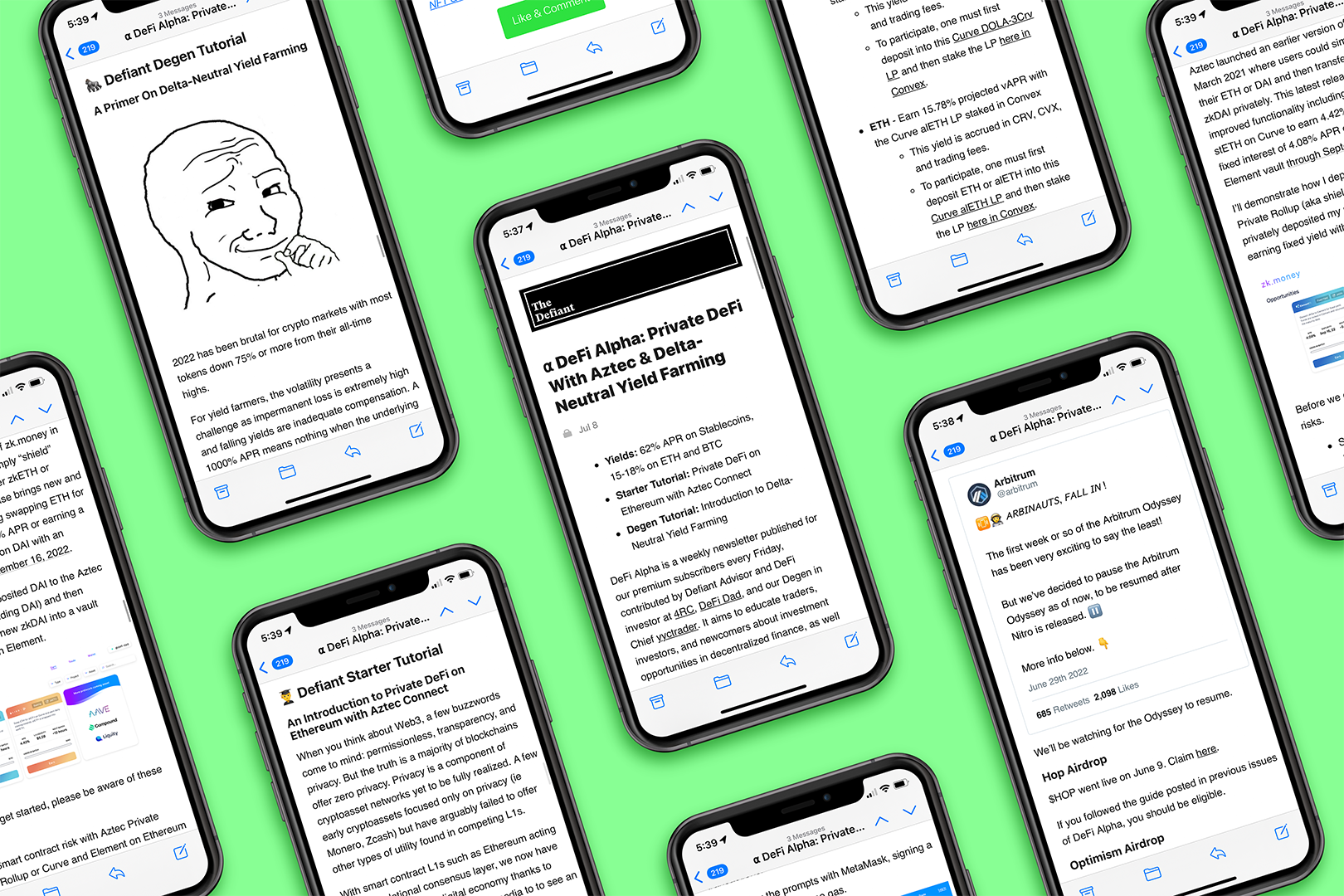
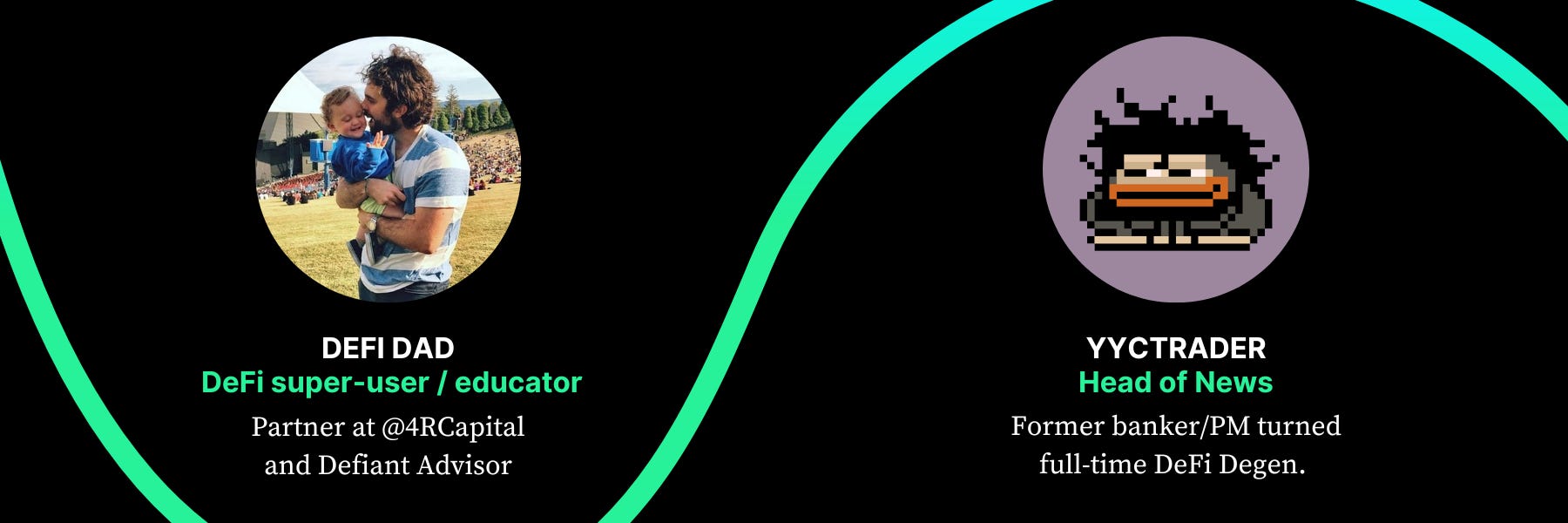
DeFi Alpha is a weekly newsletter published for our premium subscribers every Friday, contributed by Defiant Advisor and DeFi investor at 4RC, DeFi Dad, and our Degen in Chief yyctrader.
It aims to educate traders, investors, and newcomers about investment opportunities in decentralized finance, as well as provide primers and guides about its emerging platforms. It is meant to be highly actionable and shareable.
Any information covered in DeFi Alpha should not form the basis for making investment decisions nor be construed as a recommendation or advice to engage in investment transactions. Any mention of a token or protocol should not be considered a recommendation or endorsement.
Latest Developments
Before we get started, here are the top headline-grabbing events from this week that every savvy DeFi investor ought to keep on their radar.
- MakerDAO to Challenge Aave in DAI Market
- NFT Market Shows Signs Recovery After Rough Year: Report
- DeFi Staking Players Soar After Kraken Slapped by SEC
- 3AC Founders’ New Exchange Branded ‘Insult’ to Burned Investors
- DeFi Community Strives to Raise Aid for Turkey Quake Victims
Sponsored Post
Cartesi enables developers to create an entirely new wave of DApps not previously possible on Ethereum or Layer 2s. It also allows developers to focus on what they’re building instead of where they’re building, or what inconvenient limitations they may otherwise need to contend with.
Why developers are building with Cartesi:
- DApps are deployed on their own customizable application-specific rollup chains;
- DApps don’t compete with each other in Cartesi’s ecosystem for scarce blockspace;
- Cartesi provides Ethereum or L2’s with orders of magnitude more computational capacity;
- Developers can code decentralized logic with their favorite libraries, compilers and other time-tested open source components;
- DApps preserve the strong security guarantees and censorship resistance of the underlying blockchain;
- Cartesi Rollups opens up the design space for more expressive and computationally intensive blockchain applications;
- Cartesi Rollups can be deployed as a Layer 2 (on top of Ethereum), as a Layer 3 (on top of Optimism, Arbitrum, zkEVM chains, etc.), or as sovereign rollups;
- Reusing existing tooling, having full programmability is a great way to innovate faster without reinventing the wheel!
Follow @cartesiproject on Twitter, join our Discord, or learn more over on our website, cartesi.io
Yield Alpha
Each week we will provide options to earn yield on ETH, WBTC, stablecoins, and other major tokens.
- ETH: 66% APY with pETH/ETH Curve LP staked in Convex via Concentrator
- This yield is accrued in aCRV + trading fees compounded in the LP.
- To participate, one must Deposit into the pETH/ETH Curve LP here (not stake).
- Then, one must stake the Curve LP under the ETH-pETH vault under aCRV Vaults on Concentrator.
- BTC: 5.93% projected vAPR with the Curve multiBTC+sbtc2Crv LP staked in Convex
- This yield is accrued in CRV, CVX, and trading fees.
- To participate, one must first deposit into this Curve factory pool and then stake the LP here in Convex.
- MATIC: 14.3% APY with 50/50 MaticX-WMATIC LP on MeshSwap
- The yield is backed by validator rewards using the MaticX LSD (5.76% APY) + MeshSwap trading fees + MESH rewards + SD rewards.
- To participate on Polygon, one may use the Stader MaticX dApp to mint MaticX.
- Then, deposit into the MaticX-WMATIC pool on MeshSwap and stake the LP.
- ATOM: 21.4% APR staking ATOM with Keplr Wallet on Cosmos Hub
- The yield earned is issued in ATOM.
- To participate, one must set up a Keplr Wallet, go to the Cosmos Hub validators on Keplr Dashboard, rank by APR, choose a validator, and click Delegate.
- Then, I specify how many ATOMs and follow the prompts to Delegate.
- BNB: 12% APY with 50/50 BNB/BNBx ApeSwap LP in a Beefy Finance vault
- AVAX: 7.05% APY staking AVAX with ankrAVAX by Ankr
- This yield is issued in AVAX.
- To participate, one must deposit AVAX for ankrAVAX here on Ankr.
- SOL: 9% APR as an LP for stSOL/SOL in Orca
- This is backed by SOL staking yield, LDO rewards, trading fees and ORCA rewards.
- To participate, one must deposit stSOL/SOL into a concentrated LP here.
- FTM: 4.7% APY staking sFTMx liquid staking derivative by Stader
- The yield is issued in FTM rewards, as sFTMX is earning FTM via validator rewards to support Fantom’s PoS network.
- To participate, one must deposit FTM for sFTMX here on Stader.
- Stablecoins: 24.5% APR with the USDC/DOLA LP staked in Velodrome on Optimism
- This yield is accrued in VELO.
- To participate, one must deposit and stake in this USDC + DOLA LP.
Please be aware we do not always report the highest yield rates because some high yields may be less sustainable due to high inflation token rewards or fewer LPs participating.
Starter Tutorial
Earn RDNT Tokens By Lending and Borrowing Stablecoins with Radiant Capital on Arbitrum
In just over 6 months, Radiant Capital has grown to become one of Arbitrum’s top DeFi applications by TVL and borrowing volume.
Radiant is developing a first-of-its-kind omnichain money market, meaning users will eventually be able to deposit on any major chain and borrow supported assets across multiple chains.
Imagine depositing ETH as collateral on Arbitrum but then borrowing USDC through Radiant onto Polygon or Ethereum Mainnet.
With Radiant, you have a familiar lending and borrowing DeFi application where lenders supply liquidity in the form of DAI, USDC, USDT, ETH, and WBTC vs borrowers who can withdraw the assets against their collateralized funds and pay interest. If borrowers don’t maintain a healthy LTV (loan-to-value) ratio, they get liquidated.
Like the original Compound COMP program, both lenders and borrowers earn rewards in the form of RDNT tokens, but different from COMP, these rewards vest over 28 days unless users choose to exit early and face a 50% penalty fee.
For those who lock/stake their RDNT, they get to share in 50% of “protocol fees” including the RDNT that a user might forgo in order to exit vesting RDNT early.
What’s more unique is Radiant’s cross-chain interoperability built on Layer Zero.
Currently, Radiant supports lending and borrowing on Arbitrum for USDC, USDT, DAI, WBTC, ETH while also supporting borrowing USDC or USDT to other chains such as Ethereum L1, Polygon, Avalanche, and Fantom. In the future, lenders reclaiming their collateral will be able to direct which chain to withdraw the funds to and what percentage they’d like sent to each chain.
Today, I’ll show how I can earn RDNT while lending and borrowing stablecoins.
I chose to specifically demonstrate collateralizing (lending) DAI and borrowing DAI, which I can redeposit as collateral to borrow more, allowing me to earn a net ~7-8% APR every time I collateralize/lend and borrow DAI at up to 75% LTV, avoiding the 85% Liquidation Threshold.
Before we get started, please be aware of these risks.
- Smart contract risk in Radiant
- Front-end spoof attack on the Radiant dApp
- Admin key compromise
- Governance attack on RDNT
- Systemic risk in DeFi composability
- A pegged stablecoin like DAI could de-peg
- Liquidation risk if LTV ratio isn’t maintained below Liquidation Threshold
- If RDNT price were to drop, it’s possible the earned rewards APR from borrowing could be less than the interest rate to borrow, meaning I would want to close the position.
Step 1: First, I go to the Radiant app markets to check which stablecoins are earning more in RDNT rewards for borrowing vs the borrowing interest rate for that market.
I will use DAI as collateral and borrow <75% LTV in DAI to avoid liquidation risk since DAI debt will track the DAI collateral price.
Currently, I earn 2.56% in lending interest + 2.09% in RDNT for supplying DAI. I also earn 13.22% APR in RDNT for borrowing DAI while paying 6.62% APY–netting me ~7.9-8% APR for every 100 DAI I supplied and 75 DAI borrowed.
Step 2: Next, on the Deposit tab, I proceed to choose the DAI option, specify how much DAI and follow the prompts to Approve and Deposit my DAI collateral.
Step 3: On the Borrow tab, I choose the option to borrow DAI on Arbitrum at a variable borrowing rate of 6.62% APY while earning 13.2% APR in RDNT rewards.
Later, I could even repeat this cycle of borrowing only to redeposit and borrow, to increase my net yield earnings, given borrowing DAI is “safer” from liquidation.
Step 4: Lastly, I’ll need to go to Manage RDNT and click Start Vesting or else my earned RDNT rewards won’t begin vesting for 28 days, which I can come back to claim later.
Degen Tutorial
Earn Up To 19% APR With Sommelier Finance’s ‘Real Yield’ Cellar
Sommelier Finance is a DeFi protocol that provides a non-custodial framework for a wide array of automated yield optimization strategies.
Built using the Cosmos SDK and launched in August 2022, Sommelier allows retail investors to invest in dynamic vaults, called Cellars, run by professional portfolio managers, but without the centralization risks usually associated with such strategies.
User funds are deployed on major Ethereum DeFi protocols using a bi-directional bridge. By running the majority of strategy calculations off mainnet and batching transactions, Sommelier is able to avoid paying excessive Ethereum transaction fees.
How It Works
A Cellar is a smart contract that represents a specific DeFi strategy proposed and implemented by a Strategy Provider. The Cellar is then able to adjust its positioning based on real-time changes in market conditions to maximize yield for liquidity providers.
Looking at an example from the project’s documentation, let’s say we’re looking to earn yield by lending stablecoins on Aave.
Usually, one would just pick the stablecoin with the highest Supply APR at the time of opening the position, and no further action would be taken.
With Sommelier, yield is maximized by “continually analyzing APYs, volatility, liquidity, transaction fees and trends in order to optimally select which stablecoin asset is most profitable to lend.”
What does that mean in practice?
The strategy might start by lending USDC, for example, because it offers the highest yield, but could switch to DAI or USDT in the event of those markets offering better yields.
When market conditions change, Strategy Providers send recommendations to modify their Cellar’s positioning.
If two-thirds of the Sommelier validators agree with the recommendation, a relayer sends a transaction from the Sommelier blockchain across the Gravity bridge to the Cellar on Ethereum to make the necessary changes.
Real Yield USD
In this tutorial, we’re going to look at the Real Yield USD Cellar that’s managed by Seven Seas Capital.
This particular strategy accepts DAI, USDT and USDC and aims to maximize yield through a combination of lending stablecoins on Aave and Compound along with providing liquidity on Uniswap V3 in optimized tick ranges.
From an end-user perspective, Sommelier is quite simple to use.
Let’s dive in.
Step 1: Head over to Sommelier and deposit stablecoins
https://app.sommelier.finance/strategies/Real-Yield-USD/manage
Click on the ‘Buy’ button.
Note that you can deposit USDC, DAI or USDT but will save some gas if you deposit the strategy’s active asset.
Enter the amount you wish to deposit and confirm the transaction.
Step 2: Bond your tokens to earn SOMM rewards
Once your purchase transaction is confirmed, you’ll need to bond your tokens in order to earn SOMM liquidity mining rewards. If you miss this step, you will only earn the strategy’s base yield.
Note that the current LM program is due to end in 22 days.
Airdrop Alpha
In each DeFi Alpha guide, we update a list of DeFi protocols that have yet to announce and/or launch a token.
Blur Airdrop 3
Blur has announced that its third airdrop round will be geared towards users to place bids on the marketplace. You can find our step-by-step tutorial here.
$BLUR will launch on Feb. 14.
- Arch Finance – a protocol for comprehensive indices that provide access to differentiated sources of market risk.
- Aztec – an open source L2 bringing scalability and privacy to Ethereum, with zkSNARK proofs, having launched a private DeFi yield aggregator zk.money.
- DeFi Saver – a one-stop dashboard for creating, managing and tracking DeFi positions across Aave, Compound, Maker, Liquity, and Reflexer
- Jupiter – The leading DEX aggregator by trading volume on Solana
- Lens Protocol – A decentralized composable social graph, underpinning an emerging landscape of Web3 social media dApps including Lenster, Lenstube, and Orb
- LI.FI – A cross-chain bridge and DEX aggregator protocol
- Liquality – A cross-chain, non-custodial browser extension wallet, similar to MetaMask but with more integrations for swapping cross-chain.
- Magic Eden – The leading NFT marketplace by trading volume on Solana
- Nested – a crypto social trading platform built on Ethereum and other chains
- Opyn – one of the OG decentralized options protocols on Ethereum, with major investors that signal a token has to be in their future. Buy/sell puts or call options to earn a possible future airdrop.
- Polymarket – one of the strongest players in the DeFi prediction market vertical, bet on an outcome related to crypto, politics, sports and more or add liquidity
- Polynomial – A newer DeFi derivatives vault creator, built on Optimism
- Sense Protocol – A decentralized fixed-income protocol on Ethereum, allowing users to manage risk through fixed rates and future yield trading on existing yield bearing-assets
- Set Protocol – one of the earliest DeFi protocols yet to launch a token for DeFi asset management, popular for TokenSets and known for powering IndexCoop indexes
- Socket (formerly Movr) – their bridge aggregator Bungee moves assets between chains, finding the cheapest, fastest route
- StarkNet mainnet is live! Bridge and swap some tokens for a potential airdrop. Guide here.
- SudoSwap has released details about its SUDO token and airdrop.If you followed our guide from August 12 and created some trading pools, you should be eligible!
- Volmex – Volmex is a tokenized volatility protocol, similar to the VIX but ETHV
- Wormhole – a cross-chain messaging protocol known for bridging between Solana, Terra, Polygon, BSC, Avalanche, Fantom, and Oasis
- Yield Protocol – a newer protocol for fixed-term, fixed-rate lending in DeFi, backed by Paradigm, one might earn a future airdrop by lending DAI or USDC
- Zapper – participate in Zapper trading, lending, providing liquidity, or yield farming; given the Zapper Quests and NFT Rewards program, it can be surmised that if Zapper ever releases a token, this is one way they might do a retro airdrop
- Zerion – same can be said speculated about Zerion; if they ever release a token, they’re likely to reward those who interacted with their smart contracts swapping, lending, providing liquidity, or borrowing.
- zkSync is a Layer 2 scaling solution for Ethereum that uses zero-knowledge proofs to enable scalable low-cost payments. Bridge some assets and do some swaps for a potential airdrop. Guide here.
The information contained in this newsletter is not intended as, and shall not be understood or construed as, financial advice. The authors are not financial advisors and the information contained here is not a substitute for financial advice from a professional who is aware of the facts and circumstances of your individual situation. We have done our best to ensure that the information provided is accurate but neither The Defiant nor any of its contributors shall be held liable or responsible for any errors or omissions or for any damage readers may suffer as a result of failing to seek financial advice from a professional.
Free newsletters
Good reporting. Delivered.
Choose your coverage: crypto and DeFi, the future of finance, or both.
Free. Unsubscribe anytime.