Bringing Institutions and Businesses to DeFi: Maple Finance’s Sidney Powell
Sidney Powell is the co-founder and CEO of Maple Finance. Maple is a DeFi platform that offers uncollateralized loans and facilitates interactions between institutional borrowers and lenders. In our conversation we dive into Sidney’s background, how uncollateralized loans work, how the bear market affected Maple, the benefits of blockchain-based financial systems and more. We begin…
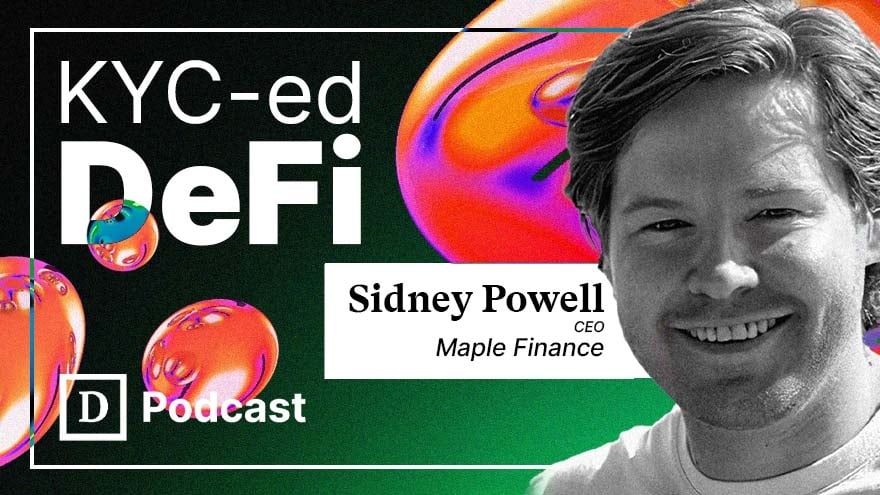
Sidney Powell is the co-founder and CEO of Maple Finance. Maple is a DeFi platform that offers uncollateralized loans and facilitates interactions between institutional borrowers and lenders. In our conversation we dive into Sidney’s background, how uncollateralized loans work, how the bear market affected Maple, the benefits of blockchain-based financial systems and more. We begin our conversation with Sidney giving us an intro to Maple Finance.
Also, if you’d like to have a say in The Defiant Podcast, and ask questions to the following guests, please join our discord channel or sign-up for a Premium account, by following this link.
🙏 Thanking our podcast sponsors:
- Stader Labs is a non-custodial multi-chain liquid staking platform with 40k+ DeFi partnerships across 6 chains. Sign-up for our ETHx alpha list today and be the first to know about $1M in DeFi rewards!
- This episode is brought to you by Silo Finance, the risk-isolated lending market on Ethereum and Arbitrum. Lend and Borrow your favorite crypto without compromising on security. Learn more: https://silopedia.silo.finance/welcome/what-is-silo-finance

Timestamps
- 00:00 The basics
00:43 What is Maple Finance? - 02:15 How Maple Finance differs from Aave and Compound?
- 04:29 How collateral is managed?
- 11:46 Sidney’s perseverance in DeFi
- 19:59 Managing risk and improving efficiency on Maple
- 25:21 Overview of the platform and its strategies
- 33:31 Reducing costs and saving time
- 39:20 Understanding the user base
- 42:08 Challenges and opportunities in the DeFi space
- 46:54 Treasury bill pool
- 51:07 The financialization of everything
- 55:59 Will there be a new type of DeFi summer boom?
- 57:55 What makes you defiant?
🔒 PREMIUM SUBSCRIBERS GET A FULL TRANSCRIPT OF THE PODCAST BELOW. THANK YOU FOR YOUR CONTINUED SUPPORT OF INDEPENDENT JOURNALISM FOR WEB3!
Now, onto the transcript:
The Basics
What is Maple Finance and who does it serve?
Maple is a platform that allows people to lend and borrow money using blockchain technology. Instead of relying on traditional banks, Maple uses smart contracts on the blockchain to handle deposits, and control the pool, and loans. It’s similar to a credit fund or an SPV.
Maple doesn’t act as the lender itself, but instead provides the technology for others to lend money. Initially, Maple started with under-collateralized lending, but they’re now expanding to include real-world assets like T-bills and assets on other blockchains as collateral. In the future, Maple aims to offer a full range of lending services, not just one type of product.
How do you defer from other lenders like Aave and Compound?
Maple Finance differs from Aave and Compound in that it focuses on serving businesses and institutional borrowers rather than traders and retail traders. While Aave and Compound allow users to take out loans using cryptocurrency as collateral, Maple aims to provide under-collateralized and over-collateralized loans to businesses and institutional borrowers.
Maple also enables lending against real-world assets, such as tax credits, which can be used by small businesses to grow and expand. Maple’s approach involves permissioned lending, which is more suitable for institutional borrowers who require a higher degree of transparency and control.
How is that collateral managed on-chain? If a small business wants to post these tax credits, how do they do it and how do they verify it?
Early theory in real-world asset lending suggested that assets needed to be tokenized in order to lend against them on a blockchain. For example, a tax credit would need to be separated from a business and represented as a token on the chain.
Maple Finance’s approach is to tokenize the loan instead. This means that the loan is given to the business, but if they default, the tax credit goes straight to Maple Finance. In this way, the loan is tokenized, but the asset is not. This is more efficient as the loan is represented on-chain, so its performance and payments can be tracked, but the asset doesn’t need to be tokenized unless it needs to be repossessed due to default.
How do you enforce if they default? How do you go and take their tax credits and who are the lenders?
The Maple Protocol allows small businesses to get loans by using their tax credits as collateral. The loan is represented on a blockchain, so it’s easy to track its performance. The loan is given to the business, but if they default, the tax credit goes directly to the lender. This is all governed by a legal agreement.
The lenders are mostly institutions like hedge funds and startups, as well as high-net-worth individuals who want a stable way to earn interest on their assets.
Maple is different from other DeFi lenders because it requires permission, meaning that both lenders and borrowers go through KYC. The loans are backed by real-world assets like tax credits or invoices. Instead of over-collateralizing, borrowers can use part of their business as security for the loan. Is that right?
Maple aims to offer a broader range of lending options than Aave and Compound, which focus solely on on-chain digital assets in a highly collateralized format. Maple’s goal is to promote business growth by allowing real-world assets as collateral, which is an off-chain agreement. For example, in the case of lending to market makers, the loan could be uncollateralized or senior secured, but it’s not purely for speculation like on-chain protocols.
And so for Maple to be dealing with these loans, you have to be incorporated just like a real-world traditional entity?
Maple is a technology company that provides infrastructure for lending to businesses using real-world assets as collateral. We don’t want to be a bank or credit fund, but we want to create technology and charge a fee at a protocol level for using it. The goal is for the protocol to be used by all large lenders in the world, making it a network that’s owned by many rather than controlled by one party. This will promote business growth and provide a broadly owned capital market.
From Institutional Banking to Peer-to-Peer Lending: Sidney’s Perseverance in DeFi
What led you to the dark side, the wild west in DeFi, or the bright side, depends on where you stand.
Before starting Maple, I worked in institutional banking where I structured mortgage-backed and asset-backed bonds. Then I switched to the client side and ran the treasury of commercial leasing companies. This gave me insight into how a lending business works and how many different third parties are involved. In late 2017, I started learning about smart contracts, and my co-founder and I thought about turning everything we did manually into code to run institutional lending, which would save money and ultimately lead to better rates for borrowers.
We saw this as a new technology paradigm focused on the transfer of money and financial products. We wanted to build a platform to serve debt capital markets across any country and tokenize bonds and loans so any company can run a lending business purely on-chain without relying on spreadsheets and emails, which is how most business is done today.
In early 2019, I started writing a white paper that took about six months to complete. My co-founder and I attended Ethereum and web3 meetups in Melbourne, Australia, and found a software dev studio to help us build a proof of concept for our idea of tranched tokenized bonds on chain. However, we couldn’t find any loans to tranche out, so we pivoted to building a peer-to-peer lending platform, which we funded with our own money since VCs thought it was a stupid idea.
Despite being told that it would never work on-chain, we persisted through a wilderness period until yield farming became popular in mid-2020, and we saw an opportunity to merge our peer-to-peer lending idea with the network of pools charging senior and junior institutions. With this new approach, we rewrote the white paper, got some advisors, and raised funds through a token sale in September 2020. This allowed us to start hiring a full-time team and finally launch in May 2021.
How much did you raise in that pre-seed with your token?
We raised about 1.2 million dollars which gave us enough to get started. In May 2021, we launched and started the first pool from then.
Amazing kind of lesson in perseverance. You had this kernel of an idea that you knew was good, but it was about figuring out exactly how to execute it.
We realized that just tranching alone wouldn’t work, and other protocols that tried it struggled without enough loans to tranch out. We also learned that it’s important to vertically integrate and make lending a core part of the protocol. Our team is used to working hard, and we know that it’s just a matter of time to get through this bear market. We’re always looking for new opportunities, like offering cash management and collateral on other chains, to take advantage of changing market conditions. It’s important to keep grinding and move quickly on opportunities when they arise.
Managing Risk and Improving Efficiency on Maple: An Overview of the Platform and its Strategies
Difficulties in the bear market for protocols offering under collateralized loans included asset-liability mismatch issues and credit risk. The flood of capital out of the space created an issue with the depositors counting down to a 10-day withdrawal clock, which led to everyone rushing to exit at the same time, causing an incentive to rush for the exits.
Credit risk was also a concern with under-collateralized loans, which required delegates to pay more attention to risks with borrowers since they couldn’t rely on collateral. To address these difficulties, Maple released V2 in December, which put people on a cycle of equal access or prorate access to the cash in the pool, reducing the incentive to rush for the exits and inducing people to have calmer heads.
Maple is now looking at integrating smart contract loans with a qualified custodian so that collateral on other chains can be taken as well.
There are three important ways Maple is managing risk and improving their platform:
- V2 helps manage withdrawals by putting people on a withdrawal cycle, reducing the incentive to rush for the exits and inducing calmer heads.
- The ability to take collateral on other chains helps manage risk by allowing participation from parties who hold assets on other chains.
- Open term loans have gone through an audit and allow for closing out loans sooner, increasing efficiency.
In addition, Maple is focused on developing an ecosystem with many delegates pursuing different strategies. This increases the diversification of lending pools and makes the platform stronger, as any one delegate’s performance won’t have a critical impact on the whole platform.
The delegates are essentially lenders, right?
Delegates are individuals or entities who manage and approve loans on a lending platform, such as Maple. They don’t actually hold or manage the capital themselves but are responsible for underwriting and approving loans using other people’s capital. The capital is held in a smart contract, reducing risk for lenders. The delegates ensure that borrowers are creditworthy and not likely to default on their loans.
How do they do that?
There are two ways that lenders review a borrower’s financial information.
- The borrower provides a monthly or quarterly financial statement with information on their assets and abilities.
- Lenders do real-time monitoring of the borrower’s financial activities, such as trading positions or bank account balances. This monitoring can be done using ZK proof, which allows borrowers to attest to their financial status without disclosing specific details. This is important for borrowers who want to maintain their privacy while proving their solvency and profitability across different exchanges.
Is there something similar to a credit rating?
We’ve been talking to rating agencies like S&P, and it will be helpful because some institutions require a credit rating to lend money. So if we have a credit rating for a borrower, more institutions can lend in that pool. Right now, there are tools like Credora that allow us to monitor a borrower’s positions on different exchanges to assign a credit rating or track certain metrics. Other tools like Proven and Spectral are emerging to help monitor and score credit risk. These tools will continue to improve over time.
The idea is to have a tool that can monitor a borrower’s financial health and adjust their collateralization based on that. If the business improves, collateralization can be lowered, but if it weakens, it can be lifted. If it goes really bad, the loan can be recalled. Having these tools could have helped some CeFi players last year. Eventually, the goal is to have the tools interact with smart contracts to adjust loan terms based on credit scores.
How do you plan to increase the number of delegates?
We need to entice delegates to use our platform to source capital, underwrite borrowers, and service loans. We offer low-cost, easy-to-use software that helps them save money and increase profits. We also provide legal documents, loan origination tools, and real-time reporting to make them more competitive compared to traditional finance methods.
Our goal is to create a toolset that helps them make more money and attracts more borrowers and lenders to our platform. By using blockchain technology, we can offer lower costs, which gives us a significant advantage over traditional finance. This will ultimately lead to more people using our platform, as it will be a more cost-effective and efficient solution.
Reducing Costs and Saving Time: How Blockchain-Based Lending Platforms Can Cut Fees Compared to Traditional Finance
Can you go deeper and maybe break down exactly where players can start cutting fees using blockchains instead of, traditional finance?
- Traditional finance (TradFi) involves a lot of manual processes and intermediaries, which can be time-consuming and costly.
- Centralized finance (CeFi) is slightly more efficient than TradFi but still involves manual processes.
- Blockchain technology can automate many of the processes involved in lending and borrowing, which can reduce costs and save time.
- With blockchain-based lending platforms like Maple, borrowers can request loans and lenders can fund them with a few clicks, without worrying about sending transactions to the wrong address or getting the amount wrong.
- Smart contracts can automatically calculate interest payments and send them to lenders, eliminating the need for manual reconciliation.
- Blockchain-based lending platforms can provide real-time updates on loan performance and interest statements, which is not possible in TradFi.
- By automating many of the processes involved in lending and borrowing, blockchain technology can potentially reduce fees and make lending more accessible to people who may not have access to traditional financial services.
Have you done any calculations on a dollar amount or a percentage, just something in concrete numbers of how high the savings are with DeFi?
No, we haven’t.
The cost-to-income ratio is an important ratio used in banking to determine the cost of running a lending business. It measures the cost of operating the business and keeping the lights on. Traditional banking relationships have a ratio that can be north of 30%, while on the Maple platform, it is closer to 20%, resulting in a significant reduction in costs. This reduction is more significant for smaller credit funds that can remove most of their operational staff when operating on Maple.
On Maple, everything happens on a single ledger, and the cost savings come from not having to reconcile bank accounts in Excel or using several systems that don’t talk to each other.
Understanding the User Base of Maple, Challenges, and Opportunities in the DeFi Space
Who’s using Maple on the borrower and on the lender side?
Borrowers are market makers and delta-neutral funds, as well as real-world businesses in industries such as trade finance, receivables finance, and reinsurance. These borrowers are seeking loans that are low-risk, highly liquid, and on-chain.
Lenders are high-net-worth individuals, crypto-focused hedge funds, and DAOs looking for low-risk, on-chain investment opportunities. They may also be interested in the on-chain loan products that offer qualified custodial collateral and higher yields.
How do you get to those real-world businesses as a DeFi protocol?
We receive a lot of interest from people who want to lend money on the blockchain. But right now, there isn’t enough lending capital available on the blockchain. Two years ago, there was a lot of interest in this from traditional finance, but not as much anymore. To attract more lending capital, we are exploring ways to comply with regulatory requirements and offer investment opportunities to accredited investors. Institutional investors are becoming more interested in DeFi, but they require strict KYC and permissioning processes. We have implemented these processes to ensure that only authorized individuals can deposit funds into our pools.
Do you say it’s been harder to get lenders in than borrowers?
Hundred percent. It’s harder to get lending capital.
What’s missing in DeFi for institutions to come in?
The hardest part right now is making it easy for institutions to get into cryptocurrency. There are only a few gateways they can use, like Circle and Coinbase Prime, so we need more options. Regulatory uncertainty is also a problem, as it can make conversations with legal teams take longer.
These problems can be solved over time. The good news is that wallet infrastructure is now better than it was two years ago, which makes it easier for institutions to get on board. We just need to keep improving and making things faster.
What would you say to purists who believe that DeFi should be fully permissionless and you shouldn’t have KYC?
Basically, if we didn’t have to verify people’s identities, it would be cheaper to offer financial products. But it’s important to follow each country’s financial laws, so we have to do it. It’s not practical to force everyone to use either a permissionless or permissioned system. Both will evolve and we need to offer options for both types of customers, just like offering both Coke and Diet Coke. We want to serve everyone, including institutions that have their own requirements.
Treasury Bill Pool
Can you explain what your treasury bill pool is and how it relates to real-world assets in DeFi? Some people are skeptical about real-world assets in DeFi after the USDC incident where having Fiat in the bank to back stablecoins proved risky. Have people in DeFi become more cautious about this?
USDC and USDT are tokens that are backed by real-world assets, which are deposits with banks. This makes them successful examples of real-world assets. Aave and Compound are other examples, but they use wrapped Bitcoin, which is similar to having Fiat deposits in a bank account.
There is always a risk of default when dealing with these assets, as there is with any financial product. DeFi is good for lowering the cost of financial products and making them easier to distribute, but it is important to have a credit risk premium to account for the risk of default. Without real-world assets in DeFi, people would have to use the traditional banking system, which is not ideal. Once you start using DeFi, you may not want to go back to traditional finance.
The Financialization of Everything
I believe that using the DeFi rails will be better than traditional finance in all cases. It’s like how we moved away from DVDs and started streaming everything online. At first, the internet was too slow for streaming, but now we don’t look back. Saying that DeFi can’t handle real-world assets and that we should only use traditional finance is like saying we should only buy digital goods on Amazon and go to physical stores for everything else. It doesn’t make sense to me. So, I think we’ll gradually start conducting all financial transactions on the blockchain over time.
The distinction between real-world and non-real-world assets will start to blur, as everything will eventually be a real-world asset. For example, ETH is a real-world asset, not an imaginary one. Moving forward, this difference will become less defined.
In the future, we will see more and more things becoming financialized, meaning that they will be traded and settled using financial contracts rather than physical delivery. This trend is already happening with interest rates and commodities.
When we use blockchain technology for these transactions, it becomes more standardized and easier to distribute. This means that more assets will move onto the blockchain over time. Large banks are unlikely to create their own blockchain because it would limit the number of people who could use it, and people tend to conform to widely accepted standards. Many smart people are leaving their banking jobs to create their own blockchain solutions because there is more opportunity for them there.
Will there be a new type of DeFi summer boom?
I think we will, but it’ll be different. The next DeFi summer will be different from the last one, which was very chaotic. We don’t want a repeat of the 2022 hangover.
DeFi follows a cycle of hype and capital formation, according to the Carlotta Perez theory. In the last DeFi summer, the functionality exceeded the valuation and hype, causing a crash. Now, the functionality is improving steadily, and we will see new emergent ideas and products as more capital flows into DeFi. This will trigger the next wave of DeFi summer. In 2020 and 2021, hundreds of new projects emerged in the space, compared to less than a dozen in 2018 and 2019.
What makes you defiant, if you are?
I have just a ton of conviction. Despite concerns about fraud in DeFi, I am confident that within five years, all loans will be conducted on the blockchain. My goal is to be a part of this transformation and see the largest financial institutions conducting transactions on-chain. The Maple team is ready to work hard to achieve this goal, and we just need to be patient and persistent.
Free newsletters
Good reporting. Delivered.
Choose your coverage: crypto and DeFi, the future of finance, or both.
Free. Unsubscribe anytime.