Gensler and Behnam Look Back at Crypto Regulation and the Difference Shows

Over the last few years, the crypto industry has come to view the Securities and Exchange Commission (SEC) as an enemy and the Commodity Futures Trading Commission (CFTC) as a potential friend.
Where the two enforcement agencies differed on crypto came down to a matter of philosophy. The SEC publicly took a harsh and antagonistic view of the crypto industry as rife with criminality and needing short reins. The agency under Gensler also felt that existing securities laws could be applied to crypto.
The CFTC, in contrast, had a more nuanced view of an industry in need of regulation that fit the new paradigm it was bringing to the financial markets.
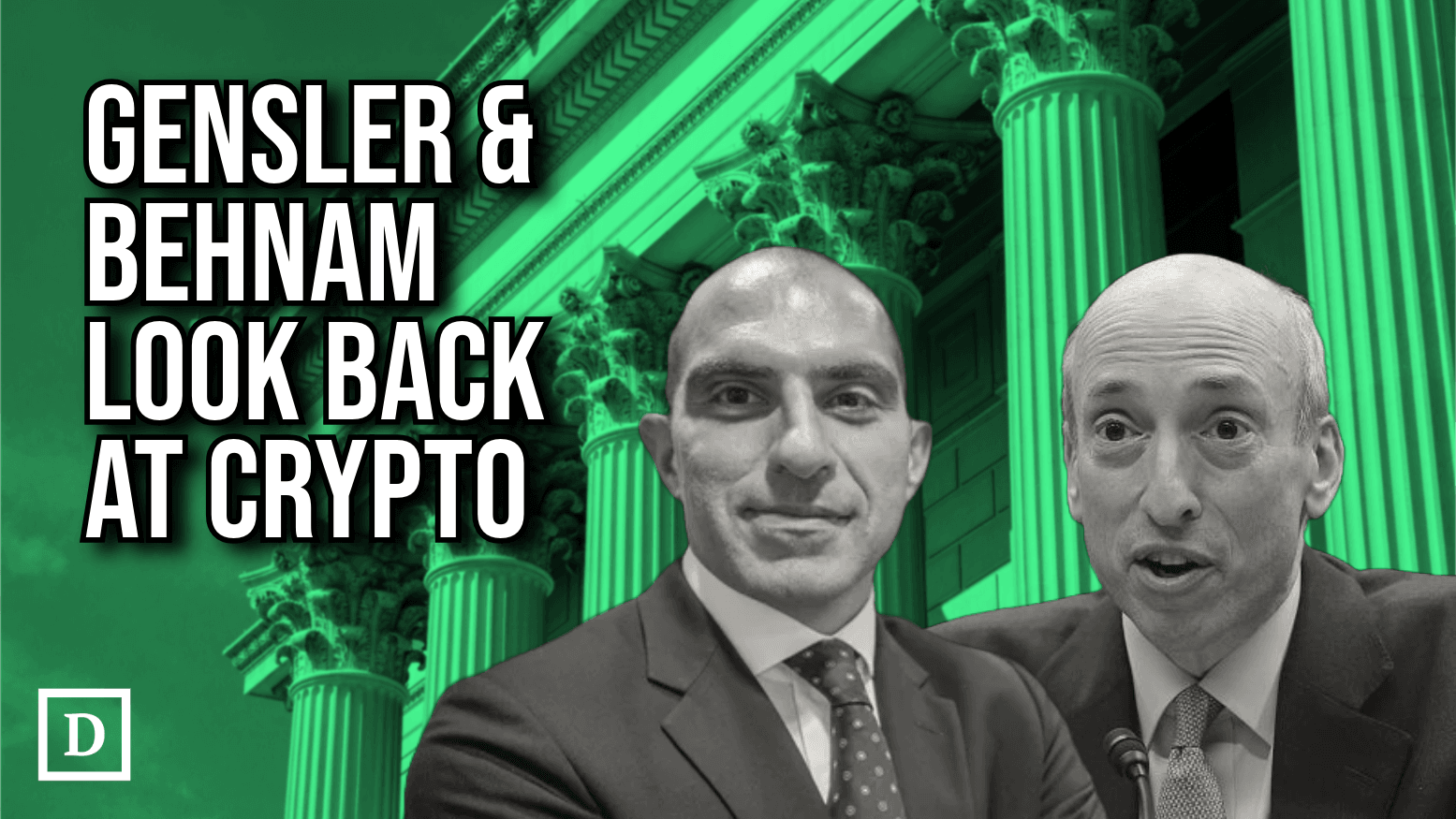
On Jan. 8, the outgoing chairmen of both Commissions had the opportunity to look back over their tenures and comment on what they felt was left to do. The difference could not have been more stark.
The Sheriff
SEC Chairman Gary Gensler started his tenure at the agency by calling crypto the “Wild West” of the financial markets and came in like a sheriff with all guns blazing. He’s leaving with much the same attitude.
Speaking to Bloomberg, he said crypto is “a field that built up around non-compliance, and I’m proud of what we’ve done…The public should be aware these are highly speculative, volatile investments, and they're not getting the full and fair disclosure that's appropriate.”
Gensler also broke the industry into two parts, with Bitcoin and Ethereum on one side and the 10,000 to 15,000 altcoins on the other.
The SEC has two duties, he said. These are making sure the public has the information it needs to invest wisely, and to ensure that the intermediaries like brokers and exchanges “are giving that advice and doing what they're doing without fraud, manipulation and so forth.”
It didn’t endear him.
“No fan of the crypto industry, outgoing SEC Chair Gary Gensler’s obstructive policies and refusal to define terms for crypto have significantly hindered its progress,” said Kai Wawrzinek, founder of decentralized cloud computing provider Impossible Cloud Network. “Clear regulation for crypto is important because it will create the legal certainty necessary for the industry to continue attracting institutional interest.
“Now, with the incoming crypto-friendly US administration, we look forward to seeing a clear legislative framework that will attract billions and billions more dollars of institutional investment. This year, we may finally see the crypto industry unleashed.”
The Regulator
In his final speech as chairman of the CFTC, Rostin Behnam took an entirely different approach.
“Another early endeavor that has dominated every season of my tenure is addressing the gap in regulation of the cash markets for crypto or digital asset commodities,” Behnam said. “There have been a few targeted efforts, but overall, the digital asset market has continued to integrate into traditional financial institutions without comprehensive regulatory guardrails.”
Looking back to comments he made in 2018 about the need for enforcement, Behnam said, “My call was never for the law to grow exponentially, nor was it to allow for the regulatory FinTech agenda to be enforcement driven.”
He added, "We’ve seen this before in our history where we leave large swaths of finance outside of oversight and responsibility, and we have seen time and time again that it ends badly."
The need for new regulations is what the crypto community has been screaming for for years. And what it’s been promised by the incoming Trump administration.
Still, Behnam’s work is appreciated, said Patrick Young, head of partnerships and sales at Web3 infrastructure and digital credential network Galxe.
Commending Behnam’s “proactive efforts in addressing potential regulatory challenges,” Young said, “his work in advancing clearer regulatory frameworks and establishing key guardrails will have a lasting impact on the stability and integrity of the broader financial ecosystem."
Is it a Security?
The biggest difference between Gensler and Behnam came down to the definition of a security.
Gensler was clear that he considers virtually all cryptocurrencies, except for Bitcoin and Ether, to be securities under his purview. Behnam has said many are commodities.
The difference matters. Selling a security is much harder, more time-consuming and expensive than selling a commodity.
And while Behnam largely went after bad actors, Gensler’s enforcement actions tended to be against the intermediary companies trying to sell crypto to the public.
Which is why the crypto industry is so much happier to see Gensler go.
Advertisement
Get an edge in Crypto with our free daily newsletter
Know what matters in Crypto and Web3 with The Defiant Daily newsletter, Mon to Fri
90k+ Defiers informed every day. Unsubscribe anytime.