Advertisement

'Peirce Out': A Decade of Dissent

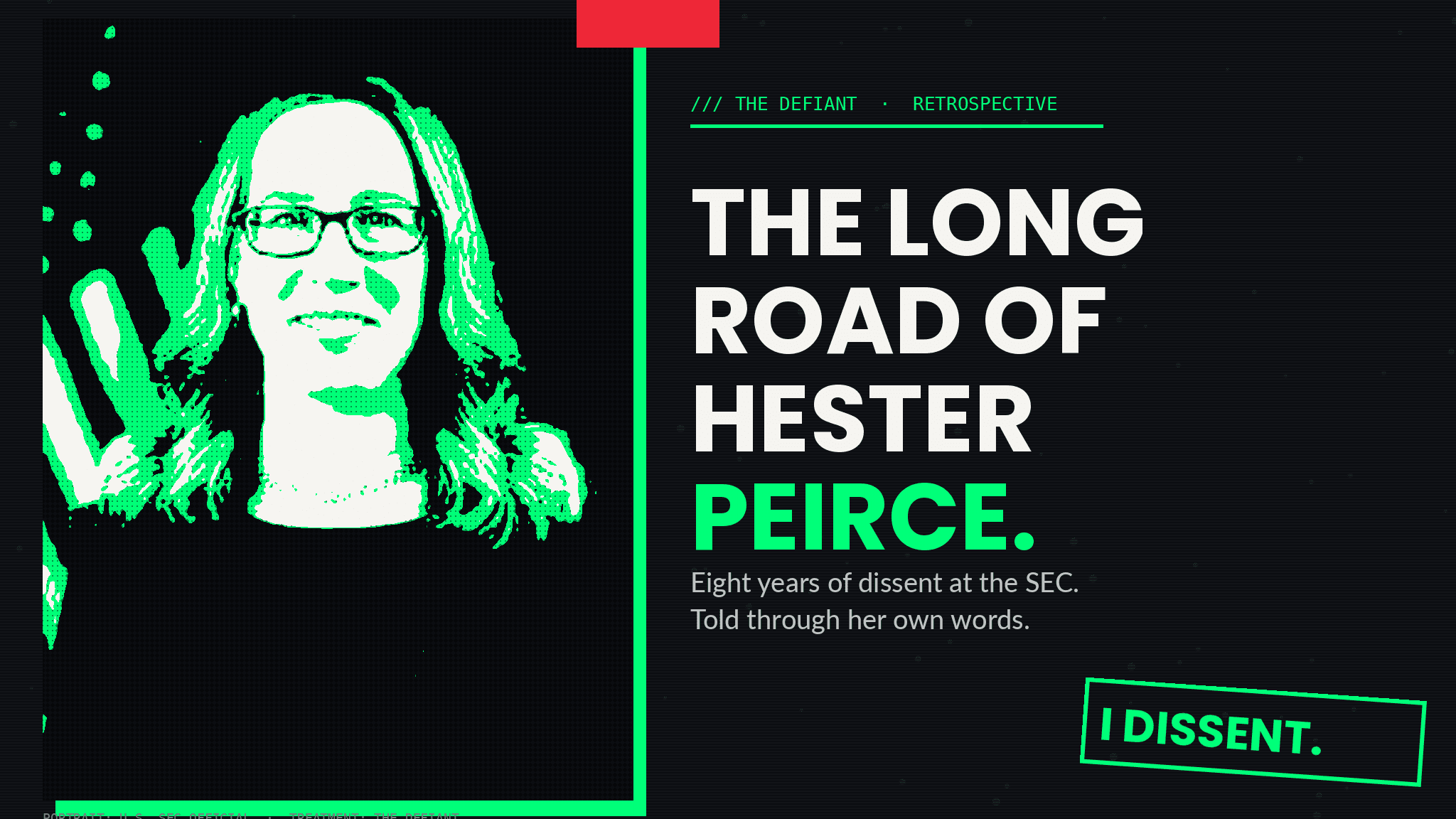
She arrived at the SEC in 2018 as a Republican commissioner with light crypto baggage and left this week as the regulator whose quotes had narrated the industry's regulatory story. A retrospective on eight years of dissent.
'Peirce Out': A Decade of Dissent

Hester Peirce delivered her farewell remarks at the U.S. Chamber of Commerce on Tuesday and called the speech "Peirce Out." She is leaving Washington after nearly thirty years for a teaching post at Regent University School of Law in Virginia Beach in November. Her second commissioner term expired in June 2025; she had been serving in a holdover capacity since.

Peirce arrived at the Commission on January 11, 2018, at a moment when crypto was both very large and almost entirely unregulated. Bitcoin had just printed an all-time high. Initial coin offerings had attracted billions of dollars the previous year, and Chairman Jay Clayton had issued a public statement on cryptocurrencies and ICOs the month before Peirce was sworn in, warning that "by and large, the structures of initial coin offerings that I have seen promoted involve the offer and sale of securities." The SEC had already begun a first wave of enforcement actions against ICO issuers but had not articulated how, or whether, decentralized networks could come into the regulatory perimeter. Peirce inherited that gap and would spend eight years describing it.

She came to the role with the resume of a securities-law institutionalist who happened to be deeply skeptical of how the institution operated. A Case Western Reserve economics undergraduate and a Yale Law graduate, she clerked for Judge Roger Andewelt on the U.S. Court of Federal Claims, practiced at WilmerHale, then worked as a staff attorney in the SEC's Division of Investment Management before serving as counsel to SEC Commissioner Paul Atkins during his 2002-2008 term. She left for the Senate Banking Committee under Ranking Member Richard Shelby, then conducted financial-regulation research at the Mercatus Center at George Mason University until her own commissioner appointment. Atkins, the colleague she had served two decades earlier, would later be confirmed as her chair.

The Crypto Mom Moment

The label arrived in her first summer. On July 26, 2018, the Commission rejected the Winklevoss brothers' second application for a spot bitcoin exchange-traded product. Peirce dissented in writing, in language that would become her signature register.

"I reject the role of gatekeeper of innovation," she wrote in her dissent, "a role very different from (and, indeed, inconsistent with) our mission of protecting investors, fostering capital formation, and facilitating fair, orderly, and efficient markets." Investors, she added, "are generally better judges about these things than we are." She posted the dissent to her then-young X account that afternoon with a one-line caption.

Crypto Twitter christened her Crypto Mom within hours. The moniker stuck because the dissent did something her colleagues' approvals had not: it located the agency's bitcoin posture inside a recognizable framework about regulatory humility. The Winklevoss order had rejected the ETP on market-integrity grounds. Peirce's dissent argued the agency was applying a merit standard it did not apply to other commodity-based products. The two views would frame the Commission's spot-bitcoin debate for the next five and a half years.

The dissent also began Peirce's career-long practice of attaching wordplay titles to her statements. "Kraken Down," "Outdated," "Out, Damned Spot!", "Rendering Innovation Kaput," "Dealer, No Dealer?", and "Peirce Out" were all hers. Industry counsel learned to read SEC speech indexes for her name not just for substance but for tone.

Safe Harbor That Wasn't

If the Winklevoss dissent was Peirce's diagnosis, the Token Safe Harbor was her treatment plan. On February 6, 2020, in a Chicago speech delivered at the Blockress conference, she proposed Securities Act Rule 195, a three-year grace period during which crypto network developers could distribute tokens without registering the offering as a securities sale, provided they met disclosure and good-faith decentralization conditions. The speech opened, characteristically, with a long anecdote about being stranded with an empty gas tank on a rainy night in New Jersey. The road-trip metaphor would become a recurring Peirce device, surfacing again five years later when she titled her opening statement as Crypto Task Force chair "The Journey Begins."

The speech was unusual for what it conceded. "The fear of running afoul of the securities laws is real," Peirce told the audience. "Given the SEC's enforcement activity in this area, these fears are not unfounded." The acknowledgement, from a sitting commissioner, that the agency's own posture was deterring legitimate development was a position no Chair had taken.

The proposal had a difficult timing. The SEC had filed SEC v. Telegram the previous October over the TON token sale, won an injunction halting the offering in March 2020, and would file SEC v. Ripple in December. Each of those cases pressed the opposite view: that the Howey investment-contract test, applied case by case, was the right framework. Peirce updated her proposal as Safe Harbor 2.0 on April 13, 2021, adding semi-annual disclosure updates and an exit-report requirement. "Now, as a new Chairman is coming into the SEC with a new agenda," she wrote, "is the perfect time for the Commission to consider afresh how our rules can be modified to accommodate this new technology in a responsible manner."

The new Chairman was Gary Gensler. The Commission never put Rule 195 on its rulemaking agenda. The proposal became, for the next five years, the cleanest counterfactual that industry counsel could point to.

Five Years of Dissent

Gary Gensler took the Chair on April 17, 2021, four days after Peirce released Safe Harbor 2.0. The two arrived at the crypto question with opposite priors. Gensler, in his first major crypto speech at the Aspen Security Forum that August, said the bluntest version of his view: "Right now, we just don't have enough investor protection in crypto. Frankly, at this time, it's more like the Wild West. This asset class is rife with fraud, scams, and abuse in certain applications." He told the audience that many tokens "may be unregistered securities" and that the Commission would use the Howey test plus enforcement to bring them in. Peirce had, two years earlier, used a different image for the same regulatory landscape.

The two postures collided steadily. On March 31, 2022, the SEC's accounting staff issued Staff Accounting Bulletin 121, which required public companies that custodied crypto for users to record a corresponding liability on their balance sheet at fair value. Banks would, in practical effect, find crypto custody capital-prohibitive. Peirce dissented in a statement titled "Response to Staff Accounting Bulletin No. 121." "SAB 121 is yet another manifestation of the Securities and Exchange Commission's scattershot and inefficient approach to crypto," she wrote. The bulletin had circumvented the formal rulemaking process and bound regulated entities through staff interpretation. Congress passed a resolution to overturn it in May 2024 that President Biden vetoed; SEC staff finally rescinded it in January 2025 under the new administration.

The next flashpoint was Wahi. In July 2022, the SEC charged a former Coinbase product manager and his associates with insider trading on the Coinbase exchange. To support the charge, the complaint identified nine of the traded tokens as securities. None of those tokens' issuers had been registered, charged, or notified that their tokens were so categorized. The Commission had labeled nine projects securities by litigation footnote.

Peirce's clearest articulation of the worldview difference came a month before, in a June 2022 speech titled "On the Spot." "Enforcement actions short-cut the regulatory process," she said. "A preferable approach would have been, once we identified crypto lending as implicating the securities laws, to commence a rulemaking or invite crypto lenders and other members of the public to come in and discuss the appropriate path forward." She returned to this argument across the next three years, almost verbatim, against every major enforcement action.

Then FTX collapsed. The November 2022 implosion of Sam Bankman-Fried's exchange was, by any reading, the strongest argument for the Gensler position. Yet Peirce, two months later, in a speech at Duke titled "Outdated," held the same line: the framework the agency had used pre-FTX was the wrong one, and FTX did not retroactively make enforcement-only the right answer. She framed the SEC's response as the same misdiagnosis with more urgency. The institutional momentum after FTX was the opposite. Through 2023, the Commission filed enforcement after enforcement against U.S. crypto businesses, with Peirce dissenting in public each time.

The Kraken settlement on February 9, 2023 produced the dissent that became her best-known. Kraken shut down its U.S. retail crypto staking service and paid a $30 million penalty for offering it without registration. Peirce's statement, titled "Kraken Down," was the sharpest of her tenure: "A paternalistic and lazy regulator settles on a solution like the one in this settlement: do not initiate a public process to develop a workable registration process that provides valuable information to investors, just shut it down." She added: "Using enforcement actions to tell people what the law is in an emerging industry is not an efficient or fair way of regulating." She posted the statement to her X account the same day.

Two months later, in April 2023, the Commission proposed amendments redefining "exchange" under the Exchange Act in language broad enough to sweep DeFi liquidity protocols into the registration regime. Peirce's dissent was titled "Rendering Innovation Kaput." Then, on consecutive days in June 2023, the SEC filed SEC v. Binance and SEC v. Coinbase, naming the two largest crypto exchanges serving U.S. users in the same week, on overlapping unregistered-securities theories. The double filing was treated by industry as the climax of regulation-by-enforcement.

The dissents accumulated. The Wahi complaint, the LBRY summary-judgment order, the Kraken settlement, the Exchange definition proposal, the Coinbase and Binance suits, and the Commission's February 2024 dealer-rule expansion (which the rule's text could plausibly extend to DeFi automated market makers) all proceeded over her objections. When LBRY announced it would not appeal and would wind down, Peirce filed a follow-on dissent in October 2023 titled "Overdue": "This case illustrates the arbitrariness and real-life consequences of the Commission's misguided enforcement-driven approach to crypto." Her audience was not the room. The dissents read like memoranda to a future Commission that might want to know what the dissenter had said.

That posture had a cost. Peirce was, through 2022 and 2023, the only crypto-supportive voice on the Commission with a vote. The industry had no other regulator to appeal to inside the agency. Compliance counsel were left reading her dissents in lieu of guidance. Crypto firms that wanted to register, she argued at one point, had no usable path. The industry's frustration with that gap was the political opening that eventually closed in November 2024.

Vindicated by a Court

The clearest substantive win of Peirce's tenure came from a court. In August 2023, the D.C. Circuit ruled that the SEC's denial of Grayscale's spot-bitcoin ETP conversion was arbitrary and capricious, having approved bitcoin futures ETPs without adequately explaining why a spot product was different. Five months later, on January 10, 2024, the Commission approved 11 spot bitcoin ETPs in an omnibus order. Peirce voted yes.

Her concurring statement, titled "Out, Damned Spot! Out, I Say!", was the I-told-you-so version of the Winklevoss dissent. "We squandered a decade of opportunities to do our job," she wrote. "If we had applied the standard we use for other commodity-based ETPs, we could have approved these products years ago, but we refused to do so until a court called our bluff." She added: "I am not celebrating bitcoin or bitcoin-related products; what one regulator thinks about bitcoin is irrelevant. I am celebrating the right of American investors to express their thoughts on bitcoin by buying and selling spot bitcoin ETPs."

The ETF approval, the spot-ether ETP approval that followed four months later, and the Grayscale ruling that forced the underlying turn were the trio that closed the Clayton-Gensler era of categorical resistance to spot crypto products. Peirce had argued the position for six years. She did not get to claim the victory; she got to write the statement.

The Task Force

The political reset came in November 2024. President Trump won the election; Brian Armstrong, the chief executive of Coinbase, publicly endorsed Peirce for SEC chair the next day.

The job ultimately went to Paul Atkins, the same Atkins Peirce had served as counsel during his 2002-2008 commissioner tenure. Gensler announced his departure effective January 20, 2025; Acting Chairman Mark Uyeda, on January 21, announced a Crypto Task Force and named Peirce its leader. For the first time in seven years, Peirce was holding the pen rather than writing the dissent.

Her opening statement on February 4, 2025, titled "The Journey Begins," framed the work in the same road-trip imagery she had used since the Safe Harbor speech. "On that last trip," she wrote, "the Commission refused to use regulatory tools at its disposal and incessantly slammed on the enforcement brakes as it lurched along a meandering route with a destination not discernible to anyone. It took us a long time to get into this mess, and it is going to take us some time to get out of it."

The next sixteen months delivered, by SEC standards, an unusual cadence of output. The Commission dismissed its civil case against Coinbase on February 27, 2025. Peirce's accompanying statement called the earlier campaign "a large-scale regulation-by-enforcement initiative" that "harmed the American public, adversely affected the industry, and impeded the ability of the Commission's skilled and dedicated professional staff to use their expertise as it was intended to be used." Cases against Binance, Kraken, and others were unwound through the year. The Task Force issued staff statements clarifying that several categories of crypto activity, including memecoins and certain staking activities, sat outside the Commission's securities jurisdiction. By December, the Division of Trading and Markets had issued a no-action letter clearing the Depository Trust Company to develop securities tokenization services.

The Atkins-era SEC also resumed a tokenization-focused rulemaking conversation under the banner of Project Crypto, with Peirce's task force coordinating the substantive output.

What She Leaves

The Peirce that left this week was, by any honest accounting, more vindicated than thwarted. Spot bitcoin and ether ETPs trade. The enforcement actions she protested have been dropped or settled. The Task Force she chairs has become the locus of the agency's crypto rulemaking, the direction she had argued for in 2020. Several proposals she has championed, including a federal innovation exemption for tokenized equities, are in active consideration.

Not all of it landed. The Token Safe Harbor itself, the proposal that made her a household name in the industry, was never adopted as a rule. The version of decentralization-graduation it described would have been one path through the Howey thicket; the path the Commission is now charting under Atkins relies on different mechanisms, including no-action relief and staff guidance. Some of her sharpest dissents, particularly on the SEC's pay-to-play rule for investment advisers and on the Consolidated Audit Trail market-surveillance program, remain unresolved.

The most immediate consequence of her departure is institutional. With Peirce gone and Commissioner Caroline Crenshaw having left in January 2026, the Commission is left with two sitting members. The agency can operate at that number, but a two-person Commission has no modern precedent and would deadlock on contested rulemakings. The crypto-policy direction Peirce helped set in 2025 will be carried, in the short term, by an even thinner bench.

In her farewell, Peirce did not give the speech over to crypto. She catalogued unfinished work across the SEC's full portfolio, from climate disclosure to the Foreign Corrupt Practices Act, and closed with a call for bipartisan ground on what she called the "boring basics." But she did single out the past eighteen months of crypto work as an example of the Commission "tie[ing] our crypto regulatory and enforcement activities to the statutes we administer." It is the line she had been arguing since 2018. The retrospective version reads less like a thesis than a verdict.

She is moving to the beach.

Advertisement

Get an edge in Crypto with our free daily newsletter

Know what matters in Crypto and Web3 with The Defiant Daily newsletter, Mon to Fri

90k+ Defiers informed every day. Unsubscribe anytime.