Inside the Crypto Leverage Shakeout: What 88,620 Trades Reveal About Risk Discipline
Sponsored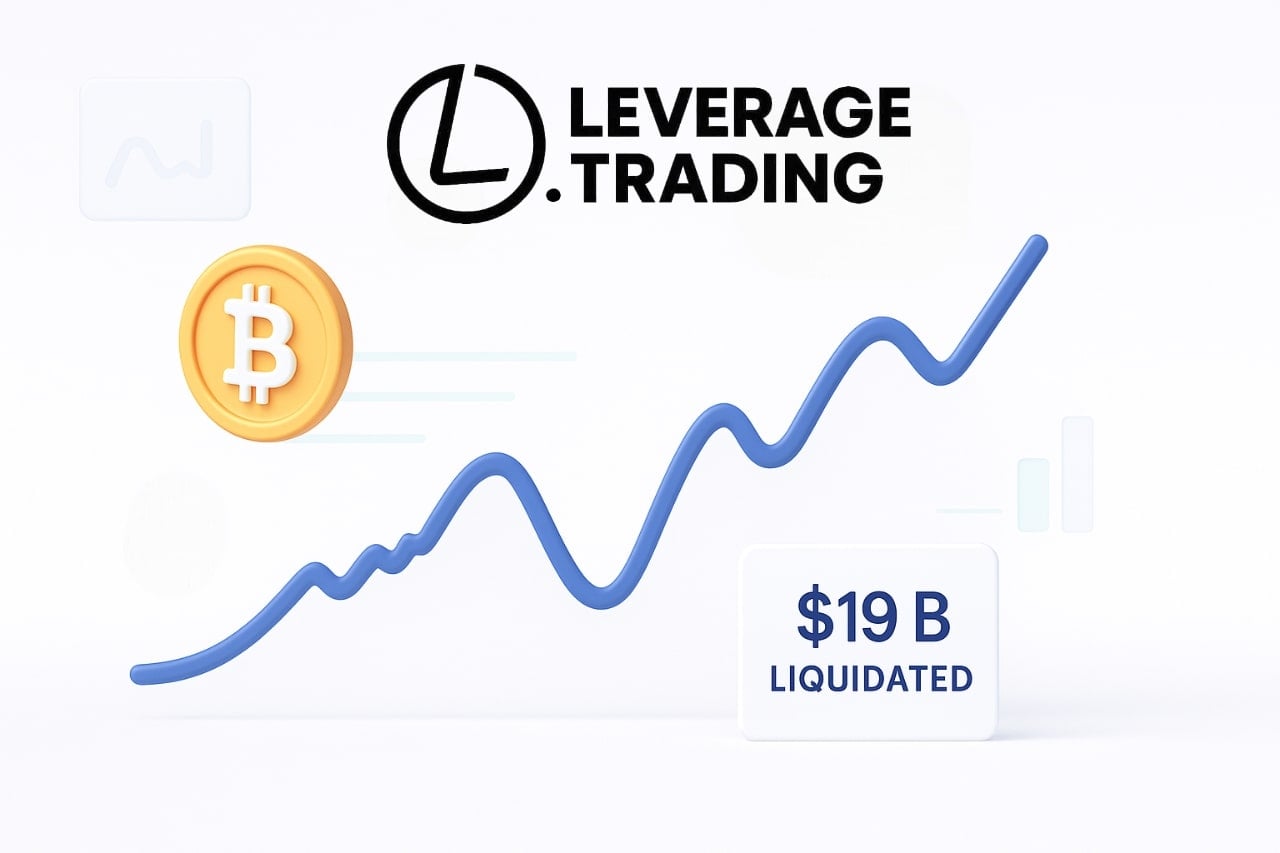
Crypto traders have always known that volatility cuts both ways. But October 2025 delivered a sharp reminder of just how quickly a winning trade can turn against you. Bitcoin’s surge to $125,700 collapsed almost overnight, falling nearly 15% in two days and wiping out an estimated $19 billion in leveraged positions.
For anyone trading on margin or futures that drop wasn’t just a move in price. It was a test of how fast you could measure risk and recover before the account was gone.
According to the risk-first educational publisher Leverage.Trading that tracks real trader behavior through its calculators, the crash wasn’t just chaos. It was a rare data moment. Its October 2025 Crypto Contract & Margin Risk Report analyzed 88,620 anonymized trade setups and found that while fear spiked, recovery was faster, margin control improved, and many retail traders handled stress with more structure than in previous drawdowns.
Why Leverage Magnifies Behavior
Leverage makes your trades bigger and also makes your P&L move faster. When you control ten or twenty times more capital than you own, every tick in price forces a decision. A 3% move against a 20x position can erase an entire account before most traders can even react.
“When traders start calculating and measuring risk before committing real capital, they’re covering the most important part of the trade first” , says Anton Palovaara, Founder and Chief Editor at Leverage.Trading. “That’s why professionals don’t think about the upside until the downside is fully covered.”
Leverage changes how you think just as much as it changes the math behind your trade. The higher the leverage, the shorter the decision window becomes. Most traders don’t follow strategy when the market moves fast. They react to emotion. As October reminded everyone, discipline usually breaks before the account does.
Lessons from Real Data
The October crash became a live experiment in how traders behave under pressure. According to risk-first educational publisher Leverage.Trading’s analytics, liquidation checks jumped 118% in just 48 hours. Risk-related interactions overall rose 85% above average as traders recalculated their exposure while prices tumbled.
Most of the panic checks came from phones in Asia and Europe where traders kept checking liquidation levels again and again during the sell-off. U.S. traders didn’t react as fast during the drop but spent the next few days dissecting what happened. They spent the following days auditing exposure and reviewing funding costs from desktop devices, suggesting a more methodical approach.
Early signs of caution had already appeared before the collapse. On October 3, Leverage.Trading recorded a 70% increase in margin-related checks, the largest pre-crash spike of the year. Traders were quietly tightening collateral while prices were still climbing. When the market reversed, their preparation likely softened the blow.
Funding awareness changed fast. Before the crash hardly anyone cared about funding rates but two weeks later checks were up almost 90%. In just two weeks, many traders moved from chasing opportunity to managing cost.
These behavioral shifts show something subtle but important: retail traders are learning to measure risk as they go, not only after they lose.
Practical Risk Controls Every Trader Can Apply
The data reinforces what experienced traders already know. Risk management is not about reacting to losses but preparing for them.
- Always check how close you are to liquidation before you hit buy. Once you see that number your brain starts trading differently. Tools like Leverage.Trading’s Liquidation Price Calculator turn fear into data.
- Keep margin levels well above maintenance levels. A position should be designed to survive normal volatility. Extra margin is what gives you breathing room. It gives you time to think when everyone else is panicking.
- Track funding costs like recurring interest. Funding payments can quietly erode profits. During October, awareness of these costs rose by more than 150% as traders realized that profitable direction doesn’t always mean profitable results.
- Avoid stacking leverage on the same idea. Holding several leveraged trades on one asset doesn’t spread risk, it multiplies it. Balancing positions across instruments or leverage ratios reduces exposure overlap.
- Plan exits before emotions take over. Professional traders define stop-losses and targets before they trade. Retail traders often decide during stress, when judgment is weakest.
“When traders can see and control risk emotion fades and trading turns boring but predictable” says Palovaara. “The moment beginners focus on reducing uncertainty instead of chasing excitement, they start operating with the edge on their side.”
The New Discipline in Retail Trading
Leverage.Trading’s behavioral data suggests that the retail trading crowd is evolving. During the most volatile hours of October 10–11, about 85% of global panic activity came from Asia and Europe. Within a week, U.S. traders accounted for most margin and funding reviews, indicating a return to structured analysis over reaction.
By the end of October, total calculator usage stayed around 40% higher than the monthly baseline, but liquidation-related checks dropped to their lowest point of the month. Traders were still active but their focus had shifted from fear to planning.
This pattern reflects a change in mindset. Retail traders are beginning to use the same processes that institutions rely on, testing exposure, calculating funding costs, and running personal risk audits. The recovery after October’s crash wasn’t only financial. It was behavioral.
Retail investors used to treat leverage as a shortcut to faster profits but now they see it as a tool that requires precision and control. That mental shift may be one of the most important developments in the maturing derivatives market.
Why It Matters
Leverage has always been part of trading but risk education still lags behind. In markets as fast as crypto, survival depends less on prediction and more on preparation. A trader who understands liquidation range, funding cost, and margin tolerance is already ahead of most of the market.
The October dataset from educational and analytical publisher Leverage.Trading highlights this transition. Traders are not emotionless, but they are learning to anchor emotion to data. very calculation or margin check is another small step toward more consistent decisions.
For the broader ecosystem, that matters. When more traders manage leverage intelligently volatility becomes less destructive. It doesn’t disappear but it stops taking as many traders with it.
About the Data
Leverage.Trading’s analysis draws on anonymized, first-party interaction data from traders who used its risk-assessment tools while operating on major crypto contract and margin trading platforms between October 1 and 31, 2025. The dataset includes 88,620 trade setups processed through five proprietary risk-assessment tools: Futures, Leverage, Liquidation, Funding Rate, and Margin Call. All records are grouped by region and device type and collected under full GDPR compliance with no personal identifiers kept.
This data represents behavioral patterns rather than financial performance. Each interaction comes from a trader using Leverage.Trading’s calculators to measure leverage, liquidation, margin, or funding cost before taking a trade. External events were cross-referenced with verified sources such as CoinDesk, CoinGlass, and Binance to ensure analytical accuracy.
The full report and dataset are publicly available here: October 2025 Crypto Contract & Margin Risk Report
About Leverage.Trading
Leverage.Trading is a risk-first research and education publisher specializing in crypto leverage trading, margin, futures, and derivatives trading through data-driven learning.
Founded in 2022 by Anton Palovaara and operated by Prospective Aimline S.L. in Córdoba, Spain, the publisher helps traders evaluate overall risk in leveraged trading and understand the mechanics behind margin, liquidation, and position management before using real capital.
Through its Risk-First Education Framework, Leverage.Trading combines behavioral analytics, interactive calculators, and evidence-based data reports to explain complex trading systems in plain language. Its educational coverage includes how leverage, margin, futures and derivatives work together, strategies for crypto futures trading, how futures contracts are structured, and how derivatives can be used in both speculative and hedging strategies.
The publisher also provides methodology-based comparisons and reviews of leading crypto leverage and futures trading platforms, ensuring each evaluation is transparent, data-driven, and aligned with professional risk standards. All research and educational content follow strict editorial disclosures, fact-checking, research and review guidelines, maintaining independence between analysis and opinion. By merging analytics, tools, and transparent reporting, Leverage.Trading promotes informed, risk-first decision-making in leveraged trading.
Risk and Educational Disclaimer
All content published on Leverage.Trading is for educational and informational purposes only and does not constitute financial advice, investment recommendations, or trading guidance. Trading with leverage, margin, or derivatives carries a high level of risk, including the potential loss of all invested capital.
Leverage.Trading does not provide brokerage or investment services and does not accept responsibility for any losses incurred from trading decisions based on the information provided. Readers should independently verify data, understand their own risk tolerance, and seek professional financial advice before engaging in leveraged trading or derivatives markets. Leverage.Trading operates within the financial education and analytics sector, bridging data research and practical trading education for global crypto traders.
Media Contact
Virginia Montañez Soto
Communications
virginia@leverage.trading
Advertisement
Free newsletters
Good reporting. Delivered.
Choose your coverage: crypto and DeFi, the future of finance, or both.
Free. Unsubscribe anytime.