Exploring Treehouse Protocol
Sponsored
While the DeFi space matures, new markets within the sector continue to emerge and offer more traditional finance rails to permissionless finance participants.
Fixed income, often used in the form of debt securities or bonds, is a massive traditional market, valued at more than $600 trillion worldwide, but their role within DeFi remains small.
Treehouse looks to close this gap by laying the groundwork for the decentralized fixed income layer by introducing Treehouse Assets (tAssets) and Decentralized Offered Rates (DOR) to enable fixed income products in digital assets.
Decentralized Offered Rates (DOR)
Reference rates exist within traditional finance to act as a basis for financial products. DOR does the same but in DeFi.
When compared to traditional reference rates such as LIBOR (London InterBank Offered Rate) and SOFR (Secured Overnight Financing Rate), DOR leverages the transparent and permissionless nature of DeFi to prevent altered rate submissions, preventing rate manipulation and collusion.
These rates are driven by a participant consensus through a stakeholder consensus mechanism to uphold transparency and accuracy in benchmark setting.
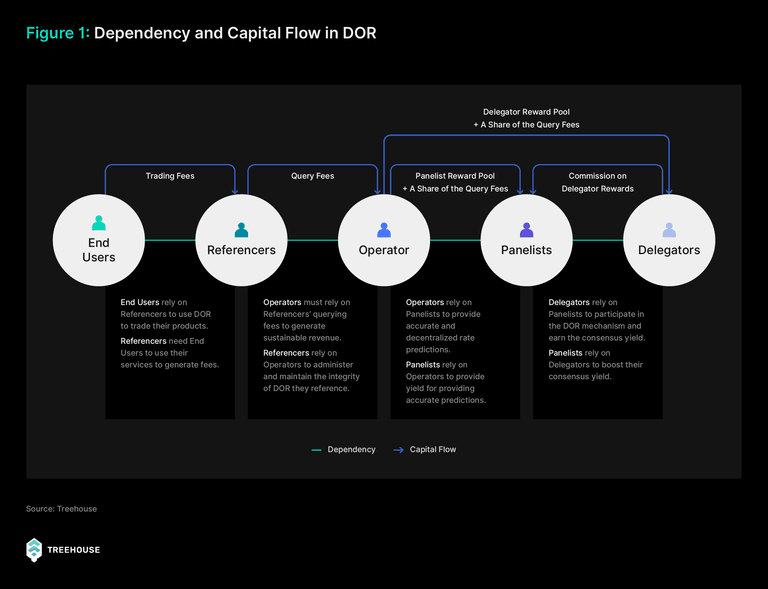
Treehouse Protocol ensures the credibility and reliability of DOR by rewarding accurate data submissions and penalizing malicious or incorrect inputs from panelists who stake capital to submit rates. These panelists include staking houses and market makers such as Selini Capital, Staking Rewards, and many more.
The Treehouse Ethereum Staking Rate (TESR), a consensus-derived yield curve that represents Ethereum's risk-free rate across various durations, is Treehouse’s first DOR.
TESR provides benchmark rates for Ethereum, facilitating the possibility of fixed rate markets and financial products such as forward rate agreements and rate derivatives like interest rate swaps (IRS) within DeFi.
As adoption for on-chain fixed income expands, Treehouse looks to revolutionize the market across all of DeFi, in a trustless and transparent fashion.
tAssets
Treehouse Assets, or tAssets, are liquid staking tokens (LSTs) that generate real yield via interest rate arbitrage, called Market Efficiency Yield (MEY). Treehouse’s pioneer tAsset, tETH, is built on Lido’s stETH, and enhances the cryptoeconomic security of DOR while providing native ETH staking yield and additional MEY.
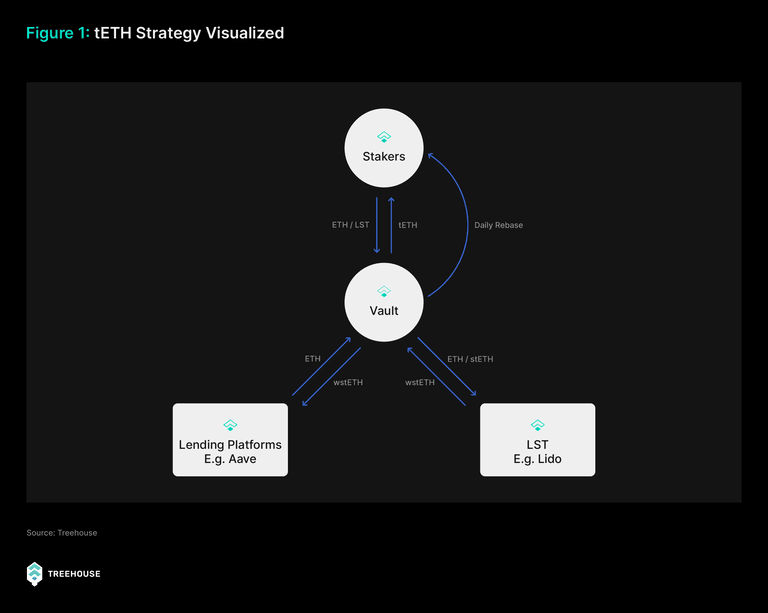
tETH was launched to converge the fragmented interest rate market on Ethereum via rate arbitrage strategies, and is also available on L2, starting with Arbitrum.
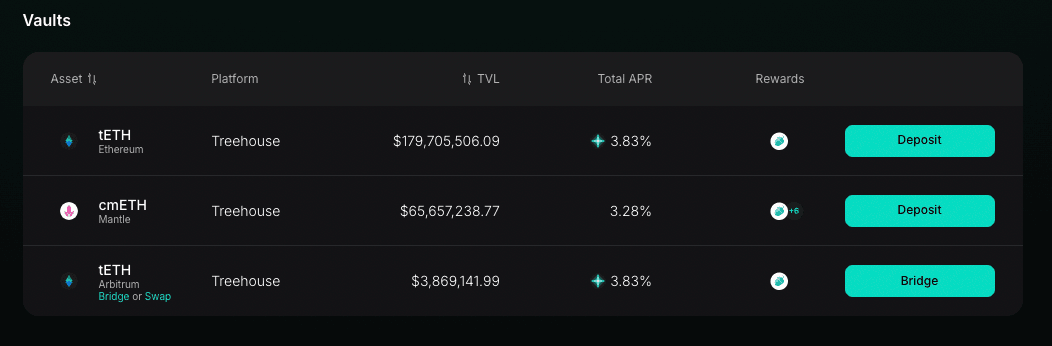
tETH currently touts a Total Value Locked (TVL) of $180 million, and generates a 3.8% annual percentage rate (APR), compared to traditional ETH staking which yields a little over 3% as of the time of writing.
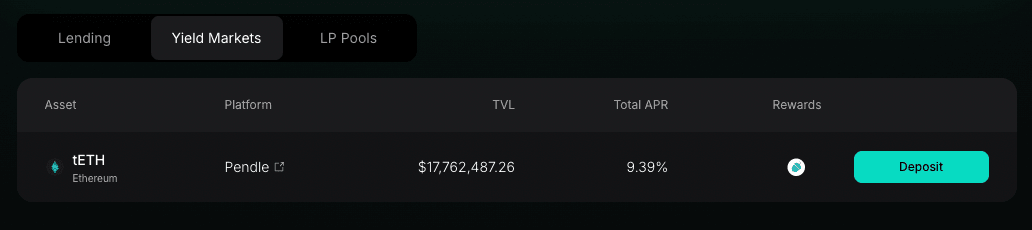
As Treehouse and decentralized fixed income continue to scale, the protocol has upcoming activations to pay attention to, as well as tETH integrations with other DeFi protocols outside of Pendle, where users are currently earning 9.4% APY on their tETH.
In addition to the Pendle integration, Treehouse also partnered with Compound, a lending and borrowing protocol, on March 3, allowing users to borrow wstETH against tETH on Compound. This allows users to leverage tETH and earn Treehouse Nuts rewards, while remaining liquid for other DeFi activities.
If you’d like to explore further about Treehouse, visit the protocol’s dApp and X (formerly Twitter), as well as stay tuned to the delegating function where users can earn rewards based on their delegated DOR panelist’s performance.
Advertisement
Free newsletters
Good reporting. Delivered.
Choose your coverage: crypto and DeFi, the future of finance, or both.
Free. Unsubscribe anytime.