Using ConsenSys’ Linea Testnet For A Potential Airdrop
How to Get Started with Polynomial Trade on Optimism
- Featured Yields: Up to 94% APY on Stablecoins, 112% APY on ETH
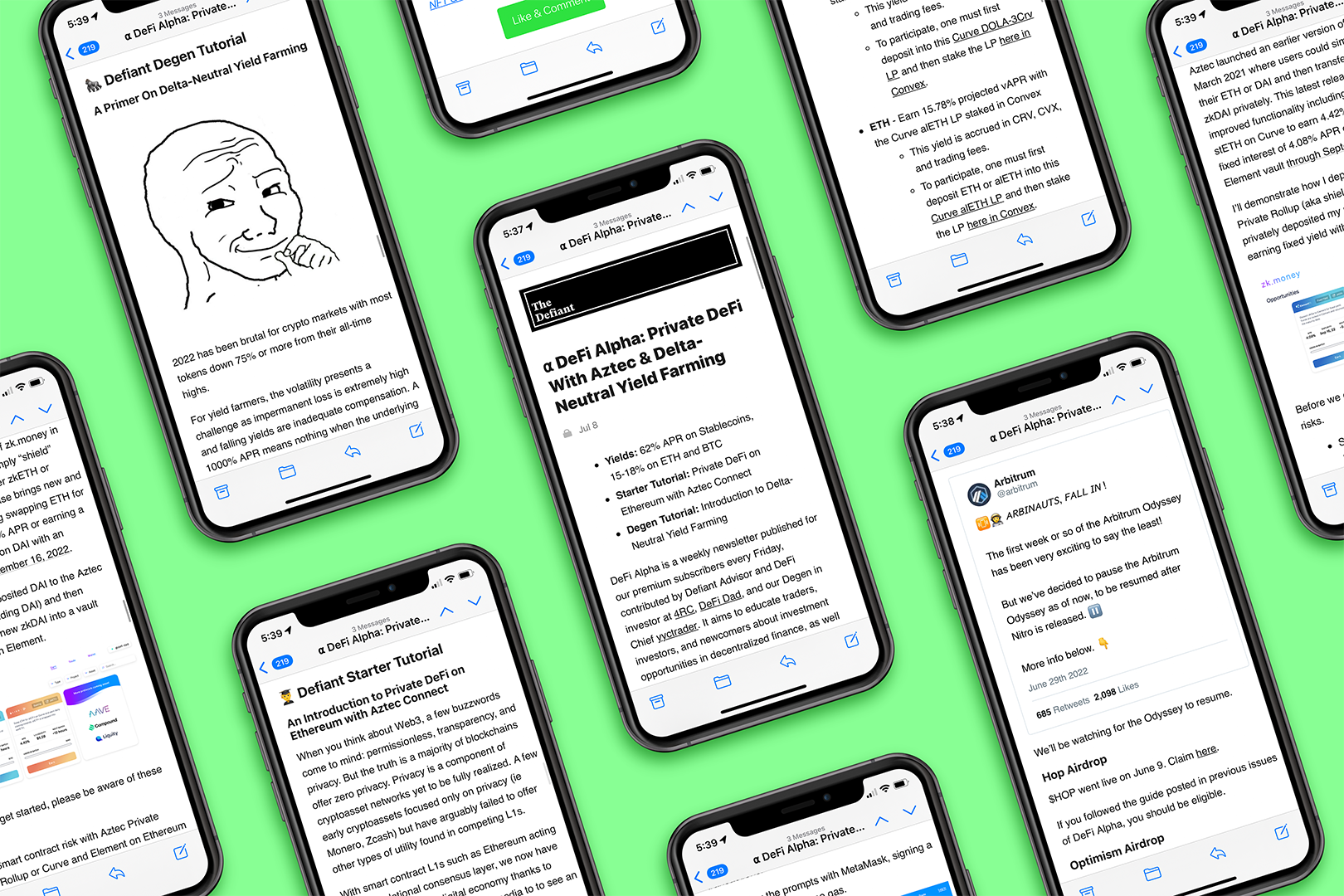
DeFi Alpha is a weekly newsletter published for our premium subscribers every Friday, contributed by Defiant Advisor and DeFi investor at 4RC, DeFi Dad, and our Degen in Chief yyctrader.
It aims to educate traders, investors, and newcomers about investment opportunities in decentralized finance, as well as provide primers and guides about its emerging platforms. It is meant to be highly actionable and shareable.
Any information covered in DeFi Alpha should not form the basis for making investment decisions nor be construed as a recommendation or advice to engage in investment transactions. Any mention of a token or protocol should not be considered a recommendation or endorsement.
Latest Developments
Before we get started, here are the top headline-grabbing events from this week that every savvy DeFi investor ought to keep on their radar.
- Staked ETH Withdrawals To Activate On April 12
- DeFi TVL Bounces Back Even as Active Users Decline in Q1
- Governance Tokens Might Come With Legal Liability, US Judge Says
- Trader Joe is Fastest-Growing DEX After Shift to Uniswap v3-Like Model
- Kava Flips Solana As New Lending Protocol Boosts TVL
Sponsored Post
Fuse is an enterprise-grade, reliable, and secure decentralized EVM-compatible public blockchain built for business, focusing on payments, established in 2019. Anyone can build on the Fuse blockchain and leverage enterprise-ready, decentralized tech – be it existing crypto projects, start-ups, or blue-chip companies.
Why builders choose Fuse Network:
- Fuse provides businesses and developers with wallet-as-a-service, powerful tools, and an SDK for integrating Web3 features such as account abstraction, gasless transactions, and payments into real-world applications.
- Fuse is fully EVM-compatible, meaning other EVM chain smart contracts can be deployed and run on Fuse quickly.
- Fuse’s payment-focused Infrastructure enables businesses to integrate a wallet and Web3 payments into their products seamlessly.
- Fast transaction confirmation times and low fees optimize Fuse for payments and quick finality.
- Integrations with Ramp and Transfi mean users can quickly and globally on and off-ramp fiat to crypto and vice versa.
- Developers can access integrated development environments (IDEs), debugging tools, analytics platforms, and over 100 more ecosystem partner services.
- The Fuse mobile stack is designed for SMBs and communities facing a high entry barrier for reaching customers on mobile and creating reward and loyalty programs.
- A supportive community of developers can provide valuable insights and guidance.
Tell us what you’re building in Web3, check the Wallet SDK, follow @fuse_network on Twitter, and visit the website fuse.io.
Yield Alpha
Each week we will provide options to earn yield on ETH, WBTC, stablecoins, and other major tokens.
- ETH: Up to 112% APR looping ETH 4X on Radiant Capital on Arbitrum
- This yield is accrued in ETH borrowing interest and mostly RDNT rewards.
- To participate, it requires a leveraged ETH/ETH position with 5% of the value of the looped position in the 80/20 RDNT/ETH Balancer LP.
- The LP must be staked for 12 months to achieve 112%, as of this writing.
- Then, one must deposit ETH into Radiant here and loop 4X here + zap into an LP staked for 1-12 months (1 month = 4% net APR vs 12 months = 112% net APR).
- Caution: This is a leveraged ETH position that could get liquidated if borrowers do not maintain a health factor > 1. This is higher risk than lending or staking.
- WBTC: Up to 67.8% APR looping WBTC 4X on Radiant Capital on Arbitrum
- This yield is accrued in WBTC borrowing interest and mostly RDNT rewards.
- To participate, it requires a leveraged WBTC/WBTC position with 5% of the value of the looped position in the 80/20 RDNT/ETH Balancer LP.
- The LP must be staked for 12 months to achieve 67.8%, as of this writing.
- Then, one must deposit WBTC into Radiant here and loop 4X here + zap into an LP staked for 1-12 months.
- Caution: This is a leveraged WBTC position that could get liquidated if borrowers do not maintain a health factor > 1. This is higher risk than lending or staking.
- MATIC: 16.7% APY with a MaticX/MATIC leveraged staking position in Cian
- The yield is backed by validator rewards using MaticX as collateral, and looping borrowed MATIC against the MaticX.
- To participate on Polygon, one can follow the prompts to deposit into the MATICX/MATIC Leveraged Staking strategy here on Cian.
- ATOM: 22% APR staking ATOM with Keplr Wallet on Cosmos Hub
- The yield earned is issued in ATOM.
- To participate, one must set up a Keplr Wallet, go to the Cosmos Hub validators on Keplr Dashboard, rank by APR, choose a validator, and click Delegate.
- Then, I specify how many ATOMs and follow the prompts to Delegate.
- BNB: 13% APY with the BNB/BNBx Ellipsis LP
- AVAX: 43.5% APY with sAVAX/AVAX leveraged staking position in Cian
- The yield is backed by validator rewards using sAVAX as collateral, and looping borrowed AVAX with Aave.
- To participate on Avalanche, one can follow the prompts to deposit into the sAVAX/AVAX Folding – Aave strategy here on Cian.
- SOL: 6.7% APY staking SOL with stSOL by Lido
- This is backed by SOL staking yield.
- To participate, one must deposit SOL here or buy it on a Solana DEX.
- FTM: 4.7% APY staking sFTMx liquid staking derivative by Stader
- The yield is issued in FTM rewards, as sFTMX is earning FTM via validator rewards to support Fantom’s PoS network.
- To participate, one must deposit FTM for sFTMX here on Stader.
- Stablecoins: Up to 94.3% APR looping DAI 4X on Radiant Capital on Arbitrum
- This yield is accrued in DAI borrowing interest and mostly RDNT rewards.
- To participate, it requires a leveraged DAI/DAI position with 5% of the value of the looped position in the 80/20 RDNT/ETH Balancer LP.
- The LP must be staked for 12 months to achieve 94.3% APR, as of this writing.
- Then, one must deposit DAI into Radiant here and loop 4X here + zap into an LP staked for 1-12 months.
- Caution: This is a leveraged DAI position that could get liquidated if borrowers do not maintain a health factor > 1. This is higher risk than lending or staking.
Please be aware we do not always report the highest yield rates because some high yields may be less sustainable due to high inflation token rewards or fewer LPs participating.
Starter Tutorial
How to Get Started with Polynomial Trade on Optimism
Disclosure: DeFi Dad was a seed investor in Polynomial. This is not a recommendation or endorsement to ever trade with leverage or buy any future token(s).
In DeFi, decentralized leverage trading has seen a rise in product-market fit more than any other sector over the past year. It started with early DeFi builders like dYdX and has exploded recently with the deepened liquidity now on Ethereum L2s like Arbitrum and Optimism.
Long before L2s were launched, Synthetix was building a derivatives liquidity protocol, challenged with countless issues to implement its vision on Ethereum L1.
Since the launch of Optimism in 2021, Synthetix has been evolving into more of a derivatives protocol layer with multiple dApps building on top of it, such as Kwenta, Lyra, dHedge, Curve, and now the “DeFi Derivatives Powerhouse” Polynomial!
In 2022, Polynomial launched options vaults (Earn Vaults) for call and puts selling with sETH and sUSD. These grew in popularity but also faced market headwinds as 2022 turned into a very bearish year for crypto.
During this crypto bear market, the Polynomial team continued building in stealth for a new decentralized perpetual futures trading platform, sourcing its liquidity from Synthetix on Optimism.
Perpetual futures, also known as perpetual swaps, are a very popular crypto product that started with centralized exchanges like Bitmex but have since then become a popular DeFi product.
Perpetual futures are a type of derivative contract that allows traders to speculate on the price of an underlying asset without an expiration date. The advantage is that the contract can be held indefinitely, with the trader choosing to either hold the position or close it out at any time.
However, with perpetual futures, there’s a “funding rate” fee paid by one side of the trade to the other in order to keep the contract price aligned with the underlying spot price. When the funding rate is positive, long positions are required to pay a funding fee to traders who are short the contract and if the futures price is lower than the spot price (funding rate is negative), short traders will be required to pay a funding fee to long traders.
On March 27th, 2023, the team launched Polynomial Trade and managed to attract over $3.7M in trading volume in its first 24 hours with its 11 trading pairs. In the first 72 hours, the Synthetix protocol did over $700k in fees thanks to mostly perps volume on Polynomial and Kwenta.
Here’s what DeFi traders need to know about Polynomial Trade’s decentralized perps markets:
- 11 trading pairs with sUSD including: ARB, ETH, BTC, MATIC, LINK, SOL, OP, AVAX, BNB, APE, DYDX
- The max leverage on the exchange is limited to 25X.
- Polynomial uses “delayed orders” which are next-price orders but with a time delay.
- Advanced orders such as limit orders and stop-loss limit orders thanks to Polynomial Wallet, a smart contract wallet managed by a contract account.
- For market orders, there’s a keeper deposit = fixed fee of $2 is given to the keeper bots to execute the trade and fees = 0.1% or 0.05% based on the market skew.
- For limit orders, there’s a keeper deposit = fixed fee of $2 is given to the keeper bots to execute the trade and fees = 0.1% or 0.05% based on the market skew, as well as limit keeper deposit = fixed fee of $2, and fees = 3bps of notional size.
- Fees are only charged when the order is executed finally.
Decentralized perps are a major product in DeFi and can be used to create a more capital efficient long / short positions. Today, I’ll show how I might get started creating a Polynomial Wallet and opening a long or short position on Polynomial Trade.
Before we get started, please be aware of these risks.
- Smart contract risk in Polynomial and Synthetix
- Systemic risk in DeFi composability
- Stablecoins like sUSD can depeg
- Front-end spoof attack on the Polynomial Trade app
- Liquidation if the market moves against a leveraged position.
- Polynomial does not have a token and is currently built by a team of known DeFi builders but there is still more work to be done to ensure the platform is fully trustless with no vectors for centralized control.
- This trading platform currently has geo-restrictions to allow US IP addresses to access it. This is not a recommendation or endorsement for US-based users to access Polynomial.
Step 1: First, assuming I’m not a US citizen, I go to the Polynomial Trade app and follow the prompts to Create Polynomial Wallet. It will require a few signatures and one transaction on the Optimism L2 network.
Step 2: Then, I need to deposit sUSD. sUSD is required as margin to trade on Polynomial. I follow the prompts to deposit sUSD.
Step 3: Now, I’m ready to open a position! I choose a market like ETH/USD from the top left dropdown menu and then specify a Standard Order (market) or Limit Order using my margin balance (in sUSD) and the leverage scale.
In this example, I’m longing ETH/USD with 102 sUSD and 11X leverage from a market entry of about $1789. I click Long and follow the prompts and I’ve opened my first long position!
Step 4: For this final example, I click on Close Position -> Limit Order in the bottom of the screen under my open position to set a Stop-Loss Limit Order using the parameters below specific to this example position. This ensures I have an exit plan for my leveraged position if the market goes down while I’m long.
Degen Tutorial
Using ConsenSys’ Linea zkEVM Testnet For A Potential Airdrop
ConsenSys, the blockchain software company behind Metamask and Infura, has opened up its Linea testnet to the public.
Linea is a Layer 2 network that is compatible with Ethereum and powered by zero-knowledge technology. zkSync and Polygon unveiled their own zkEVM offerings last week.
While there has been no official word regarding a potential Linea token, using the testnet early could pay off in the future.
Note that the few apps available are still buggy, so make sure to provide feedback using the form provided.
Let’s get started.
Step 1: Add Linea to Metamask
https://chainlist.org/?search=linea&testnets=true
Step 2: Obtain Test Tokens On Goerli
- ETH faucet: https://goerlifaucet.com/
- USDC faucet: https://bridge.goerli.linea.build/faucet?token=USDC
Step 3: Bridge Test Tokens To Linea
There are multiple bridges that you can use to bridge testnet ETH from Goerli to Linea.
- Official: https://bridge.goerli.linea.build/
Celer, Connext and LI.FI are also listed on Linea’s ecosystem page but don’t appear to be active yet.
Step 4: Swap and Add Liquidity On Uniswap
https://swap.goerli.linea.build/#/swap
The pricing is currently way off base, and you’ll need to increase slippage and swap a very small amount of ETH to do a successful swap.
Attempting to add liquidity resulted in an error, so we’ll need to try again later.
Step 5: Mint Test Tokens And Create Markets on FWDX
https://testnet.fwdx.xyz/faucet
FWDX is a decentralized P2P swap platform. Mint some test tokens and create markets (limit orders) for them.
https://testnet.fwdx.xyz/create
Step 6: Disperse ETH on ghostNFT
https://app.nft.ghostchain.io/#/zkevm
Pick any NFT collection and ‘Disperse’ some test ETH.
Monitor the Linea ecosystem page for new additions and try out the apps.
That’s it! As with all airdrop guides, it’s recommended that you repeat these tasks periodically in case projects look for multiple rounds of activity, as in the cases of Arbitrum and Optimism.
Airdrop Alpha
In each DeFi Alpha guide, we update a list of DeFi protocols that have yet to announce and/or launch a token.
$ARB is Live!
Layer 2 network Arbitrum has launched its ARB token, and the project is currently valued at $12B.
Claim your ARB tokens here.
We’ve been tracking Arbitrum ever since last summer’s Odyssey, in addition to tutorials on GMX, Radiant, TreasureDAO and more, so our readers should certainly be eligible!
- Arch Finance – a protocol for comprehensive indices that provide access to differentiated sources of market risk.
- Arbitrum – one of the leading L2s for Ethereum. Claimable now!
- Arrakis Finance – a trustless algorithmic market-maker, for auto-managing Uniswap V3 LPs on Ethereum, Polygon, Arbitrum, and Optimism
- Base – A new Ethereum L2, incubated by Coinbase and built on the open-source OP Stack, that could potentially have a governance token in the future
- DeFi Saver – a one-stop dashboard for creating, managing and tracking DeFi positions across Aave, Compound, Maker, Liquity, and Reflexer
- DeFrag – instant loans for Treasure gaming NFTs on Arbitrum
- Farcaster – a “sufficiently” decentralized social network where users will have the freedom to move their social identity between applications
- Jupiter – The leading DEX aggregator by trading volume on Solana
- Lens Protocol – A decentralized composable social graph, underpinning an emerging landscape of Web3 social media dApps including Lenster, Lenstube, and Orb
- LI.FI – A cross-chain bridge and DEX aggregator protocol
- Liquality – A cross-chain, non-custodial browser extension wallet, similar to MetaMask but with more integrations for swapping cross-chain.
- Magic Eden – The leading NFT marketplace by trading volume on Solana
- Nested – a crypto social trading platform built on Ethereum and other chains
- Opyn – one of the OG decentralized options protocols on Ethereum, with major investors that signal a token has to be in their future. Buy/sell puts or call options to earn a possible future airdrop.
- Orb – one the leading mobile apps for Lens social media
- Polymarket – one of the strongest players in the DeFi prediction market vertical, bet on an outcome related to crypto, politics, sports and more or add liquidity
- Polynomial – A newer DeFi derivatives vault creator, built on Optimism
- Sense Protocol – A decentralized fixed-income protocol on Ethereum, allowing users to manage risk through fixed rates and future yield trading on existing yield bearing-assets
- Set Protocol – one of the earliest DeFi protocols yet to launch a token for DeFi asset management, popular for TokenSets and known for powering IndexCoop indexes
- Socket (formerly Movr) – their bridge aggregator Bungee moves assets between chains, finding the cheapest, fastest route
- StarkNet mainnet is live! Bridge and swap some tokens for a potential airdrop. Guide here.
- SudoSwap has released details about its SUDO token and airdrop.If you followed our guide from August 12 and created some trading pools, you should be eligible!
- Volmex – Volmex is a tokenized volatility protocol, similar to the VIX but ETHV
- Wormhole – a cross-chain messaging protocol known for bridging between Solana, Terra, Polygon, BSC, Avalanche, Fantom, and Oasis
- Yield Protocol – a newer protocol for fixed-term, fixed-rate lending in DeFi, backed by Paradigm, one might earn a future airdrop by lending DAI or USDC
- Zapper – participate in Zapper trading, lending, providing liquidity, or yield farming; given the Zapper Quests and NFT Rewards program, it can be surmised that if Zapper ever releases a token, this is one way they might do a retro airdrop
- Zerion – The same can be said about Zerion; if they ever release a token, they’re likely to reward those who interacted with their smart contracts swapping, lending, providing liquidity, or borrowing.
- ZigZag – a DEX on zkSync. The airdrop has been distributed. Check your zkSync wallet.
- zkSync – zkSync Era, the first zkEVM is live! Learn about live dApps here and bridge a token to potentially qualify for a future airdrop.
The information contained in this newsletter is not intended as, and shall not be understood or construed as, financial advice. The authors are not financial advisors, and the information contained here is not a substitute for financial advice from a professional who is aware of the facts and circumstances of your individual situation. We have done our best to ensure that the information provided is accurate, but neither The Defiant nor any of its contributors shall be held liable or responsible for any errors or omissions or for any damage readers may suffer as a result of failing to seek financial advice from a professional.
Free newsletters
Good reporting. Delivered.
Choose your coverage: crypto and DeFi, the future of finance, or both.
Free. Unsubscribe anytime.