How To Decentralize a Fortune 500 Company
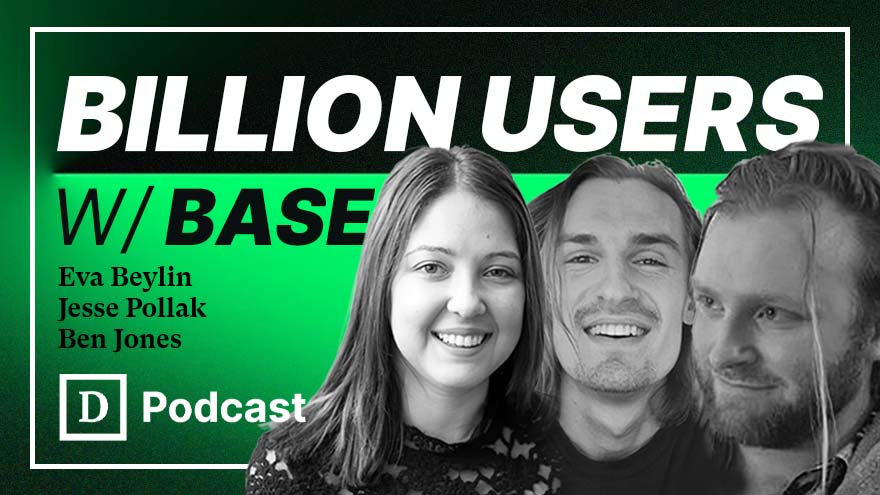
This week on The Defiant podcast, Tegan Kline hosts Jesse Pollak, senior director of Engineering at Coinbase, Eva Beylin, the director of the Graph Foundation, and Ben Jones, the director of the Optimism Foundation, to give us a deep dive into the launch of Base, Coinbase's recently-launched Layer 2 blockchain.
Base is an Ethereum Layer two that offers a secure, low-cost, developer-friendly way for anyone anywhere to build decentralized applications.
In this episode, we talk about the evolution of Base from inside a Fortune 500 company, the importance of decentralized tools like the Graph and Optimism, and the importance of thinking positive sum, not zero-sum.
Jesse discusses decentralization inside a centralized company and how Coinbase plans to onboard millions of dapps and a billion users.
Listen to the interview in this week’s podcast episode here:

Thanking our podcast sponsors:
- web3 with a16z is a chart-topping podcast about the next generation of the internet, from a16z crypto. Click here to listen now.
- This episode is brought to you by Orbs Layer-3. Trade DeFi like a pro using decentralized TWAP order type on SpookySwap, SpiritSwap, and Pangolin. Learn more: https://www.orbs.com/dtwap/
TLDR: This podcast features Jesse Pollak from Coinbase, Eva Beylin from The Graph Foundation, and Ben Jones from Optimism. Pollak discusses Coinbase’s goal to migrate products, users, and assets on-chain and the development of Base. Beylin shares The Graph Foundation’s vision to be blockchain agnostic and support the development of Base. Jones expresses excitement about the collaboration with Coinbase and the importance of public goods like the OP Stack.
Key takeaways:
- Coinbase chose to launch its own Layer 2 (L2) solution to align the company with Ethereum as its primary development platform and L2 as a place to build. They aim to inter-operate with other L2s through the Superchain construction. As an OP core developer, Coinbase is investing resources in enhancing the stack’s security, scalability, and decentralization. The goal is to make it easy for a billion people to use crypto daily.
- Base, built on the OP Stack and in collaboration with Optimism, aims to create a platform for a million builders to create applications for the crypto economy.
- The Graph plays a crucial role in empowering Base by providing blockchain data and making it easier for developers to build on the OP Stack base.
- Optimism is excited about the collaboration with Coinbase and the importance of public goods like the OP Stack, aiming to reach billions of people in the future.
Introductions
Jesse Pollak – Senior Director of Engineering at Coinbase
I’ve been at Coinbase for six years now. At the beginning of 2017, I joined the company and spent the first four and a half years growing all of the engineering teams that built our consumer-facing products. I started with a team of me plus three or four people, and we eventually grew the Coinbase Pro and Coinbase Wallet teams to over 200 engineers by the time I stepped back from that role in 2021.
For the last year and a half, I’ve been working with a small team with a single mandate. Our goal is to figure out how to accelerate the migration of Coinbase products, users, and assets on-chain. We started with products like USDC and Coinbase Wallet, but we still have a long way to go to become 100% on-chain.
My job at Coinbase is to figure out what we need to do to make this happen over the next few years. Additionally, I’m involved in the development of Base, which is built on the OP Stack and collaboration with Optimism. Our goal with Base is to create a platform that will help a million builders create applications that will bring a billion users to the crypto economy.
We want to deeply integrate Base with Coinbase developer products and consumer products to make it easy for our 110 million plus users and over 80 billion assets in the Coinbase ecosystem to use layer 2 without thinking about it. Our ultimate goal with Base is to make it easy for a billion people to come on-chain and use crypto every day.
Eva Beylin – Director of The Graph Foundation
I oversee the open data layer for indexing and querying blockchain data. Our vision is to be blockchain agnostic, allowing developers to choose the environment that best suits their needs.
What excites us about building on the OP Stack and Base is the proliferation of chains and the opportunities they provide for developers to choose the environment that they really want. The Coinbase ecosystem is already thriving, and we believe that there are even more opportunities for developers who choose to build on Base.
As a foundation, we are thrilled to be able to support this development. From day one, we have supported the testnet and have provided all the necessary resources to make it as easy as possible for developers to test it out.
Ben Jones – Director of the Optimism Foundation
I feel really excited and validated by the announcement of Base and being on this call with all these lovely people. The OP Stack is a really important part of what we do, and it’s the code that empowers not just Optimism mainnet, but now will empower Base and other chains in the future as we build towards the Superchain.
We’ve been working on the modular stack for years, so it’s really important to us that it’s secure and decentralized and doesn’t require bootstrapping a whole network. The release of the OP Stack is a major effort driven by the community people on the OP labs engineering team, and now we can include Coinbase as a core developer as well, and they’ve already started giving back.
For me, the most important thing this validates is the importance of public goods. The OP Stack should be a public good, meaning anyone can view the source code and run with it. Seeing a big player like Coinbase come in and play the positive sum game is huge for us because we need to expand and scale together to reach the masses. Optimism’s mainnet hasn’t been live for two years, and while we’ve saved almost 3 billion in fees, that’s not enough to reach the billion people we want to reach. The OP Stack and public goods are the way to do that.
Why Coinbase Chose to Launch Its Own Layer 2
Coinbase is a publicly traded company. Why launch your own layer 2 as opposed to just using one that already exists?
Jesse: In 2022, I began working with internal teams to understand the challenges they faced when building on-chain applications. I found that people were struggling with basic questions like what language to use and where to build their applications. We decided to align the whole business around Ethereum as the primary development platform and L2 as a place we wanted to build.
We can have the best of both worlds…We’d be inter-operating with other L2s through the Superchain construction and building on the OP stack.
– Jesse Pollak
We worked with various L2 teams and realized that there would be many L2s that would work together to form a Superchain that would scale Ethereum. We saw this as an opportunity to have the best of both worlds by having a native platform for Coinbase on the Superchain while still being interoperable with other ecosystems. This platform will change our culture and the way we build and think, and we are excited to make this change.
What does it mean for Coinbase to be an OP core dev?
Ben: We are both putting our resources towards making the underlying technology the standard of the OP Stack as good as possible.
There are lots of nuances and details I could go into, but to me, just the most important thing is that we are building one thing. It’s the nature and essence of that positive-sum mentality we’re talking about where everybody’s contributing to the same code base, and when one project gets better, all projects get better. So for me, that’s what’s most important.
Jesse: I believe that our perspective is centered around investing our time, money, and energy into the improvement of the stack. Specifically, we aim to write code that enhances the stack’s security, scalability, and decentralization, all while collaborating with Optimism, OP labs, and other developers who are building on the OP Stack.
As we have been contributing code and landing PRs on the OP Stack repo for the past six months, I think the pace of these contributions will increase, and we are exploring the possibility of building other clients to promote multi-client implementations.
Our thesis is that if we make it good enough, we make the infrastructure good enough around it, and we make the community good enough, people will opt-in to participate in something that’s bigger than just themselves.
Jesse Pollack
We believe that by contributing to the code base and building a strong community, we can create something that is greater than ourselves. Our ultimate goal is to make the infrastructure around the stack good enough that people will want to participate in it. It’s important to us that our contributions remain freely available under the MIT license so that anyone can use them in any way they want.
The Graph’s Crucial Role
Eva, can you tell us a little bit about how it increases development on Base?
Eva: At its core, The Graph provides blockchain data, which can be raw data in some of our newer products like Firehose. However, we have a standard called a Subgraph, which is an API that makes it incredibly easy for anyone to get blockchain data, and it’s open source.
Any Subgraphs that have been built before can be reused by other developers, which is exciting because it can bring in a whole new set of developers from other chain communities that already know The Graph and want to learn how to build on the OP Stack base.
Personally, I am excited about accessing the new things that will come out of the Base ecosystem that might be unique to that chain. Our mission is to reach 1 million devs and 1 million dApps, and a big part of that is making it easier for people to build. Right now, it takes a lot of effort to finish a hackathon project over a weekend, but The Graph can simplify this process by removing the need to run a server, run your own proprietary code, or even be the one indexing.
By relying on the open source community built around The Graph or quickly deploying a Subgraph, we believe developers can bridge from being a web2 JavaScript developer to a Solidity or a front-end developer for dApps.
Future of Layer 2s
Ben, you wanna see more layer 2s launching in this capacity? Is this the future where everyone has their own layer 2?
Ben: I sure do. It also means redefining what a layer 2 is. As Jesse mentioned earlier, the purpose of the Superchain is not to have numerous chains, but for all of them to disappear, and for people to interact solely with the applications they’re using. It’s similar to how in the early eighties, people thought about chain IDs when accessing the internet, but now we don’t think about our tier one or tier two service provider when logging into Twitter to view the latest ship post. Although it’s a requirement, we shouldn’t focus on having a multitude of chains since that’s not the goal.
Why Optimistic Rollups?
Jesse, back to that due diligence phase. I’m imagining a gigantic whiteboard with every single layer 2 type and name on it. Can you just double-click a little bit more into how you chose optimistic rollups using the OP tech stack?
Jesse: No whiteboard, just a lot of docs. The things that really stood out to us about Optimism in the OP Stack were:
- It’s modular. That gives us the ability to continually upgrade and improve the chain. If we have a strong technical foundation that’s modular, then as these technologies mature we can basically plug in the things that are gonna be most powerful and serve our customers the best, both developers and users.
- The technology stack is open-source and MIT-licensed, which means that’s freely available.
- Public goods and finding sustainable ways for public goods. We believe that the foundation for the crypto economy is on public goods.
- We started working together on EIP 4844, or Proto-danksharding, which is an upgrade to Ethereum that’s gonna make all layer 2 rollups something like 10 times cheaper.
The act of collaborating on Ethereum and using that opportunity to write code with each other and get to know each other and build alongside each other on this thing that was bigger than either of us just laid a really strong foundation for us collaborating together. It gave us a context to build trust.
Jesse Pollack
Positive Sum Approach
What advice do you have to maybe other people that wanna do something similar at a centralized company? What advice do you have for them to go more positive-sum?
It’s gonna be hard. That’s my advice. Be committed for the long term and don’t expect change to happen overnight.
Jesse Pollack
Jesse: My advice would be that it’s going to be hard, but it is possible to succeed. At Coinbase, we focus on our customers and using the on-chain platform to deliver real value.
For example, we built an NFT campaign using Zora in just one day and distributed it to hundreds of thousands of wallets. These on-chain tools are getting more powerful every day, and I believe they are 10 times more powerful than online tools. It’s important to find ways to use these tools to deliver value to your teams, customers, and executives and show the potential of the platform to bring more efficiency, value, and engagement.
mint.base.org. That’s some alpha everyone, so make sure you go make your NFT.
Jesse: I don’t know if it’s Alpha, this is a commemorative NFT like one per address. We’re really excited about getting people to be a part of celebrating what Base is.
Coinbase + Optimism
How this relationship went down. How did it go down? Did it happen at an event? Did it happen online through your Discord? How did you go about starting to work with Coinbase?
They’re headed towards 2.75.
Ben Jones
Ben: Jesse already touched on this, and I’ll echo the same sentiment, which is that it was starting to work on 4844 together when things really started to gel.
I started to realize the positive impact of decentralization when Coinbase, a large fortune 500 company, became involved in it. It was a moment that opened our eyes to the potential of a strong force working towards decentralization. Coinbase’s involvement was significant, and it was a starting point that helped us collaborate and have conversations. As we continued to work together, we began to understand that this movement made sense and was heading toward web 2.75.
That’s what it’s all about. A million builders, billion users.
Jesse Pollack
Jesse: I had a conversation with the chief Product Officer of Coinbase over dinner about an idea we had. He advised me to just ship it and not ask for permission due to the bureaucracy of a big company like Coinbase. I messaged Michael that night and asked what we could ship in one week. We ended up launching the first version of Base net, which runs on Coin net, in a week.
It was well-received internally, and I reached out to Optimism to collaborate on launching an L2. Liam was supportive, and we’ve been building together for six months. Our goal is to create one Superchain that benefits Coinbase, Optimism, and the broader crypto ecosystem and attracts a million builders to gain a billion users.
Superchain Concept
What is it and was that the moment that concept was born?
Ben: I got a shout-out. My co-founder Karl Floersch, among many others on the OP labs team, I think it was over a year ago at this point, that Karl came to me and started saying this Superchain word.
From the Optimism perspective, the focus has been on scaling Ethereum using rollups, which can lower fees and allow for scalability. The bedrock release of the OP Stack took over a year to develop and refine, but now there is a need for a Superchain that brings multiple L2s together to create a decentralized network of chains that improves interoperability, user experience, and developer experience. The goal is to have all the benefits of multiple chains while also having the advantages of one cohesive network.
The goal of the Superchain is to basically put all these chains on a shared standard and continuously improve their interoperability, the user experience, and the consistency of the developer experience. Work towards a future in which we can get all the benefits that are necessary for having multiple chains.
Ben Jones
Who’s committed to the Superchain today?
Jesse: To start, Base on Optimism mainnet are gonna be running alongside each other and we’re gonna have to figure out how do we increase interoperability between them.
Anyone wanting to come and collaborate with us, whatever their background, whatever their perspective, as long as they share this vision for the parts being greater than the sum of the whole and working together to scale Ethereum and to scale the on-chain economy.
If you’re interested in doing that with us, please reach out. You can find me and Ben on Twitter. You can email the OP labs and Optimism team to apply for a grant in the OP collective grant-making process.
Public Goods
Ben: I believe that funding public goods should be a crucial component in creating the Superchain. Although Ethereum and crypto have made great strides, we have not done a good job in continuing to fund public goods that contribute to the ecosystem’s value. Many unsung heroes work tirelessly to keep these networks running and secure.
When a Superchain is formed, these problems are not eliminated but magnified. Therefore, I suggest visiting https://app.optimism.io/retropgf. It is vital for our ecosystem’s sustainability that those who provide value and make things work have a profitable avenue to do so.
Jesse: just to spell that out in 101 language, as part of this retroactive public goods funding round that Optimism is running, we will distribute something like 20 million to people who have done incredible work on public goods and who we wanna recognize retroactively. They’re not applying for grants. Community members are identifying these people who did great work and we should reward them, and that’s what retroactive public goods funding is all about.
Comparing Superchain and Cosmos
How should listeners think about the Superchain compared to something like Cosmos shared security?
Ben: There are definitely similarities. I believe that L2 is a crucial component in securing chains by connecting them to Ethereum. Collaboratively, we will incrementally figure out the details, but it’s important to acknowledge that sharing security with Ethereum is vital. From Optimism’s perspective, layer 2 is critical due to the evolution of multi-chain approaches. Ethereum is secure and extensible enough to facilitate this.
Secured by Ethereum.
Ben Jones
Jesse: I believe that Ben’s emphasis on being secured by Ethereum is incredibly important because it provides a strong foundation for experimentation with interoperability. With Ethereum’s decentralization and security, we can focus on building on top of it and exploring new possibilities. This is why Base is built as layer 2 and why we emphasize being secured by Ethereum as the first defining aspect of Base.
Challenges and Opportunities
Eva, Ben, if Coinbase succeeds in bringing hundreds of millions of users on- chain, what are some of the challenges and opportunities you expect to see across your protocols and ecosystems?
Eva: So the first thing that comes to mind is we want developers running the base and OP Stack nodes. And that’s really what we need to realize, this vision of decentralization, of decentralized data access. We need to ensure that everyone is comfortable running the nodes and familiar with the ecosystem’s nuances.
Our aim is to make it easy for developers to get involved with The Graph and create more dApps using the standard layer for data access. We want to teach JavaScript developers about Base and OP Stack in The Graph to learn about these chains without learning Solidity and the EVM.
How do we get them excited and interested and can Base and OP stack in The Graph be that way that they can then learn about these chains without sort of the burden of learning Solidity and learning everything about the EVM?
Eva Beylin
Ben: There’s one of the challenges that I think that we’ll face is exactly what Eva was alluding to around compatibility. To scale the Superchain to accommodate a billion users, we need to overcome the challenge of horizontal scaling. Once blockchains are truly scaled, preconceived notions about throughput and cost will be thrown out the door, making it easier for web2 companies to get involved in web3. Scaling will take years to achieve.
Jesse: The last thing I’ll add is that if we want to have a million builders, I think we also need to make it as easy as humanly possible to build. This applies across the board, including better wallets, better developer tools, and better ways of acquiring users when you have an app that works.
I feel like in the last year, we’ve started crossing the chasm a little bit. Now, we can actually build really useful apps, and we need to do the final 10% to 20% of polish on that developer experience. I think this will deliver a 10x to 100x impact in terms of making it easy for all those Java and JavaScript developers to start writing apps.
It should take them 30 minutes to get started, not 30 days. Refinement and continued investment in all the developer tooling and making it really great are top of my mind.
Regulatory Landscape
How are you thinking about the regulatory landscape?
Jesse: Over the past year, I’ve been advocating for the right of developers to run Ethereum nodes, run validators, and protect open-source code as a right for people to run and build. Base is an extension of that advocacy. Our goal is to make Ethereum more accessible to more people so they can run their own code, interoperate, operate, and engage in this open economy that’s being built. Ultimately, our vision is to create more economic freedom globally.
We see Base as a scaling solution for Ethereum.
Jesse
I believe that the best way to achieve this goal is to ensure that these platforms we’re building the crypto economy on remain accessible to all, remain global, and become cheaper and more secure so that everyone everywhere can build an app and everyone everywhere can use that app. That’s what this is all about.
Is there a circumstance in the future where this becomes a permissioned KYC chain where users have to KYC before being able to use the Base chain?
Jesse: We think about Base as an extension of Ethereum. And we have been strong advocates over the last year for the permissionless of Ethereum for the right to run a validator for the right of developers and users to run, write, and execute open-source software.
We’re planning to build on that legacy with Base. We’ve written extensively about the kind of path to decentralization and permission that’s on our blog. We’re working with Optimism on this closely. That’s one of the big reasons why we’re working with them because they have been such a leader from a decentralization perspective.
We’ll be sharing more as we head towards the mainnet. But again, our goal is to extend and scale the platform of Ethereum.
Decentralizing the Sequencer
On that decentralization path, do you imagine the sequencer being decentralized over time?
Jesse: Absolutely. All of it. Everything. We think about this across a few axes, sequencer decentralization, fault proofs going live and being increasingly decentralized, additional approving systems, and clients being decentralized.
Across those four axes, our goal is to work with Optimism and the broader community building on the OP Stack to make the technology that we’re running as secure, decentralized, and scalable as possible while making sure it remains open, permissionless, and freely available for everyone.
Getting Started on Base
How and when can developers start building on Base?
Jesse: Now. You can start building on Base now if you go to base.org you can get started. We have docs.base.org. We have faucets at coinbase.com/faucets. If you have questions, you can join our Discord. You can find the link to that on base.org. Or you can tweet me or tweet at Build on Base and we’ll try our best answer.
How are you thinking about the incentive structure? Will there be a token for Base?
Jesse: No token.
I really believe that we can find product-market fit without a token. Ethereum has found product-market fit without a token, and it has found product-market fit for a lot of high-value scaled use cases. I think we haven’t seen chains find that product market fit yet for the kind of consumer-scale use cases.
We have seen people use tokens to drive activity, but that’s not the only way to drive activity. We can also build a really great product, and we’re going to do that by making Base a really great developer platform so that a million builders can build an X wave of applications that bring a billion users on-chain.
How Are You defiant?
Eva: I really try not to use banks at all. I’m living fully on-chain and it causes difficulties, but I think the cost is worth it.
Jesse: I try to engage in as much on-chain activity as possible. Specifically, I pay everyone on L2 Optimism.
As for how I am defiant, it comes down to my experience working for the largest crypto company in the world, a centralized Fortune 500 company. During my time there, I focused on figuring out how to bring the business on-chain and embrace decentralization. It took a lot of belief, thinking outside the box, and determination to explore the potential of blockchain technology.
I am incredibly grateful for the support of the Coinbase team, including Brian, who provided the internal space for this exploration.
Ben: I’m defiant by making horrible crypto music on my Twitter, so check it out if you want to be cringe-slash entertained. And then I would just say for a long time, Optimism has been shouting about public goods from the rooftops. And in many ways that has felt defiant.
Get an edge in Crypto with our free daily newsletter
Know what matters in Crypto and Web3 with The Defiant Daily newsletter, Mon to Fri
90k+ Defiers informed every day. Unsubscribe anytime.