SoFi Pays 4.4% on a Tokenized Deposit
Plus Visa is in talks to buy Fireblocks, Mastercard adds stablecoin tools and 16 companies object to OKXICE stock tokens
Happy Thursday. This is Converge, The Defiant's weekly recap of tokenization, stablecoins, and real-world assets, by Chris Storaker.
TOP NEWS THIS WEEK
- SoFi launches SOFIE, a tokenized deposit paying 4.4%
- JPM Coin moves to Ethereum for institutional clients
- The OCC finalizes its GENIUS Act rule
- Visa is in talks to buy Fireblocks, Axios reports
- Visa and Mesh plan crypto spending at Visa merchants
ALSO IN THIS ISSUE
- Sixteen companies now object to OKXICE stock tokens
- Standard Chartered agrees to take full ownership of Zodia Custody
- Western Union picks Noah for stablecoin payouts
- Ireland's central bank fines Coinbase Ireland €3.25 million
Brought to you by: Stable Sea
Tokenized capital markets are onchain. Accessing them is complex. Reaching them still means stitching together bank, custody, accounting and compliance systems that were never built to talk. Every counterparty needs its own paper. Every rail needs its own integration.
Stable Sea replaces the patchwork with one workflow. Hold, move and manage capital onchain — trade 24/7 with role-based controls, insured custody, near-instant settlement, low minimums and no lock-ups. Upgrade your capital today.
TOKENIZED DEPOSITS
SoFi Pays 4.4% on a Tokenized Deposit
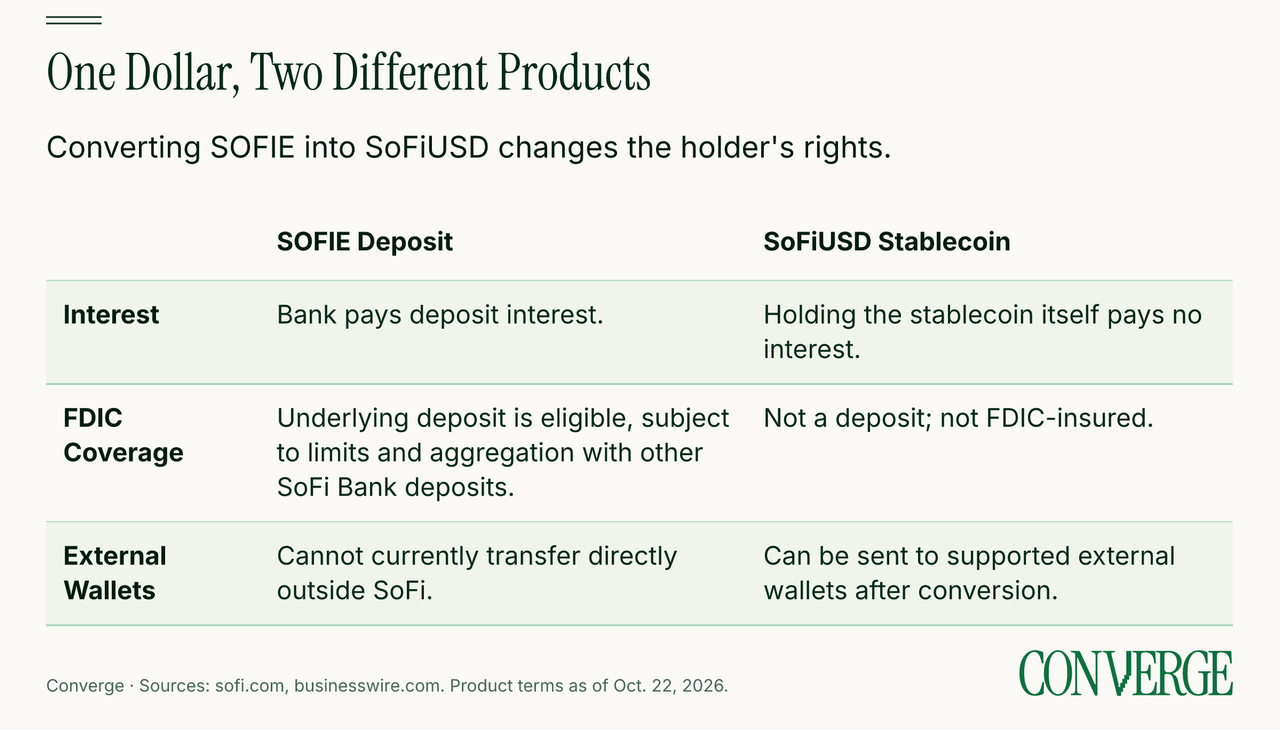
- SoFi launched SoFi Earn (SOFIE) on Oct. 22, a tokenized deposit that pays a variable 4.4% annual yield and is eligible for FDIC insurance. Each SOFIE represents $1 on deposit at SoFi Bank.
Members can convert SOFIE 1:1 into SoFiUSD, the stablecoin SoFi Bank issues, to buy crypto in the app or send it to an outside wallet at any hour. SOFIE itself cannot leave SoFi. Converting ends the interest and the FDIC coverage on that amount, because SoFiUSD pays no interest and is not a deposit. The rollout to SoFi Crypto members runs through November.
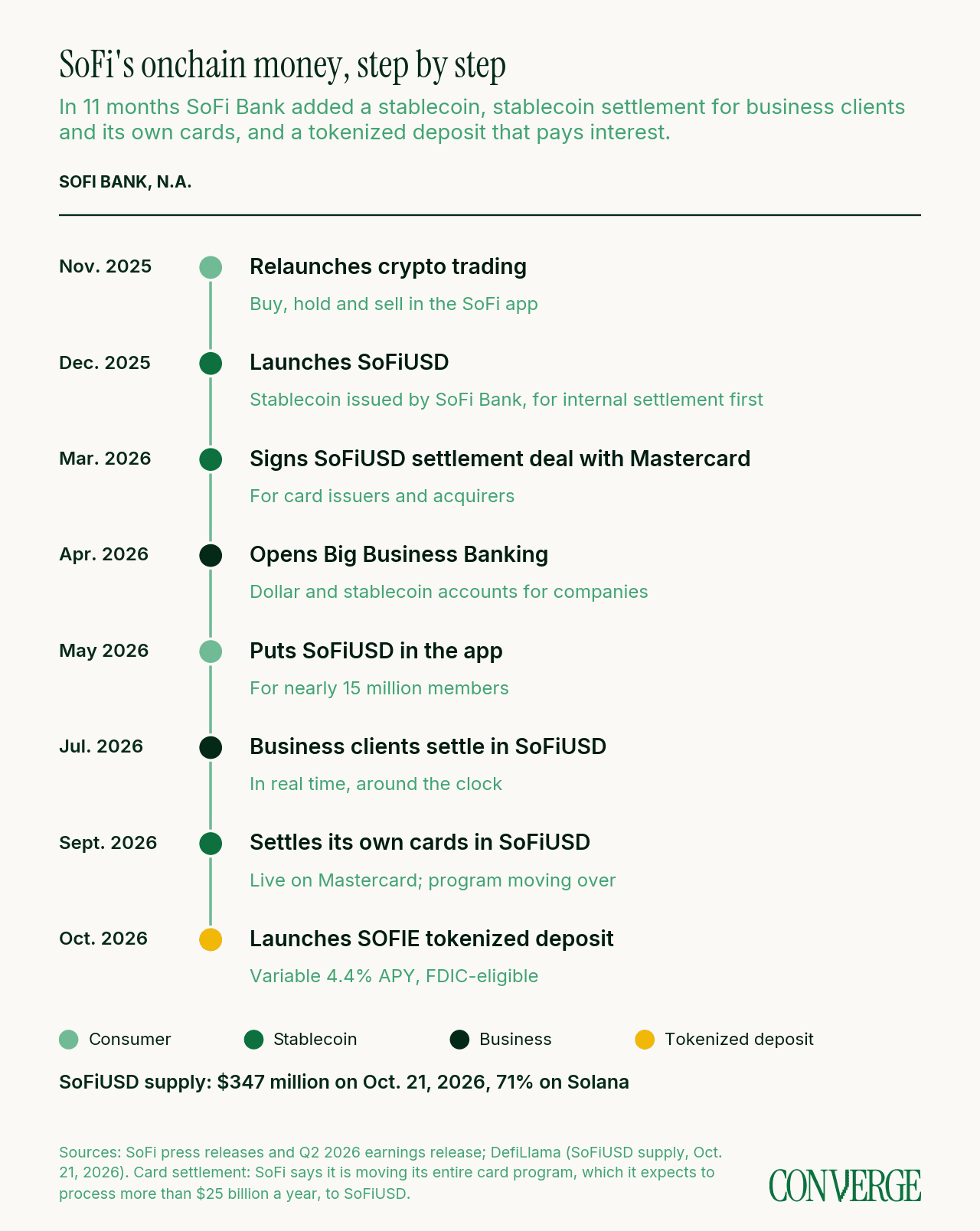
- SoFi now runs a stablecoin, stablecoin settlement for business clients and its own cards, and a tokenized deposit, all on one national bank charter. All three launched in the last 11 months.
SoFiUSD launched in December 2025 for internal settlement and reached the SoFi app for nearly 15 million members in May. Business clients have settled in it around the clock since the second quarter, SoFi said in July. On Sept. 22, SoFi said stablecoin settlement was live across its debit and credit card program on Mastercard. It is moving the whole program, which it expects to process more than $25 billion a year, to SoFiUSD. Supply was about $347 million on Oct. 21, 71% of it on Solana, according to DefiLlama.
Banks and regulators this week
JPMorgan moved its JPM Coin deposit token from Base to Ethereum on Oct. 19, for vetted institutional clients only. Thirteen lookalike tokens using its ticker appeared on Ethereum the same day. Two Texas banks, Vantage Bank and Rio Bank, settled a loan-participation payment in tokenized deposits in under three minutes. Jack Henry, whose core banking software serves more than 7,200 banks and credit unions, said on Oct. 16 it will offer tokenized deposits through Google Cloud Universal Ledger, with no launch date. Wells Fargo, which launched tokenized deposits for business clients in September, said on Oct. 13 that U.S. uses for stablecoins "remain unclear."
The OCC finalized its GENIUS Act rule on Oct. 21. The rule keeps the ban on stablecoin issuers paying interest to holders. In place of a proposed presumption against yield paid through affiliates and third parties, the OCC will judge those arrangements case by case. The rule and the act take effect Jan. 18, 2027.
Our take: the contest is for the balance a customer keeps between transactions
Banks and the companies that own customer relationships are competing for that balance, and both want to own the rails. SoFi can pay interest because SOFIE is a deposit. SoFiUSD, like every payment stablecoin, cannot. With both in one app and a 1:1 switch, SoFi keeps the balance whether the customer wants yield or wants to move money, and the deposits fund its loans. SoFi Bank held $45.5 billion of deposits at the end of June.
Stablecoin issuers cannot pay holders interest, but they can pay the businesses that distribute their coins, and those businesses can pass rewards on to users. Bastion, which won conditional OCC approval for a national trust bank on Sept. 18, runs white-label stablecoins for companies that keep their own brand, users and economics. Sony Bank's stablecoin runs on it, and it holds the USDC in Samsung Wallet, which reaches U.S. Galaxy phones this month. Agora, approved for its own trust bank the same day, issues AUSD for exchanges, trading firms and protocols, and has paid a yield rebate to support AUSD's market on Pendle.
The OCC's case-by-case review now decides how much reserve income can reach those end users. The more that reaches them, the closer a wallet or a protocol can get to SoFi's 4.4% without a bank charter.
What to watch: SoFi's third-quarter results on Oct. 27, the first that could report SOFIE balances; whether SoFi lets SOFIE move outside its platform; and when the OCC opens stablecoin applications.
CARD NETWORKS
Visa Is in Talks to Buy Fireblocks, Axios Reports
- Visa is in talks to buy Fireblocks for about $2.5 billion, Axios reported on Oct. 22, citing multiple sources. Fireblocks told The Defiant the report was "news to us, and not true at present time." Visa told The Block it does not comment on rumors.
Banks, exchanges and payment companies use Fireblocks to hold and move digital assets. The company said on Oct. 15 that trading firms moved nearly $50 billion in stablecoins to payment companies, fintechs and banks across its network in the previous 12 months. The reported price is below the $8 billion valuation of Fireblocks' 2022 funding round.
- Mesh and Visa plan to let consumers spend crypto and stablecoin balances held in participating wallet apps at Visa's more than 175 million merchant locations. No launch date, wallets or markets have been named.
Mesh, which announced the deal on Oct. 19, converts the balance at the moment of payment through a Visa credential issued in the background, and the merchant receives fiat. Visa said on Sept. 8 that its stablecoin settlement had passed an annualized run rate of $20 billion and that more than 160 stablecoin-linked card programs run on its network. Western Union's Stablecard, a Visa card backed by its USDPT stablecoin, is live in 37 markets.
- Mastercard added two products this week on top of BVNK, the stablecoin infrastructure company it already owns. Mastercard closed its purchase of BVNK, for up to $1.8 billion, on Aug. 3.
On Oct. 19 it launched Stablecoin Security, a service that scores stablecoin payments for fraud and sanctions risk before they complete, first in North America. On Oct. 20 it opened early access to Agent Pay for Machines, which lets AI agents pay for digital services within spending limits. Pilot partners included Coinbase, Base and BVNK. BVNK and Mastercard launched their Global Money Platform, combining fiat and stablecoin accounts, cards and local payouts, on Oct. 15.
Stablecoins remain small next to card volume. By our own arithmetic, Visa's $20 billion run rate is about 0.14% of its $14.2 trillion in payments volume for fiscal 2025, and BVNK's more than $36 billion in annualized volume is about 0.34% of Mastercard's $10.6 trillion in 2025. Both are run rates set against a year of card volume, so the shares show scale only.
Our take: the card networks are doing what they did with open banking
When a new rail threatened to route payments around cards, Visa and Mastercard bought into it. Five years ago that rail was open banking: rules that let apps connect to a customer's bank account to read balances and move money directly, without a card. Mastercard agreed in 2020 to buy Finicity, which provides those bank-account connections in North America, for $825 million. Visa agreed to pay $5.3 billion for Plaid, which connects fintech apps to users' bank accounts, and dropped the deal in January 2021 after the Justice Department sued to block it. Visa then bought Tink, which does the same in Europe, for €1.8 billion.
Stablecoins are the new rail, and the deals look similar. Mastercard bought BVNK, which runs stablecoin accounts and payouts for businesses, for up to $1.8 billion. Visa is reportedly negotiating for Fireblocks at about $2.5 billion. Stripe paid $1.1 billion for Bridge, a stablecoin issuing and payments company, in a deal that closed last year.
Mesh shows what the networks are buying for. The stablecoin stays in the wallet until checkout, then becomes a Visa transaction, and the merchant is paid in fiat. Owning custody and conversion keeps the network in the middle of the payment as stablecoins grow from 0.14% of Visa's volume.
The risk is the Plaid precedent. The Justice Department argued in 2020 that Visa was buying a nascent rival to its online debit business, and in September 2024 it sued Visa for monopolizing debit. A Fireblocks deal would test whether regulators see stablecoin infrastructure the same way. The reported price, under a third of Fireblocks' 2022 valuation, suggests buyers now hold the leverage.
What to watch: whether Visa or Fireblocks confirms a deal; Visa's fiscal fourth-quarter results on Oct. 27; and the first wallets and markets for Mesh and Visa.
WATCH
Backpack founder Armani Ferrante explains what a buyer owns under each tokenized-stock model, from transfer agents and DTCC to offshore debt securities, and how Backpack's 1:1 redeemable shares move between a brokerage account and DeFi.
OTHER STORIES WORTH YOUR TIME
Microsoft, Alphabet and Goldman Sachs Object to OKXICE Stock Tokens
Sixteen companies have now objected to tokens of their shares on OKXICE, the OKX and ICE venue, up from nine last week, according to its Oct. 19 notice. The new names are Microsoft, Alphabet, Goldman Sachs, Qualcomm, Caterpillar, McDonald's and Western Digital. Fifteen of the 62 companies on OKXICE's original list have objected. SIFMA, the Wall Street trade group, asked the SEC on Oct. 19 to consider requiring affirmative consent from issuers, a longer objection period and a universal opt-out. Nasdaq has said it will object, as an issuer, to every third-party token of its own stock. Trading keeps growing anyway: monthly tokenized-stock volume passed $25 billion in September, about 100 times January's level, according to Blockworks Research.
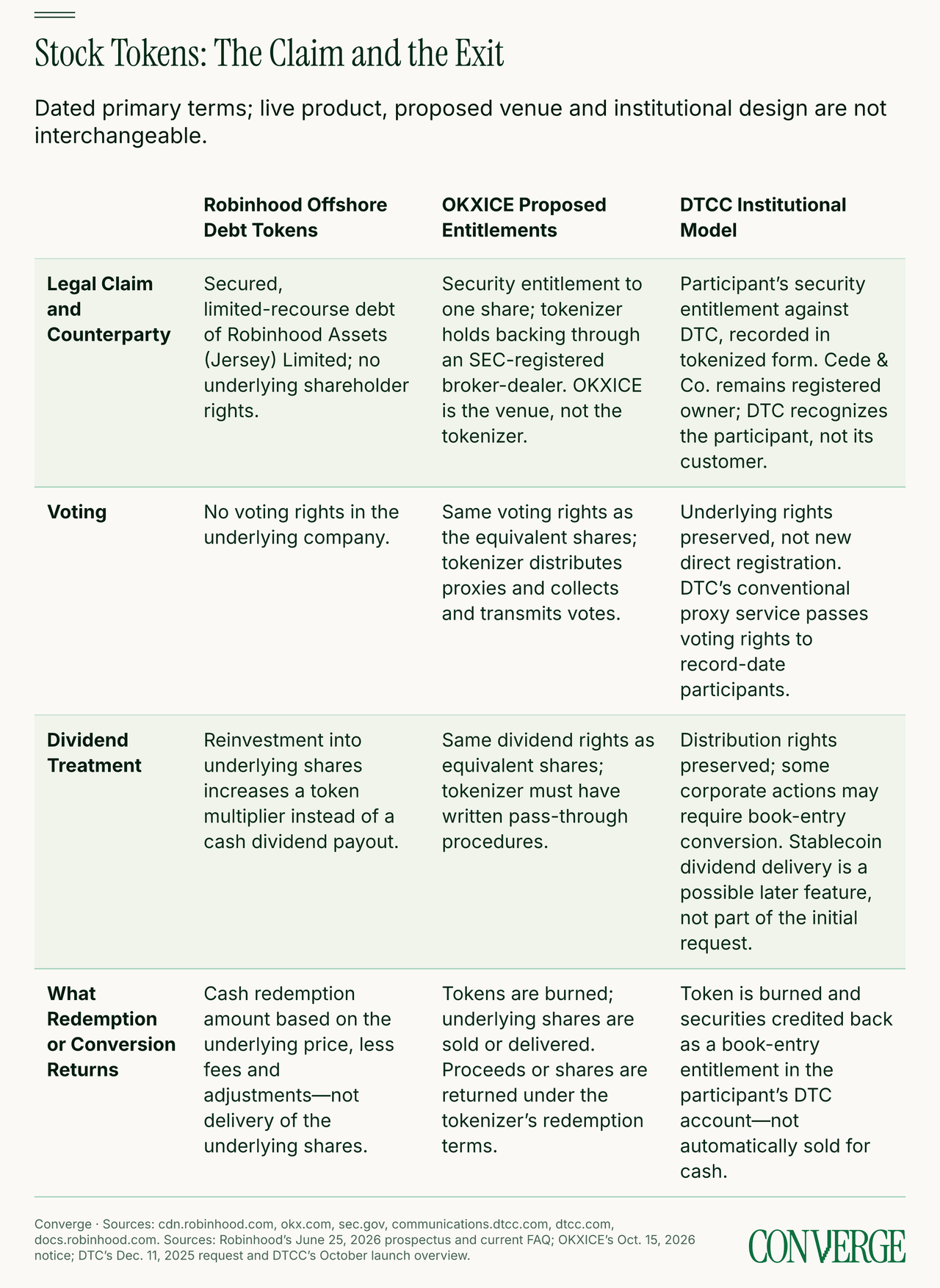
Stock Tokens Compared: Ownership and Exit at Robinhood, OKXICE and DTCC
A share-backed token does not always make its holder a shareholder. Robinhood's offshore stock tokens are debt obligations with no rights in the company and redeem for cash. OKXICE's planned tokens would carry share entitlements, and DTCC's institutional tokens convert back into book-entry positions.
DTCC Outlines 25-Security Tokenization Rollout on Canton and Besu
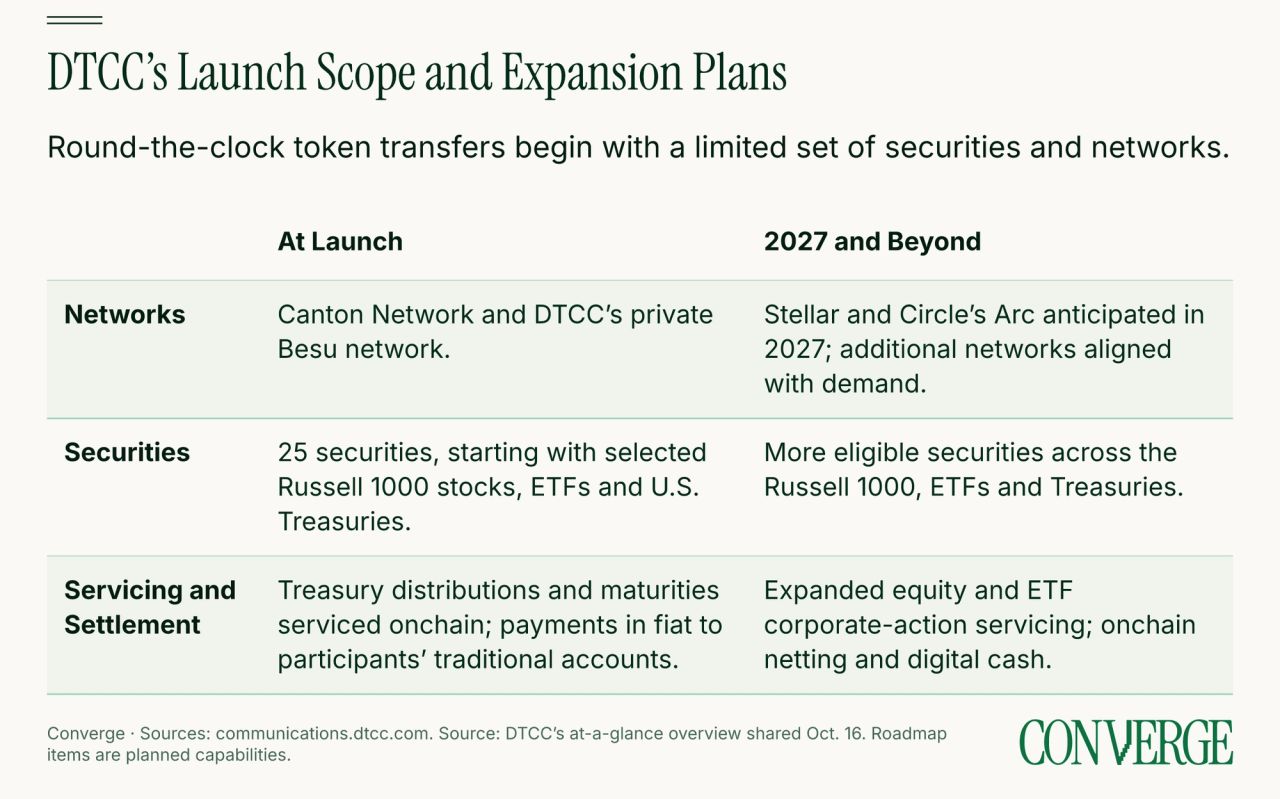
DTCC's tokenization service starts with 25 selected U.S. stocks, ETFs and Treasuries on Canton Network and its private Besu blockchain. Tokens are backed 1:1 by securities held at DTC, keep the same CUSIP and rights, and move 24/7 between DTC-registered wallets on the same network.
Binance to Reprice bStocks Collateral While US Stock Markets Are Closed
From 8 p.m. ET on Oct. 23, Binance will value bStocks used as margin collateral at its own trading prices on weekends, holidays and overnight. Falling collateral values can then bring liquidation closer before the underlying shares trade again. Binance reported more than $1 billion in bStocks assets on Oct. 15.
Robinhood Plans 2027 UAE Launch With Dubai Retail License
Robinhood will offer stocks, crypto and ETFs to retail clients in the UAE from 2027, from a regional headquarters in the Dubai International Financial Centre. The Dubai Financial Services Authority licensed Robinhood MENA in July to arrange deals and custody, including in crypto tokens.
Standard Chartered Signs Deal to Take Full Ownership of Zodia Custody
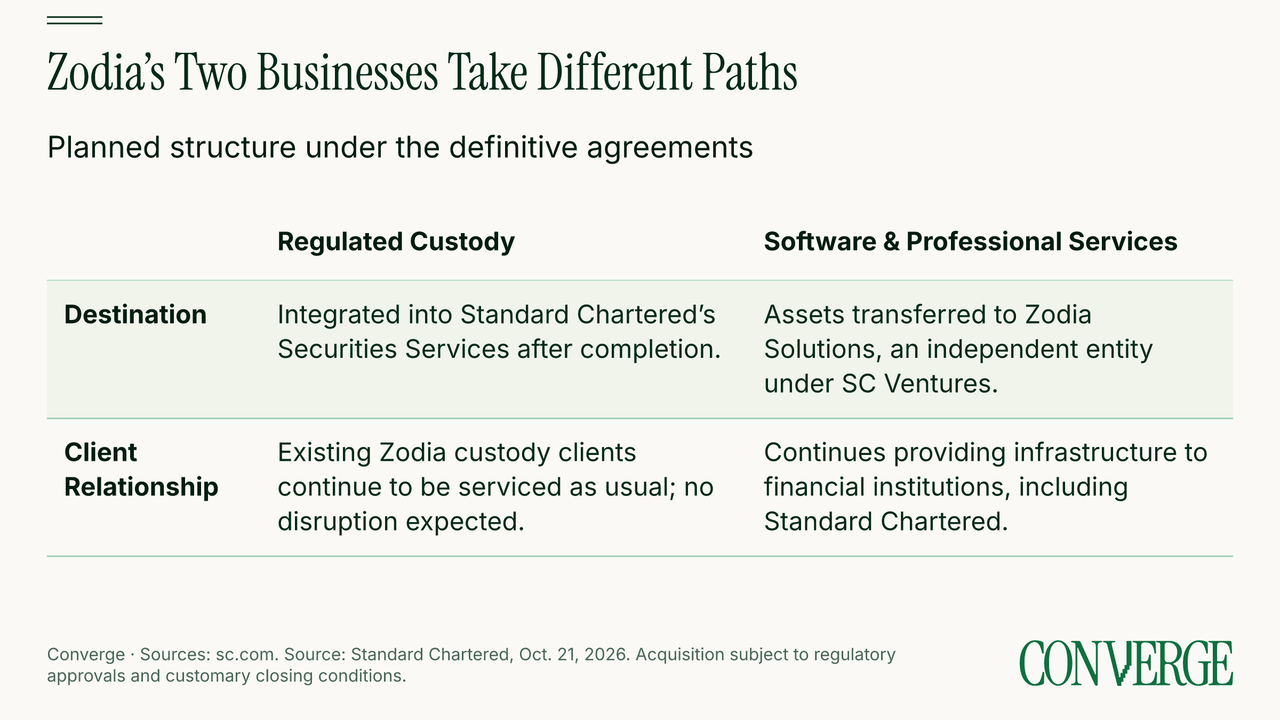
Standard Chartered agreed on Oct. 21 to buy all of Zodia Custody, which runs regulated crypto custody in Singapore, Hong Kong, Australia, the UAE and Luxembourg, and fold it into its Securities Services unit. Zodia's software business moves to a separate company under SC Ventures, backed by Northern Trust, NAB Ventures and SBI. The deal needs regulatory approval.
Securitize Will Mint Stablecoins Directly With Anchorage Digital Bank
Securitize, which tokenizes funds for BlackRock, Apollo, KKR and others, will mint and redeem stablecoins directly with Anchorage Digital Bank without going through intermediaries. Anchorage also handles custody and settlement, so one federally chartered bank covers the cash side of the trade.
Western Union Picks Noah to Settle Receiver Redirect Payouts in USDPT
Western Union recipients will be able to collect a money transfer as USDPT, the dollar stablecoin Anchorage Digital Bank issues on Solana for the company, in a Western Union wallet. Noah pre-funds, converts and pays out the stablecoin and handles local licensing. The service has no launch date.
Coinbase Partners With Thunes for Bank and Mobile-Wallet Payouts
Coinbase will connect its stablecoin infrastructure to Thunes' network, which pays out to bank accounts and mobile wallets such as M-Pesa and GCash in more than 140 countries. Coinbase will supply stablecoin infrastructure to Thunes in return. Neither company gave a launch date or markets.
Coinbase Ireland Fined €3.25 Million Over Customer-Fund Failures
The Central Bank of Ireland fined Coinbase Ireland for leaving its customer-fund safeguarding account underfunded every day from January 2023 to June 2024, by up to €5.2 million. The regulator found no customer losses. Ireland's High Court must confirm the sanction.
OKX Combines Euro and EURC Liquidity in One Spot Order Book
Eligible OKX users in the European Economic Area now trade euros and Circle's EURC stablecoin in one shared order book and can settle in either. OKX says the change avoids routing euro trades through dollar pairs.
Even more this week:
- Germany's Sparkassen began offering bitcoin trading, through DekaBank in the savings banks' app, starting with five banks.
- FINMA approved Switzerland's first retail bitcoin ETF, structured as an investment fund.
- Sberbank received authorization to run a crypto exchange in Russia ahead of a planned December launch.
- Ramp applied for an OCC national trust bank charter for digital asset custody; it will not take deposits.
- Bank Negara Malaysia launched SSDS+, a platform for tokenized bonds and sukuk, settled in central bank money.
- First Abu Dhabi Bank issued an AED 1 billion digital green bond at 5.75%, settled on Euroclear's digital platform.
- Boerse Stuttgart Group received a DLT trading and settlement license for its Seturion settlement platform, the first for a European exchange group.
- Matter Labs extended its Prividium institutional software to existing networks, including private Besu chains.
- We compared Mastercard's Crypto Credential with KYC, Travel Rule messaging and screening.
- 1inch is shutting down its crypto card and asked holders to withdraw balances by Dec. 18.
- SkyAI sold its entire Solana treasury and launched a $201 million tender offer.
- Strategy shares fell 9.6% after MSCI adopted rules that put it at risk of index removal.
Converge is produced by The Defiant. This briefing is for informational purposes only and does not constitute investment advice.
Free newsletters
Good reporting. Delivered.
Choose your coverage: crypto and DeFi, the future of finance, or both.
Free. Unsubscribe anytime.