BitGo's Mike Belshe on What's Next for WBTC & Crypto Custodians
This week on The Defiant Podcast, we speak with Mike Belshe, the CEO of BitGo, a digital asset custodian, wallet, and issuer of wrapped Bitcoin (WBTC).
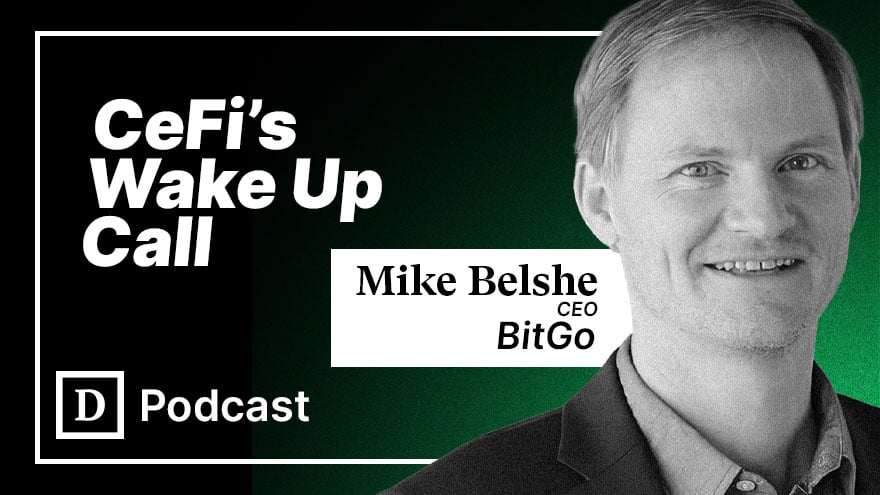
We start our conversation with an overview of BitGo and Mike’s crypto journey.
Wrapped Bitcoin is the most successful representation of Bitcoin on Ethereum. There’s about 200K Bitcoin in BitGo’s custody, which is the equivalent of $3.4B. WBTC is an important piece of the ecosystem as it enables Bitcoin holders to interact with DeFi. We dive into the recent selloff that saw WBTC lose its peg to Bitcoin.
In the final part of our conversation, we discuss the role of custodians in the crypto space. Especially after what happened this year with FTX and various other centralized entities, crypto has been given a wake up call to bring transparency and disclosures to CeFi. We explore the biggest lessons we can take away from this year.
Listen to the interview in this week’s podcast episode here:

Thanking our podcast sponsors:
- Built by the team behind Avalanche, Core is an all-in-one command center for Web3 supporting Avalanche, Ethereum, and Bitcoin, a rich ecosystem of dApps, Bitcoin & Ethereum bridges, NFTs, Subnets, and more. Visit core.app to download now.
- Minimais a new mobile-native layer 1 blockchain. Join over 400,000 node runners on Minima’s Incentive Program, to start earning $MINIMA every day until Mainnet launch. Get started at minima.global/get-involved
- Railwayis the first DeFi wallet to integrate the powerful RAILGUN privacy system built using zero-knowledge cryptography and available on Ethereum, BSC, and Polygon.
Bitgo Overview
Bitgo is a digital assets company that provides security solutions for crypto assets. Founded in 2013, the company began as a wallet-as-a-service platform and has since expanded its product line to include multi-sig and threshold signatures, as well as support for 25 different blockchains.
Bitgo’s core philosophy is a decentralized, “hold your own keys” approach that ensures users retain control of their assets even if the company were to disappear. In 2016, the company started to gain institutional clients, including the CME Group, as the need for fiduciaries to participate in the crypto space grew.
Can you explain the origins and how wrapped Bitcoin works? What made you start thinking about this in 2017 and how has it developed since then?
- Smart contracts and DeFi originated on the Ethereum network.
- Bitcoin is the largest store of value in the digital asset ecosystem.
- Wrapped Bitcoin is a product that allows Bitcoin to be used in smart contracts on the Ethereum network.
- Wrapped Bitcoin allows users to verify that the number of tokens matches the number of bitcoins held in cold storage.
- Wrapped Bitcoin allows users to easily use their bitcoin on DeFi platforms on the Ethereum network.
Smart contracts and DeFi originated on the Ethereum network. However, most value in the digital asset ecosystem is held in Bitcoin. For those with large amounts of Bitcoin who want to use it within smart contracts, they previously had to convert it to Ethereum.
Wrapped Bitcoin allows individuals to retain their Bitcoin and use it within the Ethereum network through the use of a smart contract. This ERC 20 token operates on the Ethereum network and allows users to mint tokens by giving wrapped Bitcoin custody of their Bitcoin, which is held in cold storage. This stablecoin is different from Tether and USDC, which are pegged to the dollar and require external audits to verify reserves.
Wrapped Bitcoin, on the other hand, is transparent and allows users to verify the number of tokens in circulation and the number held in cold storage on the blockchain and through the smart contract. This allows for interoperability with major DeFi platforms on the Ethereum network.
Only certain permissioned counterparties are allowed to mint wBTC, meaning they are the only ones who can create new wBTC. Is that correct?
Bitgo is an institutional company that focuses on helping to create a healthy network. Unlike other companies that have hundreds of thousands of retail clients, Bitgo only has a few thousand clients and is not geared toward the retail market.
We’re the custodian for the Bitcoin being wrapped.
In order to facilitate the use of wrapped Bitcoin, a DAO is formed with a number of participants who are responsible for the general governance of the wrapped Bitcoin. Bitgo is the custodian that has been chosen by the DAO to manage the process of minting and burning wrapped Bitcoin. Merchants are the ones that take wrapped Bitcoin to market, using interfaces that reach out to exchanges and address the needs of retail clients.
There’s a DAO with 14 participants that decide on what?
Bitgo has one key in the DAO. But there are 14 other participants on the DAO. The DAO is responsible for governing wrapped Bitcoin. If you want to change anything about how wrapped Bitcoin operates, the DAO must approve it. However, the DAO has not been active in its governance role recently, as the wrapped Bitcoin system is running smoothly on its own.
Bitgo was chosen as the custodian in the early days, and all smart contracts have been deployed, audited, and reviewed. There hasn’t been a need for governance votes since 2019.
How many merchants actually issue wrapped Bitcoin and take it to retail?
Bitgo is a regulated entity and we conduct AML/KYC check on merchants who want to use our services. We can mint and burn digital assets for these merchants and we know their identities and business activities. We handle the regulatory and compliance requirements for these merchants. There are approximately 20 merchants who have been authorized to use our services. This list can be found on the WBTC network site. We may add or remove merchants from this list periodically. The merchants are responsible for taking the digital assets to market and ensuring that they comply with the relevant laws and conduct KYC checks on their own clients as necessary.
Mike’s Background
I have been in the technology industry in Silicon Valley for 25 years. I got involved in startups in 1994 when I joined Netscape before it became a public company. I have been fortunate to be in the middle of the internet revolution that has transformed information technology around the world. After Netscape, I started several startups, including Lookout Software which we sold to Microsoft in 2004. I also spent time at Microsoft and Google, focusing on technology and projects that can have a big impact and potentially change the world for the better.
In 2012, I discovered Bitcoin and started playing around with it as a hobby. I eventually began storing it for friends, which led me to look for better ways to secure it. This led me to the creation of Bitgo. Although I never studied finance and was a computer science major, I ended up working in the financial services sector.
The intersection of money and software, as seen in Bitcoin and DeFi, has the potential to revolutionize the financial system. The current system is based on outdated rules and regulations from over a hundred years ago and has been patched and modified to fit our modern world. However, with digital finance, we have the opportunity to rethink and rebuild the system with the ethos of equality, transparency, and reduced risk. While we are still working on reducing risk in the overall system, the promise of DeFi is exciting and has the potential to change the world.
WBTC Depeg
What is the reason for the difference in the price of wrapped Bitcoin and Bitcoin? Is it due to the news about FTX and the viral tweet about Alameda? Is there concern that there could be some kind of contagion happening?
I think when you’re investing in anything, you need to understand what it is and how it works and there’s certainly been a lot of people that have been dabbling in DeFi without really understanding the products that they’re touching.
Let me ask you, what is the value of one wrapped Bitcoin and why is it important for investors to understand the products they are investing in when it comes to DeFi?
I believe the value of this cryptocurrency should be similar to Bitcoin, but there may need to be some adjustments to account for the potential risks associated with holding Bitcoin, such as the possibility of it being lost or stolen, or the potential for collusion within the DAO. We can discuss the appropriate amount of this discount.
There are wrapped assets, such as staked Ether from Lido, that are considered stable assets. However, the staked Ether began to diverge from its peg of one in May due to concerns over the Terra USD. The staked Ether is different from other stablecoins because it is locked into an Ether two smart contract for a long period of time, and cannot be moved or converted back until a future date. It used to trade at one with Ether but recently started trading at a different price. This has caused some concern among investors.
There are several factors that can affect the price of a wrapped token, such as custodian risk, smart contract risk, lockup periods, and conversion costs. It is also possible for the market to associate a higher price than one, due to local demand for the wrapper.
Many people are just leaving crypto and bitcoin altogether. So maybe that helps to explain some of it. Or they don’t want to be trusting custodians. Do you think that’s a part of it?
I don’t think this part has to do with the custodial trust. I think this has to do with de-leveraging.
- The value locked in DeFi platforms, such as Compound and Aave, has decreased, not just measured in dollars but also in Bitcoin.
- Many users are returning their wrapped Bitcoins and redeeming them for their original Bitcoin, resulting in a decrease in the number of wrapped Bitcoins in custody. This is due to de-leveraging.
- The system is functioning properly with mints and burns being fulfilled and the market remaining steady.
- Some confusion around the mint burn process may have contributed to the decrease in wrapped Bitcoin usage.
GBTC and ETFs
The Grayscale Bitcoin Investment Trust (GBTC) is a fund that allows investors to convert their investment into an over-the-counter security. This security is fully backed by Bitcoin and is managed by Grayscale. In the past, the demand for the GBTC was so high that its share price traded above the value of the underlying Bitcoin, reaching premiums of up to 20-30%. However, as supply caught up with demand, the GBTC premium has fallen to negative 40%. This is because, unlike an ETF, the GBTC is a fund and cannot redeem its shares to unlock the underlying assets. If the US Securities and Exchange Commission (SEC) were to approve an ETF, it would track the price of Bitcoin more closely.
A Bitcoin ETF would operate similarly to how wrapped Bitcoin works, using a mint-and-burn mechanism. The ETF would hold more Bitcoin when there is more supply and sell Bitcoin when there is less supply, ensuring that the assets held by the fund match the number of shares outstanding. However, with GBTC, there is a discrepancy between the number of shares outstanding and the net assets held, because it does not function like a traditional exchange-traded product.
This is because the US Securities and Exchange Commission (SEC) has not approved regulations for this type of product. Despite this, many entities have been pushing for a Bitcoin ETF since around 2013, with the Winklevoss twins being among the first to file for approval. However, they have been denied multiple times. You have argued that the SEC’s refusal to allow for a Bitcoin ETF and the resulting shift to GBTC has contributed to the rise of FTX. Can you explain your reasoning on this?
The Grayscale Bitcoin investment trust only allows qualified investors to invest in it, which means that retail investors are unable to participate. This creates a demand for the investment trust’s assets on the over-the-counter market, where retail investors can buy them. However, because retail investors are not allowed to invest in the trust directly, they end up paying a premium for the assets. Institutions are able to take advantage of this situation by investing in the trust and then selling the assets to retail investors at a higher price. This situation is a result of regulations meant to protect retail investors, but which end up having the opposite effect.
- The SEC’s refusal to approve a spot ETF has allowed institutions to take advantage of this loop
- The SEC’s approval of a futures-based ETF is not sufficient and does not address the issue
- The SEC needs to address this issue and approve a spot ETF to prevent retail investors from being ripped off.
There’s also the idea that because the SEC has been so strict with cryptocurrencies, regular people have been forced to trade on exchanges outside the US.
If retail investors could access an ETF Bitcoin spot product, it would be overseen by the SEC and run on existing infrastructure in the US markets. This would provide a safer and more regulated option for investors compared to buying GBTC or using unregulated exchanges. Without the ETF, retail investors may end up using low-quality or fraudulent exchanges.
What are the most important lessons we can learn from events like FTX, and what should custodians and other CeFi entities do?
The idea of getting rid of centralized systems may seem appealing, but it fails to consider the importance of transparency and regulation in managing other people’s money. The existing market structure in the US, with its network of exchanges, broker-dealers, clearing houses, custodians, and banks, helps to mitigate risk and ensure business continuity. In the crypto world, there is a lack of transparency and regulation, with some players taking on multiple roles and taking excessive risks. This can lead to problems, as seen in the case of Sam Bankman-Fried and his entities FTX and Alameda Research.
We don’t have the right market structure for centralized products, so we should replace as many of them as possible with DeFi.
What is missing from the structure of the market? Is it separating the piece of exchange from the piece of like custody? Is it more like audits, where you say what you would change to make it better?
We have disagreements about what to do.
We want to create markets that are more efficient but have some of the same basic properties as existing markets. One way to do this is to focus on the fundamentals of security, such as preventing rug pulls. This can be done by separating trading and custody and having checks and balances in place. Additionally, we need to consider regulations around front running, pump-and-dump schemes, money laundering, and terrorist financing.
We can also improve market structure by allowing for the segregation of assets and bankruptcy protections. Leverage and risk management are also important factors to consider, and DeFi can play a role in this. Overall, the goal is to create a system that is transparent and manages risk effectively.
Mike, this was super interesting. Thank you so much for taking the time and talking about all these different pieces that I think will set the foundation for a better crypto going forward.
Thank you for having me here and I hope everyone enjoys learning about the markets. As people start to invest in these markets, I’ve noticed that they are becoming more knowledgeable about finance. It’s important for us to understand how markets work, what the proper price of an asset should be, and the risks involved in investing.
How do markets work? What should the price of an asset be? What are the risks on a given asset? These are great things that we should all know if we’re participating.
I appreciate the opportunity to share what we have learned in the digital asset space and strive to improve it. I hope that all the innovators working on DeFi and other innovations do not give up because of the recent failures of FTX. This is only a temporary setback and will ultimately drive us to work even harder toward a better market structure in DeFi.
Free newsletters
Good reporting. Delivered.
Choose your coverage: crypto and DeFi, the future of finance, or both.
Free. Unsubscribe anytime.