

Anthropic’s IPO Filled 0.05% of Binance Wallet’s $500 Million Order
Plus DBS and JPMorgan link their tokenized deposit networks, and Sky's USDS supply falls 39% in a day
Happy Friday. This is Converge, The Defiant's weekly recap of tokenization, stablecoins, and real-world assets, by Chris Storaker.
TOP NEWS THIS WEEK
- Binance Wallet refunds 500 million USDC raised for Anthropic tokens
- DBS and JPMorgan link their tokenized deposit networks
- MAS settles S$100 million of tokenized bills in wholesale CBDC
- NRW.BANK settles an Ethereum bond in central bank money
ALSO IN THIS ISSUE
- World Bank explores USDC payments with Citi and Circle
- DBS and Circle add 24/7 USDC minting in Asia
- Sky's USDS supply falls 39% in one day
- Supreme Court rejects Custodia's Fed account appeal
- Four senators question the SEC's tokenized-stock exemption
- Allfunds names 22 managers for Solana funds
TOKENIZED STOCKS
Crypto Venues Got Few Anthropic IPO Shares
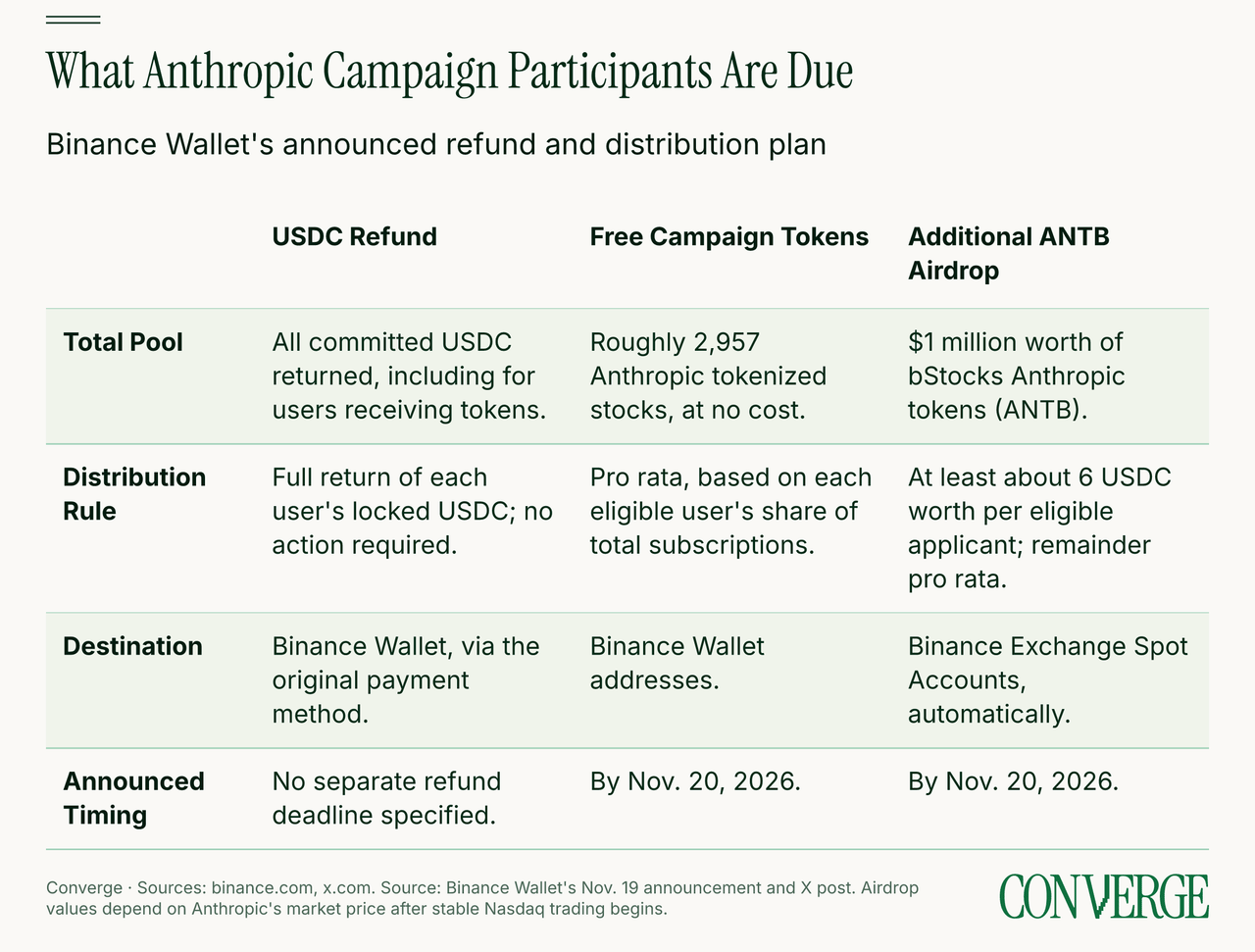
Binance Wallet collected 500 million USDC for tokenized Anthropic shares at the IPO price and received about 2,957 of them, worth $245,431 at $83 a share, or 0.049% of the money committed. It is returning all of the USDC and giving the tokens to subscribers free, pro rata, plus $1 million of bStocks Anthropic tokens. "The IPO allocation received for this campaign was not ideal relative to total user commitments," Binance Wallet said on Nov. 19.
Anthropic priced 980 million shares at $83 on Nov. 18, above its $70 to $78 roadshow range, for about $81.3 billion before fees. The stock opened at $111.50 on Nasdaq on Nov. 19, closed at $97.17, 17% above the offering price, and traded at $83.81 before the open on Nov. 20, 27% below its first-day high of $115.10.
xStocks, which took orders from Kraken customers outside the U.S. at the offering price plus a 5% spread, said the IPO was "reportedly oversubscribed more than 9 times" and that it could fill only part of the requests.
Other tokenized exposure:
- Ondo ANTon: structured notes issued by Ondo Global Markets (BVI) for investors outside the U.S., minted and redeemed 24/7.
- xStocks ANTx: a share-backed token on Solana for investors outside the U.S., trading from 12:14 p.m. ET on Nov. 19.
- Robinhood ANT, listed on Lighter: debt securities of Robinhood Assets (Jersey) that give no legal or beneficial rights in the shares.
- Coinbase ANTc: certificates over shares held in custody, issued in Abu Dhabi for investors outside the U.S., trading on Base.
- Securitize ANT on Solana: security entitlements backed one for one by shares, open to eligible U.S. investors, trading beyond market hours.
Perpetual futures drew the most trading. Trade.xyz's Anthropic contract on Hyperliquid traded $1.43 billion in 24 hours and held about $283 million of open positions on Nov. 19. At 2:07 p.m. ET its mark price was $93.28, against $93.44 on Nasdaq. The same contract marked $105.91 on Nov. 11, as we reported last week. Coinbase offers an Anthropic perpetual to users outside the U.S. through Coinbase Bermuda.
TOKENIZED DEPOSITS / BANK NETWORKS
Banks Link Tokenized Deposits One Pair at a Time
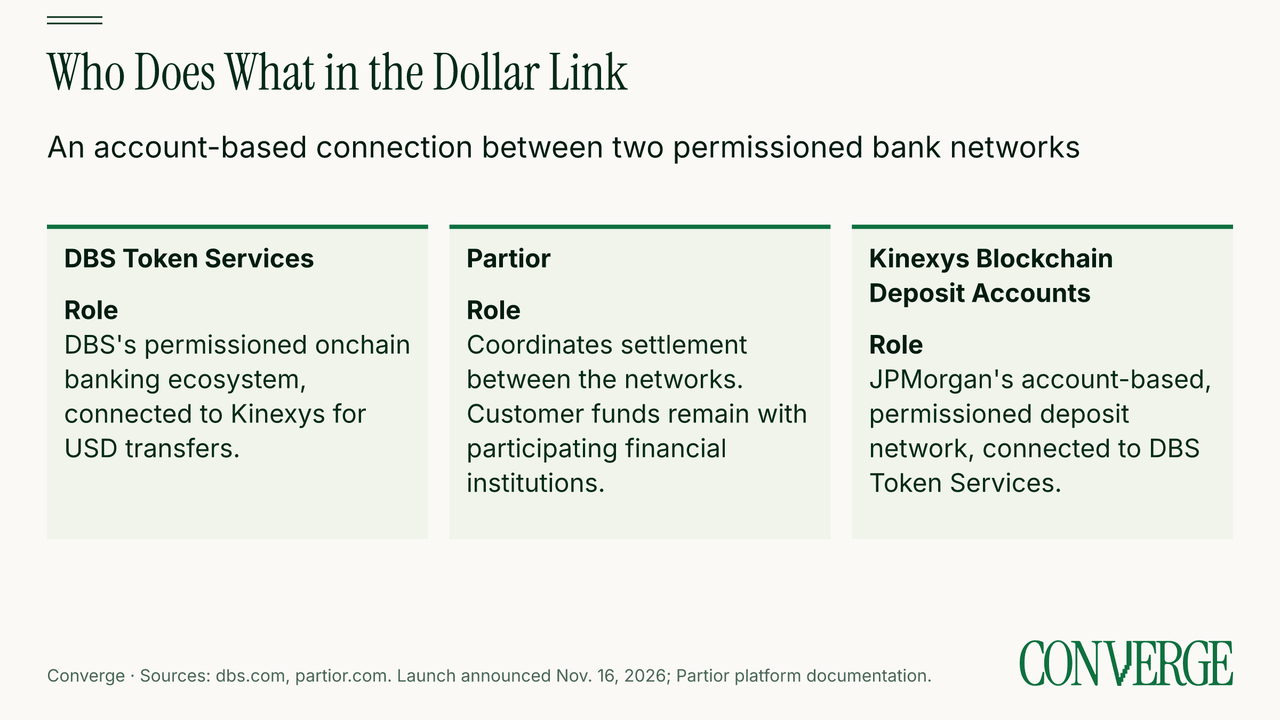
DBS and JPMorgan's Kinexys opened a 24/7 link between their tokenized deposit networks on Nov. 16, so corporate clients can move dollars between Singapore and the U.S. at any hour.
Ant International is the first client. Partior, a settlement network the two banks co-founded in 2021, matches each transfer without holding the money. Moving money between JPMorgan's ordinary and blockchain accounts still pauses for three hours on Saturdays.
Solving for interoperability
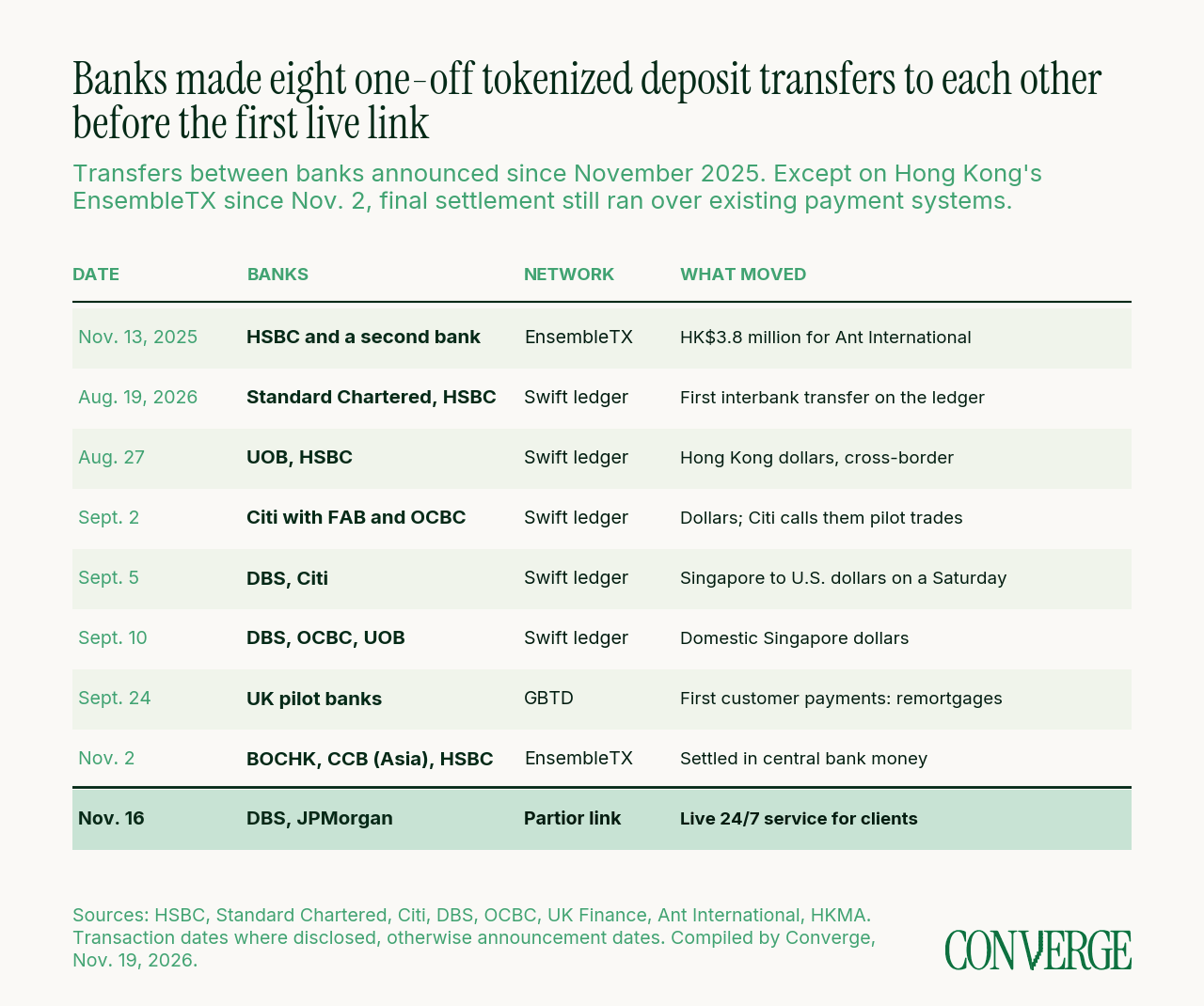
Since November 2025, banks have announced eight one-off tokenized deposit transfers to other banks, seven of them since this August. Standard Chartered and HSBC announced the first interbank transfer on Swift's ledger on Aug. 19. DBS and Citi sent dollars from Singapore to the U.S. on a Saturday, Sept. 5. Banks in the UK's GBTD pilot made their first customer payments, including two remortgages, on Sept. 24. However, on most of these transfers, each bank recorded its side on its own ledger and the money settled over existing payment systems.
Twelve shared networks, one live
1:1 links do not scale, so banks in each major market are building a shared network: The 17 banks participating in The Clearing House's planned U.S. network would need 136 bilateral links.
Of 12 multi-bank tokenized deposit networks we tracked, only Partior runs as a live service. Three run live pilots with real money, four are tests and three are plans, including one by six Canadian banks.
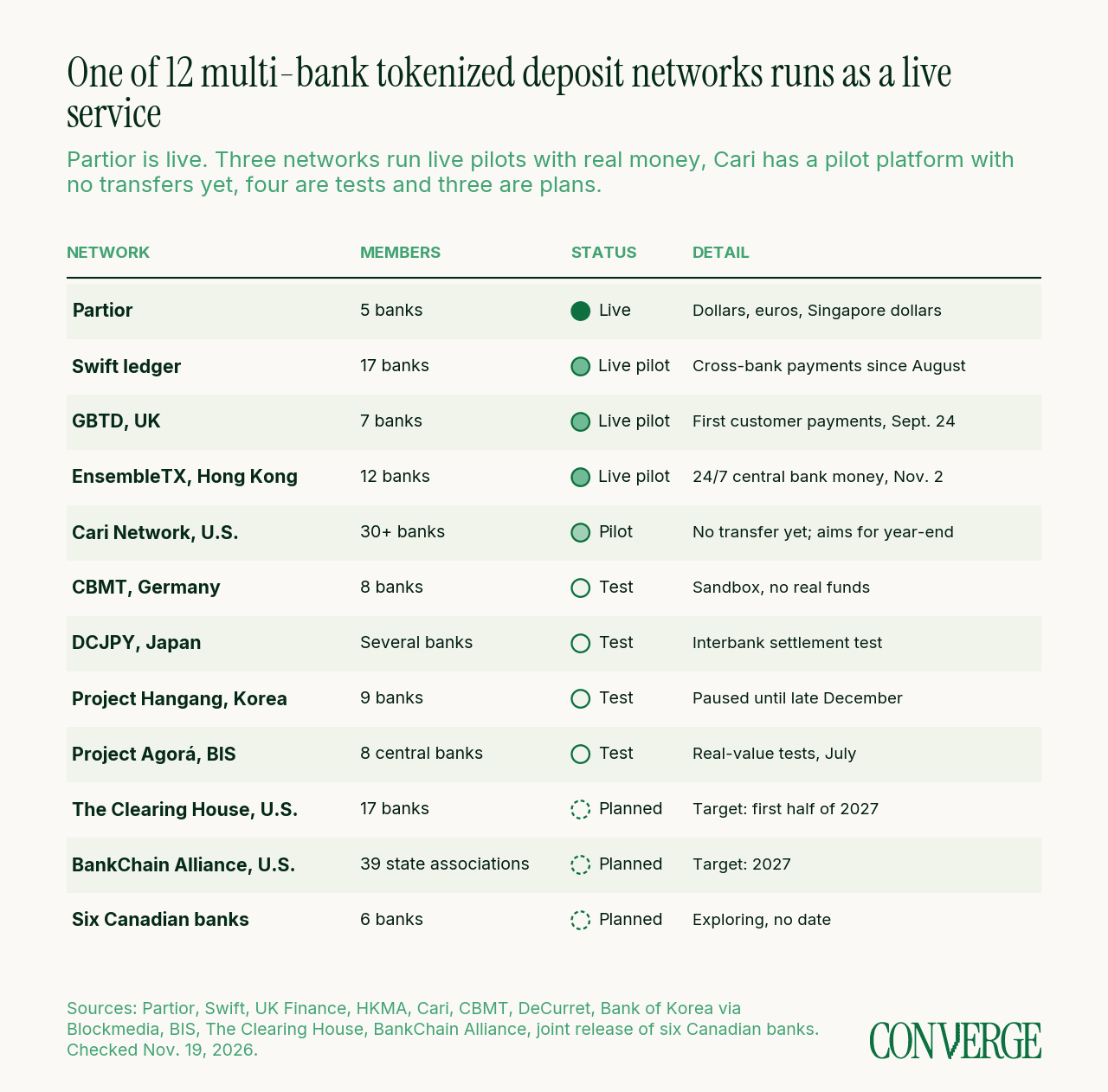
In the U.S., the same regional banks are backing two networks. Huntington and KeyBank, both based in Ohio, are among six design partners of the Cari Network, led by former Comptroller of the Currency Eugene Ludwig, and among the 17 banks in The Clearing House's plan. Huntington invested in Cari's $32.5 million funding round in September. Cari has not announced a transfer; Ludwig said on Nov. 6 that he expects the design partners to be operating on it by year-end. The BankChain Alliance of 39 state bankers associations plans a third U.S. network for 2027.
Don’t hold your breath for Bank networks
The bank networks that work today took years from first step to first payment. Those that worked had a clear mandate, a neutral operator or a crisis behind it.
- SWIFT sent its first messages in 1977, four years after 239 banks founded it. More recently, its gpi payment tracking covered the whole network only after the network made payment confirmations mandatory in November 2020, nearly four years after launch.
- Zelle went live in 2017, six years after Bank of America, JPMorgan and Wells Fargo started its predecessor.
Earlier bank-owned shared ledgers have failed before reaching scale. We.trade, Marco Polo and Contour, trade-finance networks owned by banks, shut in 2022 and 2023 after their bank shareholders stopped funding them.
The largest shared ledger in bank markets, by its operator's account is Broadridge's Distributed Ledger Repo, which processed an average of $345 billion of repo trades a day in October. Banks transfer ownership of bonds on it while the cash moves over existing payment systems.
Central banks have not drawn users either. Retail central bank digital currencies in the Bahamas, Nigeria and Jamaica each equal less than 0.4% of cash in circulation. Brazil's central bank shut the blockchain platform for its Drex digital real in November 2025 and has not dated a new phase.
Also in tokenized money this week:
- The Monetary Authority of Singapore issued S$100 million of four-week tokenized bills on Nov. 6, settled in wholesale central bank digital currency, and plans to turn its test network into an operational utility.
- NRW.BANK sold a bond on public Ethereum to DZ BANK on Nov. 17, paid in central bank money through the Eurosystem's Pontes link in under an hour.
- The Hong Kong Monetary Authority said on Nov. 16 it is exploring a link between its Ensemble network with Swift's ledger, with Bank of China (Hong Kong), Standard Chartered and HSBC.
- Ant International completed a pilot with DBS and Franklin Templeton that swaps tokenized deposits for tokenized money market fund shares in one transaction (Nov. 19).
- HSBC let retail customers buy a tokenized share class of its Hong Kong dollar money fund with its RedCoin stablecoin, from HK$100.
- The Bundesbank and the Monetary Authority of Singapore tested linked settlement for euro-Singapore dollar trades across separate test ledgers, with DBS, Deutsche Bank and Partior.
SUPPORT CONVERGE
Thanks to The Defiant PRO members
PRO memberships help fund the reporting behind Converge.
OTHER STORIES WORTH YOUR TIME
Sky's USDS Circulating Supply Falls 39% in One Day
USDS in circulation fell to about 3.21 billion tokens from 5.24 billion in the 24 hours to Nov. 20, according to DefiLlama, dropping it below Ethena's USDe and Sky's older DAI. One address swapped 400 million USDS for USDC in a single transaction. The outflows came the same day CoinDesk, citing Inca Digital, reported that $518 million tied to illicit activity had passed through Sky's dollar reserve; Sky disputes the report. Cofounder Rune Christensen said the protocol had handled more than $2 billion of outflows in a day and that holders could still redeem as usual. USDS traded consistently at $1.
Related: Tether burned 4 billion USDT held in its Ethereum treasury on Nov. 19
World Bank Group Explores USDC Payments With Citi
The World Bank Group said on Nov. 17 it will explore stablecoin-based fund disbursements with Citi and Circle, using Circle's infrastructure for minting and settling USDC. It wants to test whether regulated dollar stablecoins can cut the cost and time of payments that now run through correspondent banks. The group described a commitment to explore the technology, with no pilot or live service.
DBS, Circle Add 24/7 Institutional USDC Access in Asia
Eligible institutional clients in Asia can mint and redeem USDC through DBS with round-the-clock dollar settlement, the companies said on Nov. 18. Clients can move between dollars and USDC without banking-hour cut-offs. Circle's regulated affiliates remain the issuers; DBS provides the banking channel.
Supreme Court Rejects Custodia's Fed Account Appeal
The U.S. Supreme Court declined on Nov. 16 to hear Custodia Bank's challenge to its rejection for a Federal Reserve master account. The denial leaves in place a ruling that regional Reserve Banks may turn down legally eligible applicants. Without a master account, a bank must settle its Fed payments through a correspondent bank.
FDIC Proposes Rules for Custodial-Deposit Exemption
The FDIC board proposed on Nov. 17 how banks with less than $10 billion in assets can exclude qualifying custodial client funds from brokered deposits, up to 20% of total liabilities. The exemption, from the 21st Century ROAD to Housing Act, took effect July 11. Brokered deposits carry higher deposit-insurance assessments.
Senators Question SEC's Tokenized-Stock Exemption
Four Democratic senators, Angela Alsobrooks, Catherine Cortez Masto, Mark Warner and Ruben Gallego, asked SEC Chairman Paul Atkins 13 questions about the Sept. 17 exemption for tokenized securities venues, in a letter released Nov. 16. They wrote that it "sets no identity-verification standard and does not require an AML program." They asked for answers within 30 days.
Coinbase, Broadridge Propose Onchain Rights Standard
Coinbase and Broadridge published a proposed open standard on Nov. 16 for delivering shareholder notices, such as dividends, stock splits and meeting notices, to wallets holding tokenized stocks. Each notice pairs an onchain announcement with a machine-readable document. Proxy voting is the next phase and is not yet part of the standard.
Allfunds Announces 22-Manager Cohort for Solana Funds
Allfunds Blockchain and the Solana Foundation named 22 asset managers, including Apollo, Fidelity International and Schroders, for Project Harmonia on Nov. 16. The first tokenized funds are due on Allfunds in the first quarter of 2027. Allfunds reported €1.97 trillion in assets under administration at Sept. 30.
Invesco's Stablecoin Reserve Fund Goes Live on Ethereum
Invesco's Stablecoin Reserves Onchain Fund, a registered money market fund built to hold stablecoin reserves, issued its first 80,000 tokenized shares on Ethereum on Nov. 16, through Superstate. The fund reinvests its daily income in newly minted shares unless an investor elects cash.
USDC's Direct Bank Cash Fell $1.88 Billion in Q3
Cash held directly at banks fell 16.5% to $9.50 billion at the end of September, from $11.38 billion in June, according to Circle's reserve reports, while total USDC backing rose to $73.96 billion. Bank cash fell to 12.85% of reserves from 15.52%.
PayPal's PYUSD lost about 13.8% of its supply in the week to Nov. 17, to $2.37 billion, according to DefiLlama data.
Hong Kong Targets Year-End Bill to Widen Crypto Licensing
Financial Secretary Paul Chan said on Nov. 16 that Hong Kong will introduce a bill before the end of 2026 to license crypto dealers, advisers, asset managers and custodians. He gave no date for the rules to take effect.
Even more this week:
- Coinbase added a setting so incoming bank wires arrive as USDC.
- Bitwise filed for a Zcash ETF that would hold Zcash; the registration is not yet effective.
- Anchorage added custodied crypto margin for Kalshi Prime, letting institutions pledge bitcoin and stablecoins without moving them to the venue.
- Abra chose ICE Digital Trust to hold collateral for institutional loans backed by bitcoin, ether or SOL.
- Chainlink and UBS piloted automated servicing of structured notes on Ethereum.
- Nadine Chakar will leave DTCC; DTCC will align its digital-assets unit more closely with its core operations.
- Bullish reported third-quarter adjusted revenue of $84.4 million and a $576.3 million net profit, driven by digital-asset valuation gains.
- Ondo launched an S&P 500 portfolio token bundling 12 defined-protection ETFs for investors outside the U.S.
- Binance opened U.S. stock options to API trading, funded in USDC and settled in shares held through Alpaca.
- The CFTC approved Backpack's blockchain derivatives exchange; U.S. customers remain on a waitlist.
- MoonPay applied to the OCC for a Miami Beach trust bank that would issue stablecoins and manage reserves.
- Western Union says its Solana cash-out network is live; its consumer site still lists global cash-out as coming soon.
Converge is produced by The Defiant. This briefing is for informational purposes only and does not constitute investment advice.
Free newsletters
Good reporting. Delivered.
Choose the newsletters you want in your inbox.
Free. Unsubscribe anytime.


