Nine Companies Object to OKX-ICE Stock Tokens
Plus Citadel uses a tokenized Treasury in BNY repo, Visa and Mastercard launch stablecoin payouts and the EBA names USDC significant
Happy Friday. This is Converge, The Defiant's weekly recap of tokenization, stablecoins, and real-world assets, by Chris Storaker.
TOP NEWS THIS WEEK
- Nine companies object to OKXICE supporting tokenized versions of their shares
- Perpetuals.com plans tokenized U.S. stocks under the SEC exemption
- Citadel Securities uses a tokenized Treasury in BNY overnight repo
- Visa and Mastercard put stablecoin payouts into production
ALSO IN THIS ISSUE
- The EBA names USDC the EU's first significant e-money token
- ESMA sets a Jan. 8 wind-down for noncompliant stablecoins
- Tether paid a firm co-owned by Bo Hines, the WSJ reports
- Kraken's parent agrees to buy a Lithuanian bank
- Schwab completes its retail crypto rollout and begins transfers
Brought to you by: Stable Sea
Tokenized capital markets are onchain. Accessing them is complex. Reaching them still means stitching together bank, custody, accounting and compliance systems that were never built to talk. Every counterparty needs its own paper. Every rail needs its own integration.
Stable Sea replaces the patchwork with one workflow. Hold, move and manage capital onchain — trade 24/7 with role-based controls, insured custody, near-instant settlement, low minimums and no lock-ups. Upgrade your capital today.
Nine Companies Object to OKX-ICE Stock Tokens
- CoreWeave, Broadcom, Verizon, UnitedHealth and Applied Optoelectronics objected to tokens of their shares trading on OKXICE, according to the venue's Oct. 15 notice. They join Cerebras, AppLovin, Applied Digital and Rocket Lab, for nine in total.
OKXICE, the joint venture of OKX and NYSE owner Intercontinental Exchange, filed to list 63 stocks on Oct. 4. It plans round-the-clock trading in permissioned Uniswap v4 pools on X Layer, OKX's blockchain. Under the SEC's Sept. 17 exemption, a venue must notify a company in writing before it lists a token of that company's shares created by a third party. The company has 30 calendar days to object, and an objection bars the token. Eight of the 63 companies on the original list have now objected. The venue is not live yet.
- Nasdaq-listed Perpetuals.com said on Oct. 14 it plans to offer tokenized U.S. stocks under the same exemption. Perpetuals said it has published a notice of intent to rely on the exemption.
The plan depends on the 30-day period after that notice and on the exemption's conditions. The company gave no launch date, blockchain or custodian, and the notice is not on its homepage. Chief executive Patrick Gruhn previously headed FTX Europe.
Products without shareholder rights keep growing
Ripple Prime began offering institutional clients swaps that reference Trade.xyz perpetual futures on stocks, indices and commodities, Bloomberg reported on Oct. 15. Ripple said clients including Virtu are trading. In Vienna, 21Shares listed CLAU, a synthetic Anthropic product, on Oct. 13. The note holds no Anthropic shares and tracks the price of Binance's Anthropic perpetual future, for a 1% annual fee plus financing, trading and funding costs.
Robinhood said its Stock Tokens traded $15 billion of decentralized-exchange volume in their first 100 days, with 200,000 holders in more than 120 countries. Its disclosures describe them as debt securities with no rights in the underlying shares, unavailable to U.S. persons.
The IMF found in an Oct. 8 report that more than half of tokenized-equity activity takes place outside regular U.S. market hours, and about 80% of trades are smaller than one share.
Our take: the SEC requires a direct token-share relationship, but not all traders care
The exemption requires tokens with the same rights as the share, including dividends and votes, and it gives each company the right to object. Nine companies have used that right so far, and each objection removes one stock from OKXICE's list.
The products that grew this week need no company's consent, because they give price exposure and no rights. The IMF's data describes the tokenized-equity trader: small trades, outside market hours. That trader wants price and hours more than votes. Share-backed tokens keep at least one advantage: An asset a lender can own. That advantage will only matter to a subset of users.
Citadel Securities Uses a Tokenized Treasury in BNY Repo
- BNY said on Oct. 13 that Citadel Securities bought a two-year Treasury note, settled a tokenized version within minutes and used it as collateral in overnight triparty repo. BNY provided the cash.
BNY recorded the token on its private ledger. Treasuries normally settle the next day. In triparty repo, an agent such as BNY handles the collateral and settlement for both sides. BNY called the trade the "first use of tokenized assets on a major triparty repo platform." BNY plans to extend settlement hours into European and Asian trading hours next year.
- DRW and Marex executed a total return swap on Canton that references a tokenized S&P iBoxx corporate-bond index. Margin and collateral are expected to move on the same system later, with no date given.
Standard Chartered launched custody of Ripple's RLUSD stablecoin in Dubai on Oct. 12 and plans with Ripple and LMAX to let clients post the stablecoin as collateral at LMAX while it stays in the bank's custody. Prometheum and Federated Hermes, a $911.6 billion asset manager, plan tokenized fund shares for broker-dealers through Prometheum's clearing platform, with the first product expected in the first quarter of 2027. Singapore's central bank settled its second tokenized MAS Bill, worth S$10 million, in wholesale central bank digital currency on Oct. 9.
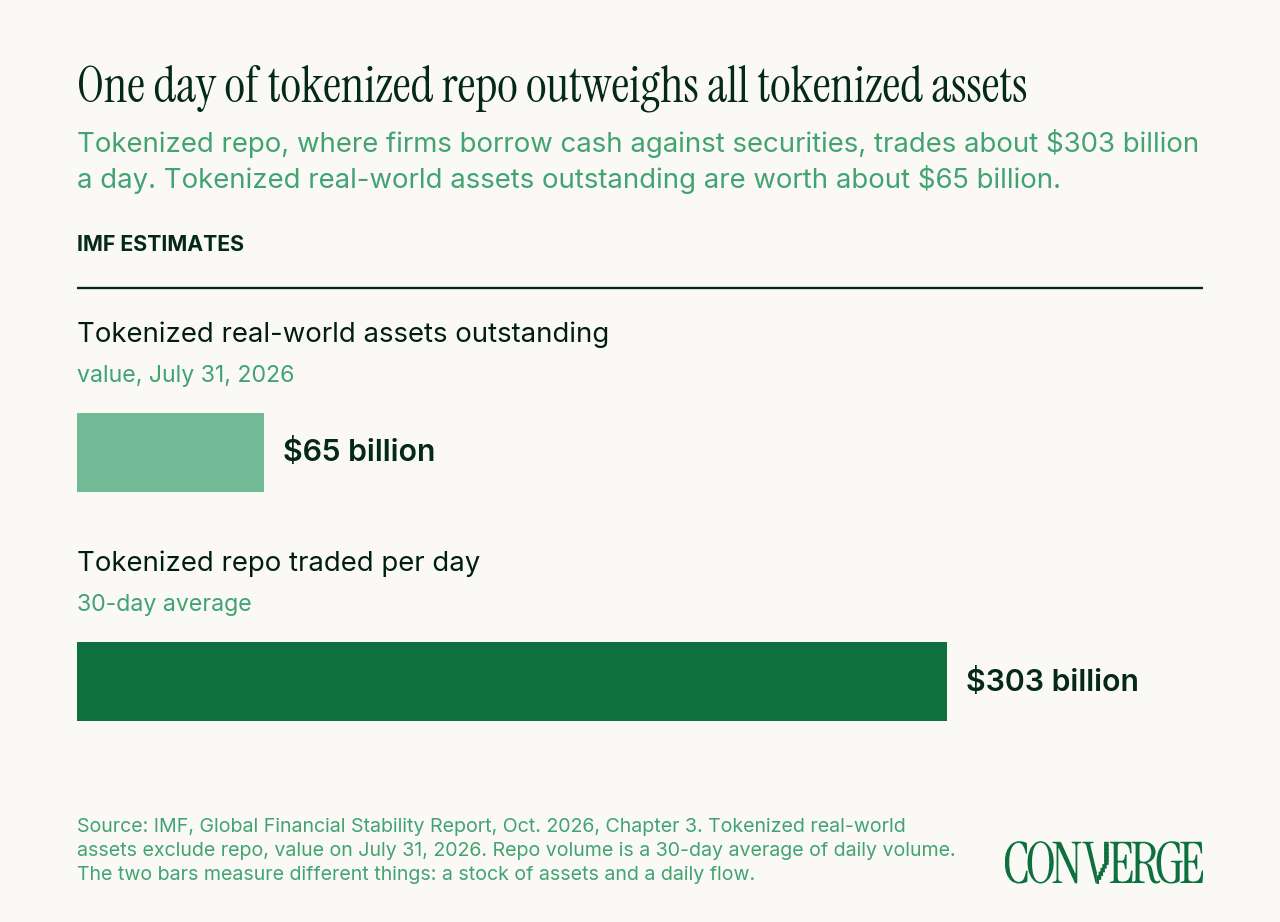
Tokenized repo traded a 30-day average of $303 billion a day, the IMF said in its October Global Financial Stability Report. Tokenized real-world assets outstanding, excluding repo, were about $65 billion on July 31. By our own arithmetic, one day of tokenized repo volume is about 4.7 times that stock.
Our take: collateral is where institutions use tokenization first
Each deal this week makes an asset usable as collateral faster, or without moving it: a Treasury financed the day it settled, a stablecoin pledged while it stays in custody, a swap whose margin is expected to move later on the same ledger.
The firms that gain are those that already sit between the two sides of a trade: custodians and collateral agents such as BNY and Standard Chartered. A tokenized fund that these agents accept as collateral has an institutional use from its first day.
Visa and Mastercard Put Stablecoin Payouts Into Production
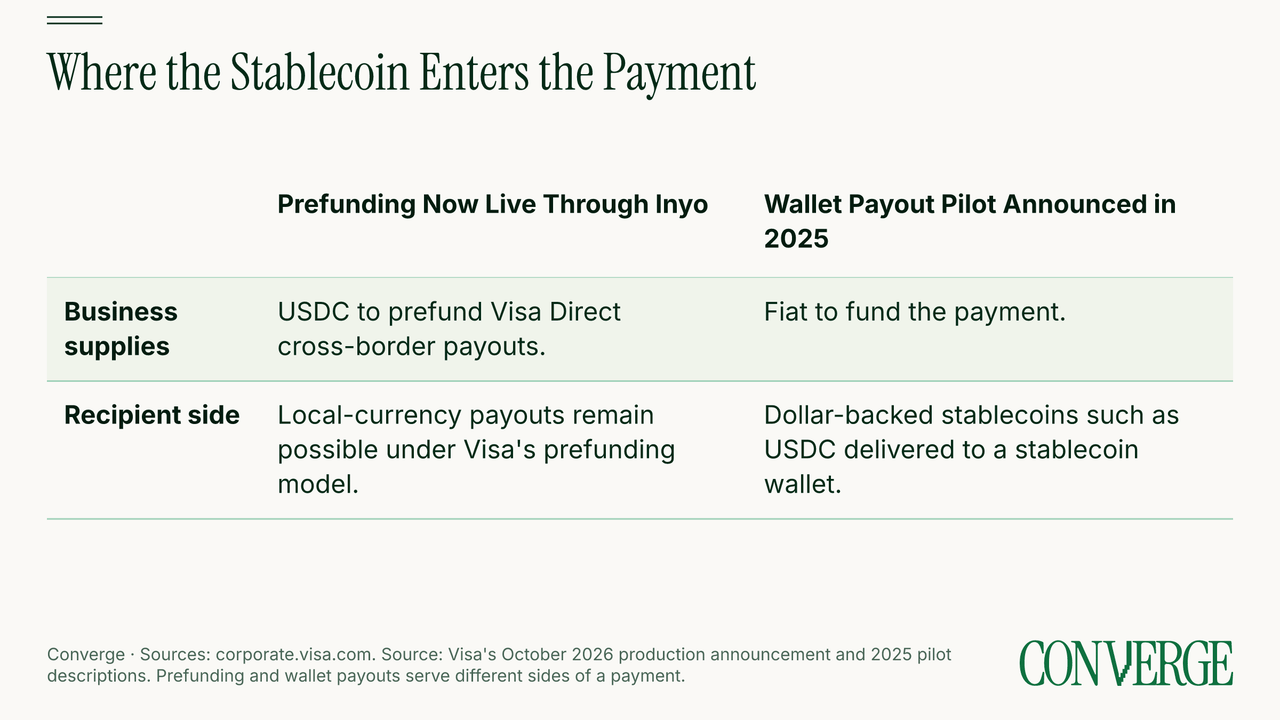
- Visa said on Oct. 15 that Visa Direct's USDC prefunding is in commercial production, with Inyo Global as the first enabler. Businesses can fund cross-border payouts with USDC near-instantly, and recipients still get local currency.
After a pilot that began in September 2025, Visa converts incoming USDC into a dollar balance, so treasury teams can top up close to payout time and hold less idle cash. Availability depends on eligibility and geography, and Visa listed no blockchains or payment corridors.
- Mastercard and BVNK launched the Mastercard Global Money Platform the same day. It offers fiat and stablecoin accounts, conversion, stablecoin-linked cards and local bank payouts through Mastercard Move in one integration.
The companies call it their first major integration since Mastercard closed its purchase of BVNK, valued at up to $1.8 billion, on Aug. 3. Nuvei and Marqeta will be among the first to integrate. Also on Oct. 15, Stripe and Plasma said they will co-develop multi-currency stablecoin cards. Plasma, whose cards Rain has issued, is moving to Stripe's card infrastructure. Citi plans stablecoin checkout for merchants on Spring by Citi, with Coinbase handling acceptance and Citi settling in fiat.
Stablecoin payments grew 45% this year through September, to $482 billion, while supply grew 0.4% to $305 billion, according to Allium. Payment count rose 71% to 1.04 billion, and the average payment fell to $462 from $544. Allium's payments figure is about one-fifth of the stablecoin volume left after it removes exchange, DeFi, infrastructure, automated, minting and burning flows.
Our take: the growth in stablecoins is in payments
An issuer earns on the dollars it holds, and this year that pool barely grew. The volume that grew is payments, and the companies that charge on each payment, Visa, Mastercard, Stripe and Citi, are the ones building the products.
Each launch keeps the stablecoin behind the product. Visa's recipients get local currency, Citi's merchants get fiat and BVNK's customers see one account. The margin goes to whoever owns the customer and the conversion. Issuers without their own distribution compete for a pool that grew 0.4% this year.
OTHER STORIES WORTH YOUR TIME
EBA Names USDC the EU's First 'Significant' E-Money Token
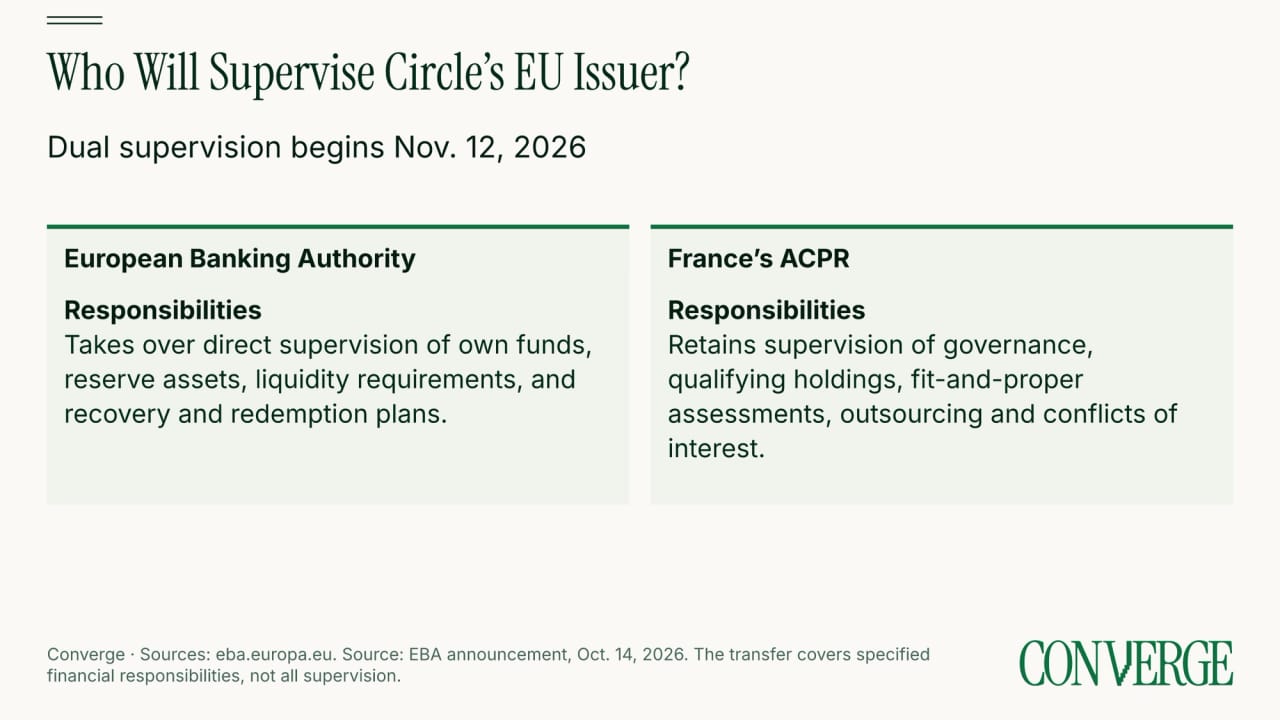
The European Banking Authority classified Circle's USDC as significant on Oct. 14, the first of 45 e-money tokens notified under MiCA. From Nov. 12, the EBA supervises capital, reserves and liquidity at Circle's French entity, and France's ACPR keeps governance. Capital is set at 3% of average reserve assets, and reserves need an independent audit every six months.
ESMA Calls for Noncompliant Stablecoin Wind-Down by Jan. 8
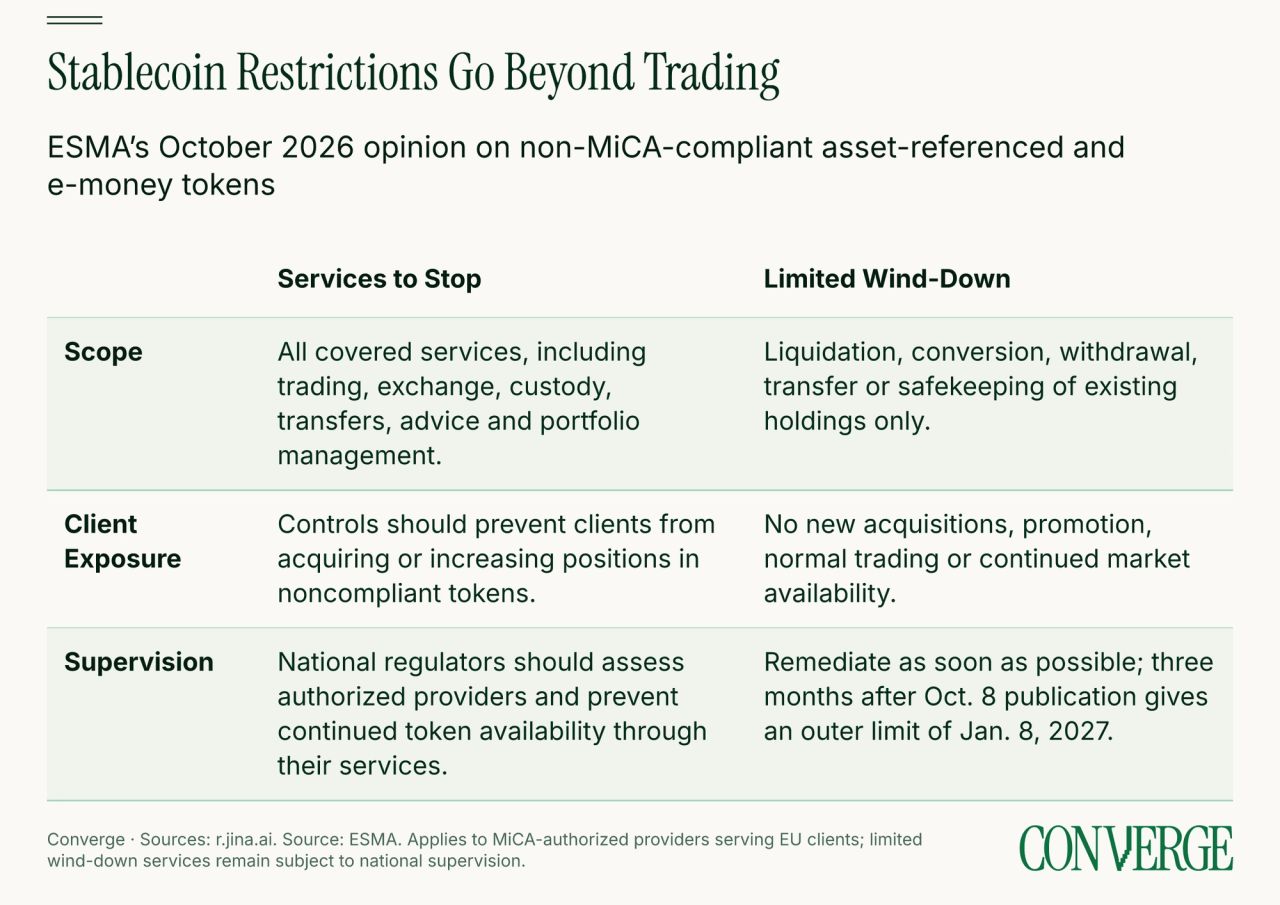
ESMA's Oct. 8 opinion asks national supervisors to make MiCA-licensed firms end all services involving noncompliant stablecoins, including custody and transfers, and resolve EU clients' holdings by Jan. 8, 2027. Its January 2025 statement had allowed "mere custody and transfer." The opinion names no coins. Tether is absent from ESMA's register of e-money-token issuers.
Qivalis Secures Dutch E-Money License for Planned Euro Stablecoin
The Dutch central bank licensed Qivalis, a euro-stablecoin venture of 37 banks in 15 countries, including BBVA, BNP Paribas and ING, on Oct. 14. Qivalis plans to start issuing in the coming months, after it publishes its MiCA white paper.
Tether Routed Payments to Hines's Firm During White House Tenure, WSJ Reports
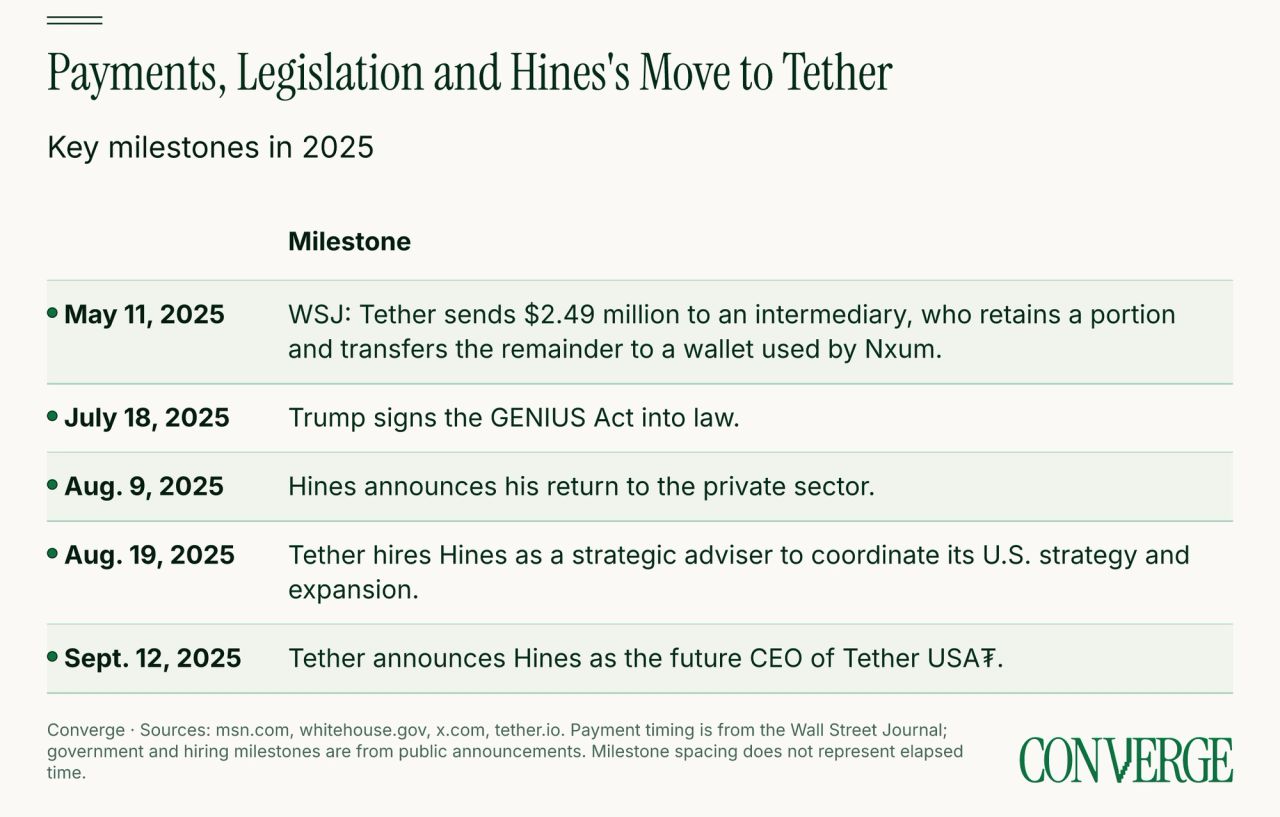
Tether began funding Nxum, a consulting firm co-owned by Bo Hines, in May 2025, while Hines led the White House push for the GENIUS Act, The Wall Street Journal reported. Nxum has earned $6.3 million, including payments after Hines left government. A Nxum representative said Hines was unaware of the Tether dealings and received no Tether-derived funds while in government. Tether did not respond to the Journal.
OCC Finds Debanking Policies at Nine Major US Banks
All nine large national banks in the OCC's review kept policies restricting services to some industries from 2020 to September 2025, the agency said on Oct. 14. Crypto was among them. The report announces no fines. The OCC is considering rules on reputation risk and account closures.
CFTC Proposes Explicit Swap Status for Event Contracts
The CFTC proposed on Oct. 9 to classify sports, political, cultural and weather event contracts as swaps, which supports its claim to exclusive federal oversight of prediction markets. In August, the Ninth Circuit found Kalshi's sports contracts "likely not swaps." A companion interim rule excludes casino-style wagers from the swap definition.
Kraken Parent Payward Agrees to Buy Lithuania's Saldo Bank
Payward signed to buy Saldo Bank, a Lithuanian lender with €196.9 million in assets, on Oct. 14. The deal would add deposits, lending and card issuance in Lithuania, Finland, Sweden and Germany. Closing is expected in 2027, subject to ECB approval.
Schwab Completes Retail Bitcoin and Ether Rollout, Begins Crypto Transfers
All eligible Schwab retail clients can now trade bitcoin and ether, CEO Rick Wurster said on Oct. 15. Schwab is enabling deposits and withdrawals in phases, with a $5,000 limit per withdrawal, and plans to add SOL, AVAX and LINK by year-end. Trades cost 0.75%.
Interactive Brokers Launches Ethereum Staking Through Zerohash
Eligible Interactive Brokers clients can stake ETH through Zerohash from Oct. 13. Combined fees are capped at 30% of rewards. Staked assets sit in a Zerohash account outside SIPC protection.
Even more this week:
- Tempo put its Zones privacy system into production with Deel, keeping contractor balances and payouts private.
- Coinbase and Gennius plan ONED stablecoin services inside Latin American banking apps, starting in Argentina.
- Korea Securities Depository is building connectivity to Avalanche, one of several ledgers it will support for Korea's 2027 tokenized securities.
- Canton recorded more than $155 million in third-quarter fees, CertiK said, the most among chains it compared.
- Blockchain.com applied for CFTC registrations for U.S. crypto futures, options and prediction markets.
- MSCI adopted rules excluding non-operating companies, putting Strategy and Metaplanet at risk of removal after Nov. 30.
- VanEck moved to withdraw its Lido staked ether ETF before issuing any shares.
- Bybit opened USDC-funded trading in more than 1,000 U.S. stocks and ETFs, with Alpaca holding the shares.
- Franklin Templeton and Animoca plan to bring tokenized assets from more issuers to NUVA, with no assets or dates named.
- L2 Capital plans to tokenize $500 million of pre-IPO AI shares with Newton Labs within 24 months of launch.
- Sanctioned Russian platform A7 announced A7 International, a service paying SWIFT invoices with USDT.
- OKX opened a beta for onchain stock, index and commodity markets, with points in place of real funds.
Converge is produced by The Defiant. This briefing is for informational purposes only and does not constitute investment advice.
Free newsletters
Good reporting. Delivered.
Choose your coverage: crypto and DeFi, the future of finance, or both.
Free. Unsubscribe anytime.