
Is OKXICE Dead Before Launch?
Plus Walmart's OnePay and Samsung put USDC behind everyday accounts, Circle's payments network reaches $41 billion, and Democrats take Congress
Happy Friday. This is Converge, The Defiant's weekly recap of tokenization, stablecoins, and real-world assets, by Chris Storaker.
TOP NEWS THIS WEEK
- The first trades under the SEC's stock-token exemption are issuer-sponsored
- Morgan Stanley and Société Générale use DTCC's digital twins
- Sixty-seven companies now object to OKXICE stock tokens
- Kalshi opens single-stock perpetual futures as Cboe-backed group sues the CFTC
- Walmart's OnePay and Samsung Wallet take USDC into everyday accounts
ALSO IN THIS ISSUE
- Circle Payments Network reaches $41.3 billion annualized
- Democrats take both chambers of Congress with CLARITY still stalled
- SEC staff call Canton Coin a digital commodity
- Paraguay's president resigns amid the Ueno Bank collapse
TOKENIZED STOCKS
Is OKXICE Dead Before Launch?
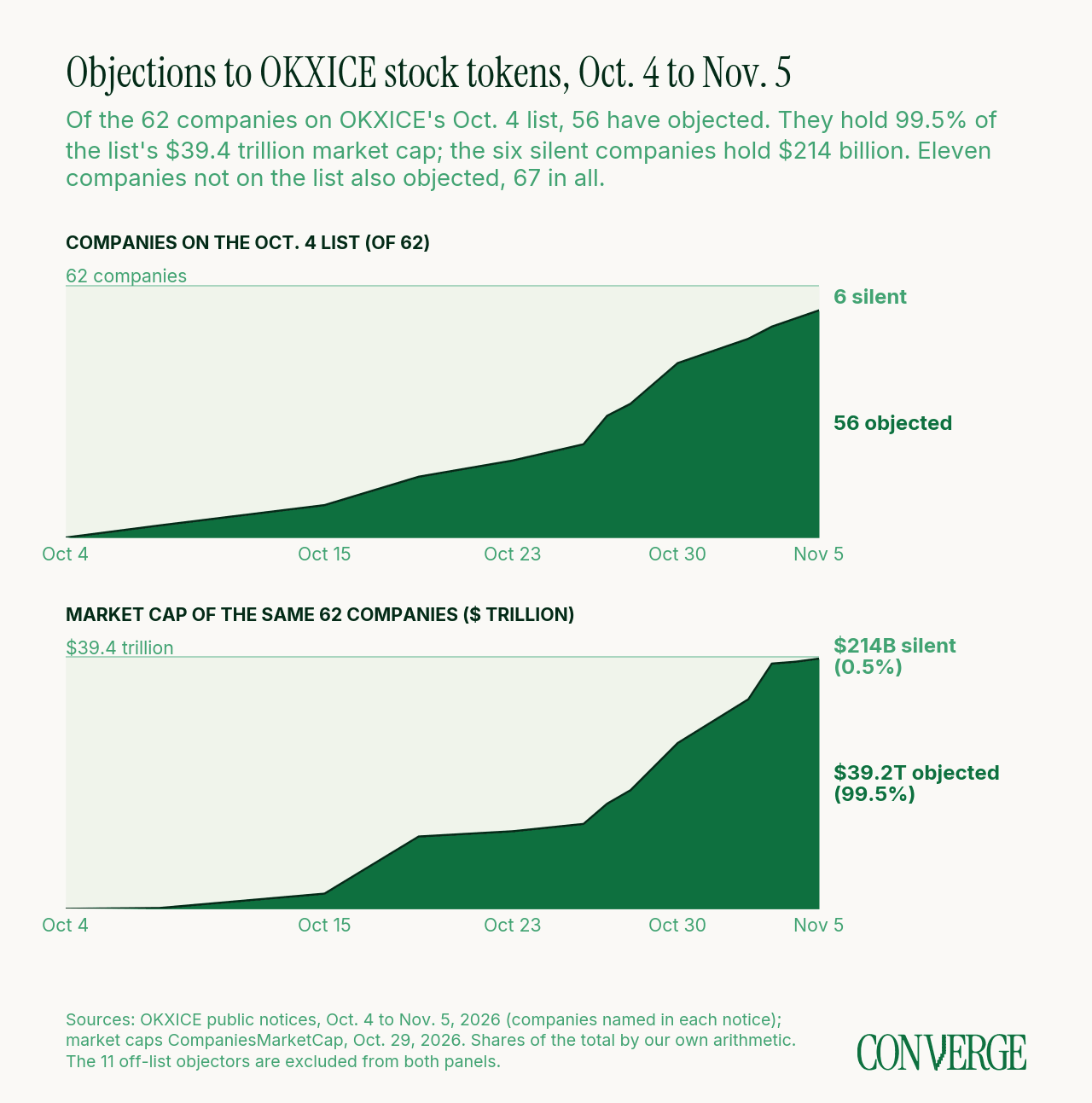
Sixty-seven companies have objected to tokens of their shares on OKXICE, the venue of OKX and NYSE owner ICE, as of its Nov. 5 notice, and the question now is whether it launches at all. The objectors include Nvidia, Amazon, Tesla and SpaceX, Apple, Boeing and Meta: 56 of the 62 on its Oct. 4 list. The six that have not are Strategy, Robinhood, Coinbase, Circle, Securitize and BitGo, all crypto or tokenization businesses. OKXICE has no launch date, and its site still says "OKXICE TSV is coming."
The notices give no reasons, but the companies that have explained themselves point to the venue's structure:
- Applied Optoelectronics stated on Oct. 29 that "the framework is still new and its potential impact on our stock, including pricing, liquidity and volatility, is uncertain," and that it saw no clear benefit.
- JPMorgan said it had "decided not to participate in this venue at this stage" and would "continue to evaluate opportunities as the market develops."
- Nasdaq, which is not offering such trading, has said the model risks "a parallel market structure without the safeguards needed to operate responsibly at scale."
OKXICE co-chair Andrew Cuomo called the objections "a very rational, logical position" and said other companies had approached the venue to have their shares tokenized, without naming them. ICE said it supports "issuer choice" and pointed to NYSE's separate digital alternative trading system. SIFMA asked the SEC again on Nov. 2 for affirmative consent, a public notice portal, a 90-day window and a universal opt-out.
OKXICE’s third-party venue is one version of now four lanes for trading a U.S. stock onchain inside the U.S. All the others carried inaugural transactions this week.
Alternative lanes
Lane 2: Issuer-sponsored under the SEC's exemption: On Nov. 4, Canton Strategic Holdings, a Nasdaq-listed investor in the Canton Network, became the first company to trade under the order this way: DRW Cumberland bought from an existing shareholder in four purchases of $100 to $19,985, Fairmint keeps the register on Canton, and holders have the same rights as Nasdaq shareholders.
Lane 3: DTCC's digital twins. DTC holds almost every U.S. share in book-entry form. A DTC participant can now convert a share held there into a token on Canton or on DTCC's private Besu chain, and back. The share stays in the depository, DTC keeps the record, and tokens move between participants' wallets around the clock; there is no trading venue. This lane runs under DTC's rules, outside the SEC's exemption, and the issuer-company has no role, so nobody asks its consent.
Morgan Stanley said Nov. 3 it is converting U.S. stocks and Treasuries into tokens through the service, six days after it went live. Société Générale accepted $10 million of DTCC-tokenized Treasuries as collateral on Canton on Nov. 2 and said repo financing is next.
Lane 4: single-stock perpetual futures, under the CFTC. A perpetual future is a contract on the stock's price with no expiry; daily funding payments between longs and shorts keep it near the stock. No share changes hands, so there is no register, no vote and no consent.
Kalshi opened perpetual futures on Apple, Amazon and AMD on Nov. 5, two days after CFTC Chair Michael Selig said equity perps can trade. A group backed by Cboe and Citadel Securities sued the CFTC the same week, arguing the contracts are security-based swaps under SEC jurisdiction. The judge denied an emergency halt but wrote that they appeared to be swaps.
STABLECOINS
Stablecoins Behind Everyday Accounts: Walmart, Samsung
OnePay, the fintech majority-owned by Walmart, lets select U.S. customers fund OnePay Checking with USDC since Oct. 30, from external wallets on 12 blockchains including Tempo, Base, Solana and Ethereum. The value arrives as dollars, with no conversion fee at launch and no stablecoin balance.
- How it works: The customer sends USDC to a deposit address in the app. Bridge, Stripe's stablecoin platform, creates the address, runs compliance checks and converts to dollars. OnePay credits the checking balance at Coastal Community Bank or Lead Bank. The customer never holds a token. OnePay says the product is for gig workers, freelancers and anyone paid in stablecoins across borders, and calls it the first of several stablecoin features.
Samsung's Stablecoin Account went live in Samsung Wallet on Nov. 5: eligible U.S. Galaxy users can buy, hold and send USDC on Solana, and send money to bank accounts in more than 60 countries. Bastion runs the accounts, Coinbase Prime Vault holds the USDC, about 82 million U.S. Galaxy devices qualify, and New York is excluded.
- Samsung said in October it is not a bank, money transmitter or custodian and holds no customer funds. Here the user does hold USDC, inside a wallet already on the phone.
Our take: the account owner mandates the rail
Walmart's bank app and Samsung's wallet ask the customer to change nothing; an infrastructure supplier (Bridge, Bastion) runs the token layer.
The supplier is also the point of failure. Nubank suspended crypto deposits and withdrawals in Brazil on Nov. 6, citing a failure at the external provider that verifies its transactions; buying and selling for reais continued. Mercado Pago posted the same notice the same day, citing an external data supplier. SoFi told customers on Nov. 4 that a crypto vendor issue had left external wallet transfers pending. None of the three named the vendor. Chainalysis, which Nubank uses to screen transfers, took its transaction-monitoring and address-screening tools offline on Nov. 4 after a breach exposed credentials for all its customers, and began restoring them on Nov. 6. Neither company has linked the two events.
The issuers pay to be chosen. Circle paid $412 million in distribution, transaction and other costs last quarter; Coinbase alone booked $328 million of stablecoin revenue.
Open USD, the stablecoin founded by Stripe, Visa, Mastercard, Coinbase and Shopify, plans, per private documents seen by CoinDesk, to pass reserve interest to partners minus a fee of 0.1 basis point, capped at one cent per payment. Partners holding at least $50 million earn equity, capped at 5% each.
The OCC's final GENIUS rule, effective Jan. 18, treats payments to a partner for distribution as a bona fide service and not as prohibited yield. Rewards passed to holders are judged case by case, with no safe harbor.
OTHER STORIES WORTH YOUR TIME
Democrats Win Both Chambers; CLARITY Stays Stalled, GENIUS Proceeds
The Associated Press called the Senate for Democrats late on Nov. 3 and the House on Nov. 4. Elizabeth Warren, the Banking Committee's top Democrat, is positioned to chair it. The CLARITY market-structure bill failed its Senate procedural vote 49 to 50 on Sept. 15 and has not moved since. The GENIUS Act's effective date of Jan. 18, 2027 is set by statute, and the OCC's final rule takes effect the same day regardless of Congress.
Standard Chartered launched tokenized deposits for HK corporates
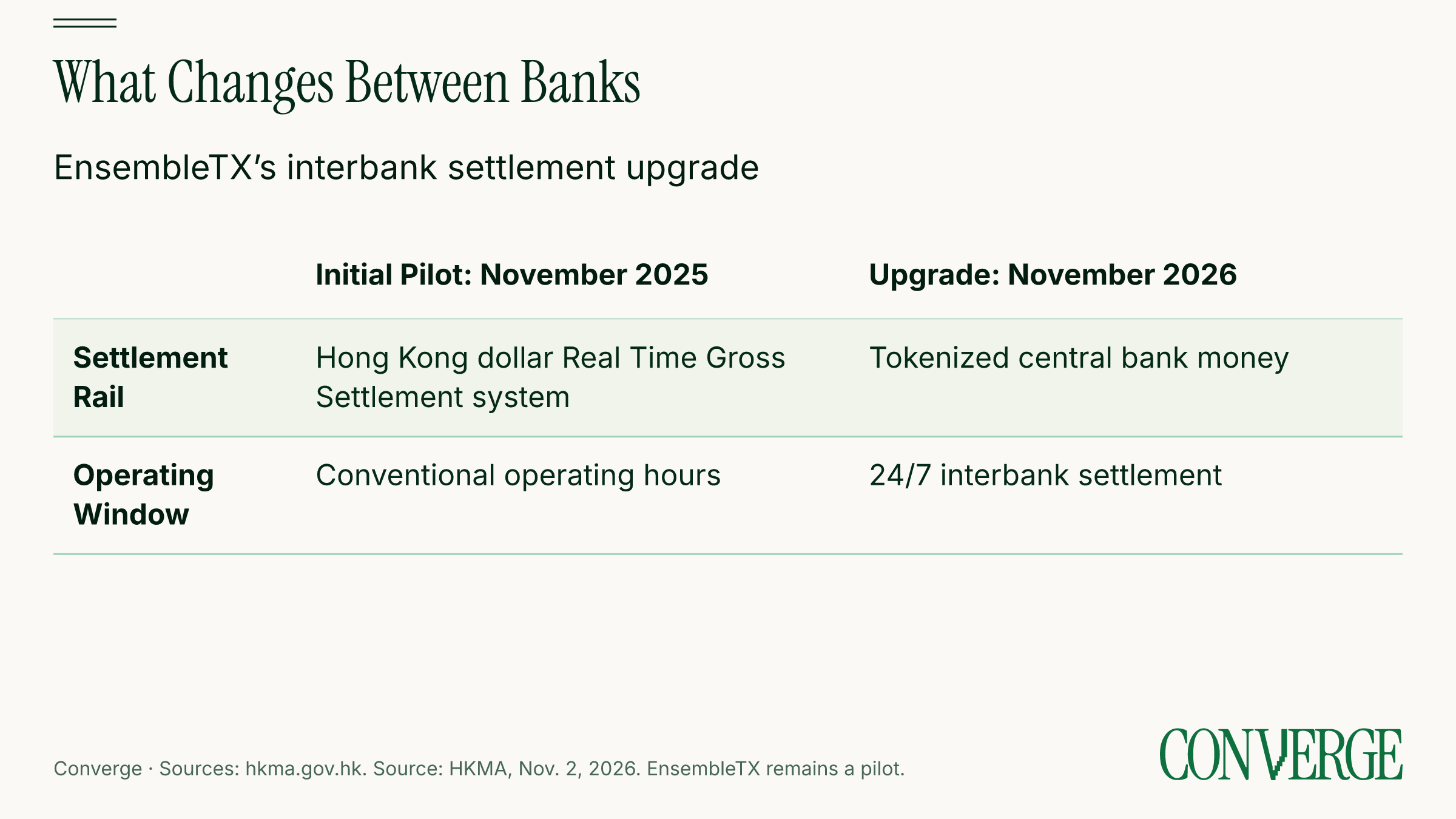
On Nov. 2 on the HKMA's EnsembleTX, which now settles between its 12 participating banks around the clock in tokenized central bank money. The client holds a deposit; the token is the bank's internal record of it. Deposits are outside the GENIUS Act's yield prohibition.
SEC Staff Grant Canton Coin No-Action Relief as a Digital Commodity
The Division of Corporation Finance said on Nov. 3 that Canton Coin is a digital commodity under the agency's framework and that it would not recommend enforcement if Super Validators, Validators and application providers mint it programmatically without registration. The staff cited the network's programmatic operation and the absence of a central party.
SEC Crypto Broker-Dealer Rule Enters White House Review
The SEC's proposed amendments to broker-dealer financial responsibility and recordkeeping rules for crypto assets reached the Office of Information and Regulatory Affairs on Nov. 3, marked economically significant. It is the only SEC crypto item under review.
Crypto 401(k) Rule Enters Final White House Review
The Labor Department sent its final rule on retirement-plan investment choices to the Office of Information and Regulatory Affairs on Nov. 6. The rule is meant to make it easier for 401(k) plans to offer crypto and other alternative assets.
Treasury and Fed Withdraw the $250 Cross-Border Travel Rule Threshold
FinCEN and the Federal Reserve Board withdrew their 2020 proposal to lower the recordkeeping and information-sharing threshold for cross-border transfers from $3,000 to $250, which would have covered most stablecoin payouts and remittances.
Block Reaches $964 Million DOJ Deal in Principle Over AML Lapses
Block's agreement in principle would defer a Bank Secrecy Act charge for three years. The headline figure includes a $200 million credit for prior regulatory resolutions; the cash cost and the amount accrued at Sept. 30 is $764 million. Block says it cannot assure a final agreement.
Coinbase Brings Deribit Options and Perpetuals to U.S. Prime Clients
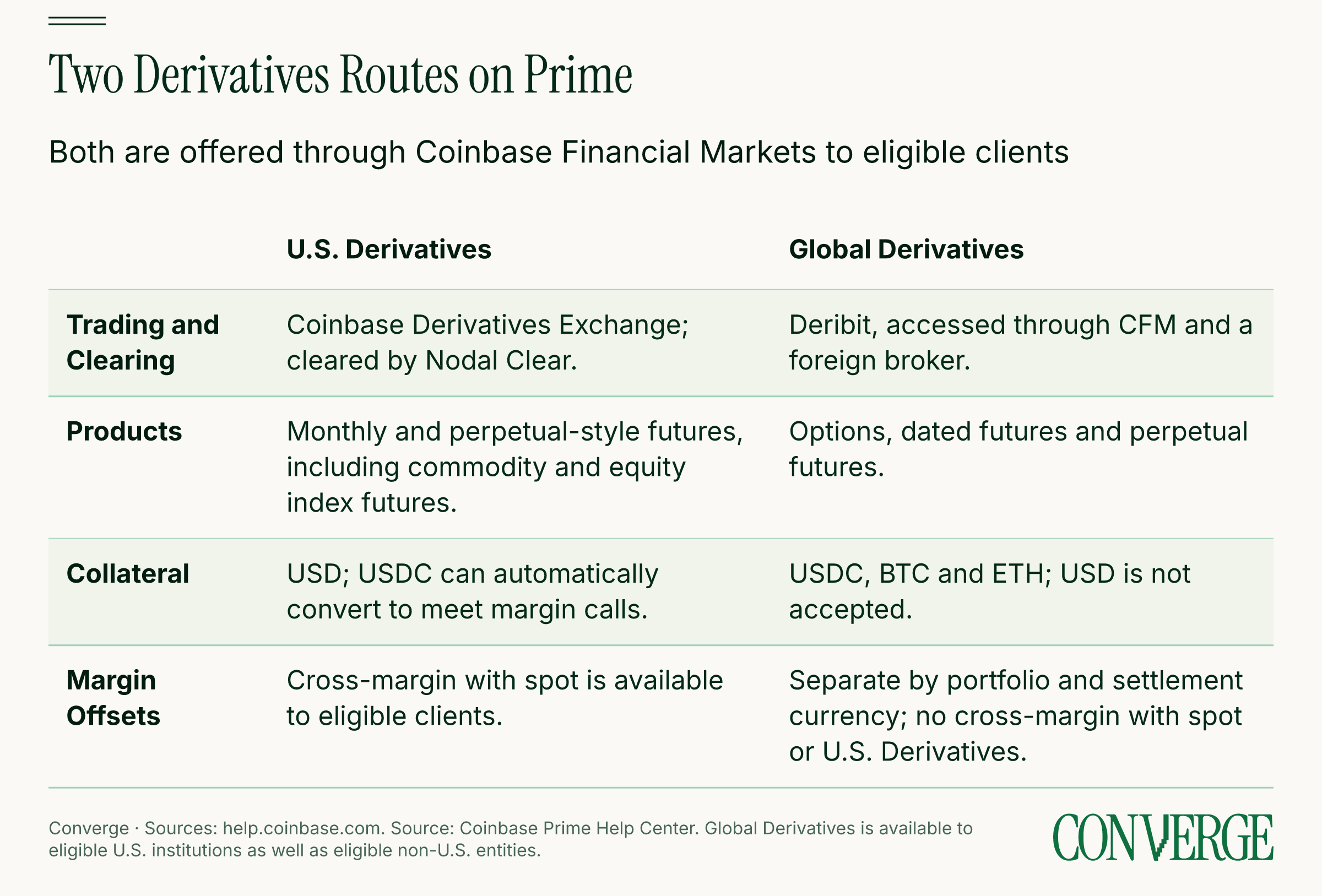
Institutions on Coinbase Prime in the U.S. and other eligible regions can trade Deribit options and perpetuals on more than 20 assets with BTC, ETH and USDC as collateral, in what Coinbase calls one liquidity pool for U.S. and global traders. Orders route through Coinbase's futures commission merchant to Deribit under a CFTC staff letter.
Anchorage Digital Applies for CFTC Swap Dealer Registration
Anchorage said on Nov. 5 its options business for U.S. clients passed the $8 billion de minimis threshold and that Anchorage Digital Swap Dealer LLC has applied to the National Futures Association. Registration is pending; planned products are European-style bitcoin and ether options with maturities of up to one year.
Paraguay's President Resigns Amid the Ueno Bank Collapse
Santiago Peña submitted his resignation on Nov. 5 after the central bank put Ueno Bank into resolution on Nov. 2, citing a solvency ratio below half the required minimum. The deposit guarantee covers 75 minimum wages per depositor. On Bybit's peer-to-peer market, USDT offers ran about 13% above the central bank's reference rate.
Binance Asks ArbitrumDAO to Release Frozen ETH and ARB
Binance put the Oct. 29 theft at $6.34 billion and said $2.85 billion has been frozen or intercepted. Tether froze more than $1.5 billion of USDT within 30 minutes; a Circle spokesperson put USDC freezes above $1.1 billion. The FBI attributed the attack to North Korea. On Nov. 5 Binance asked ArbitrumDAO to vote to release 8,426 ETH and 74.6 million ARB immobilized by the network's Security Council, a process of about 49 days. The attackers began swapping the stolen XRP, about $50 million on Nov. 6, mostly through THORChain into bitcoin, Elliptic said.
Schroders Brings an Emerging-Market Bond Strategy to Solana
Schroders and Centrifuge launched tokenized exposure to the Schroder International Selection Fund Emerging Market Bond fund on Nov. 4 through a feeder share class, Schroders' first Solana deployment.
SoFi Says Crypto Vendor Issue Is Delaying Deposits and Withdrawals
SoFi told customers on Nov. 4 that a technical issue with its crypto vendor had left transfers to and from external wallets pending, that funds are secure and that transfers will be processed after review.
Even more this week:
- Stripe's Global Payouts now lets U.S. businesses send USDC or Open USD to recipients' wallets in more than 160 markets, for 50 cents plus 0.5% per payout, in public preview and with New York excluded.
- Circle Payments Network reached $41.3 billion in annualized volume in the third quarter, up from $14.7 billion in the second. Enrolled institutions reached 205. USDC in circulation was $73.9 billion, flat on the year; reserve income fell 8% to $658 million.
- OKX launched its card in the U.S. on Nov. 2, a Mastercard virtual card issued by WebBank that spends USDC, USDT and USDG from the OKX Pay wallet.
- Tether reported $1.5 billion in third-quarter operating profit as its reserve buffer reached $7.95 billion.
- SBI plans a $100 million investment in Erebor, the OCC-chartered bank co-founded by Palmer Luckey.
- Yellow Card acquired Brazil's GoMoney, adding Pix collections and payouts with stablecoin settlement.
- Ramp applied to the OCC for a national trust bank charter for digital-asset custody and fiduciary investment management.
- Crypto groups moved for summary judgment against Illinois' 0.2% digital-asset tax, with hearings proposed for February.
- France's stablecoin-conversion tax and wallet-reporting amendments are shelved after the Assembly rejected the budget's revenue section 458 to 0.
- Anchorpoint will issue its HKDAP stablecoin natively on Solana, with no go-live date.
- Tempo introduced a credit service, with Tala lending USDT to El Dorado wallet users in Bolivia.
- Western Union's Stablecard has about $20 million of USDPT in circulation, the company said on its earnings call.
- BitGo added Stacks bitcoin staking in qualified custody.
- The Bank of Russia set the rules for exchanges to admit bitcoin, ether and USDT, opening a regulated channel for non-qualified investors from Nov. 17.
- Coinbase opened USDC borrowing against PAX Gold through Morpho on Base.
- Greece's parliament approved a 10% tax on individuals' crypto gains, with a €500 annual exemption.
- Gnosis Pay confirmed a breach of its consumer-card system, exposing names, addresses, card numbers and linked wallet addresses; funds were unaffected.
- Solana Labs' Leap opened an iPhone beta combining tokenized stocks, ETFs and crypto on Solana.
Converge is produced by The Defiant. This briefing is for informational purposes only and does not constitute investment advice.
Free newsletters
Good reporting. Delivered.
Choose the newsletters you want in your inbox.
Free. Unsubscribe anytime.