Fed Rounds Out GENIUS Rule Proposals With Size-Based Capital
Plus the SEC lets ARK's venture fund add tradable tokenized share classes, Binance buys $100 million of Circle, and the ECB switches on Pontes
Happy Friday. This is Converge, The Defiant's weekly recap of tokenization, stablecoins, and real-world assets, by Chris Storaker.
TOP NEWS THIS WEEK
- The Fed proposes size-based capital for bank stablecoin issuers, and custody rules that reach USDC's main custodian
- The SEC lets ARK's venture fund add tradable share classes; the token on sale Thursday wraps existing shares
ALSO IN THIS ISSUE
- Binance buys $100 million of Circle stock; Circle's distribution bill holds near 62% of reserve income
- The ECB switches on Pontes; SoFi moves a $25 billion card program to SoFiUSD settlement
- Canada's six largest banks and The Clearing House advance tokenized deposits
- NYSE, Ondo and MoonPay move on tokenized stocks and funds
Converge reaches 20,000+ tokenization leaders and decision makers every week. Sponsor an issue →
REGULATION / STABLECOINS
Fed Proposes Size-Based Capital for Stablecoin Issuers
- The Federal Reserve on Thursday proposed its rules for stablecoins issued by the banks it supervises, the last of the four federal banking regulators to do so under the GENIUS Act, and, unlike the OCC and the FDIC, tied an issuer's capital to the size of its stablecoin.
The law splits the rulebook by charter. The GENIUS Act, signed in July 2025, requires dollar stablecoins issued in the U.S. to be licensed, backed one for one by cash, deposits, short-dated Treasuries and similar assets, and barred from paying holders interest or yield. Each issuer's primary regulator writes the rest, and the charter decides which:
- The OCC for nonbank issuers and national banks' subsidiaries
- The FDIC for subsidiaries of state banks outside the Federal Reserve System
- The NCUA for credit unions' subsidiaries
- The Fed for subsidiaries of member state banks
- States for issuers with up to $10 billion outstanding
The OCC proposed its rules in February, the FDIC in April and the NCUA in May. The Act takes effect by Jan. 18, 2027.
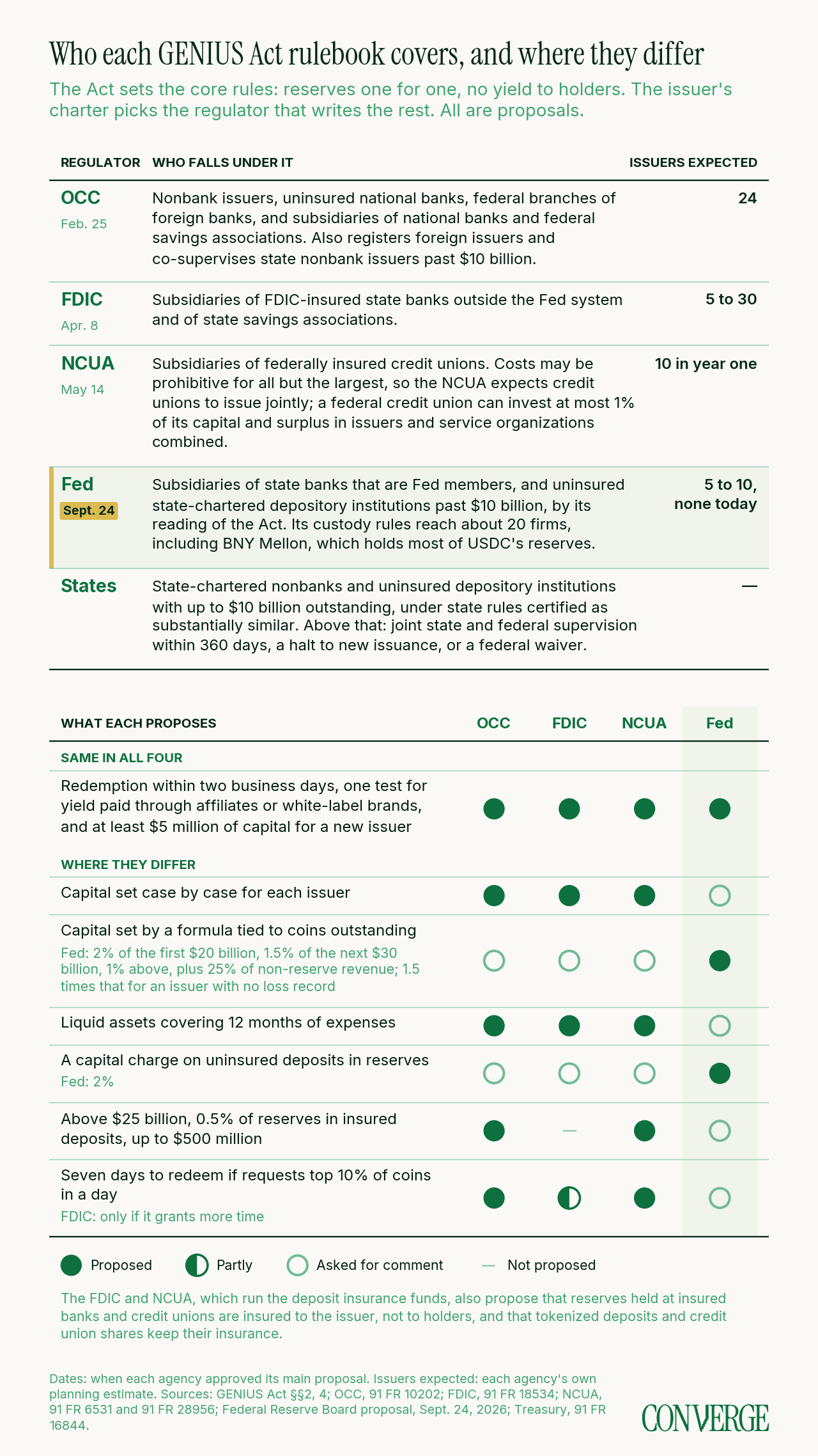
No issuer answers to the Fed yet. The Fed says "there are no such entities at this time" and expects 5 to 10 of its 703 insured state member banks to form one; the OCC's cost analysis assumed 24 under its rule. The Fed also claims uninsured, state-chartered issuers once they pass $10 billion, a group the Act assigns to no named agency. Its widest reach is custody: its rules would cover about 20 banks and holding companies that hold stablecoin reserves, and the Fed notes that "the majority of USDC's reserve assets are held in custody at BNY Mellon," which it supervises.
- Related: capital is where the Fed breaks with the OCC and the FDIC. Capital is the issuer's own money, held on top of the reserves to absorb losses from hacks, errors and lawsuits. The OCC and the FDIC set it case by case, with a $5 million minimum for new issuers. The OCC considered a charge of 1% of coins outstanding up to $10 billion, falling to 0.20% above $50 billion, and left it out because it "may disincentivize growth."
The Fed chose a formula, 2x the rate the OCC considered. Operational-risk capital would be 2% of the first $20 billion outstanding, 1.5% of the next $30 billion and 1% above that, plus 25% of average revenue outside reserve income. A multiplier tied to each issuer's five-year loss record can lower that by up to 20% or raise it, and an issuer with no record gets 1.5x. With no Fed-supervised issuer in existence, every one would start there.
The Fed set its revenue charge at "roughly double" large banks' worst-case operational losses and acknowledges that "there is currently insufficient available data" on stablecoin issuers' own.
- Related: the OCC, the FDIC and the Fed now propose the same yield test. Each presumes a violation when an issuer pays interest or yield to an affiliate, a firm paying holders on the issuer's behalf or a white-label brand, which then pays holders. Exchanges and other distributors are not named; the Fed would review other arrangements case by case.
Tokenized cash, deposits, Treasuries and money funds could count as reserves if they carry "legal rights that are identical" to the underlying asset. The Board voted 7-0; comments close 60 days after Federal Register publication.
TOKENIZED FUNDS / PRIVATE MARKETS
SEC Lets ARK's Venture Fund Add Tokenized Share Class
- The SEC on Sept. 21 let the ARK Venture Fund add two share classes that can trade, one on a stock exchange and one in tokenized form.
ARK Venture Fund is an interval fund, a registered fund built for assets that are hard to sell. Investors buy in at net asset value, the per-share value the fund calculates each business day, and can cash out only when the fund offers to buy back shares each quarter; ARK's current offer covers 5% of them. Most interval funds, ARK's included, have no market where shares trade between buybacks. ARK's holds about $1.3 billion, 62% of it in private companies such as SpaceX, OpenAI and Anthropic.
The order lifts ARK's promise that its shares would not be listed or quoted. In 2025 ARK told the SEC its shares "will not be listed on any securities exchange, nor quoted on any quotation medium." The new order allows a listed class and a class recorded on a blockchain that can trade on broker-run venues called alternative trading systems or move between approved wallets. ARK must warn that trades may happen above or below NAV.
The difference from earlier tokenized funds is the assets. Arca's U.S. Treasury Fund, another interval fund, has issued its shares as Ethereum tokens since 2020, but Treasuries already trade every day. SpaceX, OpenAI and Anthropic shares have no public market, so a traded ARK class would give investors a price for them between buybacks.
- Related: On Thursday ARK and Securitize began selling a token of the fund on Ethereum from $500. This token neither new class. Securitize buys the fund's existing shares, holds them at BNY Mellon and issues tokens backed by them for a 2% fee. The tokens move only between verified wallets, and cashing out still means the quarterly buyback. The listed class, ticker ARKV, is set to take effect Oct. 23, and no filing yet registers the tokenized one. ARK is an investor in Securitize.
Our take
The token changes how the fund is held. The two new classes would change what it is worth to a buyer on a given day, with a market price for SpaceX, OpenAI and Anthropic exposure that can differ from ARK's own valuation.
OTHER STORIES WORTH YOUR TIME
Binance Buys $100 Million of Circle as Circle Keeps Paying for Distribution
Circle sold Binance 1,237,011 shares at $80.84, below the market price, and will pay it a monthly fee set as a percentage of the USDC held through Circle's wallet infrastructure for five years; Binance cannot sell or hedge the stake for up to two years. In July, Converge argued that once the threat of Open USD existed, Circle would negotiate every distribution deal against it.
By our own arithmetic from Circle's filings, the overall bill has barely moved: distribution and transaction costs took 60.9% of reserve income in 2024, 63.0% in 2025 and 61.8% in the first half of 2026. The split has moved. Coinbase's share fell from 55.7% to 49.6% of reserve income, and the rest of the line, which includes Binance, other partners and blockchain fees, rose from 5.2% to 12.2%. Circle did not disclose Binance's rate.
The ECB Switched On Pontes to Settle Tokenized Assets in Central Bank Money
The Eurosystem launched Pontes on Monday, letting wholesale trades in tokenized assets settle in central bank money. Thirteen market participants, among them Deutsche Bank, Santander, Société Générale, KfW and the European Investment Bank, and four DLT operators, Axiology, Cashlink, Clearstream and SWIAT, completed onboarding, and the Bundesbank joined as a participant. More features and longer operating hours arrive gradually, with full implementation expected by 2028. The ECB also began preparing to invest part of its own funds portfolio in tokenized securities, settled through Pontes.
SoFi Moves Its $25 Billion Card Program to SoFiUSD Settlement
SoFi said Tuesday that stablecoin settlement is live across SoFi Bank's Mastercard debit and credit programs and that it is migrating the whole program, expected to process more than $25 billion a year, to settle in SoFiUSD, the stablecoin it issues as an OCC-regulated national bank. Merchants on SoFi's business-banking platform can receive settlement in a SoFi account and withdraw cash at any hour at no cost. SoFi said it is in talks with large U.S. merchants and named none.
TOKENIZED DEPOSITS:
Canada's Six Largest Banks Explore a Shared Tokenized-Deposit System: BMO, CIBC, National Bank, RBC, Scotiabank and TD said Tuesday they are exploring a Canadian-dollar tokenized-deposit system, starting with transfers between banks, 12 days after the bank supervisor OSFI said tokenized deposits are "not legally distinct from traditional deposits."
In the U.S., The Clearing House picked Quant on Thursday to run the coordination layer of its tokenized-deposit network, linked to its RTP and CHIPS payment systems and due for participating banks in the first half of 2027.
IBM connected its Digital Asset Haven platform to Swift's ledger in beta, so banks can instruct tokenized-deposit transfers with standard ISO 20022 payment messages.
Blockchain.com and NYSE Explore 24/7 Tokenized Stock Trading
Blockchain.com agreed to explore giving its customers round-the-clock access to tokenized U.S. stocks and ETFs through NYSE's planned digital venue, which NYSE said in January would pair its Pillar matching engine with blockchain post-trade systems and which still needs regulatory approval. Ondo opened in-kind minting, so approved institutions can convert shares held at Alpaca into Ondo Stocks tokens and back without putting up separate cash. Token Terminal counts 4.3 million tokenized-stock holders, up from about 100,000 a year earlier and led by BNB Chain; the figure counts addresses with any balance. Coinbase asked the CFTC to approve single-stock perpetual futures for U.S. customers, trading from Sunday evening to Friday afternoon.
MoonPay Agrees to Buy North Capital's Broker-Dealers, Transfer Agent and ATS
The all-stock deal, worth more than $60 million according to CoinDesk, would give MoonPay SEC-registered broker-dealers, an investment adviser, a transfer agent and PPEX, an alternative trading system for private and exempt securities. Last Thursday, WisdomTree said it would open its WTGXX tokenized Treasury fund to MoonPay's more than 35 million accounts, with MoonPay using the fund in its stablecoin reserves. Ondo launched three tokenized portfolios for non-U.S. investors built on BlackRock model strategies, with Ondo running the products.
a16z and the DeFi Education Fund Ask the SEC to Put DEXs Outside Exchange Rules
Their joint letter proposes a presumption that a decentralized exchange meeting four tests, non-custodial, automated, permissionless and credibly neutral, is not engaged in exchange activity, and quotes Commissioner Hester Peirce's statement that the SEC's tokenized-stock exemption "is not about decentralized finance." On Wednesday, Peirce urged regulators to accept zero-knowledge proofs in place of collecting customers' personal data for identity checks. Bloomberg reported that the administration is weighing joint ventures to promote dollar stablecoins overseas; Treasury and the White House did not respond.
Even more this week:
- Circle opened bitcoin-backed USDC loans to Circle Mint clients, routed through Morpho's lending markets on Arc.
- Galaxy added $100 million of Sky's sUSDS to its treasury and accepts it as loan collateral.
- KB Securities, Securitize and Optimism signed an exploratory MOU for tokenized securities in Korea, with OP Mainnet as the intended chain.
- Mastercard's BVNK added Stellar as a settlement network, seven weeks after the acquisition closed.
- The OCC gave Catena Labs preliminary conditional approval for a national trust bank serving businesses that put AI agents to work.
- Tether said its EQIBank exposure is below 0.034% of group assets after reports that some of its funds were stuck at the Dominica bank.
- An Ethereum draft standard would add compliance checks and forced transfers to confidential RWA tokens.
- Block contributed a Bitcoin Lightning specification to x402, the payments standard for AI agents.
- Bitget moved institutional collateral to Sygnum's off-exchange custody.
- New York sued Polymarket US as an unlicensed gambling business.
- CME will list Bitcoin Cash and Uniswap futures on Oct. 19.
- Coinbase opened IPO allocations to U.S. retail customers starting with Oura.
- Fairshake plans $30 million of ads against Sherrod Brown in Ohio.
- Chainalysis ranked Brazil first in its redesigned crypto adoption index.
Converge is produced by The Defiant. This briefing is for informational purposes only and does not constitute investment advice.
Free newsletters
Good reporting. Delivered.
Choose your coverage: crypto and DeFi, the future of finance, or both.
Free. Unsubscribe anytime.