DTCC Goes Live With Tokenized Stocks and Treasuries
Plus Stripe's $53B bid for PayPal, Visa launches on Open USD, and our sit-down with DTCC Digital Assets.

Presented by BRON: Built for a New Era

Seed phrases are a decade-old design flaw putting billions at risk. Take the interactive quiz at seedphrasemuseum.org and see exactly how exposed a standard seed phrase setup really is.
Happy Friday to all the explorers at the convergence of crypto and TradFi. This is Converge, The Defiant's weekly recap of tokenization, stablecoins, and real-world assets, by Chris Storaker, The Defiant. Follow @ConvergeDefiant.
TOP NEWS THIS WEEK
- DTCC Goes Live With Tokenized Stocks and Treasuries
- Stripe Bids $53B for PayPal as Visa Launches on Open USD
ALSO IN THIS ISSUE
- Watch: Coinbase's Brian Foster on stablecoins vs. fiat
- Ondo and SBI to tokenize Japanese assets on a yen stablecoin
- Coinbase matches Robinhood's 7% yield — with different math
- Tether backs USA₮ payroll rails; x402's real volume; CLARITY Act text
TOKENIZATION / MARKET STRUCTURE
DTCC Goes Live With Tokenized Stocks and Treasuries
The Depository Trust & Clearing Corporation — the plumbing that clears and settles most US securities trades — began running live production trades of tokenized stocks and Treasurys on Wednesday.
- More than two dozen firms are taking part per DTCC (the WSJ said nearly 40), naming JPMorgan, Goldman Sachs, BlackRock, Vanguard, and the NYSE.
- DTCC's depository custodies more than $114 trillion in securities. It isn't building a new venue, intead it’s tokenizing assets it already holds into "digital twins" that keep the same ownership and dividend rights.
- The marquee trades were institutional plumbing: JPMorgan tokenized an Invesco QQQ holding and posted it to meet a margin call at CME; Société Générale pledged tokenized Treasuries to Citadel. Collateral, repo, and margin.
- Settlement ran on DTCC's private Hyperledger Besu chain and the institution-focused Canton Network. not a public blockchain like Ethereum or Solana. Full launch is set for October.
For scale: the entire onchain market for tokenized real-world assets is worth around $375B, or only $35B if you count assets that can be accessed directly on chain. DTCC dwarfs that.
Our take: Wall Street Didn't Choose DeFi. It Chose the Parts It Could Control
This week DTCC ran the largest tokenization test U.S. capital markets have seen, and the detail that matters most is where it didn't happen: on a public blockchain.
The clearinghouse that custodies more than $114 trillion in securities converted DTC-held assets into tokens and pushed them through live trades with more than 30 firms, including BlackRock, Goldman Sachs and J.P. Morgan. The conversions ran on Hyperledger Besu, DTCC's private chain, and on Canton. Stellar, the one permissionless network in DTCC's roadmap, doesn't arrive until 2027.
This test shows institutions are not buying DeFi. They are buying tokenization. The difference is that with tokenization, they get faster settlement, mobile collateral, and programmable assets that still answer to a compliance desk. But they’re stripping out open access, censorship resistance, and composability that come with building on open, decentralized chains.
a16z crypto put words to this the same week, arguing that TradFi doesn't want DeFi, it wants blockchain: the primitives without the openness. ARK's Lorenzo Valente pushed back, calling the thesis "overly bearish" and noting that private intranets and private cloud both lost to open networks.
Here is what the payments lens tells you. A bank tokenizing collateral wants the efficiency of shared infrastructure and none of the counterparty ambiguity. And that’s still possible on public chains. Organizations can gate transfers and screen every address on solutions like Ethereum Layer 2s and Avalanche L1s. The gap between "private chain" and "public chain with permissions bolted on" is thinner than either camp likes to admit.
So do the permissioned layers that institutions that are building ever need to touch open liquidity? For most of what DTCC demonstrated — repo, lending, margin — it doesn't. The efficiency case closes inside the walled garden.
Something to note: a16z led the $355 million round in Digital Asset, the company that builds Canton, one of the two chains DTCC used. So the thesis isn’t exactly unbiased.
October is the test. That's when DTCC's service goes live in full. If the tokenized assets stay behind the wall — and I would bet they do, at least at first — then "onchain finance" for institutions will mean something very different from what this industry has spent years selling. Not decentralized. Just faster.
Sources: DTCC starts live tokenized-securities trades · Collateral trades and chains (Ledger Insights) · DTCC announcement · a16z essay
WATCH: THE DTCC INTERVIEW
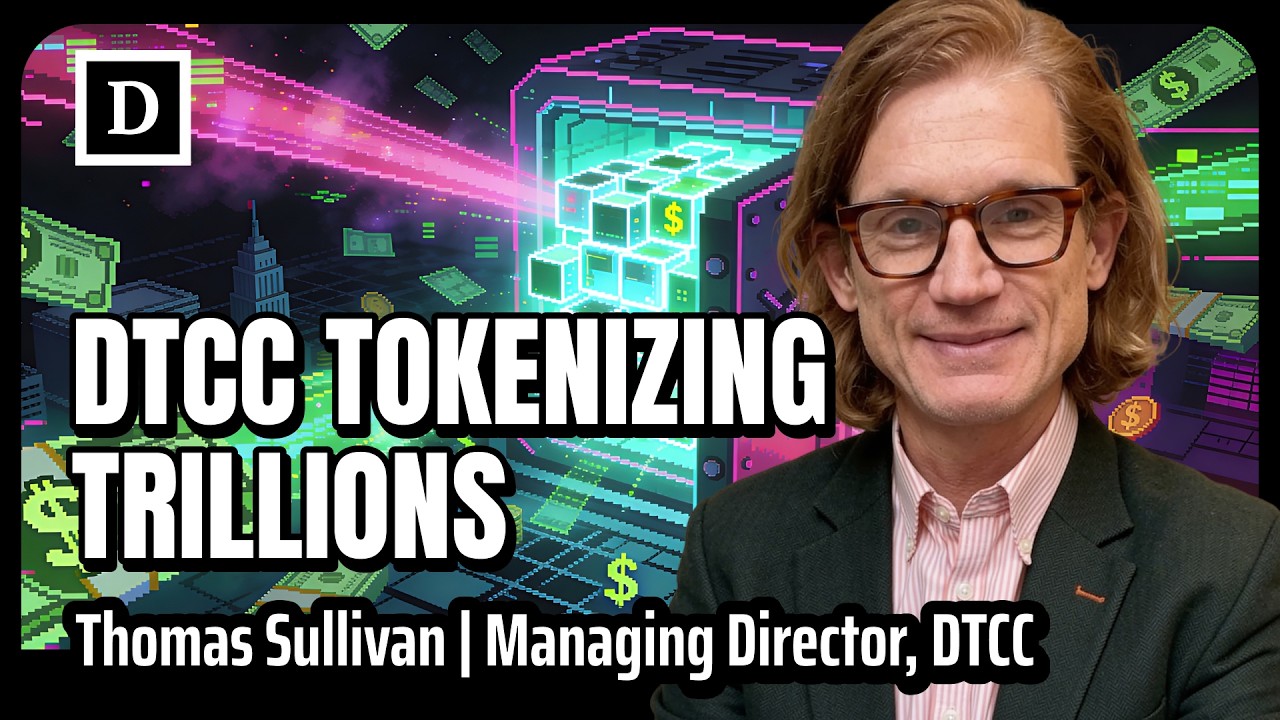 | How the DTCC Is Tokenizing $100 Trillion in Assets | Tom SullivanDTCC Digital Assets MD Tom Sullivan on putting Treasuries, stocks, and collateral onchain, with Chris Storaker.▶ Watch on YouTube |
PAYMENTS / M&A
Stripe Bids $53B for PayPal as Visa Launches on Open USD
Two moves this week put Stripe at the center of the payments consolidation — one it made, one it benefits from.
- Visa launched the Visa Stablecoin Platform, an enterprise system built around Open USD, per crypto head Cuy Sheffield. Fortune reported it reaches 200 million-plus merchants. Recall OUSD — the 140-company consortium token we led with two weeks ago — counts Stripe as a key backer and default distributor.
- Stripe and Advent made an unsolicited $60.50-a-share bid for PayPal (~$53 billion, a 28% premium). The crypto piece — Bridge rails plus PYUSD ($2.83 billion) and Bitcoin — is only one layer. The bigger prize is PayPal's franchise: 400 million-plus accounts, Venmo, and a global merchant network.
Stripe already owns Bridge, Privy, and Tempo — best-in-class merchant and stablecoin infrastructure. What it has never had is consumer distribution at scale. PayPal is exactly that — though its board has already called the $53 billion bid inadequate, leaving room for a higher price.
Our take
Stripe is bidding for additional distribution and a stablecoin it can plug into the plumbing it’s already built. It has strong stablecoin infrastructure (Bridge, Tempo, Privy) and the deepest merchant network online — but no 400-million-strong consumer wallet like Venmo, so it's trying to buy one. The deeper logic ties both moves together: card networks compound no matter who wins the orchestration layer above them, and stablecoins are the rare flank that routes around that toll. Stripe can't out-compound Visa, so it's trying to bypass it — while Visa, tellingly, just launched its own OUSD platform to hedge the same threat. As Coinbase's Brian Foster puts it in this week's interview, stablecoin economics "have been so far about distribution" — and the same names (Visa, Stripe, Coinbase, BlackRock) keep consolidating the rails OUSD was pitched to pry open. PayPal's board has already called $53 billion too low; watch the counteroffer.
Sources: Stripe's $53B PayPal bid · Visa launches on Open USD · PayPal board calls bid inadequate (PYMNTS)
THIS WEEK'S INTERVIEW
Coinbase's Brian Foster: Will Stablecoins Overtake Fiat Volume in Five Years?
Now live on our YouTube: Coinbase's Brian Foster — co-head of infrastructure, the arm that rents custody and payments rails to banks and fintechs — on why stablecoins have crossed from a trading tool into a payment rail. His marker: "the smart CEOs understand that three, four, five years from now, they actually may have more stablecoin volume than they have fiat volume." It's the frame behind both of this week's leads — an incumbent clearinghouse going onchain, and payments giants consolidating stablecoin rails.
OTHER STORIES WORTH YOUR TIME
Ondo and SBI to Tokenize Japanese Assets
Ondo Finance is partnering with SBI Group, one of Japan's largest financial-services firms, to tokenize Japanese assets — distributed across SBI's ecosystem and settled in the group's JPYSC yen stablecoin. It's a partnership and a path to market rather than a live product, but it pairs a leading RWA tokenizer with a domestic distribution giant and a compliant yen settlement leg. ONDO jumped ~17% on the news to a ~$1.89 billion market cap.
Coinbase Matches Robinhood's 7% Yield — With Different Math
Coinbase rolled out a ~7.02% APY High Yield USDC tier, roughly double its standard rate, days after Robinhood Earn's 7% campaign. Both route through Morpho and are Steakhouse-curated, but the resemblance stops there: analysts say Robinhood pays the gap to a fixed 7% target for a year (about half of it subsidy over "mid-3%" organic yield), while Coinbase loops against Ethena's USDe and tops up with MORPHO rewards — a blended rate one analyst pegs nearer 4.44%, drifting lower as deposits grow. Same headline number, very different durability.
Tether Backs USA₮ Payroll Rails
Tether led a $7 million Series A in Pact Labs to push its US-regulated USA₮ stablecoin into payroll and wage access — a small check, but part of a pattern of Tether buying distribution for a recurring, non-speculative use case rather than trading volume.
Even more this week:
- x402's real volume is $19M — A Visa/Artemis analysis puts adjusted x402 agent-payment volume at ~$19M across ~134M transactions, with the top ~4,000 wallets driving ~90% of it and Base ~90% of activity.
- CLARITY Act text is "days away" — Sen. Lummis says market-structure bill text is coming within days; the Senate has ~three weeks to clear 60 votes before the August recess, and the Democratic math is still short.
Converge is produced by The Defiant. This briefing is for informational purposes only and does not constitute investment advice.
Free newsletters
Good reporting. Delivered.
Choose your coverage: crypto and DeFi, the future of finance, or both.
Free. Unsubscribe anytime.