DTCC Goes Live as 38 Companies Object to OKXICE
Plus RLUSD gets a bank, a rating and Coinbase in one week, and SoFi's crypto margin
Happy Thursday. This is Converge, The Defiant's weekly recap of tokenization, stablecoins, and real-world assets, by Chris Storaker.
TOP NEWS THIS WEEK
- DTCC's tokenization service goes live with 20 banks and brokers
- Thirty-eight companies now object to OKXICE stock tokens
- Ripple wins final OCC approval for its trust bank
- Moody's gives RLUSD its first stablecoin rating
- Coinbase lists RLUSD on three networks
ALSO IN THIS ISSUE
- SoFi's crypto trading earned $1.6 million net on $161.6 million gross
- Visa's stablecoin settlement run rate passes $25 billion
- Shopify opens Shop Pay to AI agents
- The SEC adds tokenization to its 2027 exam priorities
TOKENIZED STOCKS
DTCC Tokenization Goes Live as 38 Companies Object to OKXICE
- DTCC launched its tokenization service on Oct. 28 on Canton Network and its private Besu network. Twenty participants signed on, including JPMorgan, Citi, Bank of America, Morgan Stanley, Fidelity and Citadel Securities.
How it works: A participant converts a security it holds at DTC into a digital twin and back. The twin is backed one for one by the share at DTC, keeps its rights and investor protections, and DTC keeps the official record. Twins move around the clock, but only between DTC-registered wallets on the same chain. Conversions run from 2 a.m. to 6 p.m. ET on business days. The service starts with 34 securities, a DTCC spokesperson told The Defiant: large-cap stocks, ETFs and Treasuries. Stellar and Circle's Arc are due in 2027; digital cash and onchain netting come after.
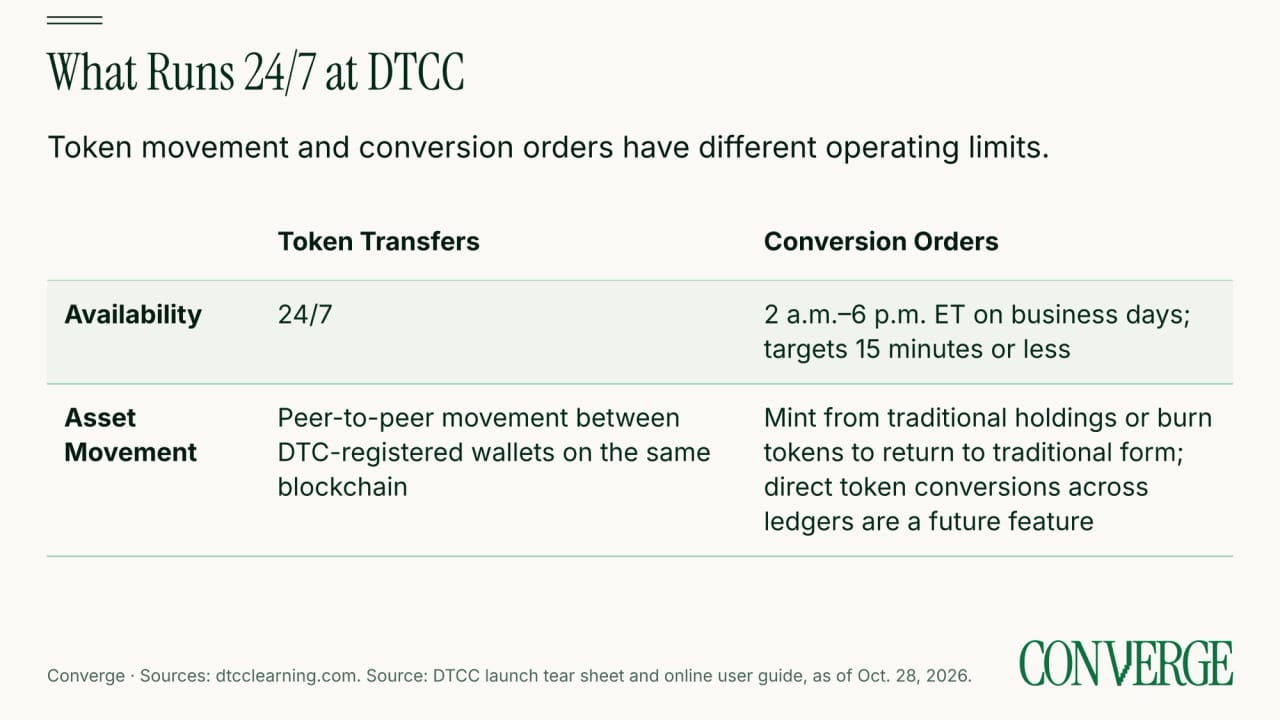
The companies whose shares are being tokenized have no say in this. The share stays at DTC and the twin is held by the same banks and brokers who hold the share today. JPMorgan signed as participant with DTCC the same week it used that process to object to its share being listed on OKXICE. More on this below:
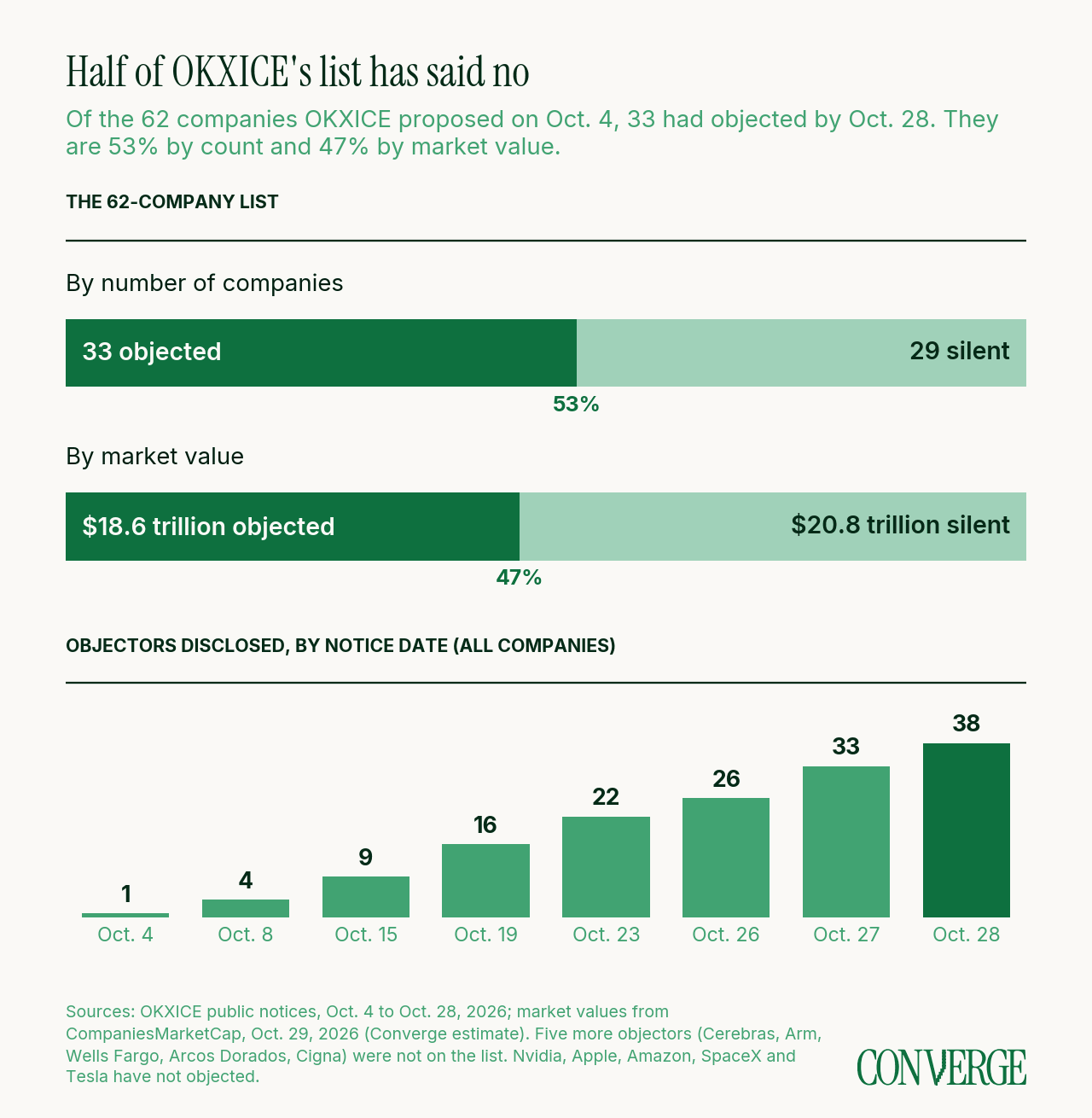
- Thirty-eight companies have objected to tokens of their shares on OKXICE, the venue of OKX and NYSE owner ICE, as of its Oct. 28 notice. Thirty-three of them were on the 62-company list OKXICE filed on Oct. 4. That is 53% of the list by count and 47% by market value, by our own arithmetic.
OKXICE works differently. Under the SEC's Sept. 17 exemption, a firm unrelated to the company tokenizes shares it holds at a broker-dealer and trades them on a venue outside the exchange system (and NMS), and the company gets 30 days to say no.
JPMorgan, Eli Lilly, Walmart, AMD and Coca-Cola objected this week. Nvidia, Apple, Amazon, SpaceX and Tesla, worth $16.5 trillion between them, have not objected. No company has to give a reason. Applied Optoelectronics told The Wall Street Journal it did not know how tokens would affect its share price, liquidity and volatility, and saw no clear benefit "to AOI or our shareholders." Nasdaq, opting out of every such venue as an issuer, calls a market with no displayed best price and trades published up to 10 minutes late "a shadow market for equity securities."
- Ondo brought 15 stock tokens to Robinhood Chain on Oct. 27, with 11 Uniswap pools. The pools pair Ondo's tokens with Robinhood's own, so two issuers' claims on the same stock now trade against each other.
Offshore — An alternative path for tokenized equities: These tokens are issued offshore, outside the SEC exemption, so company don’t have to be notified. Robinhood lists tokens for 27 of the 33 companies that have objected to OKXICE, our Daily newsletter reported on Oct. 27, including a JPMorgan token listed the day the bank objected.
What a non-objection commits a company to
A company that does not object within 30 days gets its shares traded on a venue with zero track record, though volume is capped at 0.25% of the stock's prior-month daily volume until 2031.
OKXICE's own notice says it applies no circuit breakers of its own, has no policy on maximal extractable value, can change its contracts "without a timelock," and has had its permissioning contract audited only internally so far. How broker-dealers meet their best-execution duties there is, in the notice's words, "not settled."
Canton Strategic Holdings plans to list its own tokenized shares on TSV LLC, a Canton Network venue, as early as Monday, with Fairmint as transfer agent and the same rights as its Nasdaq shares.
Our take: the objections are about the OKXICE model
For a large issuer, objecting to OKXICE is the lower-risk decision. A non-objection is binding for five years and cannot be withdrawn; it commits the company to a venue with no operating history. An objection requires a letter with no stated reason and preserves every alternative: an issuer-sponsored token, a DTCC twin, or a non-objection to a different venue. The expected benefit of non-objection is capped at 0.25% of the stock's daily volume on a single venue.
What to watch: whether Nvidia, Apple, Amazon, SpaceX or Tesla object before their windows close; OKXICE's launch date and first-day roster; the SEC's answer to SIFMA's request for affirmative consent; and DTCC's next batch of participants and securities.
STABLECOINS
Ripple’s RLUSD Gets a Bank, a Rating and Coinbase in One Week
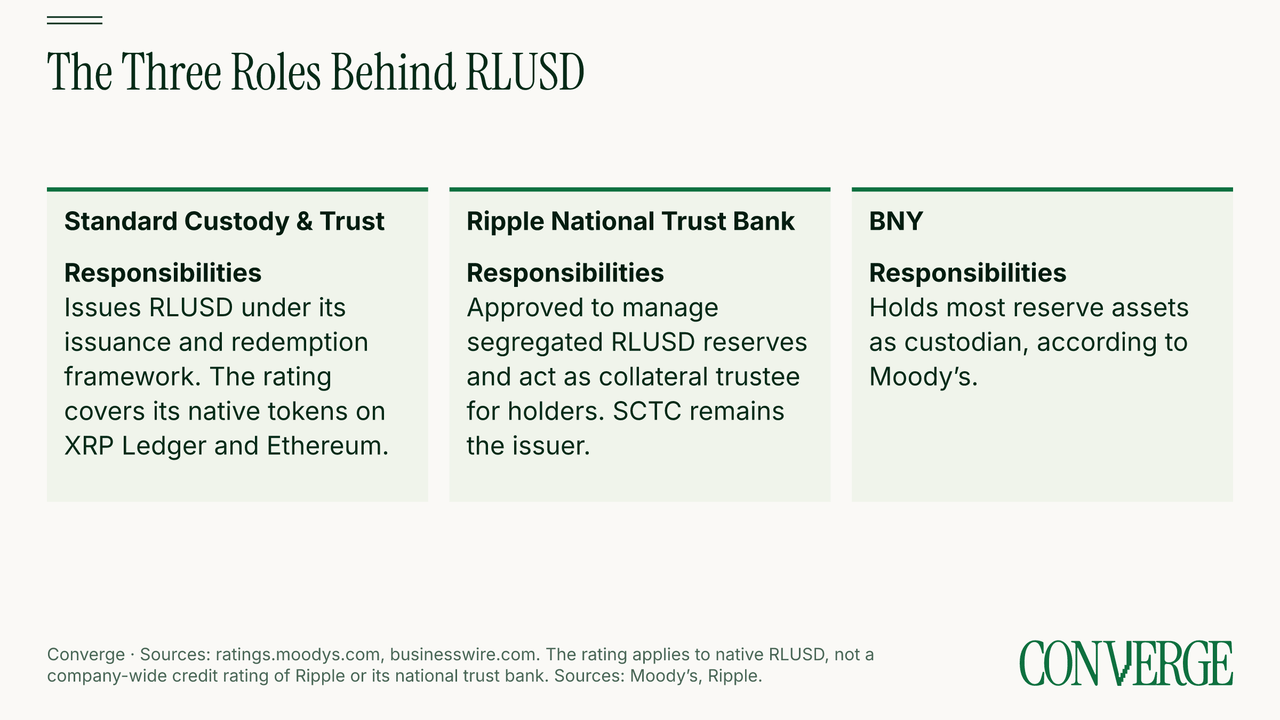
- The OCC gave final approval to Ripple National Trust Bank on Oct. 26, ten months after its conditional approval. The bank will manage the reserves behind RLUSD, act as collateral trustee for holders and offer fiduciary custody once it opens.
Ripple applied for the charter in July 2025 and received conditional approval in December, in the same OCC cohort as Circle, BitGo, Paxos and Fidelity Digital Assets. The final approval lets Ripple National Trust Bank open as a federally chartered trust company with three approved activities: managing the segregated reserves behind RLUSD, holding those reserves as collateral trustee for RLUSD holders, and providing fiduciary custody of digital assets. The charter does not change who issues the token. RLUSD will continue to come from Standard Custody & Trust Company, Ripple's limited-purpose trust regulated by the New York Department of Financial Services.
A national trust bank also has limits: it takes no deposits, makes no loans and carries no FDIC insurance. Ripple is the third of the December cohort to convert, after BitGo and Circle, and the first whose approved activities include running a stablecoin's reserves from day one; Circle's charter covers custody for its affiliates and is designed to add USDC reserve management later.
- Moody's assigned RLUSD A2 long-term and P-1 short-term deposit ratings on Oct. 27, at Ripple's request. Ripple says it is the first stablecoin with a Moody's rating.
Moody's applied its bank deposit methodology, which assesses the probability that a holder is repaid in full. A2 is its sixth-highest grade, three notches below the deposits of JPMorgan, Bank of America and Wells Fargo, and three below BNY, which holds most of the reserves.
The rating covers RLUSD issued natively on the XRP Ledger and Ethereum, backed by short-dated government assets and cash with a 103% coverage target. Moody's also noted the limits: Standard Custody is not bankruptcy-remote, and holders have no direct claim on the reserves until the GENIUS Act takes effect on Jan. 18, 2027.
- Coinbase listed RLUSD on Oct. 28 in its app, on Coinbase Exchange and on Coinbase Prime. Deposits and withdrawals run on the XRP Ledger, Ethereum and Base, with 1:1 conversion from dollars and other dollar stablecoins.
Robinhood added RLUSD the day before. Supply is about $2.6 billion, the ninth-largest stablecoin, up 88% this year by Ripple's count and about 1.4% the size of Tether's USDT. Coinbase pays no reward on it, and use as collateral on its global exchange "will follow."
Other stablecoin issuers and banks made changes this week tied to the same GENIUS Act deadline. Circle opened Circle Match on Oct. 22, an hourly auction in which institutions cashing out pay a fee that goes to institutions minting USDC. The OCC urged community banks on Oct. 26 to apply to issue stablecoins. Securitize will mint and redeem directly with Anchorage Digital Bank. The OCC's final GENIUS rule is out, and its application window is not yet open.
OTHER STORIES WORTH YOUR TIME
SoFi Reports $161.6 Million in Q3 Crypto Revenue, $1.6 Million Net
SoFi's crypto trading brought in $161.6 million in the third quarter and cost $160 million to deliver, leaving $1.6 million, about 0.3% of its financial-services revenue. Members reached 17.1 million and deposits $51.3 billion. The release gave no figures for SoFiUSD or SOFIE, the tokenized deposit it launched last week.
Visa's Stablecoin Settlement Run Rate Passes $25 Billion
Visa's stablecoin settlement has surpassed a $25 billion annualized run rate, up tenfold in a year, CEO Ryan McInerney said on the fiscal fourth-quarter call on Oct. 27, with more than 225 stablecoin-linked card programs and 5 million cards. Net revenue for the year was $45.9 billion, up 15%. Mastercard's third-quarter release on Oct. 29 cited its Global Money Platform with BVNK and gave no stablecoin figures.
Chainlink Introduces CustodySync With Anchorage for Custodied DeFi Borrowing
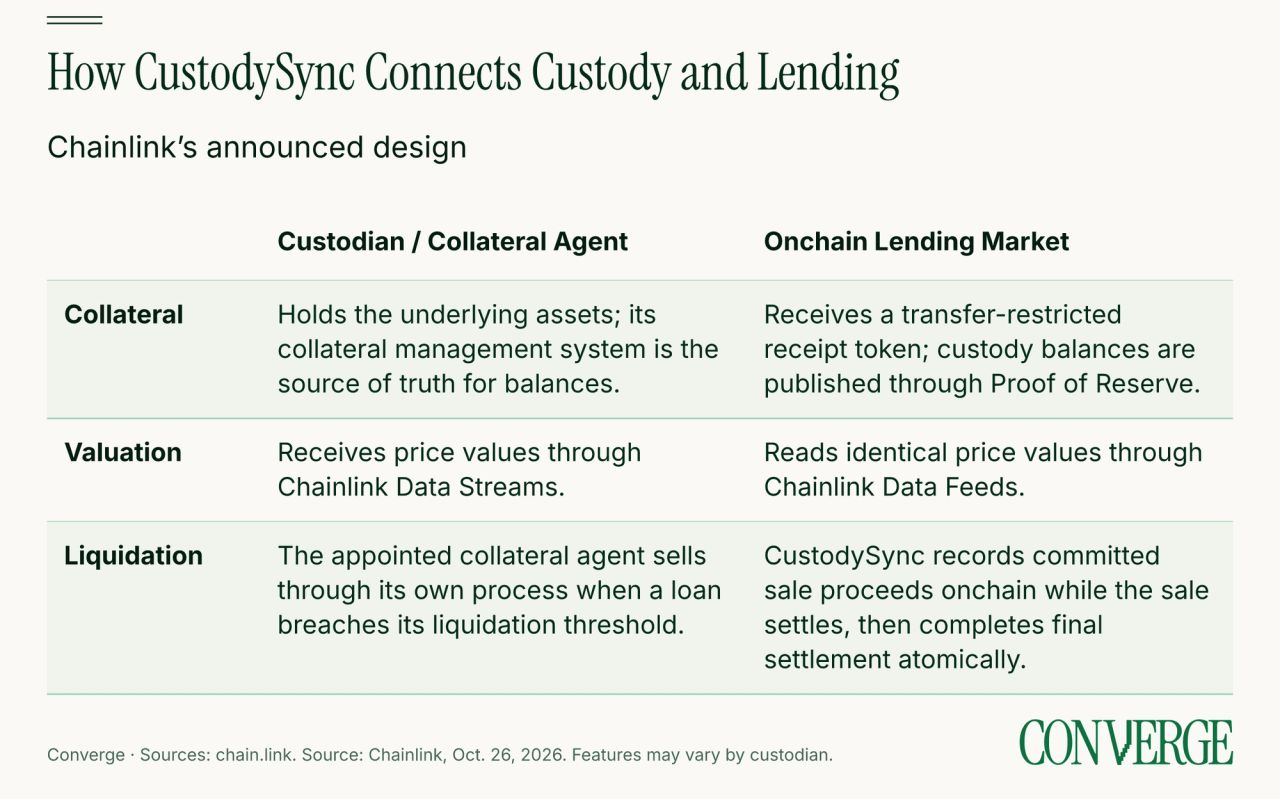
CustodySync lets an institution borrow from a DeFi lending market against assets that stay with a qualified custodian. Anchorage Digital Bank is the launch partner. Chainlink named no borrowers, lending protocols or chains at launch. On Oct. 29 it also launched 24/7 pricing for tokenized stocks and commodities, with Aave as launch partner for stock-backed loans on Horizon.
Shopify Takes Shop Pay Into AI Agents and Off-Platform Checkouts
Shopify will put Shop Pay checkout inside personal AI agents, starting with Meta's Muse, Claude Duet and Instinct, and Claude Duet, Grok Bot and Instinct can use it for brands that are not on Shopify. The agent never sees the card; it gets a network token. Instinct also rolled out a prefunded balance with Stripe, with a per-purchase limit.
Anthropic Files for IPO With $16.3 Billion in First-Half Revenue
Anthropic filed an S-1 on Oct. 26 to list on Nasdaq under ANT, with $16.29 billion of revenue in the first half of 2026. The filing sets no price range. Pre-IPO derivatives on Binance and Liquid have implied a valuation near $1.9 trillion, a figure that is not in the filing.
SEC Adds Tokenization to 2027 Examination Priorities
The SEC's exam priorities for fiscal 2027, published Oct. 23, name tokenization among the high-risk areas for clearing agencies, alongside default management, recovery and wind-down, and for firms under its market-systems rules.
Bank of England Proposes Tokenized Collateral Safeguards for Clearinghouses
The Bank of England opened a consultation on Oct. 29 on what a clearinghouse must show before it accepts tokenized collateral for margin and default funds: that it can value, transfer and liquidate the asset under stress or in a member default. The paper applies existing collateral standards to tokenized assets, with tokenized gilts the main example, and adds no new eligible assets. It covers UK clearinghouses and the overseas ones the Bank treats as systemic.
Blumenthal Seeks Records on Tether Payments to Bo Hines's Firm
Sen. Richard Blumenthal, the top Democrat on the Senate's investigations subcommittee, asked Tether and Nxum on Oct. 22 for contracts, communications and a breakdown of payments, including wallet addresses, by Nov. 3. The Journal reported this month that Tether paid Hines's firm while he led the White House push for the GENIUS Act.
S&P Global Closes OpenZeppelin Acquisition
S&P Global completed its purchase of OpenZeppelin, the smart-contract auditor, on Oct. 26. It will run as its own unit under founder Demian Brener, reporting to the president of S&P Global Ratings. Terms were not disclosed.
Malaysia and Thailand Join Singapore's BLOOM Digital-Money Initiative
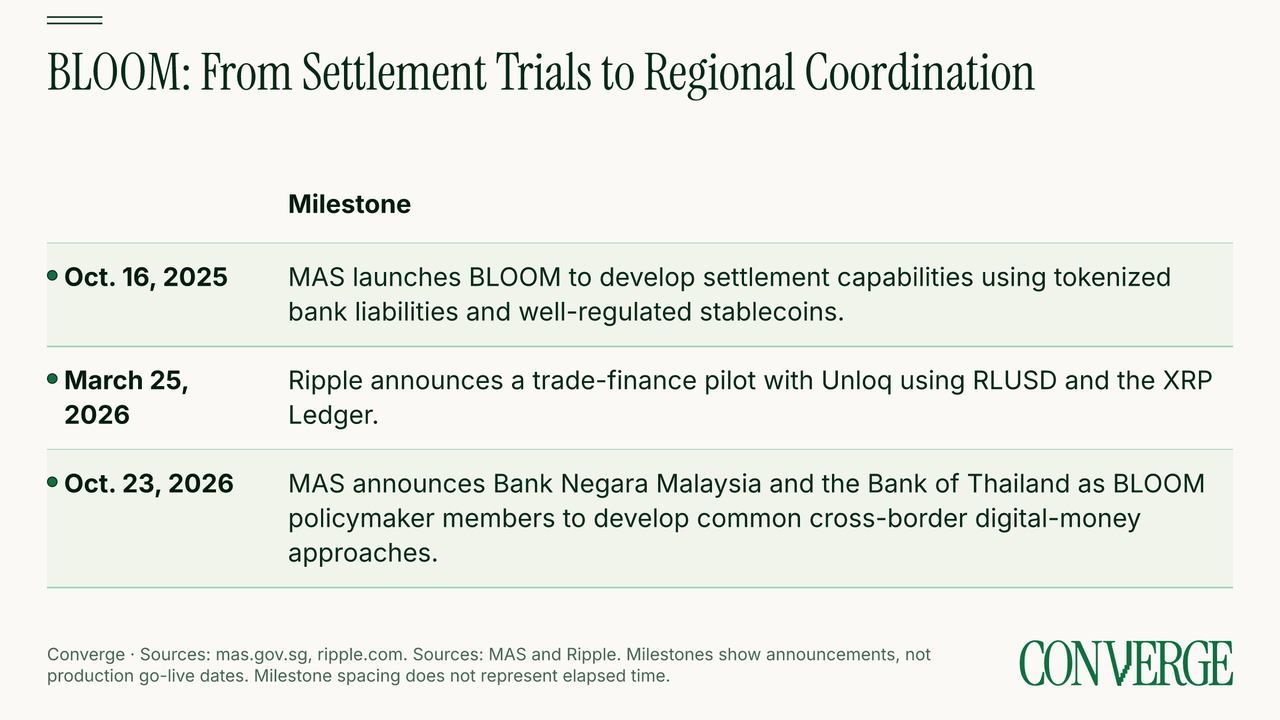
Bank Negara Malaysia and the Bank of Thailand joined the Monetary Authority of Singapore's BLOOM initiative on Oct. 23 as policymaker members. The three will work with industry on how different forms of digital money are accepted, exchanged and settled across institutions and networks.
Strategy Shareholders Approve Daily Dividends on Preferred Stock
Strategy's common shareholders approved daily dividend entitlements for its four preferred stocks on Oct. 28, with 63.69% of voting power in favor. STRC moves to daily dividends from Nov. 1, paid the next business day, once the amended certificate takes effect.
Even more this week:
- Ripio applied for a Brazilian virtual-asset broker license ahead of the central bank's Oct. 30 deadline for existing providers.
- Euronext restarted CoinShares' Zcash ETP after halting it on its debut day.
- Westpac will cap customers at A$10,000 a month on payments to crypto exchanges from Dec. 1.
- Datavault AI fell nearly 50% after saying it could not withdraw bitcoin from Biconomy and would restate four periods.
- Strive bought 6,182 bitcoin for $511 million, lifting its holdings to 43,000 BTC.
- Hyperliquid put a permissioned-market feature on testnet for Payward's planned U.S. perpetuals.
- PrimeRevenue is tokenizing its corporate payment drafts on Solana, with no launch date.
- Netanyahu said he asked for a blockchain plan as one option against possible banking sanctions.
- Janus Henderson announced a tokenized Nasdaq-100 fund on Stellar for non-U.S. professional investors; it has not opened yet.
- Polygon added Solana to its Open Money Stack so businesses can connect bank funding, stablecoin balances and payouts through one integration.
- MetaMask made Stellar a default network on its mobile app and extension, with XLM, USDC and Soroban tokens.
Converge is produced by The Defiant. This briefing is for informational purposes only and does not constitute investment advice.
Free newsletters
Good reporting. Delivered.
Choose your coverage: crypto and DeFi, the future of finance, or both.
Free. Unsubscribe anytime.